Idle RPGs, MMOs, browser games and mobile RPGs, taken apart properly. Every review carries a
score out of 10, what the game does well, what it does badly, and the kind of player it is actually for.
An adorable desktop-companion idler where pixel animals roam the bottom of your screen while you work — undercut by a genuinely strange design choice for a game in this genre, its own idle mascots get sick if you leave them alone for too long.
Respawn Entertainment's 2016 shooter remains Overwhelmingly Positive across more than 284,000 Steam reviews, widely regarded as one of the finest FPS campaigns ever made — a reputation shadowed by a genuine, years-long multiplayer DDoS crisis this review can confirm directly from the developer's own communications, and by the mandatory EA App launcher requirement that recurs as a real, persistent complaint even in reviews from Steam Deck-era players decades removed from launch.
East Side Games' 2017 licensed idle tycoon turns Sunnyvale Trailer Park into a business-management loop, wraps its prestige reset in the show's own running joke about jail, and is still getting seasonal updates on mobile nine years later — even after its Steam PC version was quietly abandoned and delisted.
Two Point Studios' museum management sim remains Overwhelmingly Positive across nearly 13,000 Steam reviews, widely credited by longtime series fans as the best entry yet — undercut by a real, remarkably consistent complaint about its "Thieves" mechanic, which recurring reviewers describe as a poorly-tuned frustration distinct from the rest of the game's gentle, decoration- focused design, alongside a real, repetitive "expedition loot-box" content-acquisition loop.
The deckbuilder that removed the luck. You see every reward in advance and rebuild your deck between every fight — which makes it the most controllable game in its genre, and is exactly why some players bounce off it. Six dollars, 251 achievements, and criminally under-noticed.
A puzzle game built around one genuinely brilliant idea — photographs you place in the world become the world, letting you reshape reality by swapping what a picture shows for what's actually there — undercut by a runtime and a script that its own fans agree don't live up to the mechanic carrying them.
The most technically ambitious combat sim on Steam — planes, tanks and ships in one engine, free to install, twelve years of updates. Its 35 add-ons total more than NZ$2,100, and after a decade the single most consistent thing players say about it is that the grind is designed to sell you out of itself.
Some of the best-written quests and dialogue in any CRPG, wrapped around turn-based combat that knows what it's doing — and six years of bug reports that never quite stopped, concentrated almost entirely in the co-op mode it was sold on.
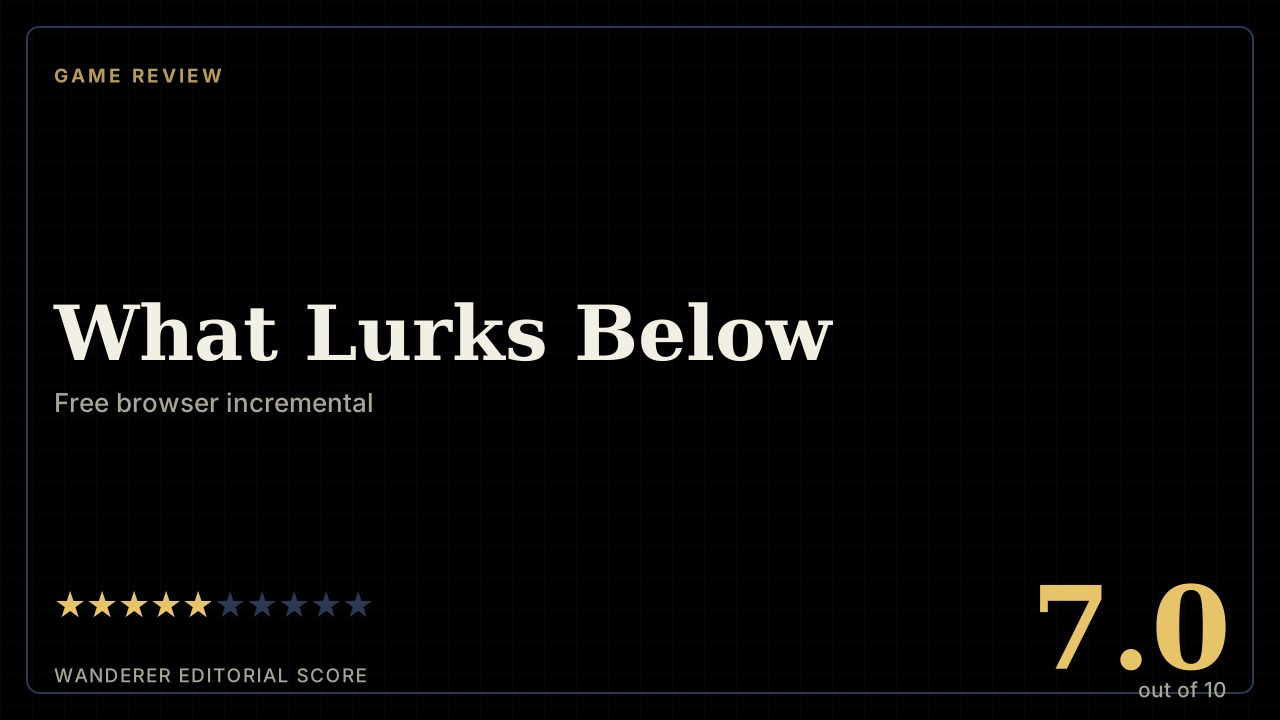
A free browser incremental built for a 2025 game jam, about hauling a strange substance up out of a mining town's collapsing depths — deliberately short, unusually confident about its Lovecraftian ending, and patched several times since launch to fix the rough edges that shipped with it.
A dark fantasy strategy RPG that flips Darkest Dungeon's premise — you're the cult building up to destroy the hamlet, not the party defending it — wrapped in some of the most striking art in the genre and undercut by a tutorial that still can't explain its own systems more than a year after launch.
MachineGames' sequel brings B.J. Blazkowicz's fight against a Nazi-occupied America to Steam with genuinely praised gunplay and presentation, sitting Very Positive across nearly 50,000 reviews — undercut by a real, remarkably consistent "step down from The New Order" complaint about cutscene-heavy pacing and underdeveloped new characters, and by a specific, dateable technical incident this review can confirm: an August 2018 patch that broke previously-working video memory handling, which the developer then hotfixed within roughly five days.
MachineGames' 2014 reboot remains Very Positive across more than 61,000 Steam reviews a decade later, widely credited with successfully reviving a dormant franchise through genuinely strong gunplay and an unexpectedly earnest story — undercut for AMD graphics card owners by a severe, reproducible technical incompatibility this review can confirm has gone unresolved in the developer's own communications for well over a decade.
Ten years on it's still the sharpest turn-based tactics game ever made, built on one brilliant, divisive decision: you are always out of time. The thing that's actually got worse since 2016 isn't the game — it's what you have to agree to in order to launch it.
A technically polished remake of a beloved Yakuza entry, bundled with a well-regarded new prequel chapter, whose Mixed reception is driven by two distinct and separately documented problems — substantial cuts to the original's beloved side content, and a genuine, well-sourced controversy over the studio's decision to recast a character using an actor who has admitted to sexual misconduct, despite a sustained fan campaign asking them not to.
A four-dollar tower defence roguelite where the towers shoot themselves and you pick the upgrades — and whose players are averaging fourteen hours in its first week. The best value on this list, and the most repetitive thing on it.
A four-player co-op deckbuilder that solves the genre's most obvious gap — playing Slay the Spire-style card combat as an actual shared party instead of a shared seed — and then spends the years after its Paradox acquisition undermining that achievement with DLC pricing its own community calls predatory.
The same demonstrate-it-once robot scripting that made Autonauts click, now defending a base against raiders with automated squads — a genuinely fun idea that never quite justifies asking for a second full-price purchase.
A one-person city-building survival game from 2014 that still holds a Very Positive Steam rating across 37,800-plus reviews, built on a genuinely unusual pitch — no money, no skill trees, no combat — that a decade of players keep bumping up against the same mid-game ceiling to enjoy.
A soft reboot that keeps the Brave and Default battle system and Asterisk job system that made the series' name, wrapped around a new cast and a story a meaningful share of its own Steam reviews call the weakest part of the package.
Relic's standalone wave-defence spin-off is the rare Mixed rating where both sides agree the game is fun. The fight on its review page is entirely about the price tag — a full-expansion ask for five maps, four factions and a perk tree.
An Early Access idle shop sim built to be ignored — it lives in the corner of your monitor, restocks its own shelves and asks for a glance every twenty minutes. Charming, three dollars, and currently carrying a save bug that can wipe a 76-hour store.
A Kickstarter-funded spiritual successor to Suikoden, built by the genre veterans who created it, that delivers on its hundred-recruit army-building promise while carrying a rough English localization and a completionist grind that its own Steam reviews argue about at length.
Twenty-two years old, twenty-two expansions deep, and still shipping a full expansion every December — EverQuest II is one of the most content-dense MMOs ever built, sold through a free-to-play shell that takes away the auction house, the chat channels and the top half of your spellbook until you subscribe.
A medieval survival city builder from the makers of Grim Dawn that spent three years building the deepest farming and disease system in the genre, then left Early Access in October 2025 to a Very Positive Steam rating and a still-vocal minority saying the milestone patch didn't fix what was wrong with it.