Game review
Two Point Museum
7.5 / 10
- Developer
- Two Point Studios
- Publisher
- Sega
- Released
- 4 March 2025
- Platforms
- Windows
- Genre
- Construction and Management Simulation
- Monetisation
- Full premium purchase, plus separately sold themed DLC packs including Zooseum and Arty-Facts; no in-app purchases or premium currency
- Players
- None. Single-player only, with no leaderboard, co-op or shared-progress feature
The short version
Two Point Museum lets players build and curate sprawling museums across prehistory, botany, marine life, space and the supernatural, sending staff on expeditions to gather exhibits and decorating exhibit halls to maximise visitor delight. Overwhelmingly Positive across nearly 13,000 Steam reviews, longtime series fans consistently credit it as a genuine high point: "I loved Two Point Hospital and Two Point Campus, so this was an instant buy for me and my partner. I can't believe it, but it's genuinely better than the previous two installments," one review states. What tempers that acclaim is a real, remarkably consistent complaint recurring specifically around one system: "The thievery mechanic needs to be completely overhauled, because it ends up pulling focus away from all other game aspects. Unless you like having hours of your real time literally stolen by this poorly- designed 'feature,'" one detailed review states, a frustration echoed independently by numerous reviewers who otherwise praise the game's gentle, decoration-focused design. A related, structural complaint concerns content acquisition itself: "Acquiring new exhibits involves sending your staff on expeditions, which result in a semi-random 'lootbox' being brought back to your museum... most of the game is just sending out expeditions and throwing away most of what they come back with, repetitively," one review states, describing a genuine, repetitive grind underneath the game's charming presentation.
Biggest strengths
- The core museum-building and decoration systems draw sustained, specific praise as genuinely creative and more freeing than the room-optimisation focus of earlier Two Point games
- Longtime series fans consistently credit this as the best entry yet, with real, specific praise for meaningful quality-of-life improvements over Two Point Hospital and Campus
- The game's writing and humour draw independent, detailed credit, including from a reviewer who works as a real museum professional describing specific details that "hit really close to home"
Biggest weaknesses
- A real, remarkably consistent complaint describes the "Thieves" mechanic as poorly tuned and disproportionately frustrating, with multiple independent reviewers describing it as pulling focus away from the rest of the game and, in one case, a specific dealbreaker
- A related, structural complaint describes the expedition-based content-acquisition system as a genuinely repetitive "loot box" grind, with most gathered items discarded in pursuit of specific desired exhibits
- Several detailed reviews describe the game's difficulty as close to nonexistent, with one reviewer noting the sandbox mode specifically is not a true unrestricted sandbox despite being marketed as one
Who it's for: Fans of gentle, decoration-focused management sims and longtime Two Point series players, with real, specific caveats around the Thieves mechanic and expedition-based content grind.
Our recommendation: A genuine high point for the Two Point series and a charming, low-stakes management sim in its own right, held back by one specific, widely-criticised mechanic worth understanding before buying.
7.5 / 10
Two Point Museum, released 4 March 2025, sent Two Point Studios' management-sim series into museum curation after Hospital and Campus, and the review sample's reception is unusually enthusiastic for a long-running franchise's third entry. Overwhelmingly Positive across nearly 13,000 Steam reviews, this review sets out to explain both that genuine, widely-shared enthusiasm and a real, specific complaint recurring around one particular system.
A genuine high point for the series
The review sample's praise for Two Point Museum is specific and consistent, especially from reviewers with real history in the franchise. "I loved Two Point Hospital and Two Point Campus, so this was an instant buy for me and my partner. I can't believe it, but it's genuinely better than the previous two installments. They really nailed the whimsy and fantasy of building your museum, and they've made a TON of QOL improvements," one review states. Another, contrasting the game's design philosophy directly against its predecessors: "having your exhibits' Buzz be d[irectly tied to layout]... I felt like in Two Point Campus I was just randomly strewing things around to increase a room score" — a specific, mechanical improvement several reviewers credit independently. The game's writing draws its own genuine, detailed praise, including from an unusual source: "as a museum professional that many of the comments, visitor behaviors, and staff behaviors all hit really close to home," one review states, a specific, credible endorsement of the game's attention to real curatorial detail.
A real, remarkably consistent complaint about Thieves
What tempers that enthusiasm is a specific, structural complaint recurring with real consistency across otherwise-positive reviewers. "Fun game up until the Thieves are unlocked. The thievery mechanic needs to be completely overhauled, because it ends up pulling focus away from all other game aspects. Unless you like having hours of your real time literally stolen by this poorly-designed 'feature,'" one review states plainly. A detailed account with nearly 200 hours invested corroborates the same frustration persisting despite patches: "Thieves, despite a recent patch, are still very much an annoyance. If you put up an expert (and expensive to maintain) security system, you might nab them all. But it only takes that" one slip for a prized, hard-won exhibit to be lost permanently. A separate reviewer describes this specific mechanic as the deciding factor in an otherwise positive experience: "I gave this game several chances because I really wanted to like it. But I just cannot handle the thieves feature. Thieves can steal your exhibits and once they're gone you have no chance to get them back... The frustration of having an exhibit stolen I grinded a lot of expeditions for is too much for me." That specificity — reviewers who clearly enjoy the rest of the game naming this one system as their specific breaking point — is the sample's clearest, load-bearing finding.
A real, related complaint about content acquisition
A structurally connected complaint concerns how new exhibits are actually obtained. "Acquiring new exhibits involves sending your staff on expeditions, which result in a semi-random 'lootbox' being brought back to your museum. The box might have the exhibit you want, or it might be garbage that you don't need. This means that most of the game is just sending out expeditions and throwing away most of what they come back with, repetitively," one detailed review states. This complaint compounds the Thieves frustration directly — reviewers describe grinding repeatedly for a specific rare exhibit only to have it stolen once finally obtained, a genuine, real tension between two of the game's own systems rather than two isolated complaints.
Where this leaves a buyer
At NZ$54.95, Two Point Museum delivers what this review's sample credits, with unusual consistency, as a genuine creative and mechanical high point for its series — its decoration-focused design, quality-of-life improvements and specific attention to real curatorial detail earn real, repeated praise, and Two Point Studios' sustained, substantial content investment well over a year after launch is real and verifiable. The honest, necessary caveat concerns a real, specific, widely-shared complaint about the Thieves mechanic disproportionately frustrating players relative to the rest of the game's gentle design, compounded by a genuinely repetitive expedition-based content grind underneath the game's charming presentation. Players drawn to relaxed, decoration-focused management sims, and prepared to manage or accept the Thieves system's real friction, are very likely to find one of the genre's more distinctive recent entries here. Players who specifically want low-stress, low-loss progression should know, honestly, exactly which system is most likely to disrupt that experience.
Pros and cons
Pros
- The core museum-building and decoration systems draw sustained, specific praise as genuinely creative and more freeing than the room-optimisation focus of earlier Two Point games
- Longtime series fans consistently credit this as the best entry yet, with real, specific praise for meaningful quality-of-life improvements over Two Point Hospital and Campus
- The game's writing and humour draw independent, detailed credit, including from a reviewer who works as a real museum professional describing specific details that "hit really close to home"
- Two Point Studios has sustained an unusually active, substantial live-service cadence well over a year after launch, with regular numbered updates and a major Zooseum expansion in December 2025
Cons
- A real, remarkably consistent complaint describes the "Thieves" mechanic as poorly tuned and disproportionately frustrating, with multiple independent reviewers describing it as pulling focus away from the rest of the game and, in one case, a specific dealbreaker
- A related, structural complaint describes the expedition-based content-acquisition system as a genuinely repetitive "loot box" grind, with most gathered items discarded in pursuit of specific desired exhibits
- Several detailed reviews describe the game's difficulty as close to nonexistent, with one reviewer noting the sandbox mode specifically is not a true unrestricted sandbox despite being marketed as one
- A specific, real complaint describes at least one detailed account of persistent save-corruption issues, with the reviewer unable to resolve the problem despite following official troubleshooting guidance
Screenshots
-
Two Point MuseumImage: SEGA via Steam -
Two Point MuseumImage: SEGA via Steam -
Two Point MuseumImage: SEGA via Steam -
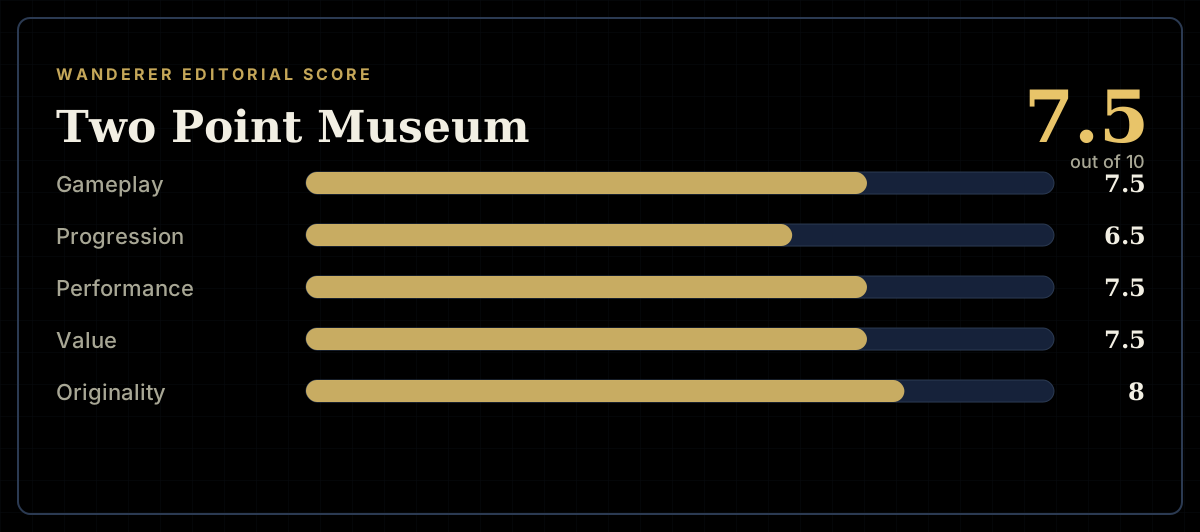
How the review scores each part of the gameWanderer Editorial -
The short versionWanderer Editorial