Game review
RimWorld
9 / 10
- Developer
- Ludeon Studios
- Publisher
- Ludeon Studios
- Released
- 17 October 2018
- Platforms
- Windows, macOS, Linux
- Genre
- Colony simulation and management sim
- Monetisation
- Premium, one-off purchase for the base game, plus five separately sold paid expansions (Royalty, Ideology, Biotech, Anomaly, Odyssey) released one at a time since 2020, each priced on its own rather than bundled as season-pass content. No ads, no premium currency, no loot boxes, no subscription. Ludeon's own stated policy (via its FAQ) is that RimWorld went seven years, from 2013 to 2020, without ever being discounted, on the reasoning that a fair upfront price beats chasing impulse buys; since 2020 it has said it will join sales "for the foreseeable future" at small discounts of around 10%, a ceiling players report the game has rarely if ever exceeded
- Players
- No official multiplayer or co-op exists in the base game or any expansion; a long-running unofficial mod adds shared and co-op play but sits outside Ludeon's own support
The short version
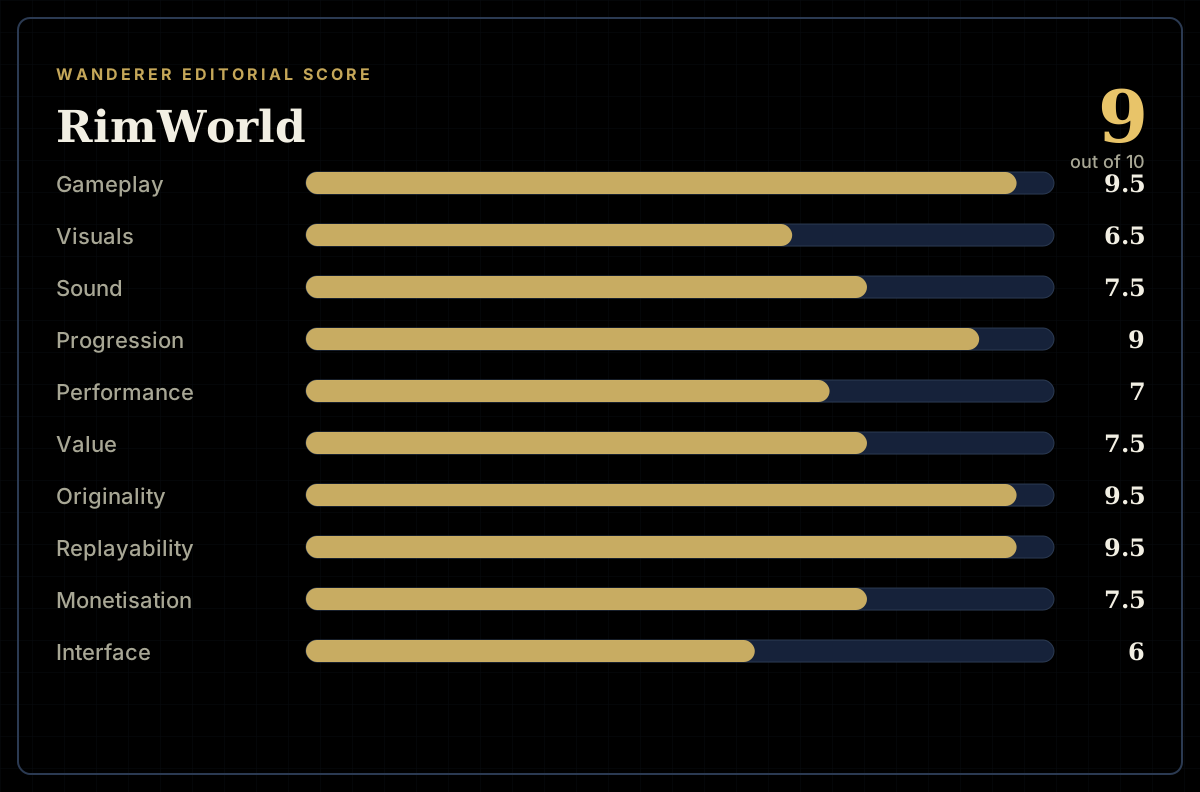
RimWorld's real product isn't colony management, it's narrative pressure. The three AI storytellers watch your wealth, your population and your defences climb and answer every gain with a proportionally worse threat, which turns ordinary progression — a new turret, a bionic arm, a bigger stockpile — into the thing that makes your next crisis harder rather than easier. Almost nothing else in the genre commits to that idea as completely, and the skill, mood, research and production systems underneath it are deep enough to support the weight.
The costs are real and worth naming plainly: the interface is dense, unforgiving and built to be finished by mods rather than by Ludeon itself; performance sags once a colony's population and item count grow past the point the simulation was tuned for; the art is legible rather than attractive; and owning every expansion now runs past NZ$200, with no bundle discount offered for buying them together. None of that changes what the base game is on its own — one of the best systems-driven simulations on PC, expansion or no expansion.
Biggest strengths
- The three AI storytellers turn ordinary numeric growth into escalating narrative stakes instead of just bigger stat bars
- Skills, traits, backstories and relationships give every colonist enough individuality that losing one to a raid actually stings
- The mood and mental-break system forces real trade-offs between productivity and colonist wellbeing rather than treating happiness as a background stat
Biggest weaknesses
- The interface is dense and unwelcoming even by strategy-game standards, and community wisdom treats certain quality-of-life mods as close to mandatory
- Simulation performance degrades noticeably once a colony's population, item count and animal herds grow past the game's comfortable range
- The pixel-art presentation is functional and readable rather than attractive, and it hasn't meaningfully evolved since Early Access
Who it's for: Systems-oriented strategy and simulation players who want emergent stories more than scripted ones, and who don't mind a genuinely brutal early learning curve or leaning on the Steam Workshop to smooth out the interface. Less suited to players who want a game to explain itself, or who need combat and building to be a spectacle rather than a spreadsheet with a face.
Our recommendation: The base game alone is worth its full price without qualification — treat it as a complete, hundred-plus-hour game and decide only afterward whether a specific expansion's theme appeals enough to pay for it separately. Don't buy all five at once expecting a discount; Ludeon's sales policy doesn't offer one, and the base game is deep enough on its own to justify a long wait before deciding the rest is worth NZ$165.95 more.
9 / 10
Most strategy games treat a growing base as an unqualified win. More turrets, more colonists, more stockpiled steel — the number goes up, the player feels safer, the game gets easier. RimWorld inverts that relationship on purpose. Its three AI storytellers are watching your wealth, your population and your defences the entire time, and every one of them uses that growth as the input for how hard to hit you next. Build a bigger colony and you haven't made yourself safer. You've raised the budget for the raid that's coming to test it. That single design decision — narrative escalation tied directly to the player's own progression curve — is why a decade-old Kickstarter project from a two-person Auckland studio is still the reference point serious colony-sim fans measure everything else against.
Ludeon Studios' founder Tynan Sylvester started the project in 2012 under the working title Eclipse Colony, crowdfunded it on Kickstarter in October 2013, and then spent nearly five years shipping public alpha and beta builds before RimWorld reached 1.0 on 17 October 2018. That development style — years of visible iteration in front of a paying audience — shaped a game that feels unusually considered for how much systemic complexity it's carrying. Since 1.0 it hasn't slowed down: five paid expansions, released roughly one every year and a half, have each added a genuinely new pillar to the design rather than more of the same pillar, and the game currently sits at 98% positive across close to 244,000 Steam reviews — a number that has held steady for years rather than spiking on a single patch.
The storyteller is the actual main system
Everything else in RimWorld exists to feed the storyteller. Cassandra Classic escalates tension in a rising curve with recovery windows between crises, built for players who want a shaped difficulty arc. Randy Random throws out that structure entirely and fires events with no cooldown or pacing logic, so a plague and a mechanoid raid can land in the same afternoon, or you can go quiet for a season with no warning why. Phoebe Chillax stretches the gaps between threats out further than either, aimed at players who want time to actually enjoy the base they're building. None of these are difficulty sliders in the conventional sense — they're closer to three different authors, each with an opinion about what makes a good story, all reading the same colony data and deciding what happens to you next.
The genius of the system is what it's actually reading. It isn't tracking play time or an arbitrary level number, it's tracking your wealth and your defensive capability, which means the things a normal strategy game rewards you for — building more, stockpiling more, arming more colonists — are the exact inputs the storyteller uses to decide how much worse your next event should be. A tribal start with three colonists and no walls gets small-scale trouble. A sprawling, turret-ringed fortress with a hundred thousand silver in the stockroom gets mechanoid clusters and coordinated multi-pawn raids. Progression and difficulty aren't separate systems here, they're the same system viewed from two directions, and that's a genuinely rare piece of design discipline for a genre that usually treats "number go up" and "story gets interesting" as unrelated goals.
Colonists as characters, not units
The storyteller only works because the thing it's threatening actually matters to you, and that's where RimWorld's colonist-level detail earns its keep. Every pawn carries a randomly generated backstory, a set of skills with their own passion levels, a handful of traits that can range from mildly quirky to actively colony-threatening, and a web of opinions about every other colonist in the base. A pyromaniac who loves cooking and hates being told what to do is a different management problem than a chronic depressive who happens to be your best surgeon, and the game never lets you forget it — both of them will occasionally do something the storyteller didn't schedule, purely because their own personality demanded it.
Layered on top is the mood and mental-break system, which is one of the more honest "wellbeing" mechanics in the genre because it has real teeth. Ignore a colonist's need for beauty, decent food and enough sleep, and mood drops toward a threshold where they can snap — wandering off, breaking down in tears, or in the worst cases turning violently on the people around them. That's not a flavour system bolted onto the productivity math, it's a genuine constraint on how hard you can push a colony before it starts costing you the colonists you pushed. Combined with permadeath as the default expectation, losing a well-developed pawn to a raid or a mental break carries actual weight, in a way most strategy games with disposable units never manage.
Research and production, without the padding
Underneath the story is a genuinely deep crafting and technology ladder. Research benches unlock new production chains rather than flat percentage bonuses — a new type of workbench, a new weapon tier, a new construction material — and almost every unlock changes what a colony is capable of rather than just how fast it does the same thing. Getting from stone tools and simple guns to power armour, ship components and psychic tech is a legitimately long arc, and the game paces new problems into that arc regularly enough that the mid-game rarely turns into pure repetition: managing a slowly growing power grid, keeping a stable food surplus through a bad winter, and defending an expanding perimeter are all separate disciplines that layer on top of each other rather than replacing one another.
Where this gets tested is at scale. Production, farming and trading logic all run per-item and per-pawn, and a colony with dozens of colonists, hundreds of stored items and a full complement of animals asks noticeably more of the simulation than a small, tidy base does. RimWorld doesn't fall over — this isn't a game that crashes on you — but tick rate and pathfinding responsiveness both visibly soften as a colony's population and item count climb into the upper range the design was tuned for, and that's a real limitation for the exact kind of sprawling megabase the endgame content is built to reward you for building.
Five expansions, five different games bolted to one core
Royalty (February 2020) was the first, and it's still one of the more interesting: it introduces psycasting — genuine psychic powers that can mind-control an enemy, induce vomiting in a crowd, or render a colonist briefly invisible for a stealth kill — alongside an Empire faction offering noble titles and honour in exchange for loyalty, or a fight if you'd rather betray them. Ideology (July 2021, alongside the free 1.3 update and its Archonexus ending) lets you design a custom belief system for your colony from scratch — memes, precepts, deities, rituals — which reframes things the base game treated as fixed, like cannibalism or slavery, as legitimate choices some ideoligions actively endorse. Biotech (October 2022) adds reproduction and childhood as a real mechanical layer, plus gene modification for building xenotypes with inherited traits, and mechanitors who can command loyal, tireless mechanoid workers and soldiers. Anomaly (April 2024) turns the tone horror, adding sanity-fraying threats — flesh monstrosities, invisible hunters, cultist raids — built around capturing and studying anomalous entities to harvest bioferrite for void-powered tools. Odyssey (July 2025), the newest, adds gravships: buildable vessels that let a colony travel and land anywhere on the planet, push into orbit, and eventually chase a Mechhive endgame.
What's notable is that none of these read as padding. Each expansion inverts or extends a different assumption the base game trained into you, rather than selling more of the same systems with a new coat of paint, and that consistency across five separate release cycles is genuinely rare for a five-year DLC ladder. The catch is what it costs to own all of it: NZ$28.99 each for Royalty and Ideology, NZ$35.99 each for Biotech, Anomaly and Odyssey, which adds up to NZ$165.95 in expansions on top of a NZ$46.99 base game — NZ$212.94 in total for a player who wants everything, checked 30 July 2026. That's a legitimately steep ask by premium PC pricing standards, and Ludeon doesn't soften it with a bundle discount for buying the full set together.
A price that has, mostly, held the line
Ludeon's own FAQ states plainly that for RimWorld's first seven years on sale, from 2013 to 2020, the game was never discounted at all — a deliberate choice, framed as wanting buyers who value the game enough to pay full price rather than chasing impulse purchases during a sale window. Since 2020 the studio's stated position has shifted to participating in sales "for the foreseeable future," but only at small discounts of around 10%, a ceiling long-time players report the base game has rarely if ever exceeded. It's a more honest story than a flat "never on sale" claim would be, and it's worth knowing going in either way: whether you buy this month or in a year, you're unlikely to see the base game meaningfully cheaper than it is today, and the expansions follow the same modest pattern when they do appear in a sale at all.
An interface that expects you to bring mods
This is the review's clearest structural criticism, because it's the thing that most consistently turns new players away before the storyteller gets a chance to hook them. RimWorld's UI is dense, text-heavy and unforgiving — work priorities, zone management, stockpile filters and the bill-queue system for production all live behind menus that assume you already understand the game's internal logic before you've had a reason to learn it. None of that is necessarily wrong for the audience the base systems are built for, but the game doesn't meaningfully soften it itself, and the community response has been to treat certain interface mods — better work-tab layouts, clearer alert systems, improved bill management — as close to mandatory rather than optional polish. That's a real product gap that Ludeon has, for years, effectively outsourced to its own modding community rather than closed from the inside, and it shows up constantly in how the game is discussed and recommended: almost no veteran suggests playing it completely unmodded.
The flip side of that same dependency is one of the strongest arguments for the game's longevity. The Steam Workshop for RimWorld runs into the tens of thousands of published mods, built on shared libraries like Harmony and HugsLib that let the community patch and extend the game's C# systems directly rather than working around them. Total conversions, deep quality-of-life overhauls and entirely new mechanics all coexist on the same Workshop, and that ecosystem is mature and stable enough that "which mods should I install" is a completely normal onboarding question for new players to ask, rather than a niche hobbyist pursuit. It's effectively part of the product at this point, whether or not Ludeon frames it that way officially.
Presentation serves the systems, not the screenshots
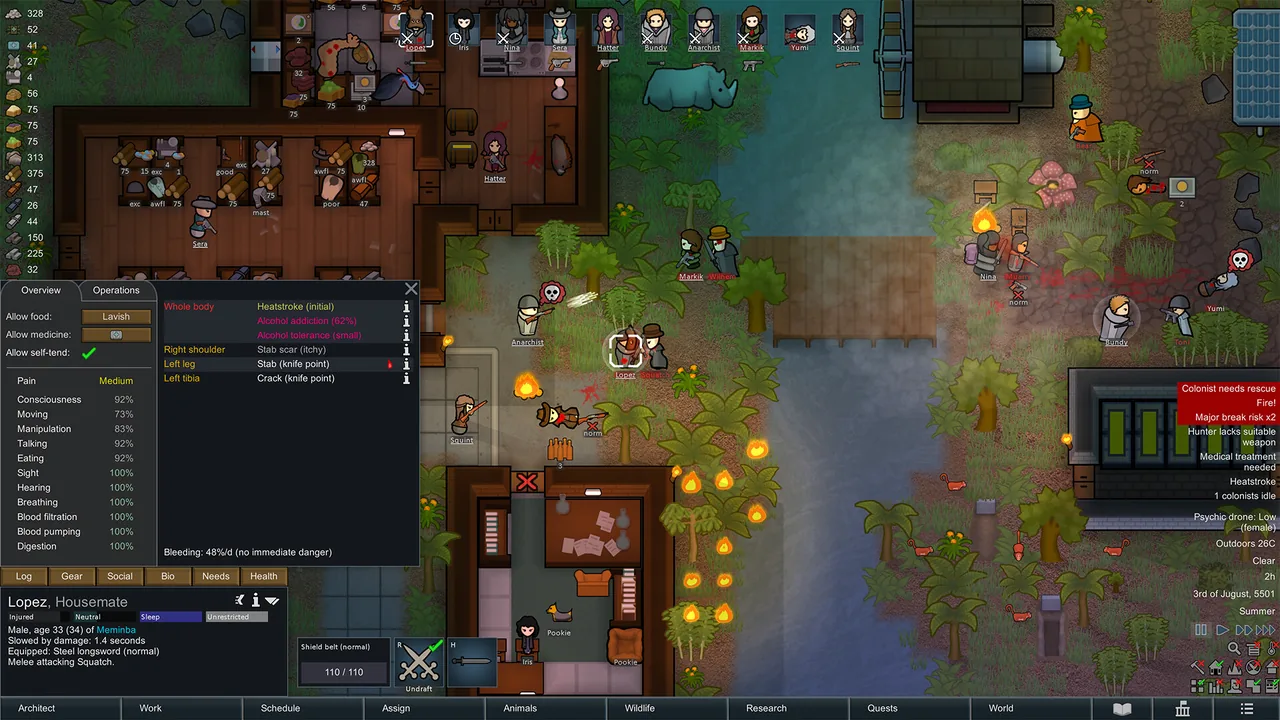
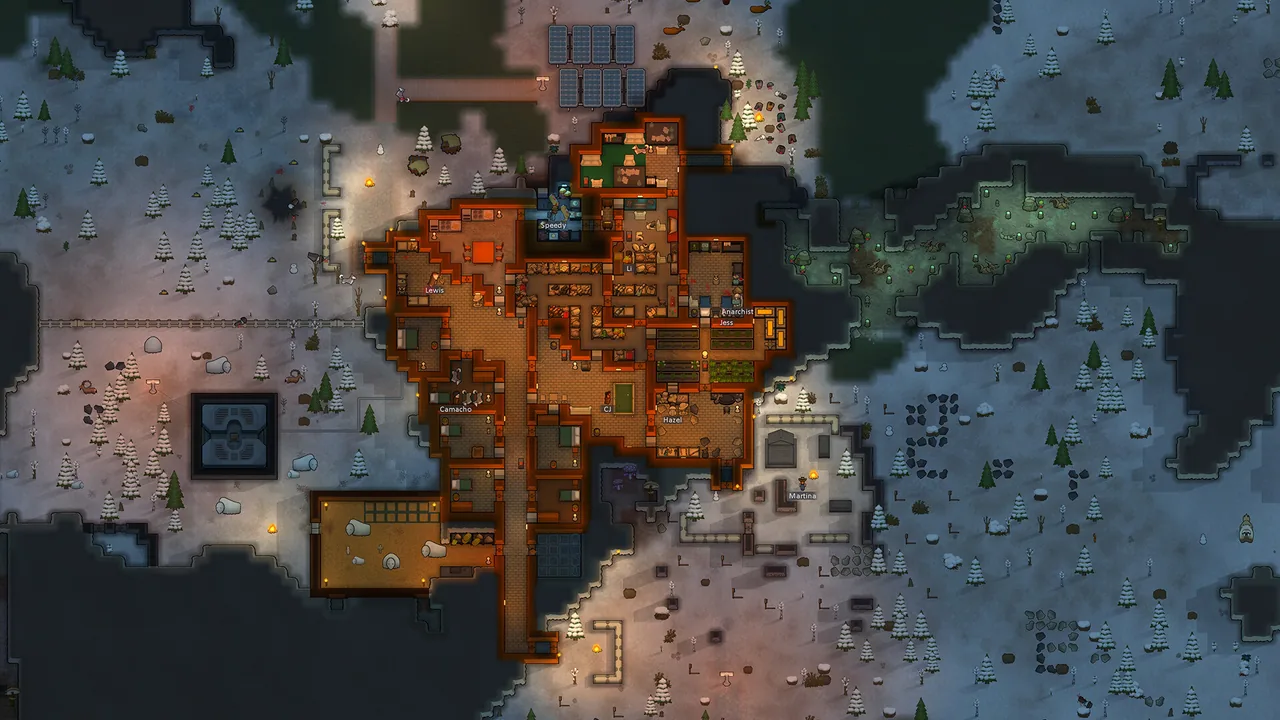
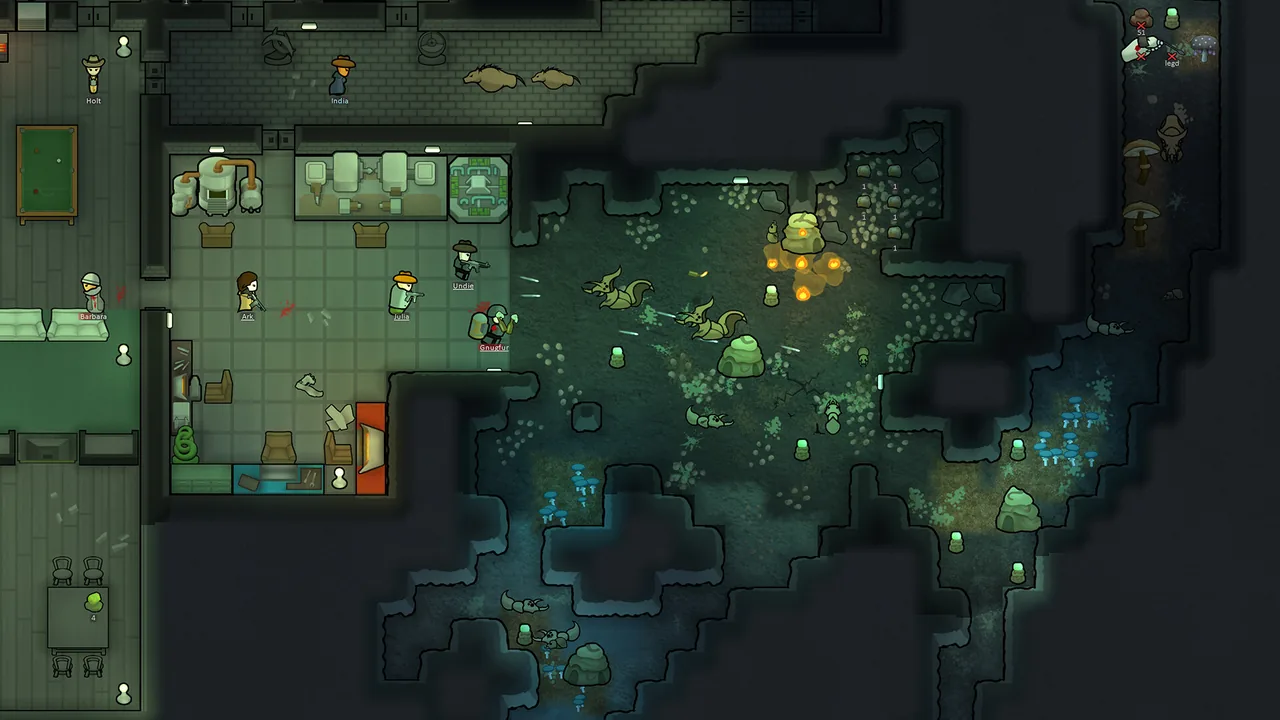
Visually, RimWorld has never chased spectacle and it isn't going to start now. The isometric pixel-art style is legible — colonists, threats, terrain and stockpiles all read clearly even when a raid and a cave-in are happening in the same frame — but it's a purely functional aesthetic, not an attractive one, and it hasn't meaningfully evolved since the alpha years beyond incremental sprite additions with each expansion's new content. Sound design does more of the heavy lifting: ambient music shifts with weather and threat level, and voiceless colonist "mutters" and sound cues do a decent job of communicating colony state without a UI element, though the overall soundscape is more competent than memorable.
Multiplayer exists, just not officially
RimWorld shipped, and remains, a single-player game. Ludeon has never added native multiplayer, and the reason a shared-colony experience exists at all is a long-running, actively maintained community mod that layers networked play on top of the base simulation. It works well enough that groups genuinely use it for long-term shared colonies, but it's unsupported by the developer, can lag behind new expansion content, and represents a real gap for anyone assuming a game this deep would ship with co-op as a first-party feature.
Players who like the idea of a system quietly raising the stakes as their own numbers climb, rather than treating growth as pure safety, may recognise a smaller-scale cousin of that instinct in Wanderer's own difficulty pacing.
Verdict
Nine out of ten. RimWorld's central idea — that a colony's own growth should be the input for how much worse its next crisis gets — is one of the smartest pieces of systemic game design running on PC right now, and the skill, mood, research and production systems underneath it are deep enough to carry that idea across hundreds of hours without running dry. Five expansions have each added a genuinely distinct mechanical identity rather than diluting the core loop, which is a rare kind of follow-through for a five-year DLC ladder.
What keeps it from a higher score is just as real: the interface is built to be finished by mods rather than by Ludeon, performance softens once a colony grows past a modest size, the art has never aimed higher than legible, and a player who wants literally everything is now looking at roughly NZ$213 with no bundle discount in sight. None of that undoes what the base game is on its own — a complete, extraordinary hundred-plus-hour simulation that doesn't need a single expansion to justify its price. Buy that first, let a colony fall apart in a way that actually means something to you, and decide afterward whether a specific expansion's theme is worth paying for separately.
Price, expansion and platform details checked 30 July 2026.
Pros and cons
Pros
- The three AI storytellers turn ordinary numeric growth into escalating narrative stakes instead of just bigger stat bars
- Skills, traits, backstories and relationships give every colonist enough individuality that losing one to a raid actually stings
- The mood and mental-break system forces real trade-offs between productivity and colonist wellbeing rather than treating happiness as a background stat
- Research and production form a genuinely deep tech ladder, from stone tools to starship components, without ever feeling padded
- Each of the five expansions adds a mechanically distinct pillar — psycasts and nobility, belief systems, genetics and mechanoids, cosmic horror, space travel — rather than reskinning the same loop
- An enormous, mature Steam Workshop modding scene extends the base game further than almost any other premium PC release currently on sale
Cons
- The interface is dense and unwelcoming even by strategy-game standards, and community wisdom treats certain quality-of-life mods as close to mandatory
- Simulation performance degrades noticeably once a colony's population, item count and animal herds grow past the game's comfortable range
- The pixel-art presentation is functional and readable rather than attractive, and it hasn't meaningfully evolved since Early Access
- The learning curve in the opening hours is unforgiving, and the built-in tutorial doesn't fully prepare new players for the systems waiting past it
- Owning the base game and all five expansions now costs roughly NZ$213, with no bundle discount for buying the full set at once
- There is no official multiplayer of any kind, so shared colonies depend entirely on an unsupported community mod
Screenshots
-
RimWorldImage: Ludeon Studios via Steam -
RimWorldImage: Ludeon Studios via Steam -
RimWorldImage: Ludeon Studios via Steam -
How the review scores each part of the gameWanderer Editorial -
The short versionWanderer Editorial