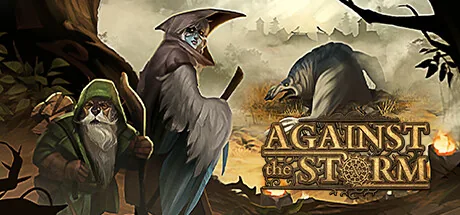
Game review
Against the Storm
8.5 / 10
- Developer
- Eremite Games
- Publisher
- Hooded Horse
- Released
- 8 December 2023
- Platforms
- Windows, PlayStation 5, PlayStation 4, Xbox Series X|S, Xbox One, Nintendo Switch
- Genre
- Roguelite city builder
- Monetisation
- Premium, one-off purchase for the base game. Two paid species expansions exist — Keepers of the Stone (frogs, September 2024) and Nightwatchers (bats, July 2025) — plus a cosmetics-and-soundtrack Supporter Pack. None of the three touch the base game's balance; they add optional species and biomes to settle, not power
- Players
- Single-player only; no co-op or competitive mode exists or is planned
The short version
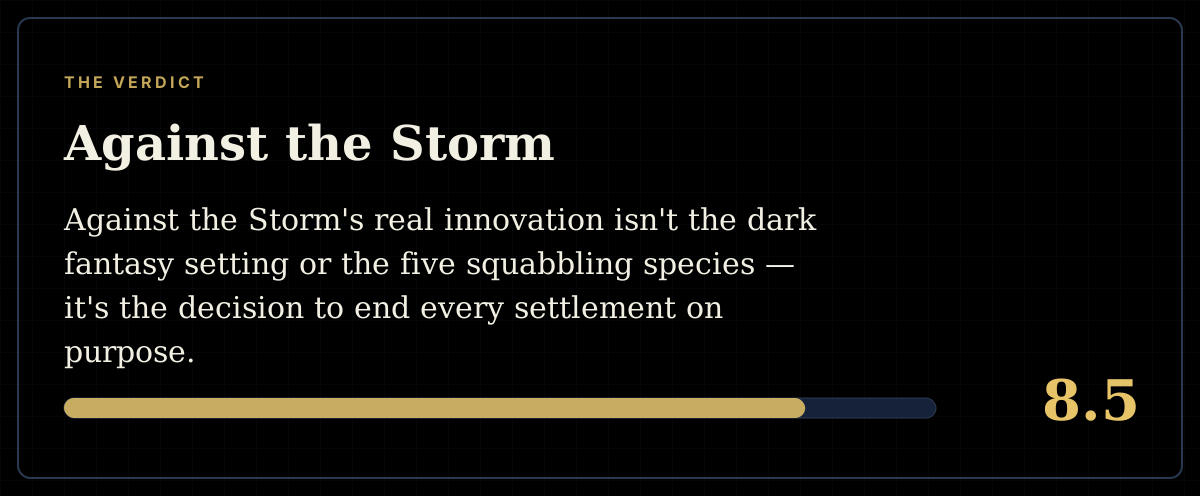
Against the Storm's real innovation isn't the dark fantasy setting or the five squabbling species — it's the decision to end every settlement on purpose. City builders have spent decades running out of ideas the moment a town becomes self-sufficient, and this game sidesteps that entirely by making completion, not permanence, the goal. Every settlement is a closed loop that pays into a persistent meta-progression layer, and starting over with a fresh map and a fresh set of demanding species is the reward for winning, not a punishment for losing.
The production chains underneath that structure are the best reason to keep playing: five species with genuinely different housing, food and happiness requirements force real trade-offs rather than a single optimal build. The interface hasn't kept pace with that complexity, and the opening twenty minutes of a run repeat themselves closely enough, hundreds of runs in, that some players burn out on the ritual before the real decisions start.
Biggest strengths
- Deliberately ending each settlement and banking the result into meta-progression solves the sag every long-running city builder eventually hits
- Five species with distinct housing, food and happiness needs turn recipe choices into real trade-offs instead of one optimal build
- Resolve, Hostility and the Queen's Impatience timer interact so that rushing and stalling are both genuinely risky, not just one obviously-correct pace
Biggest weaknesses
- The opening minutes of founding a settlement, unlocking the same early buildings and reading the same starting recipes repeat closely enough across hundreds of runs that the ritual wears thin before it should
- Menus, resource icons and recipe comparisons are dense enough on a 1080p monitor that community requests for larger, scalable text have gone unaddressed for years
- The tutorial explains individual prompts without building toward why the three meters matter together, leaving new players to learn the real game from outside guides
Who it's for: Colony-sim and city-builder players who've felt a base RimWorld or Cities: Skylines settlement go slack once the challenge disappears, and who like the idea of a roguelike's session structure applied to a genre that rarely uses one. A poor fit for anyone who specifically wants a single permanent city to keep returning to, or who bounces off timers and RNG in strategy games.
Our recommendation: Buy it, ideally on one of its frequent 50-70% off sales rather than at full price the moment curiosity strikes. Start on Settler or Veteran difficulty and expect the first several runs to end badly — that's the game teaching you its three meters, not the game being unfair. Viceroy and the Prestige ladder above it are for players who already love the loop, not an on-ramp for new ones.
8.5 / 10
Every long-running city builder eventually hits the same wall. You solve food, you solve power, you solve defence, and then the simulation you spent twenty hours building keeps running in the background while you have nothing left to decide. Against the Storm's answer is structural rather than cosmetic: it doesn't try to make an endless settlement stay interesting. It ends the settlement, on a clock you can see the whole time, and turns what you built and lost into permanent progress toward the next one. That single decision does more work than the dark fantasy setting, the talking beavers, or the eternal rain the marketing leads with, and it's the reason a roguelite city builder from a first-time studio landed at 91 on Metacritic and has stayed there.
Eremite Games launched Against the Storm into Early Access on the Epic Games Store in October 2021, moved to Steam Early Access on 1 November 2022 once that exclusivity window closed, and shipped 1.0 on 8 December 2023 through publisher Hooded Horse, day-and-date with a PC Game Pass listing. A console port followed on 26 June 2025, rebuilt for gamepad rather than a stretched mouse UI. Two paid species expansions have shipped since — Keepers of the Stone in September 2024 and Nightwatchers in July 2025 — and Eremite is still patching monthly, with a July 2026 "Over-Haulers" update and a spin-off survival game in the same world already announced. This isn't a studio that shipped 1.0 and walked away.
The settlement is supposed to end
Against the Storm casts you as the Scorched Queen's Viceroy, sent from a besieged capital called the Smoldering City to found temporary settlements in glades scattered through a forest an apocalyptic, endless rain is slowly reclaiming. Every settlement runs against three interacting meters rather than one. Reputation is the number you're trying to fill — generated once a species' Resolve, essentially their morale, clears a threshold and they start contributing. Hostility rises the longer a settlement sits at low Resolve and triggers worse random events during the Storm Season. Queen's Impatience is the loss condition: a timer that climbs on its own, faster when villagers die or desert, counting down against your Reputation total whether you're ready or not.
The part worth dwelling on is how those three meters fight each other rather than simply adding pressure. Impatience and Hostility are inversely linked — letting Impatience climb actually suppresses Hostility, so stalling for safety on one meter accelerates your loss condition on the other. There's no clean "play carefully" strategy, because caution against one clock is recklessness against the other. That's genuinely well-built systems design: it forces you to read your settlement's specific state rather than apply a memorised opening, which is why runs that look identical on paper — same species, similar glade — can demand completely different pacing.
Winning a settlement, or evacuating a doomed one before Impatience maxes out, both pay Seal Fragments and Citadel resources back to the Smoldering City. Losing outright still usually leaves you something, just less of it. That's what makes the design honest: a bad run isn't a wasted evening, it's a shorter, worse-paying version of a good one — precisely the frame a roguelite needs to make failure feel like data instead of punishment.
Does ending the game actually fix the genre, or just hide the problem
City builders sag at the end because designers usually stop building content past the point where a city is self-sufficient. Against the Storm's fix is to make sure you're never in a settlement long enough to find that ceiling: runs typically resolve in an hour or two, well before the production chains have been fully mastered, and the reset puts you back at a new beginning rather than staring at a solved city with nothing left to decide.
That's a real solution to a real problem, not a dodge. The clearest evidence is that the game's actual endgame — the Prestige ladder unlocked after clearing Viceroy difficulty, stacking harder modifiers on top of a base already tuned to be unforgiving — is where Against the Storm is at its most demanding, not its most hollow. Compare that to a RimWorld colony a hundred hours in, coasting on a stockpile so large the AI storyteller's escalating raids barely register anymore. Against the Storm never gets there, because it isn't designed to be gotten there. It's a fair trade, not a trick — you give up the slow, proprietary pride of one permanent city shaped over months, and in exchange get a system that never runs dry. What you don't get is the option to just keep one great settlement forever, and players who specifically want that will find the reset frustrating no matter how well-designed the loop around it is.
Species and production chains are where the actual game lives
The meters create pressure, but the production chains are what you're actually managing under it, and this is where Against the Storm distinguishes itself from a generic survival-builder loop. Five species — humans, beavers, lizardfolk, foxes and harpies in the base game, with frogs and bats added by the two paid expansions — each carry different housing tiers, food preferences and things that make them miserable or content. A recipe for planks might suit beavers and actively upset harpies; a food that keeps foxes happy can leave lizardfolk indifferent. You rarely pick your species mix freely — the starting roster is assigned — so the actual skill on display is reading what you were given and building housing and recipe chains around it, rather than defaulting to one favourite build.
Layered on top, most core resources can be produced multiple distinct ways from different raw materials and buildings, so a glade rich in one resource and poor in another still has a viable path through it. That's the real decision space: not "what's optimal," since the optimal answer changes with every map seed and species roster, but "what's viable given what this settlement actually has." It's a more honest complexity than a game with one best build repeated every session, and it's why experienced players describe individual runs as distinct rather than variations on a memorised script.
Meta-progression that genuinely compounds
The Smoldering City is the hub between runs, and it's where losses get paid back. Citadel resources earned from completed and abandoned settlements alike buy permanent perk-tree upgrades; Deeds reward specific milestones with Cornerstones, decorations and experience; and Seal Fragments assemble into full Seals that unlock harder difficulties and better starting conditions. None of it is cosmetic filler — early Citadel upgrades measurably smooth out the opening of every future run, which means the ladder from Settler through Veteran to Viceroy and the Prestige tiers above it stays satisfying precisely because early failures are visibly buying later successes.
Slay the Spire proved this shape works for roguelike deckbuilders: a single-run structure with no mid-run safety net, backed by account-level unlocks that never touch the moment-to-moment tension of an individual run. Cornerstones function like Spire's relics — real bets with real trade-offs rather than flat power boosts — and neither game lets its meta-progression trivialise an individual run, which is exactly what keeps both feeling earned a hundred hours in rather than solved.
A tutorial that explains prompts, not systems
The most consistent complaint in Against the Storm's own review section is the tutorial, and it's fair. New players report finishing the mandatory tutorial steps able to click the right buttons without understanding why Resolve, Hostility and Impatience interact, which is the one thing a tutorial for this specific game most needs to teach. The result is a common pattern: players bounce off in fifteen minutes, decide the game "isn't for them," and never see the systems that make the loop work, because nothing in the opening hour explained that stalling for safety on one meter is actively dangerous on another. That's a design failure specific to this game, not generic onboarding fatigue — the mechanic is unusual enough that a normal strategy-game tutorial template genuinely doesn't cover it.
Interface density that hasn't scaled with the game's growth
Against the Storm's interface was built for a smaller game than the one it eventually became. Two species DLCs, dozens of recipes and a growing Citadel perk tree have landed on top of a menu system that was already busy at 1.0, and the result is small text, dense icon grids and recipe-comparison screens that ask a lot of a player's attention on a standard monitor. Community requests for a proper font-size slider, rather than a global UI scale that overlaps menus once pushed high enough to actually help, have gone unanswered for years. It's the clearest gap between how much care went into the systems and how much went into presenting them, and a legitimate reason some players who'd otherwise enjoy the loop don't stick around long enough to learn it.
Repetition is the real cost of a fast reset
The flip side of ending every settlement quickly is that you found a lot of settlements, and the opening minutes of each one — the same starting buildings, the same first recipes, the same early-game rhythm before a run's species and map seed start actually diverging from the last one — repeat closely enough that dedicated players report real fatigue with the ritual, even when they still enjoy where each run eventually goes. It's the most honest criticism the roguelite frame invites: solving the endgame problem by resetting constantly just moves the repetition earlier, from "the late game has nothing left to do" to "the early game is the same fifteen minutes for the five-hundredth time." Against the Storm manages this better than most roguelites, because species and map variance genuinely change what the early game asks of you, but it doesn't erase the pattern, and a player chasing Prestige 10 for its own sake feels it more than someone playing casually.
Is the difficulty fair, or just harsh
Against the Storm's difficulty range is genuinely wide — Settler through Veteran gives newer players room to learn the three-meter system without punishing every mistake severely, while Viceroy and the Prestige tiers above it stack exponential hostility increases onto maps that can spawn without reliable food or safe expansion room. That width is a real strength: this isn't a game that only works for masochists, whatever its reputation among the loudest voices online. The complaint worth taking seriously is narrower — at the top of the ladder, a badly seeded resource glade or an unlucky run of Forest Mystery events can end a settlement in a way no skilled play would have prevented in time, and that's where "hard" tips into "unfair" for players who've already earned better. It's not the majority experience, but it's real, and the game doesn't currently signal when a seed is simply bad from the start.
Presentation carries the mood the mechanics create
The rain-soaked dark fantasy art direction is doing more than set dressing. Muted, weather-beaten palettes and a storm-reactive score make the tension of the three meters feel earned rather than purely numerical, and the Smoldering City hub between runs is inviting enough that returning after a loss feels like a reprieve rather than a chore. It's not a technically demanding game, and performance holds up well as a settlement grows, softening only slightly in the largest, most developed settlements late in a run.
Value and what the DLC actually sells
At NZ$39.99 for a complete, still-updated base game with dozens of hours of difficulty runway before Prestige even enters the picture, Against the Storm is fairly priced even before accounting for how often it goes on sale — discounts of 50 to 70% have run close to monthly through 2026. Neither paid expansion is required: Keepers of the Stone and Nightwatchers each add one species, its own biomes and its own building chains, genuinely diversifying the roster rather than reskinning it, but the base game's five species are a complete, balanced experience alone. The Supporter Pack is pure cosmetics and a soundtrack. There's no premium currency, no energy system, no battle pass and nothing resembling pay-to-win in a single-player game with no competitive stakes to win at.
Colony-sim players who like permanent progress accruing quietly across separate sessions, rather than needing one unbroken city to hold all of it, will recognise a familiar shape in Wanderer.
Verdict
8.5 out of 10. Against the Storm's central bet — that a city builder's endgame problem is better solved by ending deliberately than by escalating forever — pays off, and the three-meter tension under every settlement is some of the smartest resource-management design running on PC or console right now. Five species with real, distinct needs turn recipe planning into genuine decision-making instead of a solved build, and the Smoldering City's meta-progression gives every loss permanent weight instead of wasting the hour you just spent.
What holds it below a 9 is concrete: the interface hasn't kept pace with everything the game has grown into, the tutorial explains actions without ever explaining the system that makes them matter, the opening minutes of a run repeat more than a five-hundred-run design should tolerate, and the top of the difficulty ladder occasionally tips from demanding into simply unlucky. None of that undoes what's here. This is a genuinely novel answer to a problem the genre had mostly stopped trying to solve, built by a small studio still actively supporting it three years after launch, and it's worth full price even before you catch it on one of its frequent sales.
Pricing, platform and release-date details checked 1 August 2026.
Pros and cons
Pros
- Deliberately ending each settlement and banking the result into meta-progression solves the sag every long-running city builder eventually hits
- Five species with distinct housing, food and happiness needs turn recipe choices into real trade-offs instead of one optimal build
- Resolve, Hostility and the Queen's Impatience timer interact so that rushing and stalling are both genuinely risky, not just one obviously-correct pace
- The Smoldering City's Citadel perks and Cornerstones give losses permanent value instead of wasting a failed run entirely
- Rain-soaked dark fantasy art direction and an atmospheric, weather-reactive score make the between-runs hub as inviting as the runs themselves
- Console versions ship with a genuinely rebuilt gamepad interface rather than a stretched port of the mouse-driven UI
Cons
- The opening minutes of founding a settlement, unlocking the same early buildings and reading the same starting recipes repeat closely enough across hundreds of runs that the ritual wears thin before it should
- Menus, resource icons and recipe comparisons are dense enough on a 1080p monitor that community requests for larger, scalable text have gone unaddressed for years
- The tutorial explains individual prompts without building toward why the three meters matter together, leaving new players to learn the real game from outside guides
- Viceroy difficulty and the Prestige ladder above it lean on hostile map seeds and compressed timers that read as unfair rather than merely hard until you've memorised the system
- A single bad Forest Mystery roll or a poorly seeded resource glade can doom a settlement in ways no amount of skill would have caught in time
- The Frog and Bat species DLC are absent from console, so cross-platform players don't get the same roster
Screenshots
-
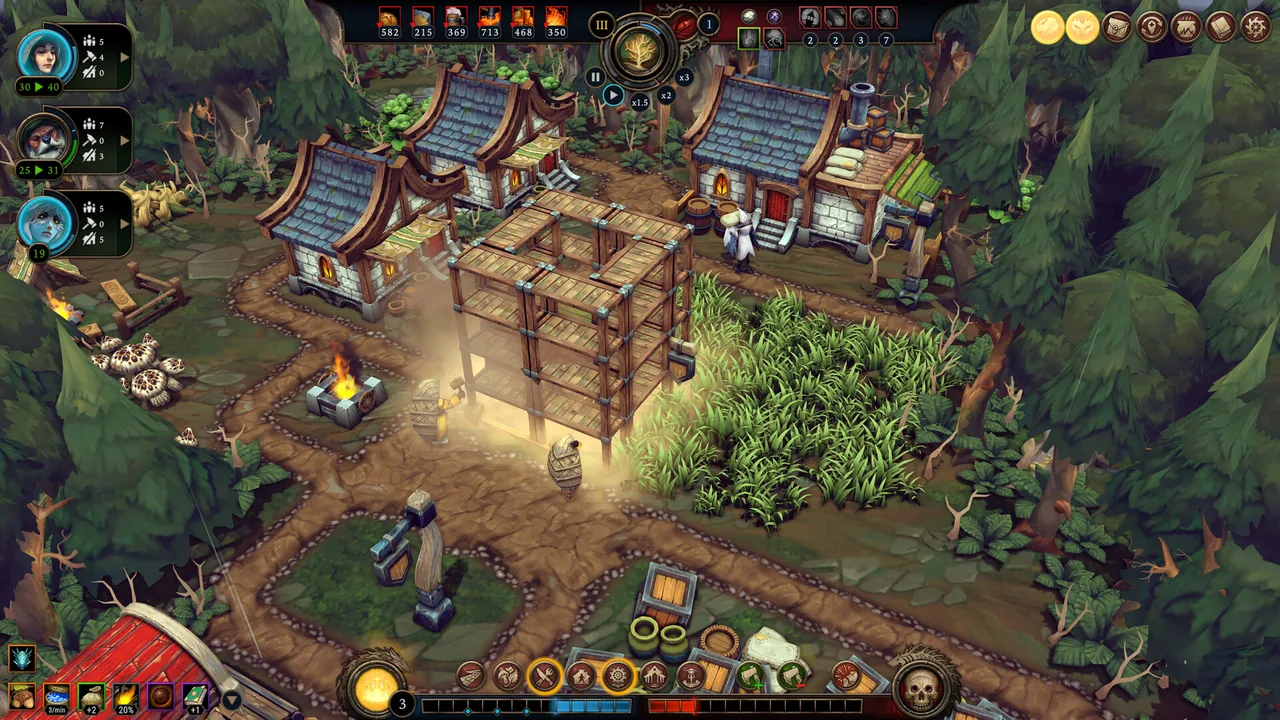
Against the StormImage: Hooded Horse via Steam -
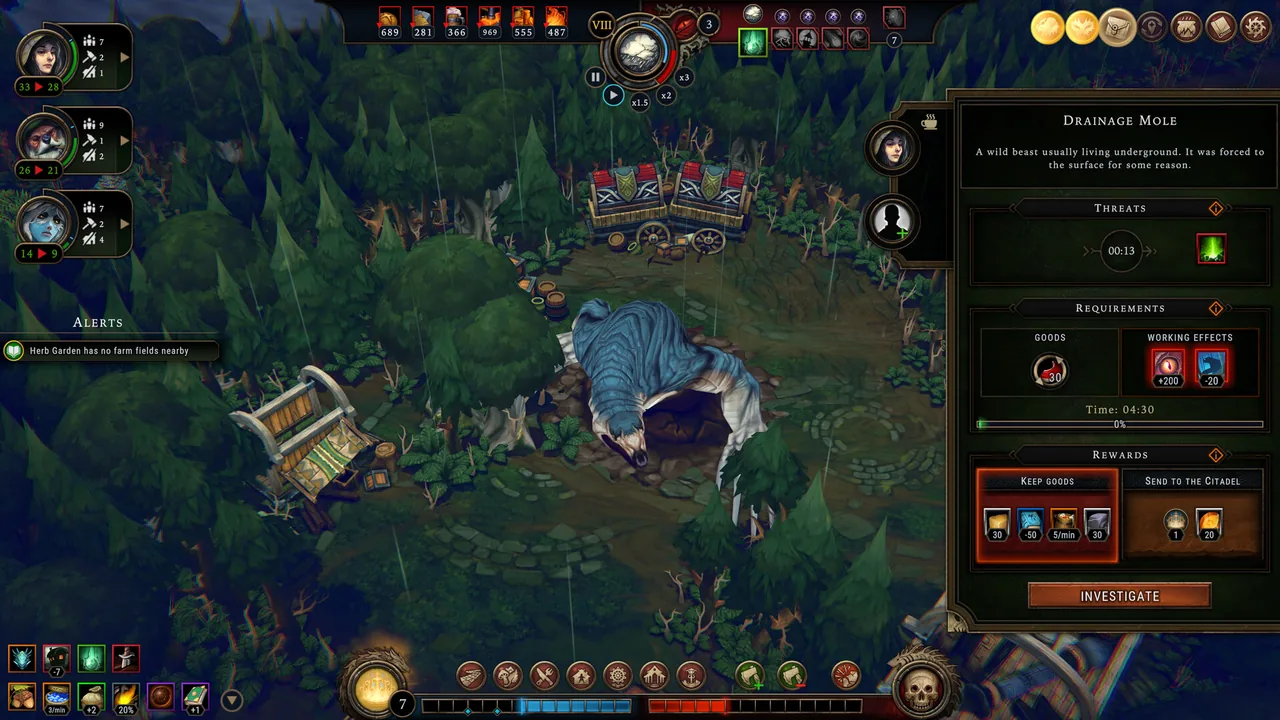
Against the StormImage: Hooded Horse via Steam -
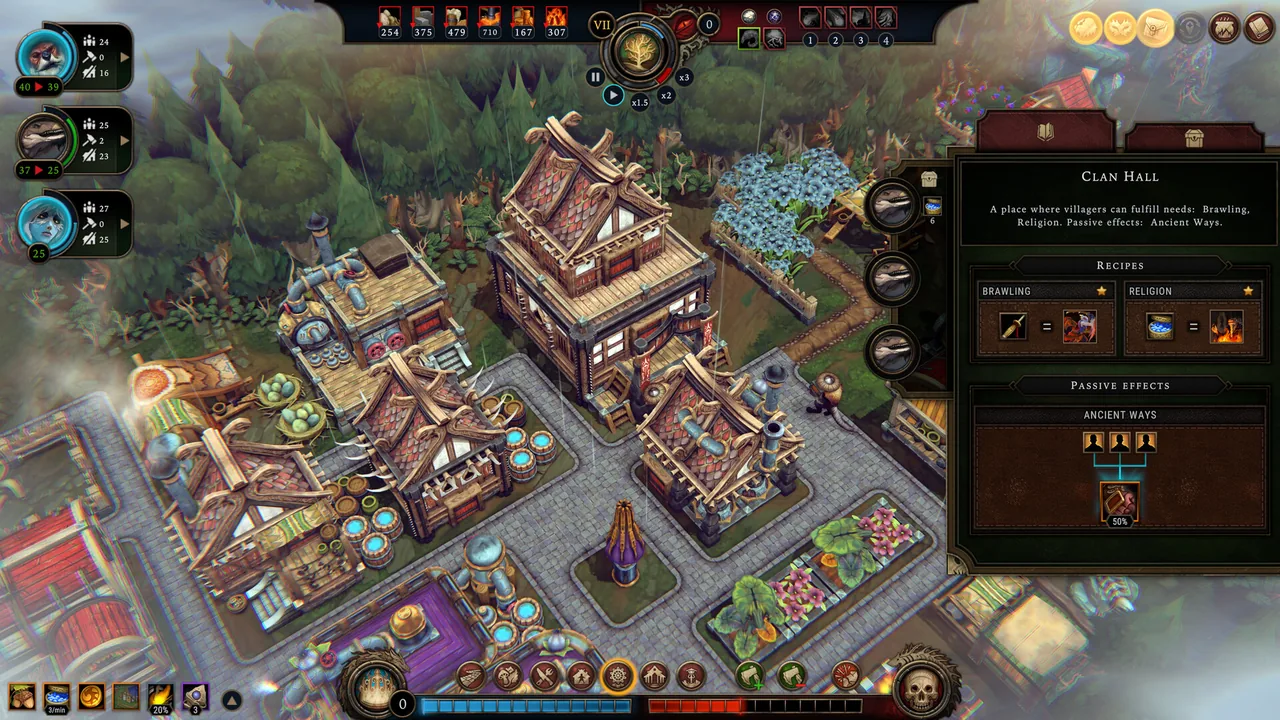
Against the StormImage: Hooded Horse via Steam -
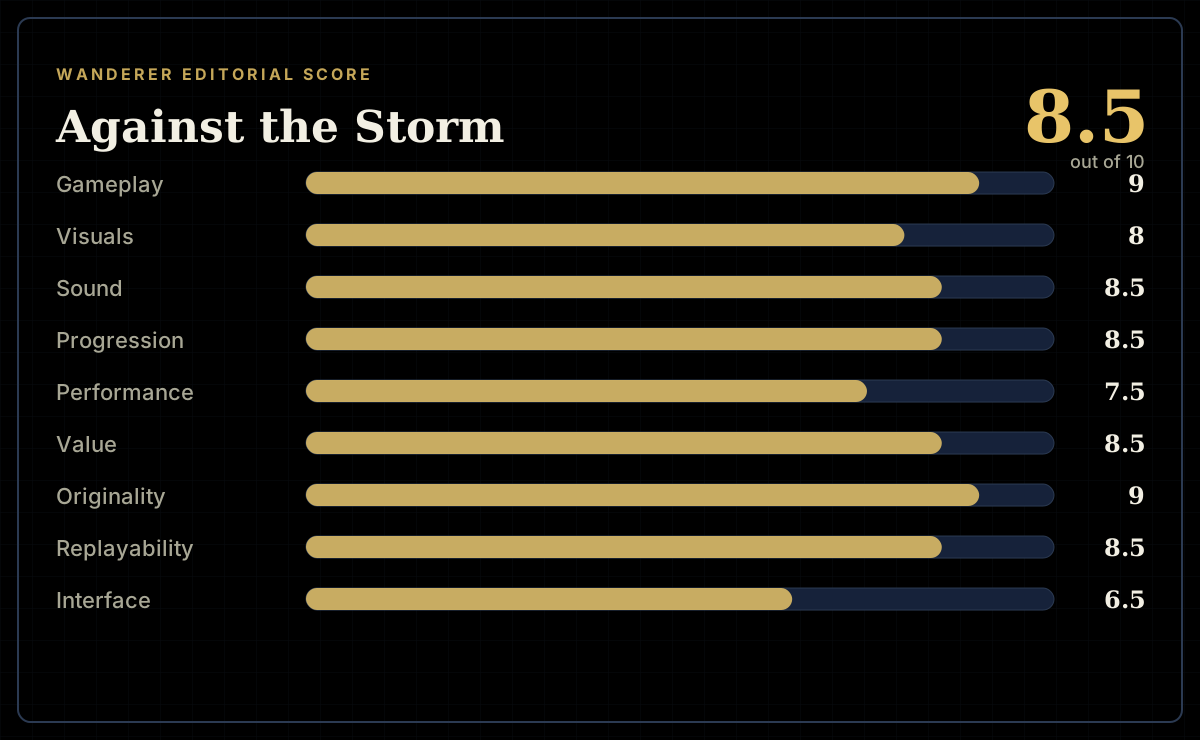
How the review scores each part of the gameWanderer Editorial -
The short versionWanderer Editorial