Game review
Noita
9 / 10
- Developer
- Nolla Games
- Publisher
- Nolla Games
- Released
- 15 October 2020
- Platforms
- Windows
- Genre
- Action Roguelite / Physics Simulation
- Monetisation
- Premium, one-time purchase. The only DLC is the official soundtrack; it changes nothing about the game itself. No ads, no in-game currency, no live-service systems of any kind
- Players
- Officially single-player only. There is no built-in co-op, versus mode or shared world of any kind; every multiplayer experience with Noita comes from unofficial Steam Workshop mods
The short version
Noita's pitch sounds like a tech demo — every pixel on screen is a simulated material that burns, freezes, dissolves, conducts or explodes according to the same rules whether you caused it or not — but the game built on top of that engine is one of the most complete expressions of "systems as content" on Steam. The wand editor, which lets you chain spells into combinations the designers never explicitly authorised, is the real skill tree, and the roguelite runs wrapped around it exist mostly to keep raising the stakes on what you're willing to try.
It is also punishing in ways that are only partly about difficulty. Deaths frequently arrive from off-screen, from a material interaction you didn't know existed, or from a wand you built wrong three menus ago, and the game will not soften any of that for you. Global achievement data backs up what its own negative reviews describe: most owners see the first couple of biomes and stop.
Biggest strengths
- The Falling Everything engine simulates fire, gas, liquid and solid matter as one consistent physical system rather than a set of scripted effects layered on top
- The wand editor turns spell order, timing and modifiers into the actual skill tree, and mastering it matters more than any stat on a piece of gear
- New Game+ cycles, periodic Fungal Shifts that rewrite material interactions mid-run, and a sprawling item-hunting secret quest give committed players years of material past the first ending
Biggest weaknesses
- There is no official multiplayer or co-op of any kind; every shared-Noita experience depends on an unofficial community mod
- Controller support is only partial and Steam Deck sits at "Playable" rather than "Verified," in a game whose combat leans hard on precise mouse aim
- The game explains almost none of its own systems, leaving material interactions, wand mechanics and biome hazards to be learned from the community wiki rather than from anything on screen
Who it's for: Players who treat "figure out the system yourself" as the actual game, fans of immersive sims and emergent physics toys who want that emergence wrapped in real stakes, and roguelike veterans who've already made peace with losing runs to things they couldn't have predicted. A poor fit for anyone who wants a game to explain itself, offer an easier setting, or guarantee that a death was fair.
Our recommendation: Buy it — at NZ$24.79 with no meaningful DLC to chase, it's one of the cheapest ways to buy dozens of hours from a genuinely original engine. Go in expecting to lose badly and often for the first several hours, keep a wiki tab open once material interactions start mattering, and don't feel obligated to chase the secret endings unless the hunt itself sounds fun.
9 / 10
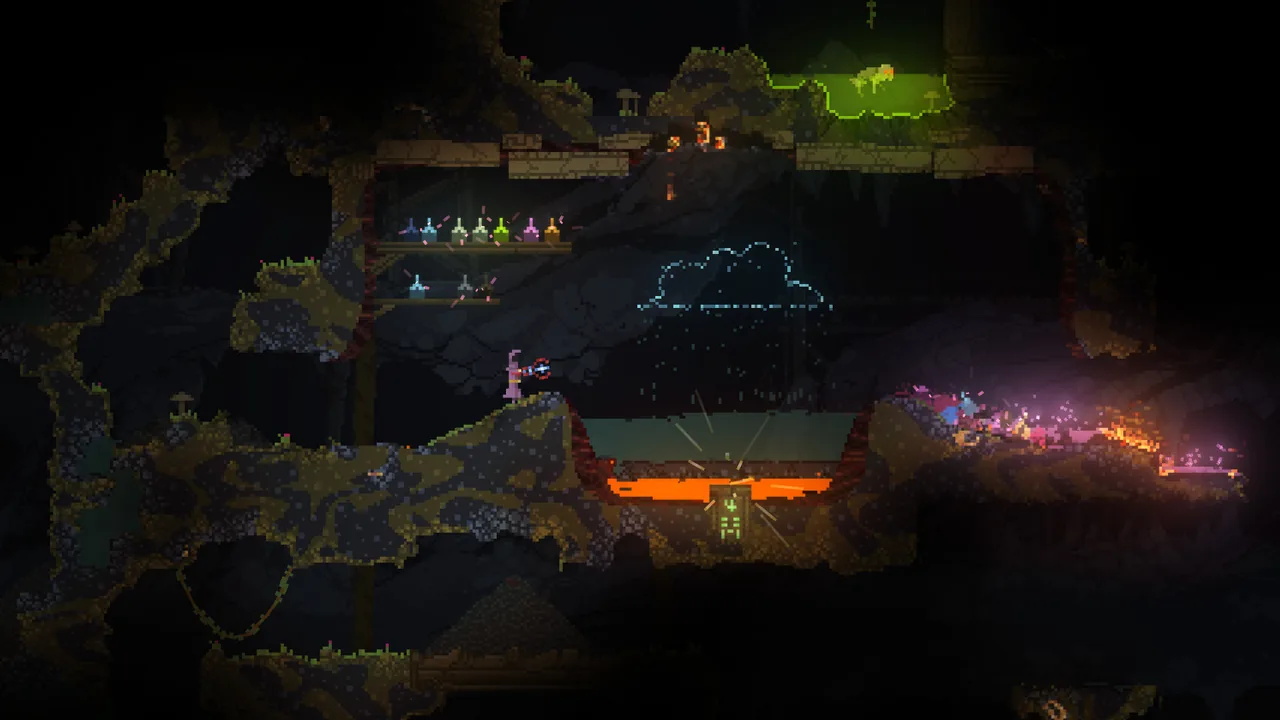
Most games that simulate physics use the simulation to decorate a level that would work fine without it. Noita does the opposite: take away the falling-sand engine and there is no game left, because every threat, every shortcut and every disaster in it is made of the same simulated material as everything else. A pool of lava isn't a hazard trigger volume, it's actual simulated liquid that will keep burning through wood, boiling water into scalding steam, and setting fire to whatever oil you dragged through it five minutes ago. That single decision — simulate it honestly, all the way down, and let the consequences be real — is the whole reason this game has the reputation it does, split about evenly between "one of the most original things on Steam" and "the most unfairly I have ever died in a video game." Both halves are correct, and they're describing the same design choice.
Every pixel is real: the Falling Everything engine
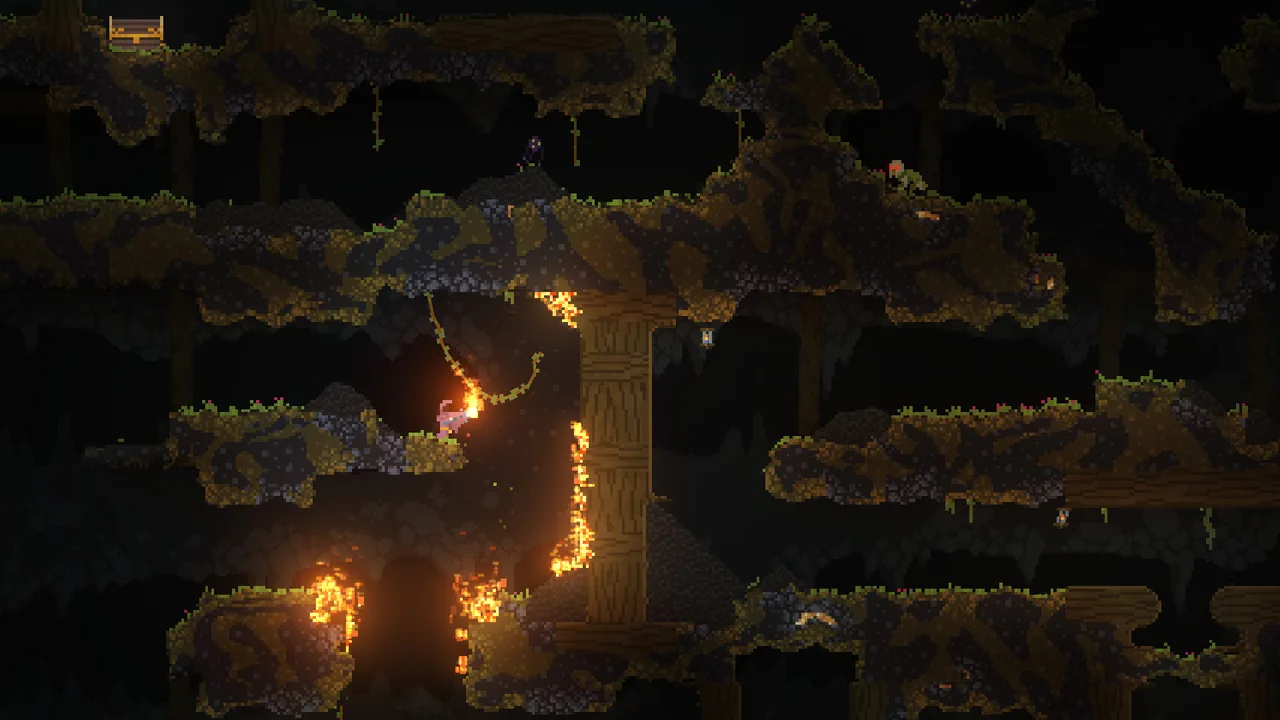
Nolla Games built Noita around a custom engine the studio calls Falling Everything, which treats the entire world as a grid of individually simulated pixels: sand and dirt behave as granular solids, water and lava as liquids that flow and mix, smoke and toxic gas as clouds that spread and dissipate, and fire as a chemical reaction that consumes nearby fuel rather than playing a particle effect on a timer. Chunks of the world only update when something in them is actually changing, which is how the engine keeps enormous, fully destructible levels running without buckling — a technical achievement frequently cited by other developers building their own falling-sand projects, and one of the few pieces of Noita's design that reviewers and players agree on without much argument.
What makes that engine more than a tech demo is that Noita never treats it as backdrop. Digging is a core traversal tool, not a side activity — every wall is diggable terrain, and tunnelling through it to shortcut a dangerous room is as legitimate a strategy as fighting through it. Alchemy works by genuinely mixing materials in a cauldron rather than consulting a recipe list. Electricity conducts through water exactly as you'd expect, meaning a fight in a flooded room changes the risk calculus for both sides. None of this is scripted per-encounter; it's the predictable result of consistent rules applied everywhere, which is precisely why players keep finding interactions Nolla Games itself never explicitly designed.
Building wands is the actual game
Combat in Noita runs almost entirely through wands, and the wand editor is where the game actually lives. A wand has capacity, mana, a cast delay and a recharge time, and spells slotted into it — projectiles, modifiers that alter the next projectile in the sequence, multicasts that fire several spells at once, triggers that spawn a payload on impact — combine according to the order you place them in, not just the sum of their individual effects. Chaining a homing modifier onto a chainsaw spell produces something meaningfully different from the same chainsaw fired straight, and a wand built around triggers and timers can turn a single cast into a slow-building chain reaction that detonates seconds later. This is the game's real skill tree: there is no class, no talent grid and barely any traditional levelling, just an ever-growing library of spells whose actual value only becomes clear once you understand how they interact with everything else you're carrying.
That depth is also where a lot of the difficulty complaints actually originate, and it's worth being specific about that rather than filing every death under "the game is hard." A wand that looks fine on paper can behave unpredictably once its spells start interacting in ways the editor's tooltips don't fully explain, and a player who hasn't yet internalised how capacity, mana drain and cast order interact will regularly build something that kills them on the first attempt to fire it. That's a genuinely different failure mode from bad luck or a strong enemy, and Noita rarely distinguishes between the two for the player in the moment.
Permadeath, and what the negative reviews reveal
Runs end permanently on death, full stop — there's no partial progress carried into the next attempt beyond a small number of persistent unlocks, and everything a run built, from wand configuration to accumulated gold, resets. That's a standard roguelite contract, and on its own it wouldn't be controversial. What generates the friction is how those deaths actually happen: enemies that hit from off-screen, chain reactions from a material combination the player never triggered on purpose, and status effects — burning, poison, freezing — that can stack in ways that go from "manageable" to "dead" faster than most players expect the first several times it happens.
Reading through Noita's own recent negative Steam reviews makes the shape of the complaint clearer than any single quote does. These aren't reviews from players who bounced off in twenty minutes — recorded playtimes on negative reviews from the last month run from a few hours up into the hundreds, with one coming from a player who has logged over a thousand. The recurring language is telling: "you will die unfairly about 999 out of 1000 runs," "a sandbox that tried to put a game on top and failed," "dying and having to restart from zero a hundred times is just not fun." These are complaints from players who kept coming back, not ones who quit early — the frustration reads less like "this game is too hard for me" and more like "the same unexplained, unavoidable death keeps happening no matter how much I've learned," a more serious criticism than raw difficulty, and one the developers have never fully addressed.
The achievement curve: how far players actually get
Noita ships with only fourteen Steam achievements, deliberately sparse so they don't spoil the game's secrets, and the global completion percentages are the cleanest evidence available for how far players actually progress. Six of them mark reaching successive biomes and form an almost perfect staircase: Excavation Site sits at 72.4%, Snowcave at 59.2%, Snowcastle at 37.1%, Rainforest at 22.9%, Vault at 19.1% and Crypt at just 14.3%. Only 10.0% of players have ever beaten the game through its standard ending. The alternate-ending achievements, tied to angering, impressing or unsettling the game's hidden gods through how a run is finished, sit at 6.5%, 3.7% and 1.2% respectively, and collecting every orb in a single run — a prerequisite for the game's deepest secret content — sits at 2.7%. The rarest achievements of all are three cumulative meta-goals for having encountered a large share of all the game's perks, spells and enemies across every attempt ever made, none of which clear 1.2%.
Put plainly: over a quarter of players who've engaged with achievements at all never make it past the second biome, and roughly nine in ten never see the game end. That's not an unusually punishing curve for the genre in isolation, but it's sharper than most, and it corroborates the negative review pattern above with numbers rather than anecdotes — this is a game whose difficulty wall is real, early, and rarely gets meaningfully lower no matter how many hours a player puts in.
Parallel worlds, Fungal Shifts and secrets bigger than one playthrough
Finishing a run through its standard ending offers the choice to begin a New Game+ cycle rather than simply stopping, and each cycle shifts details of the world in ways that reward players who've already learned the base game — turning "beat it once" into the start of a longer commitment rather than the end of one. Mid-run, the game periodically triggers Fungal Shifts, random reassignments of which material transforms into which other material, so a liquid that was harmless earlier in a run can turn corrosive or explosive without warning. Layered on top is one of gaming's more famously convoluted item-hunting side quests, built around interactions the game never states outright, that leads to a secret final encounter almost nobody reaches without outside help. Noita's community has spent years collaboratively reverse-engineering these systems, and that culture of shared discovery is arguably as much a part of the game's identity now as anything in an official patch note.
No official multiplayer, a thriving unofficial one
Noita has never shipped official multiplayer, co-op or any shared-world feature, and nothing in its update history suggests that's changing. What exists instead is an active Steam Workshop scene building the feature Nolla Games never did: Noita Together lets separate players explore their own instances while seeing and lightly interacting with each other, Noita Entangled Worlds implements genuine online co-op within a shared run, and smaller projects like Couch Co-Op and Iota Multiplayer cover local play. None of it is officially supported, none of it is guaranteed to keep working across future patches, and a player who wants co-op Noita needs to go looking for it rather than finding it in the base game's menu. It's a real gap for a game this social online — but the fact that multiple separate mods exist to fill it says something about how much demand there is for a feature the developers themselves apparently never prioritised.
Aiming, controllers and the accessibility question
Combat in Noita is built around precise mouse aim — most wands fire toward the cursor, and dodging, digging and positioning all depend on pixel-level accuracy that a controller struggles to replicate. Steam lists only partial controller support, and Steam Deck compatibility is rated "Playable" rather than "Verified," which in practice means it runs but wasn't built with a handheld screen in mind. There is also no difficulty setting of any kind — no easier mode, no way to reduce enemy damage or slow a run's pace — a defensible stance for a game this committed to permadeath meaning something, but it does mean the accessibility conversation here isn't about visual or audio options. It's about a game offering exactly one way to experience it, at exactly one difficulty, through exactly one input method it was actually built around.
Four years of support, mostly finished now
Nolla Games is a three-person Finnish studio — Petri Purho, Olli Harjola and Arvi "Hempuli" Teikari, each previously known individually for Crayon Physics Deluxe, The Swapper and Baba Is You respectively — and their post-launch record with Noita is unusually long for a game this size. The free Epilogue Update in March 2021 was explicitly billed as the last major update; the studio then returned three years later with an even larger Epilogue 2 Update in April 2024, adding new spells, enemies, three boss encounters and another secret quest, before a smaller modding-focused patch in January 2025 rounded things out. That's roughly four and a half years of continued free content after 1.0, all of it free beyond the optional soundtrack. Whether more ever arrives is uncertain — but what's already shipped is substantial enough that nobody buying the game today is buying an abandoned one.
Value and final verdict
At NZ$24.79 with a single, inessential soundtrack DLC as the only optional purchase, Noita is priced like a much smaller game than it actually is. There's no currency, no battle pass, no edition split — the version everyone owns is the complete version, and the hours a serious player gets back from it comfortably outstrip what a lot of NZ$70 releases manage. That value proposition alone would carry a strong recommendation. What pushes the score to 9.0 is the Falling Everything engine itself: few games on Steam commit this completely to letting one consistent set of physical rules generate all of their content, and the wand-building system built on top of it rewards genuine mastery in a way very few action games manage.
It doesn't reach higher because the difficulty here isn't only about skill — a meaningful share of what kills players is unexplained, off-screen, or the product of systems the game never bothers to teach, and the achievement data shows plainly that most owners never get past the game's early stretch as a result. Pair that with no official multiplayer, only partial controller support, and zero accessibility options of any kind, and Noita reads less like a game with rough edges than a game that has deliberately declined to file them down. For the audience willing to meet it on those terms, that refusal is exactly the point. For anyone hoping the depth would eventually come with a gentler on-ramp, it won't, and it never has.
Players drawn to Caves of Qud's commitment to letting one honest simulation generate its own surprises, or Risk of Rain 2's and Dead Cells's permadeath-run structures, will recognise a lot of what Noita is doing — it just does it one level closer to the pixel, and with noticeably less patience for a player who hasn't earned its systems yet. Wanderer's own progression runs in the opposite direction entirely: nothing resets on death, and nothing punishes stepping away. Noita is the sharpest possible contrast to that idea, and worth playing at least once to understand why some games choose not to be forgiving.
Pricing, review totals and achievement data checked 2 August 2026.
Pros and cons
Pros
- The Falling Everything engine simulates fire, gas, liquid and solid matter as one consistent physical system rather than a set of scripted effects layered on top
- The wand editor turns spell order, timing and modifiers into the actual skill tree, and mastering it matters more than any stat on a piece of gear
- New Game+ cycles, periodic Fungal Shifts that rewrite material interactions mid-run, and a sprawling item-hunting secret quest give committed players years of material past the first ending
- A built-in Daily Run mode delivers a fair, identical seed to every player without needing any mod or external tool
- At roughly NZ$25 with only an inessential soundtrack DLC, the price asks almost nothing against the hours a serious player gets back
- Nolla Games kept shipping free content for four and a half years after 1.0, including a genuinely large second Epilogue update in 2024
Cons
- There is no official multiplayer or co-op of any kind; every shared-Noita experience depends on an unofficial community mod
- Controller support is only partial and Steam Deck sits at "Playable" rather than "Verified," in a game whose combat leans hard on precise mouse aim
- The game explains almost none of its own systems, leaving material interactions, wand mechanics and biome hazards to be learned from the community wiki rather than from anything on screen
- There is no difficulty option and no way to soften the instant, sometimes off-screen deaths that dominate its own negative reviews
- Large simulated events — long fire fronts, big liquid spills, chain explosions — can still visibly slow the engine down
- Global achievement data shows the overwhelming majority of owners never get past the first few biomes, let alone see an ending
Screenshots
-
NoitaImage: Nolla Games via Steam -
NoitaImage: Nolla Games via Steam -
NoitaImage: Nolla Games via Steam -
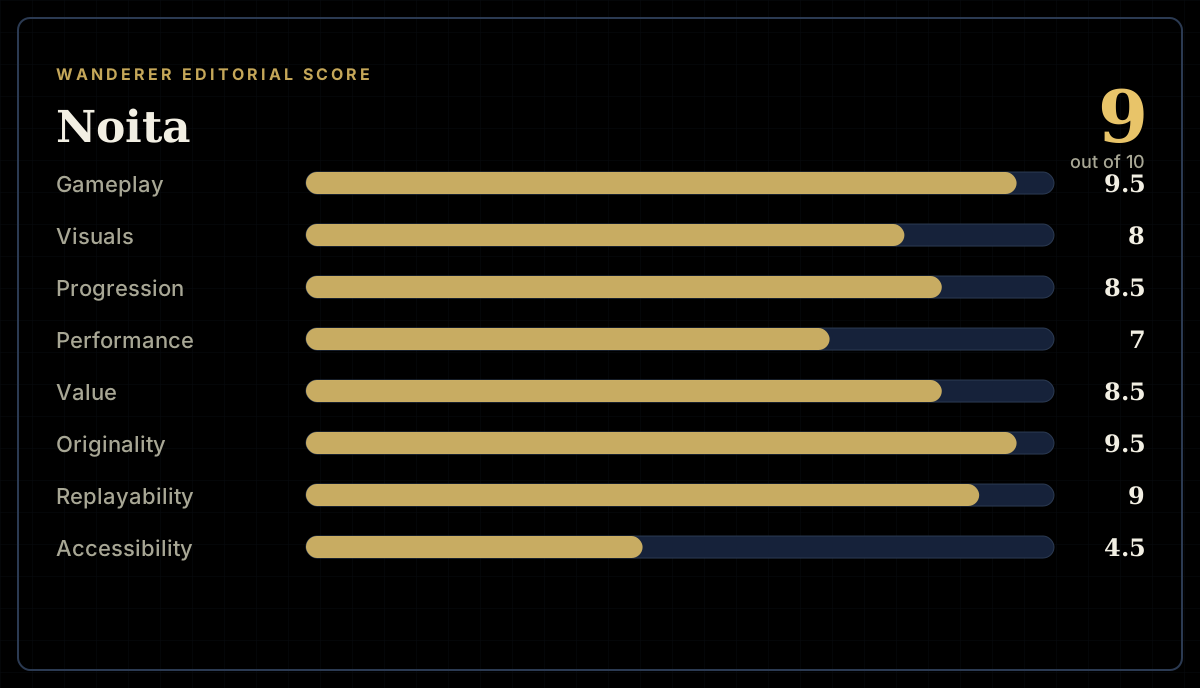
How the review scores each part of the gameWanderer Editorial -
The short versionWanderer Editorial