Game review
Risk of Rain 2
8 / 10
- Developer
- Hopoo Games
- Publisher
- Gearbox Publishing
- Released
- 11 August 2020
- Platforms
- Windows, PlayStation 4, PlayStation 5, Xbox One, Xbox Series X/S, Nintendo Switch
- Genre
- Roguelite / Third-Person Shooter
- Monetisation
- Premium one-time purchase with three paid expansions and three optional soundtrack packs sold separately; no in-game currency, loot boxes, ads or ongoing subscription of any kind
- Players
- Online co-op for up to four players on every platform, drop-in and drop-out mid-run; native local split-screen exists on PlayStation 5 and Xbox Series X/S only, not on PC, PS4, Xbox One or Switch; a lightly populated competitive mode, Prismatic Trials, also exists
The short version
Risk of Rain 2 is a shooter with almost nothing shooter-like at its centre: the real game is drafting a stack of items whose effects multiply together while a difficulty clock rises on a fixed schedule underneath you, whether you're ready or not. That design is still one of the smartest expressions of number-go-up progression on Steam, and it survives contact with a rough chapter in the game's own history — a 2024 expansion built by a new team that launched broken enough for the developer to publicly call it a bad place for the game to be in.
A year of patches and a full survivor revamp later, that expansion is in a genuinely better state, and the studio's next paid content proved it could still land a launch. The base game and its original DLC were never the problem, and neither shows any sign of the trouble around them.
Biggest strengths
- Item stacking turns every pickup into a compounding multiplier, so a mid-run haul can turn a shaky start into an unstoppable build within minutes
- The fixed per-stage difficulty clock forces real decisions instead of letting a strong build simply coast to the end
- Survivor kits are distinct enough that switching characters meaningfully changes which items are worth drafting toward
Biggest weaknesses
- Screen and audio clarity collapse once four players and a few hours of stacked items are on screen together, with no option to thin the clutter
- Seekers of the Storm launched in a technically broken state under a new internal team, and its lifetime Steam rating still sits at roughly 54 percent despite a year of subsequent fixes
- Procedurally shuffled stage layouts are noticeably shallower than the item system built on top of them, so exploration runs out of ideas long before builds do
Who it's for: Players who like watching a build snowball out of control and want a shooter that respects short sessions, co-op groups looking for chaos that scales with the group, and anyone drafting deckbuilders or incrementals who wants to see the same instinct wearing combat's clothes. A poor fit for players who want deliberate, readable combat rather than a stack of effects doing the work for them.
Our recommendation: Buy the base game and Survivors of the Void without hesitation. Seekers of the Storm and Alloyed Collective are worth adding once you've cleared the base campaign a few times — just go in knowing the former had a genuinely bad first year even though it's since been substantially repaired.
8 / 10
Take the aiming and positioning skill out of a twin-stick shooter and you're usually left with nothing. Risk of Rain 2 takes almost the opposite subtraction: it keeps the shooting, keeps the movement, keeps the boss fights, and then quietly makes none of that the actual point. The point is what's in your inventory. Every item you pick up stacks with every other one you're carrying, effects compound into effects, and by the twenty-minute mark a competent build isn't fighting monsters so much as detonating them from a distance while barely breaking stride. That's a familiar shape to anyone who's watched a clicker's numbers climb past reasonable limits or drafted a deckbuilder run into an unbeatable engine. Risk of Rain 2 just points a gun at it.
The stack is the whole game
Every stage drops a scattering of items — some from chests, some from shrines, some from the enemies themselves — and nearly all of them share one property: picking up a second copy doesn't replace the first, it adds to it. A damage item that does something modest on its own becomes genuinely absurd at five or six stacks, not because the game does anything clever with the maths but because it does almost nothing clever with the maths. Most items apply flatly, stack for stack, which sounds like it should get boring fast and instead produces the opposite effect: a run where you're hunting for the one item that turns your current build from workable into ridiculous. A handful of items buck the flat-stacking rule with their own logic — some apply diminishing returns on their own numbers, and the game's rarest tier, Void items, actively overwrite a same-tier item you already hold with a corrupted, stronger version of it rather than sitting alongside it — and those exceptions are exactly interesting enough to reward remembering which items behave which way.
None of that would matter if a snowballing build had nowhere to go, so Risk of Rain 2 gives it somewhere it has to go: a fixed, ever-rising difficulty timer that ticks the entire time you're in a run, independent of how strong you've become. Monster difficulty scales on a schedule regardless of your item count, which means a run that's going too well doesn't just idle to victory — it has to keep proving itself against threats that arrive whether you're ready or not. That's the real architecture underneath the shooting: a run has a shape because the clock imposes one, and the tension of "should I keep looting this stage or move on before the timer punishes me for lingering" is a sharper decision than anything the combat itself usually asks for. Take the timer away and you'd have a power fantasy with no edges. Keep it, and every stack of items is measured against a threat curve that never stops climbing to meet it.
Survivors change what you're drafting for, not just how you fight
Eleven survivors shipped at 1.0, each built around a genuinely different kit rather than a reskinned moveset, and the roster has grown since through both free updates and paid content — Alloyed Collective, the most recent expansion, added two more, Operator and Drifter, built around squad-controlled attack drones and a resource-spending brawler kit respectively. What matters more than the raw character count is how much a survivor's base kit reshapes which items are worth prioritising. A build oriented around one character's on-hit procs wants an entirely different item stack than one built around another's ability-spam cooldowns, and that means the drafting decisions described above aren't static — they're filtered through whichever kit you brought into the run. Switching survivors doesn't just change your combat animations, it changes the entire shopping list you're chasing for the next twenty minutes, which is a smarter use of a character roster than most of the genre bothers with.
Co-op is where the design is actually built to live
Solo, Risk of Rain 2 is a tight, well-tuned loop. With three friends, it turns into something the solo game only gestures at: four players' worth of item stacks colliding, four different builds' worth of on-hit effects triggering off each other's kills, and a shared difficulty clock that scales harder for the extra bodies but rewards the group with proportionally more loot to offset it. That trade is the correct one, and it's why co-op reads as the format this game was actually designed around rather than a feature bolted on afterward. Drop-in, drop-out play across every platform means a session doesn't need to be scheduled in advance, and cross-platform matchmaking removes the usual friction of getting a specific group of friends into the same lobby regardless of what they own the game on.
The console side of co-op has a real asymmetry worth knowing about before buying for a specific setup: PlayStation 5 and Xbox Series X/S support native split-screen, while PC, PS4, Xbox One and Switch don't. For a game whose biggest player base sits on PC, that's a strange gap — anyone wanting couch co-op without a console upgrade is stuck relying on unofficial community mods rather than a built-in option, and there's no indication that's changing.
Artifacts, Eclipse and the ladder for players who've already won
Clearing the campaign once is a few hours of work for a capable group; staying interested after that is where Artifacts and Eclipse take over. Artifacts are toggleable modifiers unlocked through in-game challenges — friendly fire, randomised survivor assignment, forced item-tier restrictions and similar rule changes — that let a group reshape the entire run without touching a settings menu built for it. Eclipse goes further: it's a fixed escalating ladder, separate from the Artifact system entirely, where clearing a run at one Eclipse level permanently unlocks the next tier of stacking modifiers for that survivor, up through eight levels of compounding difficulty. Artifacts are explicitly disabled inside Eclipse, and the mode insists on defeating the final boss properly rather than taking the alternate, faster ending available in standard difficulties — both choices that keep Eclipse honest as a test of the base systems rather than a party mode stacked on top of them. Between the two, a player who's mastered a normal run has a genuinely long ladder left to climb, built entirely from systems the base game already taught them rather than from new content they have to buy.
Presentation holds up better than the framerate does
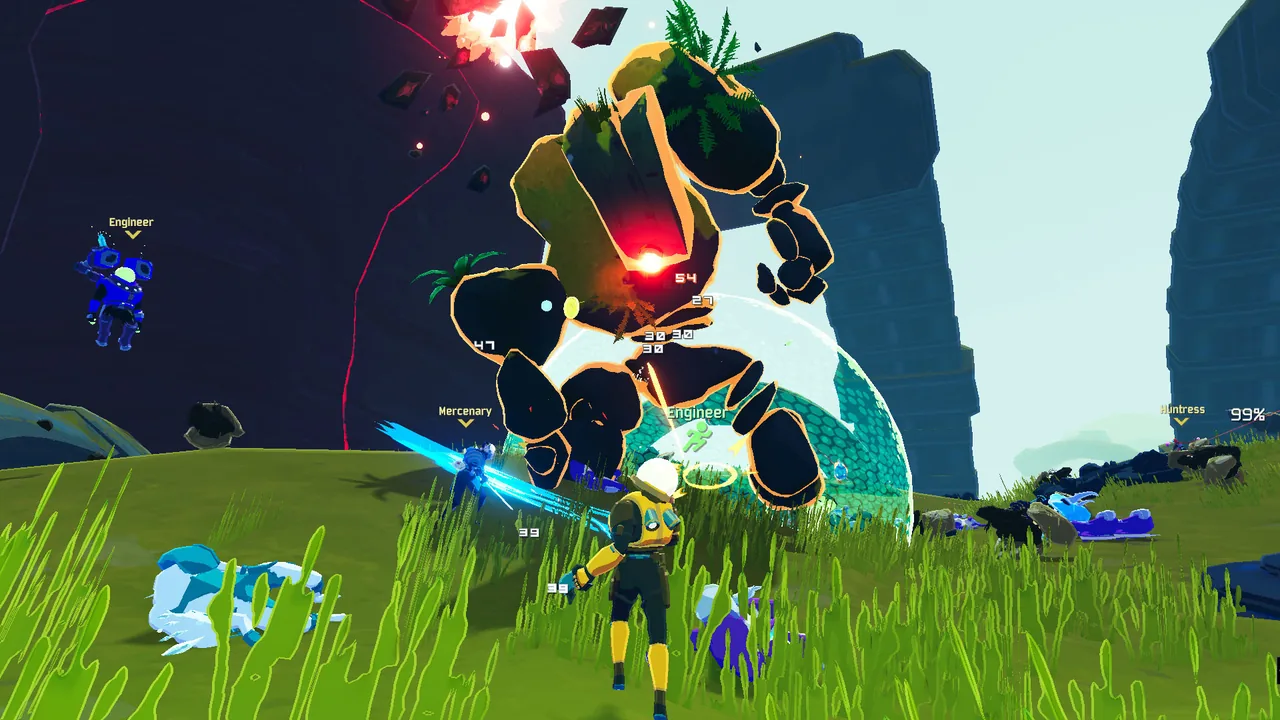
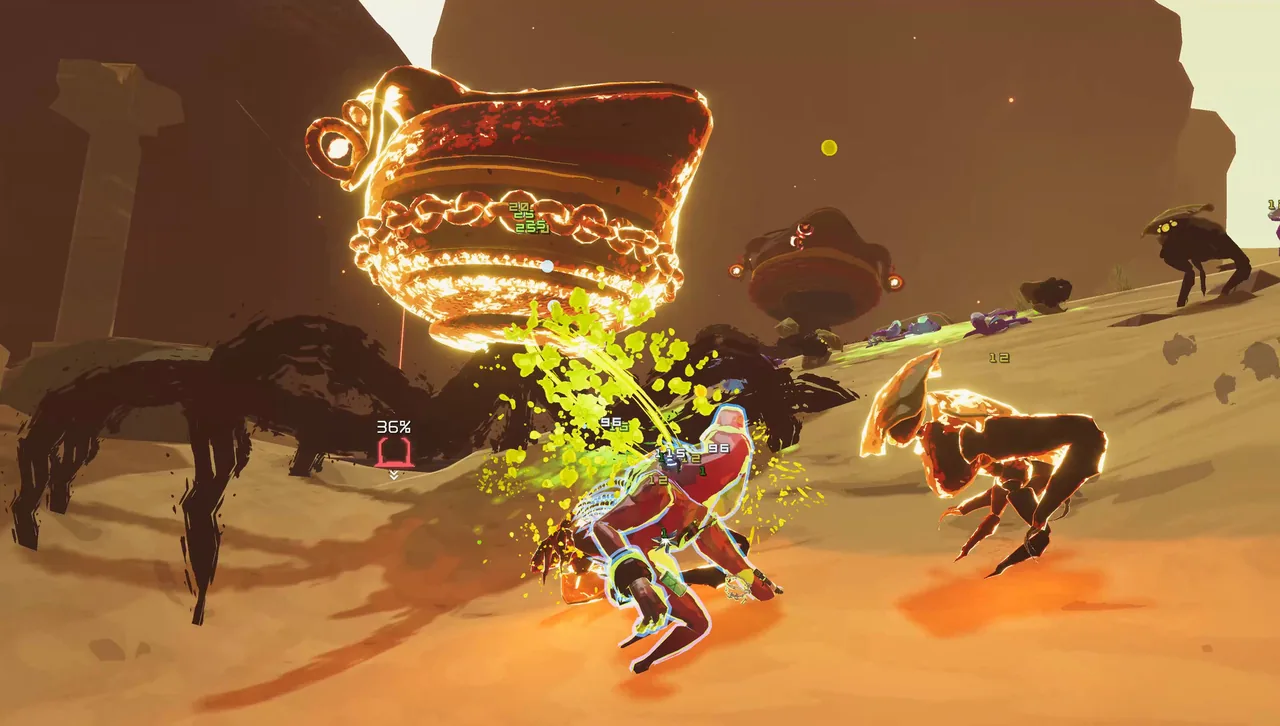
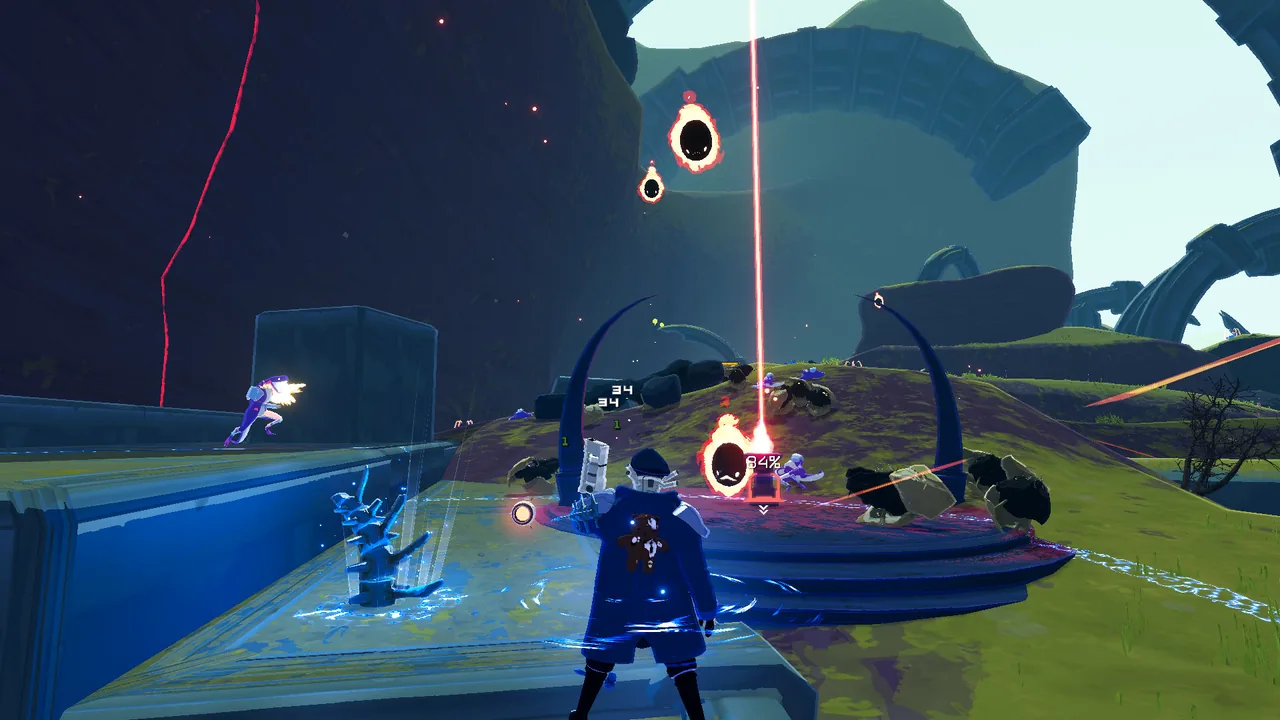
The low-poly art style has aged into something closer to a deliberate choice than a budget constraint — clean silhouettes read clearly even with a dozen enemies on screen, and the handful of biome themes still look distinct from each other rather than palette-swapped. Chris Christodoulou's soundtrack is doing more work than the visuals, though: the score shifts and layers as a fight escalates rather than looping flatly underneath it, and it's aged into one of the more genuinely memorable original scores the genre has produced. None of that survives a heavily stacked four-player run at full item count without some cost. Once particle effects, drone summons, elemental procs and a swarm of enemies are all rendering at once, the screen stops being legible in any precise sense and framerate becomes the thing under strain rather than clarity alone — a familiar cost in this genre, but one Risk of Rain 2 hasn't solved any better than its contemporaries have. There's no clarity option to thin the effect load, and a player sensitive to visual noise or inconsistent frame pacing at the extreme end of a run has no accommodation built in.
What actually happened with Seekers of the Storm
This is worth stating plainly rather than gesturing at, because the review needs to separate three things that get blurred together in casual conversation: the base game's quality, the DLC's launch state, and where things actually stand now.
Survivors of the Void, the first paid expansion, shipped in March 2022 while Hopoo Games — the original two-person studio behind both Risk of Rain games — was still leading development, and it remains well regarded, sitting at roughly 88% positive on Steam. Sometime after that, stewardship of new content shifted to Gearbox's own internal team, and the first result of that handover, Seekers of the Storm, launched in August 2024 to a genuinely bad reception: widely reported balance problems, bugs and technical issues on PC drove its review score down to roughly 21% positive within days, and Gearbox's own public statements at the time acknowledged the PC version was, in the developer's own words, in a really bad place. That's not an inference from angry players — it's the studio's own characterisation of the launch.
What followed was a genuine, sustained recovery rather than a quiet abandonment. Gearbox published a public roadmap within two months, shipped incremental fixes through the rest of 2024, and delivered a full "2.0" relaunch in mid-2025 that substantially revamped the expansion's survivor and reworked large parts of what had launched broken. The lifetime Steam rating for Seekers of the Storm still sits at roughly 54% positive — Mixed — because that number permanently includes the wave of launch reviews from players who experienced the original broken state, and Steam's aggregate scoring has no mechanism to retire old reviews once a game genuinely improves. That's an important distinction for anyone judging the expansion today from its storefront score alone: the number reflects the crisis more than it reflects the game as it currently plays.
The clearest evidence the fix actually worked arrived in November 2025, when the same internal team shipped Alloyed Collective, a third paid expansion, to roughly 93% positive reviews — a level of reception the studio hadn't managed since taking the franchise over. It's also worth noting, separately, that Hopoo Games' founders shut down their own studio and joined Valve in September 2024, weeks after Seekers of the Storm's rocky launch; that was reportedly a move tied to Hopoo's own unannounced next project rather than a direct response to the DLC's reception, but its timing means the original creators' hands were fully off the wheel from that point on, for reasons separate from the DLC crisis itself. A fourth expansion, Hallowed Concepts, is currently in development and being previewed through regular dev diaries as of mid-2026, which at minimum suggests the current team isn't treating Alloyed Collective's recovery as a one-off.
None of this changes what the base game is. It changes what buying into the DLC ladder means: the core game and Survivors of the Void are safe purchases with no asterisk attached, Seekers of the Storm is a genuinely improved product wearing a storefront score frozen at its worst moment, and Alloyed Collective is the clearest sign yet that whatever went wrong in 2024 wasn't permanent.
Value
At its base price, Risk of Rain 2 alone is an easy recommendation — dozens of hours of replayable content from a single purchase, no in-game currency, no ads, nothing sold that affects power beyond what every player earns identically through play. The expansion pricing is less straightforwardly generous: three paid expansions at NZ$19.99 each add up to more than double the base game's price for the full ladder, and buyers weighing Seekers of the Storm specifically are paying full price for content whose worst chapter is a matter of public record, however much better it plays today. The honest advice is to treat the base game and Survivors of the Void as the default purchase, and add the later expansions once you've decided you want more of the same system rather than assuming the storefront score alone tells the whole story in either direction.
Verdict
Eight out of ten. The core idea — items that stack into absurdity while a clock keeps rising to meet them — is still one of the smartest applications of number-go-up design to come out of the shooter genre, and co-op is where that idea is at its most purely enjoyable. What holds the score back isn't a mystery: presentation and readability strain badly at the extreme end of a stacked run, the procedural stages never matched the depth of the item system sitting on top of them, and the game's recent history includes a real, publicly acknowledged failure that took a year to properly fix. None of that erases what the base game does well, and the studio's more recent work suggests the crisis was a genuine setback rather than a new normal. Buy it for the item stacking and the clock. Go in with clear eyes about which parts of the DLC ladder earned their reputation the hard way.
Anyone drawn to the feeling of a build compounding on itself until the numbers stop making sense might also enjoy Wanderer — a much slower version of the same instinct, without a difficulty clock forcing the decision.
Pricing, review scores and DLC details checked 30 July 2026.
Pros and cons
Pros
- Item stacking turns every pickup into a compounding multiplier, so a mid-run haul can turn a shaky start into an unstoppable build within minutes
- The fixed per-stage difficulty clock forces real decisions instead of letting a strong build simply coast to the end
- Survivor kits are distinct enough that switching characters meaningfully changes which items are worth drafting toward
- Eclipse's stacking modifiers and the Artifact system give committed players a genuine long-term ladder once the base campaign stops being a challenge
- Chris Christodoulou's soundtrack escalates with the run instead of just scoring it, and remains one of the best original scores in the genre
- The base game and its first expansion, Survivors of the Void, are excellent regardless of what happened to the DLC that followed them
Cons
- Screen and audio clarity collapse once four players and a few hours of stacked items are on screen together, with no option to thin the clutter
- Seekers of the Storm launched in a technically broken state under a new internal team, and its lifetime Steam rating still sits at roughly 54 percent despite a year of subsequent fixes
- Procedurally shuffled stage layouts are noticeably shallower than the item system built on top of them, so exploration runs out of ideas long before builds do
- A run that's snowballing hard turns its back third into cleanup rather than decision-making, the same problem that affects most of the genre it helped popularise
- Split-screen co-op is native on PlayStation 5 and Xbox Series X/S but absent everywhere else, including PC, which is where most of the playerbase actually is
Screenshots
-
Risk of Rain 2Image: Gearbox Publishing via Steam -
Risk of Rain 2Image: Gearbox Publishing via Steam -
Risk of Rain 2Image: Gearbox Publishing via Steam -
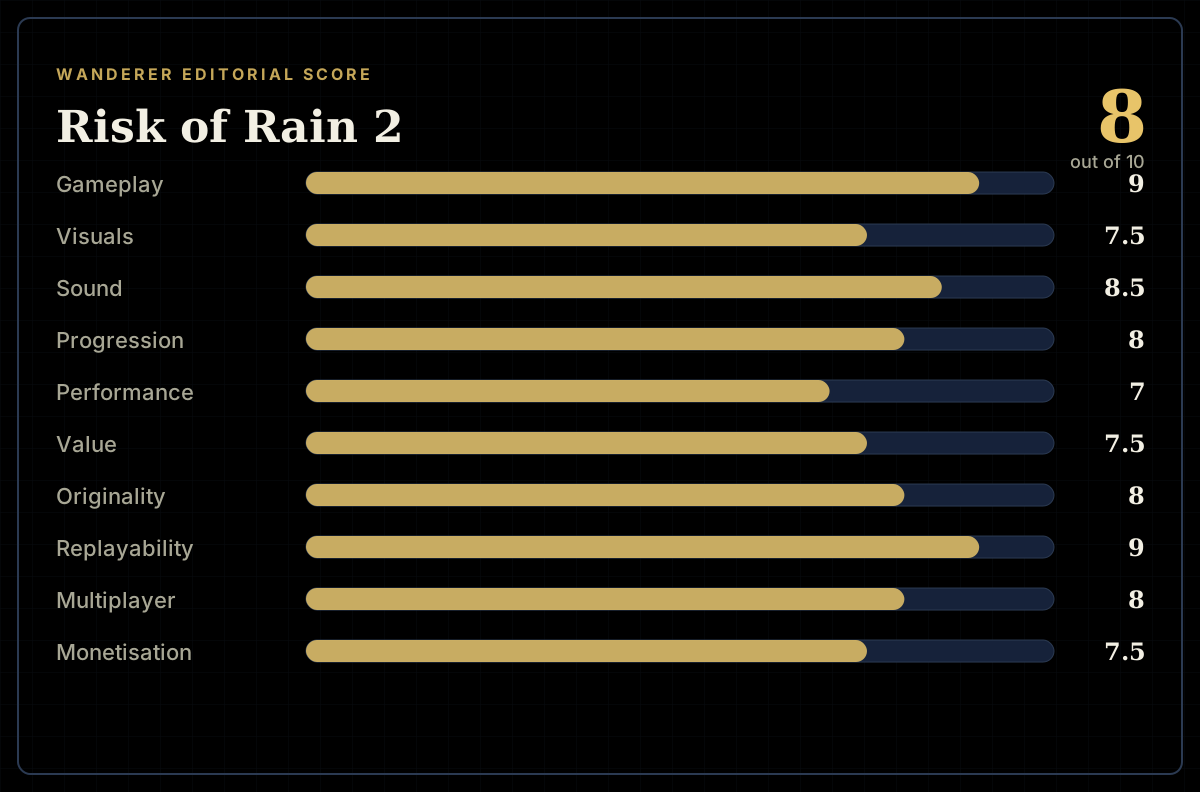
How the review scores each part of the gameWanderer Editorial -
The short versionWanderer Editorial