Game review
Terraria
9.5 / 10
- Developer
- Re-Logic
- Publisher
- Re-Logic
- Released
- 16 May 2011
- Platforms
- Windows, macOS, Linux, PlayStation, Xbox, Nintendo Switch, iOS, Android
- Genre
- Action, Adventure, Sandbox, RPG
- Monetisation
- Premium, one-off purchase — no in-game purchases, no expansions sold separately; the two Steam DLC listings are soundtracks
- Players
- Local and online co-op and PvP, dedicated servers and Steam invites supported
The short version
Terraria is still the reference point for what a 2D sandbox can become once a studio refuses to stop working on it. The dig-build-fight loop is as good as it's ever been, hardmode remains the smartest gate in the genre — bosses that rewrite the map instead of just raising a number — and fifteen years of free content updates make the original purchase price look almost unfair to Re-Logic.
It asks more of a new player than it should. Big chunks of its crafting tree and its boss-preparation checklists are effectively unlearnable without outside help, and combat has never been more than solid. Neither stops this from being essential.
Biggest strengths
- Hardmode's mechanical bosses each rewire the map's ore, enemies and biomes, turning progression into a series of concrete before-and-after states rather than a number going up
- Fifteen years of major content updates have shipped free, funded entirely by the original purchase price with no expansions or season passes
- Building and terraforming tools give non-combat players a genuine long-term project independent of boss progression
Biggest weaknesses
- Item and recipe discovery leans so heavily on the community wiki that the in-game Guide NPC feels vestigial by comparison
- Combat is functional rather than expressive — most weapon classes reduce to walking backward and holding a direction key
- The inventory and crafting grid still show their 2011 origins and punish players who haven't pre-sorted storage
Who it's for: Anyone who likes systems that reward being clever rather than just being strong, players who want a co-op world that can genuinely occupy a group for a full year, and returning players who haven't seen what a decade of free updates actually added.
Our recommendation: Buy it once, keep the Guide NPC around, and accept early that a wiki tab is part of the experience rather than a failure of it. At fifteen dollars for a decade and a half of content, there is no better-value premium game currently on Steam.
9.5 / 10
Fifteen years after it first appeared on Steam, Terraria is still adding content. Re-Logic shipped version 1.4.5 in January 2026 with crossover gear from Palworld and Dead Cells, and 1.4.6 is already confirmed. The studio announced 1.4 — subtitled Journey's End — as the last major update back in
- That promise has become a running joke inside the game's own community, because every time
Re-Logic says it's done, a new update proves otherwise. For a genre built on live-service treadmills and one-and-done Early Access exits, a fifteen-year-old game that's still free-updating on its original purchase price is close to unheard of.
The question worth asking in 2026 isn't whether Terraria was good. It obviously was — over 70 million copies sold, a Metacritic average in the low-to-mid 80s across every platform it's touched, and a Steam review tally that sits at 97% positive across more than 1.2 million reviews. The question is whether a game whose core structure hasn't changed since Journey's End still teaches itself to a new player, or whether it's become a game you can only really play with a wiki open on a second monitor. The honest answer is both things are true at once, and understanding why is most of what makes Terraria worth talking about a decade and a half in.
The loop that started a genre
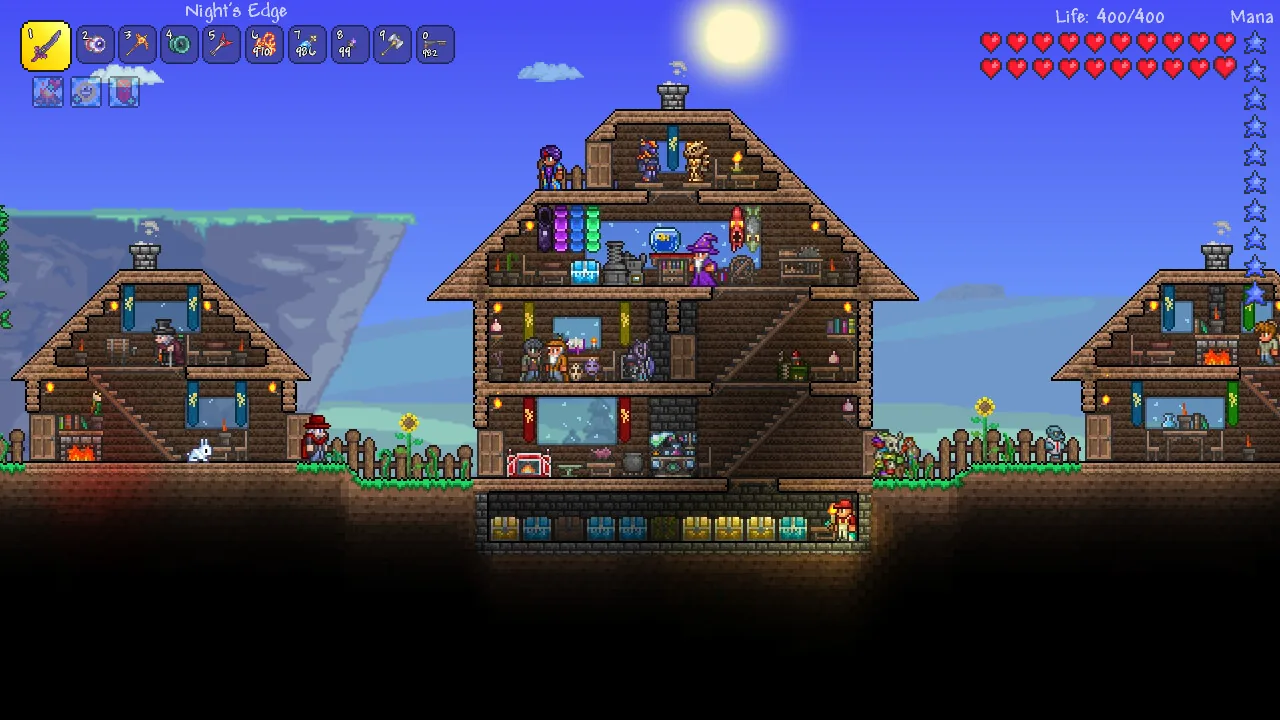
Strip away the sixteen years of additions and the core loop is still the one from 2011: dig down, find ore, build tools, fight something bigger than the last thing, repeat. What made it distinctive even then, and what still separates it from the Minecraft-likes it inspired, is that Terraria treats combat and building as equally serious systems rather than one being a means to the other. You don't build a base to survive nights so you can go back to mining — the base is arenas, traps, NPC housing, and eventually a small city, and the game expects you to invest in it as an actual design project. Wiring, actuators, and a full logic system exist purely so players can automate farms and build working contraptions, and none of it is required to finish the game.
That duality — genuine 2D platforming combat wrapped around genuine sandbox construction — is why Terraria never quite got replaced. Plenty of games copied the mining and crafting. Very few matched the sense that your world was also, simultaneously, a home you were building with real design choices in it.
Hardmode: progression as a world event
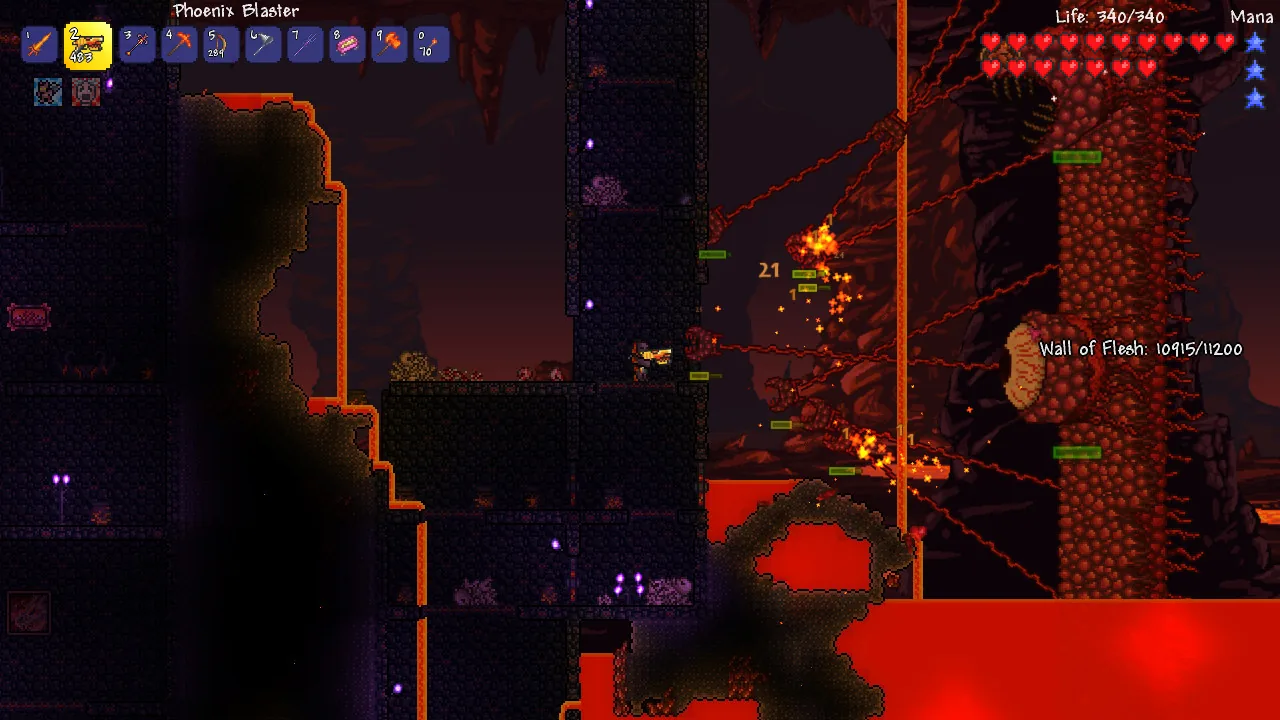
This is the part of Terraria that still doesn't have a real competitor. Instead of gating content behind a character level, Terraria gates it behind boss kills that permanently alter the world itself. Defeat the Wall of Flesh — the pre-hardmode final boss, summoned by dragging a voodoo doll into lava in the underworld — and the entire map changes. New ore veins (cobalt or palladium, mythril or orichalcum, adamantite or titanium, randomly rolled per world) appear seeded through stone that was previously just stone. The Hallow, a glowing biome full of new enemies, spreads outward from wherever the Underground Hallow spawned. The Corruption or Crimson, whichever your world generated with, becomes more aggressive and starts spreading too. Monsters everywhere get harder, including in areas you'd already cleared.
It's a genuinely clever piece of design because it turns "you've gotten stronger" into something the world visibly demonstrates rather than something a stat sheet claims. You don't check a level number to know you're in a new tier of the game — you can see it, in new blocks pushing through old biomes and new mobs replacing familiar ones. Each of hardmode's four mechanical bosses (the Twins, the Destroyer, Skeletron Prime — any order, any combination) then acts as its own smaller gate, unlocking specific ore tiers, NPCs, and crafting stations tied to which boss you killed. Plantera, deep in an expanded jungle, gates the true endgame. The Moon Lord caps it.
The structure teaches you something important through pure repetition even if it never says it out loud: in Terraria, "ready for the next fight" means "prepared the world and your equipment for a category of enemy," not "hit level 40." That's a genuinely different mental model from most action RPGs, and it's the single best argument for why Terraria still reads as distinctive rather than dated.
Where the self-teaching breaks down
Here's the honest problem, and it's the same one Terraria had at launch, just larger now because fifteen years of content have been bolted onto systems that were never redesigned to explain themselves. The in-game Guide NPC will tell you what an item crafts into if you hand it to him, and that's genuinely useful for individual items. What he won't do is tell you that you need a specific, non-obvious combination of pylons, biome placement, and NPC happiness to unlock fast travel between towns, or that a particular accessory only drops from a specific enemy that only spawns under specific lighting conditions in a specific biome at a specific depth. Terraria's crafting tree isn't one tree — it's dozens of small, interlocking trees gated behind mechanics, biomes, and events that the game rarely cross-references for you.
Console and mobile versions ship with a tutorial world that at least explains basic building and combat. The PC version, still, does not. New players are functionally expected to either stumble into the community wiki or fail to progress efficiently, and the wiki is good enough — thorough, well-organised, community-maintained for over a decade — that Re-Logic has had very little pressure to fix this. That's a defensible trade-off for a ten-person studio's priorities. It's still a real cost to a player picking Terraria up cold in 2026, expecting the kind of guided onboarding that newer survival-crafting games have made standard. If you want the intended experience of steady in-game discovery, you'll get roughly the first third of the game that way before you're checking a wiki for boss prep checklists, whether you meant to or not.
Combat has aged into "solid," not "great"
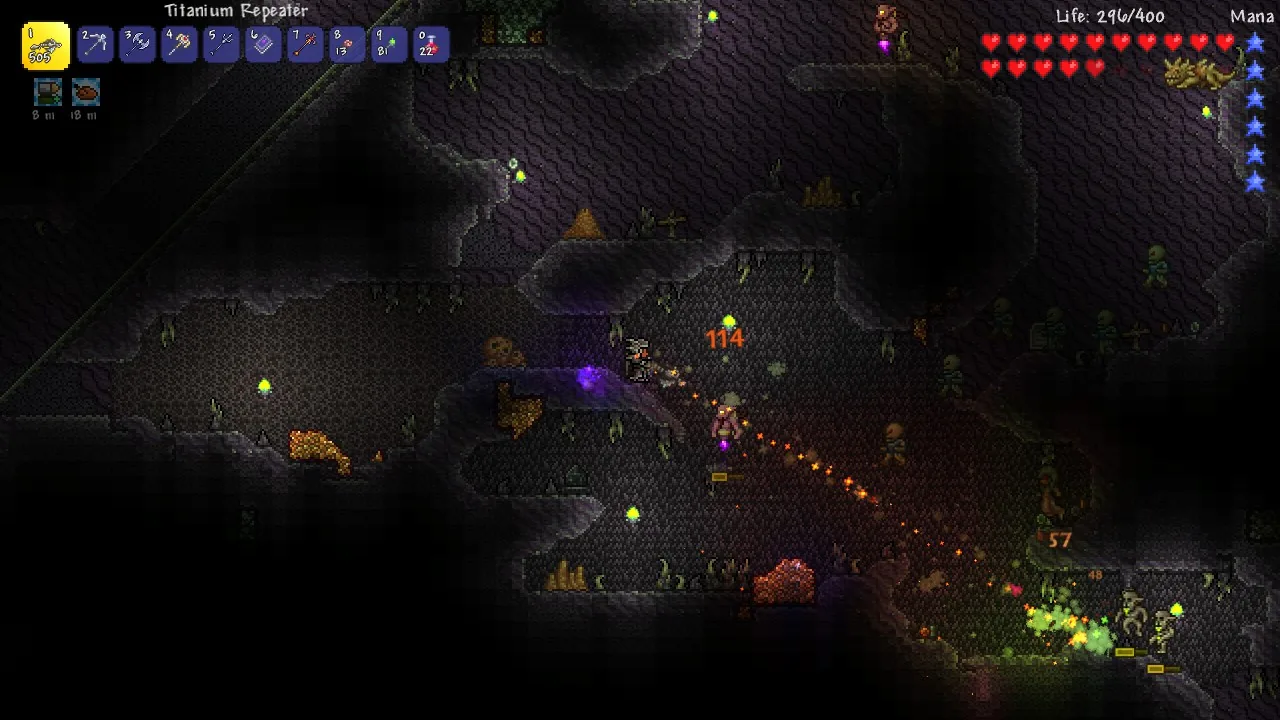
Terraria's combat is 2D platformer combat: you jump, you swing or shoot, you dodge by moving. It works, and the weapon variety is enormous — melee, ranged, magic, and summoner are all fully realised classes with their own late-game builds, accessories, and armor sets. But the actual moment- to-moment feel hasn't evolved much past "walk backward while holding down the attack key," and most boss fights are pattern-memorization exercises in arena management more than they are tests of combat mechanics. That's not a criticism unique to Terraria — it's close to the ceiling for what 2D sprite combat with this control scheme can offer — but it means the game's real technical depth lives in build-crafting and preparation, not in the swing of a sword. Players who come to Terraria expecting Hollow Knight-level combat precision will be disappointed; players who treat combat as one input into a bigger preparation puzzle will find it entirely sufficient.
Multiplayer holds up, mostly
Co-op is where Terraria's design philosophy pays off best. A world doesn't lock content behind the highest-level player, so a friend three hardmode tiers behind you can still meaningfully contribute — mining, building, fishing, running NPCs — without every fight needing to be re-balanced around them. Dedicated servers are straightforward to run, Steam's invite system covers casual sessions, and local co-op still exists on console. The rough edges show up at the margins: joining a PC-hosted world from console or mobile isn't guaranteed to be smooth, and the newest content update typically reaches consoles and phones weeks or months after PC while certification runs its course. If your group spans platforms, plan around that gap rather than assuming day-one parity.
Fifteen years of free updates, and what that actually bought
It's worth being specific about what "still supported" has meant in practice, because it's the rare case of a marketing line that undersells the reality. Journey's End in 2020 added Master Mode, Journey Mode (a genuinely useful accessibility and creative-freedom difficulty tier with resource duplication and world manipulation), and made tModLoader an officially supported free mod platform — which alone has kept a modding scene alive for a decade-plus-old game. Labor of Love in 2022 was a pure quality-of-life pass, closing out balance and bug backlogs rather than adding flashy new content. 1.4.5 in January 2026 leaned into crossover content, folding in gear referencing Palworld and Dead Cells. None of it has ever cost a returning player anything beyond the original purchase. There's no season pass, no expansion tier, no "definitive edition" resale. The two DLC listings attached to Terraria on Steam are soundtrack albums.
That's an unusual position for a studio to hold this long into a game's life, and it's the strongest part of the value argument below.
Presentation and performance
The pixel art hasn't been redrawn to chase modern resolutions, and it doesn't need to be — the sprite work is dense, readable at a glance despite the small canvas, and biome-to-biome visual variety has only grown as new content stacked on top of the original palette. It runs on essentially any hardware that can run a browser; the engine's age is a genuine asset here, and the game scales down to Switch and phones without losing the core experience. Where performance does dip is very late in an established world with heavy wiring, huge NPC housing blocks, and dense lighting all loaded at once — the kind of base a hundred hours in tends to produce. It's a minor, late-stage complaint against a game that otherwise runs comfortably on a laptop from a decade ago.
Value, checked today
At NZ$14.75 with no discount currently applied, and a full price history that rarely strays far from that figure even during sales, Terraria remains one of the strongest value propositions on Steam, full stop. There's no energy system, no premium currency, no cosmetic shop, and — this bears repeating — no paid expansion in fifteen years. Compare that to almost any other game with this much content and the maths stops being close.
Verdict
Terraria earns its reputation honestly. Hardmode's boss-triggered world transformations are still the smartest progression idea the crafting-sandbox genre has produced, the building tools give it a second life beyond combat entirely, and Re-Logic's refusal to stop supporting the game for free has turned an already-good 2011 release into one of the best value propositions in PC gaming. It loses half a point, not more, for a discovery problem it has never fully solved — new players are still functionally expected to lean on the wiki past the early game — and for combat that does its job without ever becoming the game's best feature. Neither undoes what's here. If you've never played it, or haven't touched it since before Journey's End, this is still one of the easiest recommendations in the genre.
Players who like a world that keeps rewarding attention long after the tutorial ends, and who don't mind that reward system running while they're away from the keyboard too, may also find something to like in Wanderer.
Price and store details checked 30 July 2026.
Pros and cons
Pros
- Hardmode's mechanical bosses each rewire the map's ore, enemies and biomes, turning progression into a series of concrete before-and-after states rather than a number going up
- Fifteen years of major content updates have shipped free, funded entirely by the original purchase price with no expansions or season passes
- Building and terraforming tools give non-combat players a genuine long-term project independent of boss progression
- Drop-in local and online co-op both work, and a friend well below your gear level is rarely locked out of your world
- Full controller support and long-standing console and mobile ports make the same design legible well outside mouse-and-keyboard
Cons
- Item and recipe discovery leans so heavily on the community wiki that the in-game Guide NPC feels vestigial by comparison
- Combat is functional rather than expressive — most weapon classes reduce to walking backward and holding a direction key
- The inventory and crafting grid still show their 2011 origins and punish players who haven't pre-sorted storage
- The difficulty spike immediately after the Wall of Flesh can strand underprepared players with no in-game warning of what just changed
- Console and mobile versions regularly lag behind PC on the newest content while certification catches up
Screenshots
-
TerrariaImage: Re-Logic via Steam -
TerrariaImage: Re-Logic via Steam -
TerrariaImage: Re-Logic via Steam -
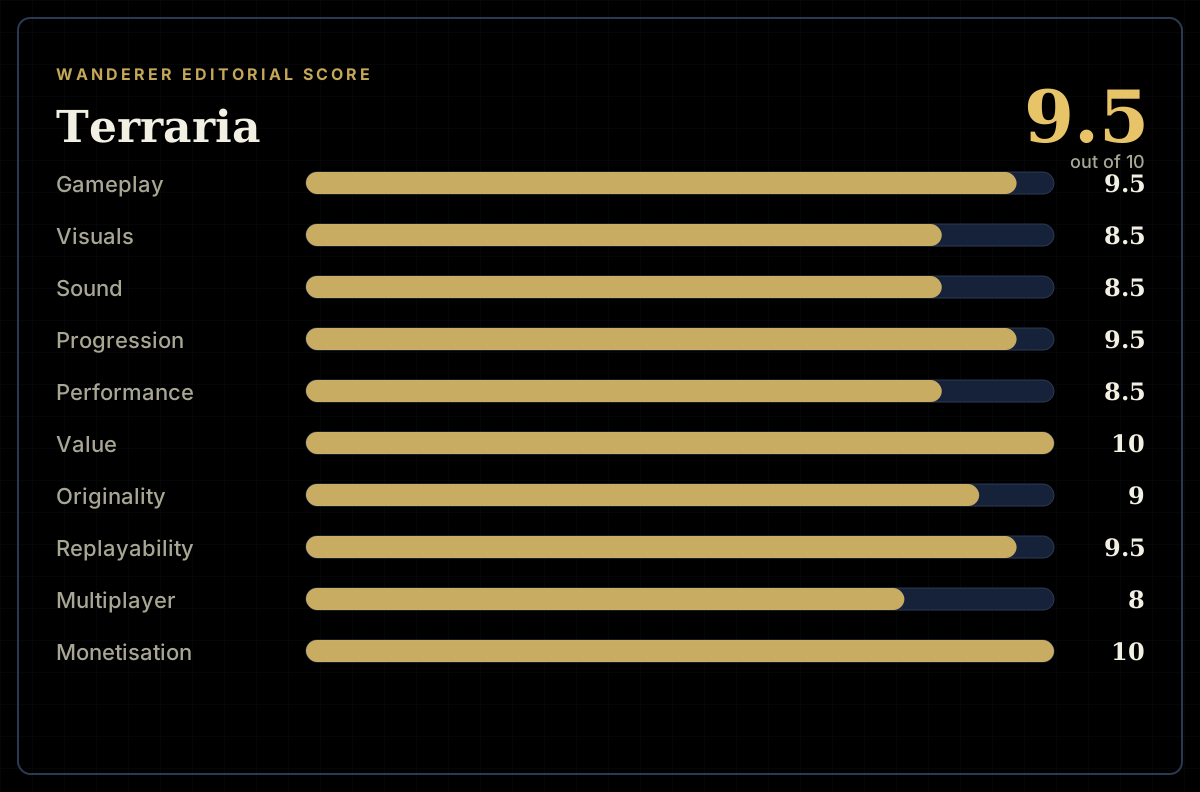
How the review scores each part of the gameWanderer Editorial -
The short versionWanderer Editorial