Game review
Baldur's Gate 3
9.5 / 10
- Developer
- Larian Studios
- Publisher
- Larian Studios
- Released
- 3 August 2023
- Platforms
- Windows, macOS, Linux (Steam Deck Verified), PlayStation 5, Xbox Series X/S
- Genre
- CRPG / Turn-Based RPG
- Monetisation
- Premium, one-off purchase. An optional Digital Deluxe upgrade adds cosmetic and soundtrack extras; there is no in-game store, currency or ongoing purchase of any kind
- Players
- Online and LAN co-op for up to four players, cross-platform play between Steam, PlayStation and Xbox, and split-screen co-op on console
The short version
Baldur's Gate 3 built its reputation on a single, specific idea executed further than any RPG before it: the game does not just remember what you did, it keeps writing around it. Fail a persuasion check and the scene doesn't end, it escalates. Let a companion die and the campaign doesn't stop, it continues without them, permanently. Kill a quest-giver and someone else picks up the thread. That's a different kind of reactivity than a branching dialogue tree with two endings bolted on, and three years of patches haven't produced a rival that matches its depth.
It's not a flawless game, and pretending otherwise does it no favours. Act 3 is a dense, sprawling city that noticeably outweighs the pacing of the first two acts, even after eight rounds of patching. The 5th Edition ruleset underneath it assumes a level of tabletop literacy the tutorial only gestures at. And a build optimised around action economy and multiclass dips will out-perform an in-character playthrough badly enough that "system mastery" and "roleplay" often pull in different directions. None of that changes what this is: still the clearest evidence the genre has that consequence can be a game mechanic rather than a marketing line.
Biggest strengths
- Companion and world state genuinely carries across acts, so a failed check or a dead ally reroutes the story instead of ending it
- Turn-based 5th Edition combat makes height, light, terrain and elemental interactions matter as much as raw stats
- Nearly every character with a line of dialogue is fully voiced, which makes throwaway conversations feel authored rather than padded
Biggest weaknesses
- Act 3's dense open city noticeably drops frame rate and load performance compared with the tighter first two acts, even after years of patching
- The 5th Edition ruleset front-loads jargon — advantage, saving throws, reaction economy — that the tutorial explains once and never revisits
- Four-player co-op runs into real friction when one player's dialogue choices and pacing outrun the rest of the party
Who it's for: Players who want an RPG that treats failure as a plot event instead of a reload screen, and who don't mind a turn-based combat system with real tabletop depth underneath it.
Our recommendation: Worth full price even three years in — NZ$99.99 with no discount as of 30 July 2026 buys a complete, still-supported campaign with no further purchases required. Skip it if turn-based combat with genuine rules complexity isn't for you; no difficulty slider removes the action economy, only the stakes around it.
9.5 / 10
Baldur's Gate 3 is three years old, has been patched eight times, and as of this week is still sitting at full price on Steam with a 96 percent positive rating from three-quarters of a million reviewers. Larian Studios has also said, plainly, that it is done with it — no sequel, no further DLC, the team has moved on to new original projects. That combination is worth sitting with before getting into systems and numbers: a game this large, this expensive and this old is still the default answer to "which RPG actually reacts to what I do," and nobody has taken that title away from it yet.
That's the central strength, and it's specific enough to be worth explaining properly rather than just asserting. The central weakness is just as specific: an unevenly paced final act and a ruleset that rewards knowing the system over playing a character. Both are true. Neither one erases the other.
What "reactive" actually means here
Most RPGs that advertise player choice mean one of two things: a handful of dialogue options that reach the same scene from a different angle, or a small number of distinct endings gated behind a final-act decision. Baldur's Gate 3 does something structurally different, and it's the reason the word "reactivity" attaches to this game specifically rather than to RPGs in general.
The clearest example is what happens when you fail. In most CRPGs, a failed persuasion or intimidation check is a dead end — the conversation loops back to a menu, or the game quietly locks the option and moves on. Here, a failed check is usually the start of a different scene, not the end of the current one. Botch a lie to a guard captain and you don't get a "try again" prompt; you get combat, or a chase, or the captain remembering you specifically the next time your paths cross. The failure state has content behind it, not a wall.
The same logic runs through the companion system. A party member can die — permanently, with no resurrection scroll waiting around the corner in every case — and the campaign does not pause to ask if you're sure. It continues. Other companions react to the loss in camp. Quest lines tied to the dead character either close off or reroute through someone else. That's a meaningfully different design decision than a story that treats its cast as fixed furniture: it means the writers built failure paths for their own major characters, which is a lot of additional content that most players who succeed at every check will never see.
None of this is possible without an enormous amount of state-tracking under the hood — the game is keeping score of decisions made in Act 1 and paying them off in Act 3, across companion approval, faction standing, which NPCs are alive, and what the player character has personally done or said. It's not magic, and it's not infinite; there's a finite (if very large) tree of variables the writers pre-built responses for, same as any branching narrative. What makes it land is how rarely the seams show. A choice from ten hours earlier resurfacing in a throwaway line of camp dialogue does more to sell "this world remembers you" than any end-of-game slideshow ever could.
Combat, and the ruleset most players have never read
Underneath the writing sits a faithful, turn-based implementation of Dungeons & Dragons 5th Edition, with twelve classes and eleven races to build from at character creation. This is where the game asks the most of a player and explains the least.
The system is genuinely excellent once it's understood. Verticality matters — high ground grants advantage, and shoving an enemy off a ledge is a legitimate tactic, not an exploit. Light and darkness matter, with darkvision and stealth built around actual line-of-sight rules rather than a simplified meter. The environment is a weapon in its own right: oil ignites, water conducts lightning and douses fire, grease makes footing treacherous, and a well-placed Fireball can end a fight in one turn if the terrain cooperates. None of that is decorative. Ignoring it is genuinely the harder way to play.
The problem is that 5th Edition brings real tabletop vocabulary with it — advantage and disadvantage, saving throws, concentration, the action-versus-bonus-action-versus-reaction economy — and the tutorial explains each concept exactly once, in the moment it first comes up, and rarely circles back. A player who already knows Dungeons & Dragons will find the systems legible almost immediately. A player who doesn't will spend the first several hours making decisions without fully understanding their own toolkit, and the game is not particularly interested in re-explaining itself once the tutorial prompts have scrolled past. This is a real barrier, not a minor inconvenience, and it's worth being honest that "just play it and you'll pick it up" is easier advice for some players than others.
Where mastery and roleplay pull apart
The flip side of a rules-deep combat system is that the rules can be optimised, and Baldur's Gate 3 rewards optimisation more than it rewards staying in character. Multiclassing — dipping two or three levels into a second or third class to stack specific abilities — produces builds that substantially outperform a single-class character played "as written." Positioning a party in a tight chokepoint with pre-placed area spells before a fight even starts is a legitimate, expected tactic that has nothing to do with how a bard or a paladin would actually approach a room.
That's not a flaw unique to this game — it's the same tension every deep tactical system carries — but it's worth naming here specifically because the writing is so good at selling immersion that the mechanical layer underneath can feel like a betrayal of it by comparison. A player who wants to stay purely in character, making choices a paladin would make rather than the statistically correct one, will sometimes find the game punishing that restraint. The two best versions of this game — the roleplaying epic and the tactics puzzle — coexist, but they don't always pull in the same direction, and Larian never really resolves that tension. It just leaves it there for the player to navigate.
Origins, companions, and a cast built to be interrogated
Character writing is where the reactivity argument is easiest to see in miniature. Every companion, including the six pre-built Origin characters players can choose to play as directly, has an approval system that tracks specific choices rather than a single blunt morality meter. Camp conversations change based on what's happened, romance and rivalry arcs develop or close off depending on choices made hours earlier, and companions will occasionally challenge a decision directly rather than simply commenting on it after the fact.
The Dark Urge origin — a fully customisable protagonist wrestling with an inherited compulsion for violence — is the sharpest expression of this, because it forces the reactivity system to account for a player character who might act against their own party's interests. It's a genuinely uncommon thing for a big-budget RPG to build a mainline origin story around, and it works because the underlying state-tracking is robust enough to support it without collapsing into a single "good or evil" binary.
Voice work carries an enormous amount of this. Nearly every character with a speaking line is voiced, not just the named cast, which means dialogue that would be silently skimmed text in most RPGs gets full performance instead. That's a large part of why exploring off the main path so rarely feels like padding — a random NPC's aside is delivered with the same care as a companion's central arc.
The acts don't carry equal weight
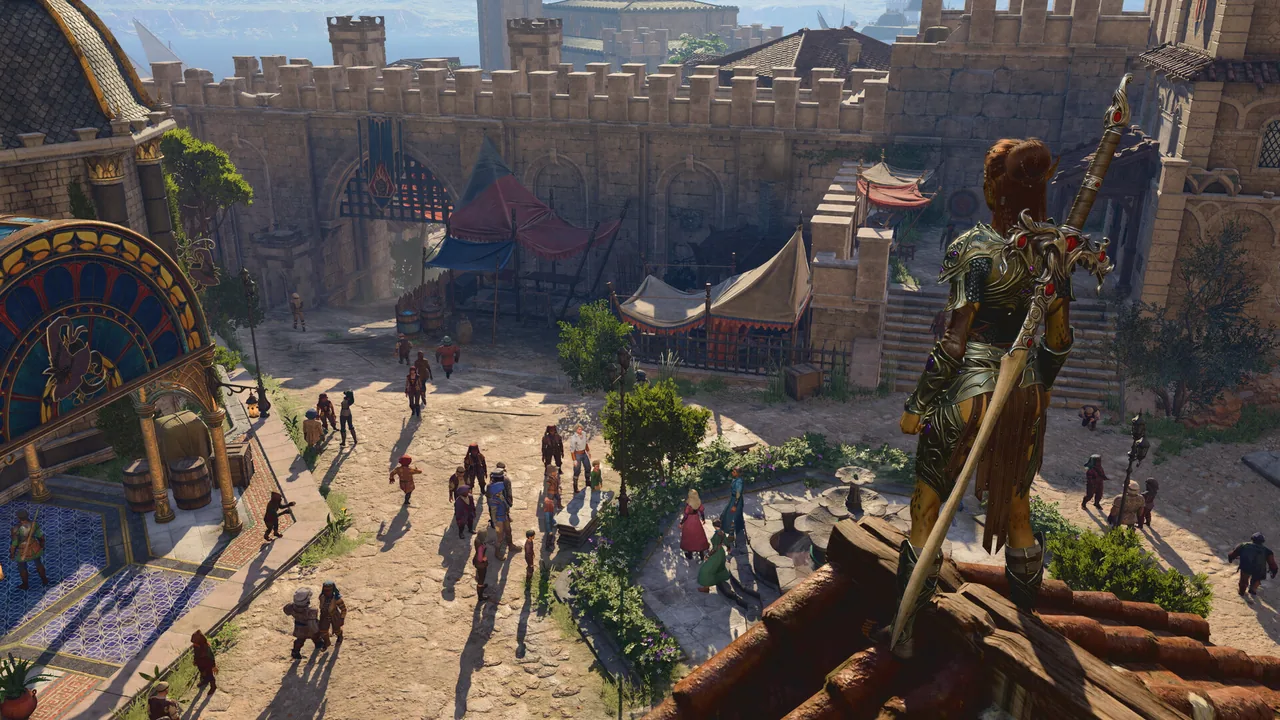
This is the most consistently reported structural weakness, and it hasn't fully gone away with patching. The first two acts are tightly built: a forest and its surrounding wilds, then a haunted, layered Shadow-Cursed environment, both scaled to be thoroughly explorable without sprawling past the point of purpose. Act 3 opens into a full city — dense, vertical, packed with side content — and it noticeably strains against the pacing the first two-thirds established. Quest threads multiply faster than the narrative can comfortably track them, and the sheer density of the map works against the momentum the story had been building.
Performance tracks the same curve. Frame rate and load times are consistently reported as worse in Act 3 than earlier in the campaign, a gap that's narrowed since launch but never fully closed — years of patches, including the eighth and what Larian has said is the final major patch in April 2025, improved stability and added content (a dozen new subclasses, a photo mode, cross-platform play, and split-screen co-op on Xbox Series S) without eliminating the late-game performance penalty entirely. Save files also grow heavier the deeper a campaign runs, a direct side effect of how much state the reactivity system is quietly tracking — the same feature that makes the story feel alive is also what makes the back half of a long save noticeably heavier to run.
Co-op, and where four players stretches the design
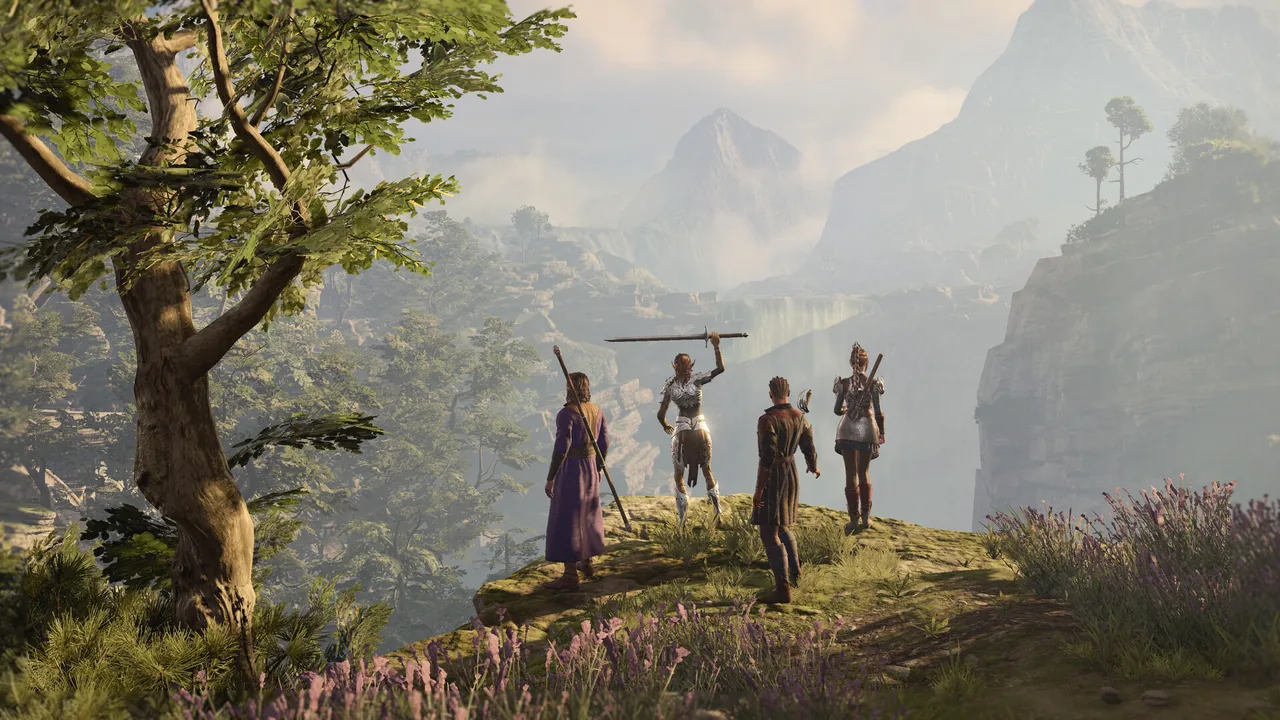
Up to four players can run the campaign together online, on LAN, or in split-screen on console, with cross-platform play added well after launch. The concept is a natural extension of the solo game's design — a real tabletop party making real tabletop decisions — and at its best it's the closest a video game gets to an actual session at the table.
The friction shows up when players move at different speeds. Dialogue in this game is frequently solved by whichever player reaches the conversation first, and a party can end up narratively ahead of players who wanted to explore a side area first, or split across different parts of a map with very little to do about it beyond waiting. It's not broken, and groups who communicate get a great experience out of it, but it's a system built around one player's pacing more than four players' pacing, and that shows in extended sessions.
Where it sits in 2026
Larian has been unambiguous that this is the finished product. Studio head Swen Vincke has said publicly that there will be no sequel and no further downloadable content for Baldur's Gate 3 — fan appetite for more existed, but not enough internal enthusiasm to chase it — and the studio has since announced new, unrelated original projects, the first of which isn't expected before the end of the decade. Practically, that means the eighth patch is the last major update this game is going to receive: what's here now, including the official modding toolkit that arrived as its own free Steam entry, is close to what's here permanently, aside from bug fixes.
That's not a reason to hesitate. A complete, no-longer-changing game with this much density is arguably a better proposition than a live-service RPG still finding its shape, and the sales numbers back up how many players have already reached that conclusion — tens of millions of copies sold across three years, spanning five platforms including a native Linux build that arrived as recently as September 2025. Pricing hasn't moved to reflect its age either: full price on Steam, no discount, as of this review.
Verdict
Baldur's Gate 3 remains the best public demonstration of what "reactive" is supposed to mean in an RPG — not a branching dialogue tree, but a world that keeps building around your specific failures and successes long after the scene that caused them has ended. That's still true three years on, and no competitor has matched the depth of it since. The turn-based combat underneath is genuinely excellent once its 5th Edition rules click, though the tutorial doesn't do newcomers many favours getting there, and the tension between playing optimally and playing in character never fully resolves.
Act 3's density and performance cost are real, well-documented weaknesses that patching has softened rather than solved, and four-player co-op works better in theory than it always does in practice once a group's pacing diverges. None of that is enough to keep this out of the conversation about the best RPGs made this console generation — it's enough to keep it out of a perfect score. Players who want consequence to feel like a mechanic rather than a marketing line should already own this. Players who bounce hard off rules-heavy tactical combat, or who want a game still receiving new story content, should look elsewhere.
Wanderer's own audience tends to lean toward systems that keep progressing without constant active attention — Baldur's Gate 3 asks for the opposite, a fully engaged turn at every turn, and it earns that demand often enough to be worth the trade.
Price and Steam review data checked 30 July 2026.
Pros and cons
Pros
- Companion and world state genuinely carries across acts, so a failed check or a dead ally reroutes the story instead of ending it
- Turn-based 5th Edition combat makes height, light, terrain and elemental interactions matter as much as raw stats
- Nearly every character with a line of dialogue is fully voiced, which makes throwaway conversations feel authored rather than padded
- Honour Mode's single permadeath save turns a game you've already finished into a genuinely tense second run
- Mid-campaign respecs and deep multiclassing mean an early build mistake never has to sink a save file
- Larian kept shipping free major content for a year and a half after launch instead of turning the game into a live-service platform
Cons
- Act 3's dense open city noticeably drops frame rate and load performance compared with the tighter first two acts, even after years of patching
- The 5th Edition ruleset front-loads jargon — advantage, saving throws, reaction economy — that the tutorial explains once and never revisits
- Four-player co-op runs into real friction when one player's dialogue choices and pacing outrun the rest of the party
- Optimised multiclass builds and metagamed positioning outperform in-character choices badly enough that system mastery becomes its own reward
- Console menus still ask a lot of a controller in an inventory and spell list built around a mouse-driven grid
- No further story content is coming; the two Steam add-ons are a cosmetic deluxe upgrade and modding-toolkit data, not new campaign material
Screenshots
-
Baldur's Gate 3Image: Larian Studios via Steam -
Baldur's Gate 3Image: Larian Studios via Steam -
Baldur's Gate 3Image: Larian Studios via Steam -
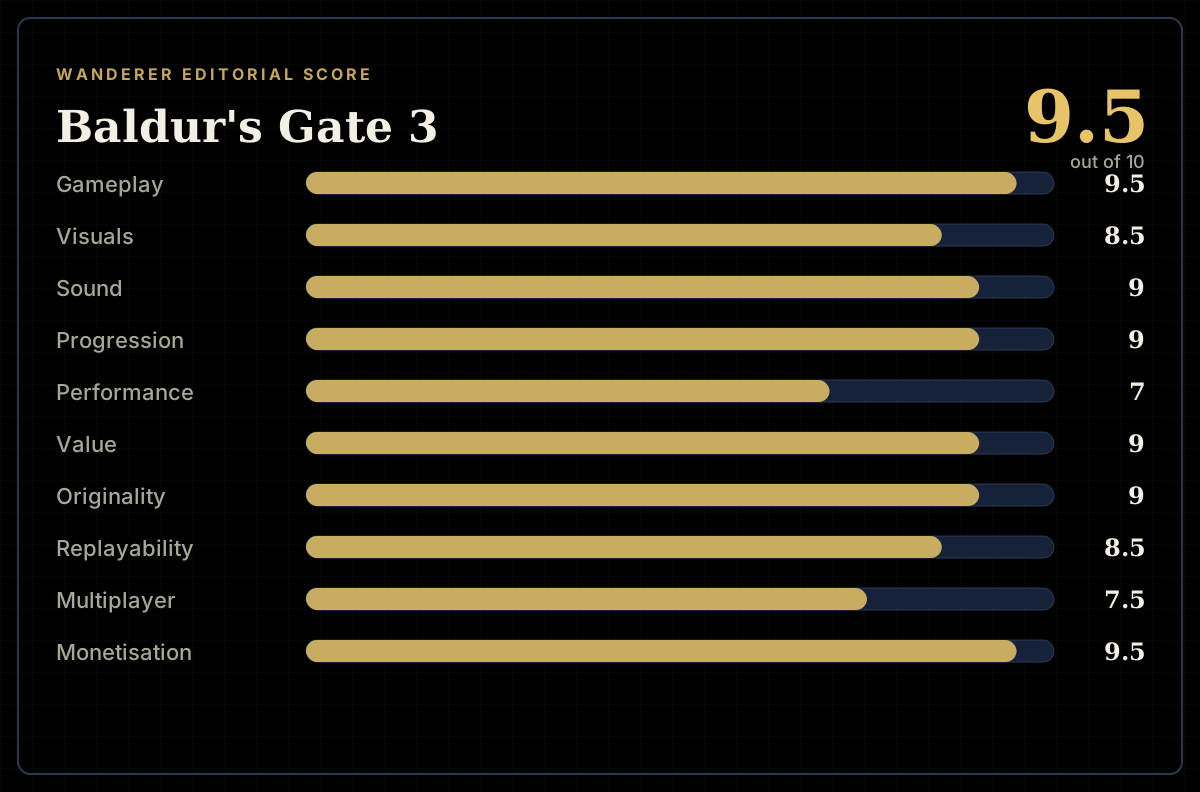
How the review scores each part of the gameWanderer Editorial -
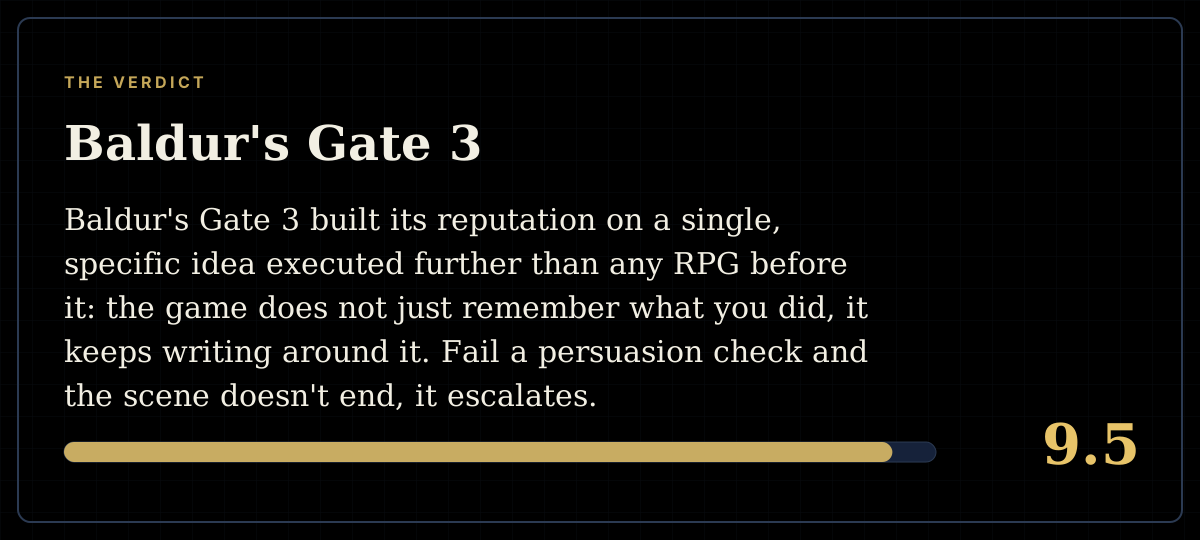
The short versionWanderer Editorial