Game review
Enshrouded
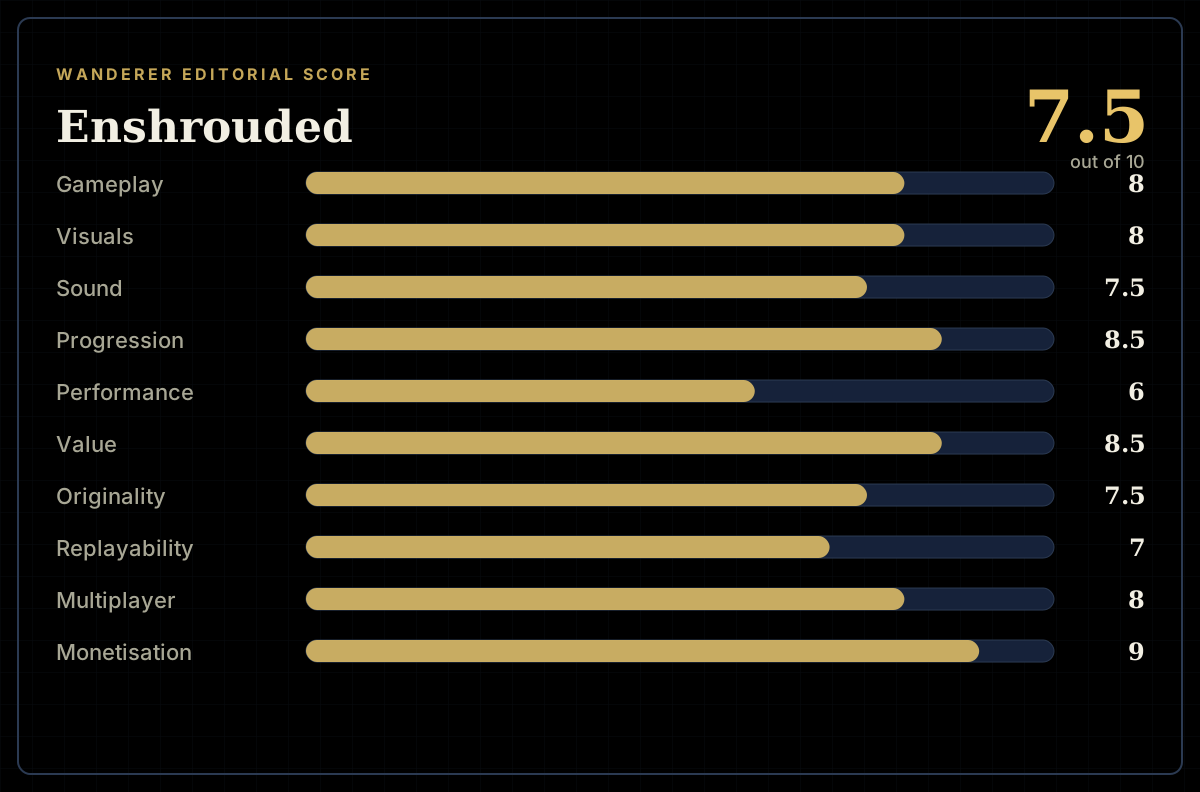
7.5 / 10
- Developer
- Keen Games
- Publisher
- Keen Games
- Released
- 24 January 2024
- Platforms
- Windows (Steam); PlayStation 5 and Xbox Series X|S confirmed for the 1.0 launch window
- Genre
- Survival action RPG
- Monetisation
- Premium, one-off purchase — no premium currency, no loot boxes, no battle pass; the only paid add-on is an optional two-disc soundtrack, and cosmetic items distributed through Twitch Drops are free
- Players
- Co-op for up to 16 players in one world, with dedicated server support
The short version
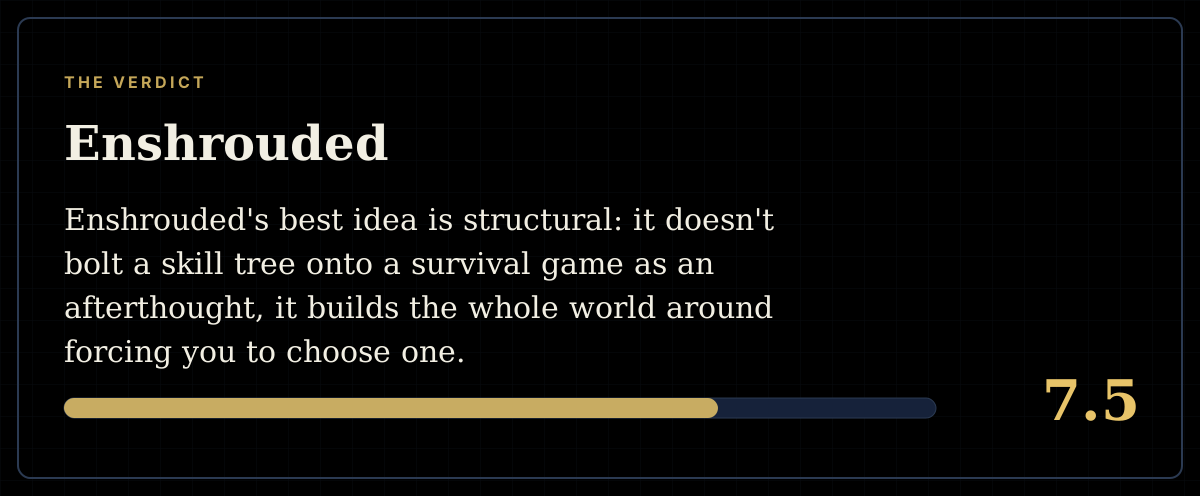
Enshrouded's best idea is structural: it doesn't bolt a skill tree onto a survival game as an afterthought, it builds the whole world around forcing you to choose one. Three archetypes, twelve specialties and a voxel engine that lets you sculpt terrain rather than just decorate it make this one of the more mechanically ambitious entries the genre has produced since Valheim.
The Shroud itself is the game's sharpest tool — a fog that turns exploration into a series of held breaths — but the combat it's supposed to test still feels stiffer than the systems around it, and two and a half years of Early Access haven't fully solved the performance complaints that show up in this week's user reviews as readily as last year's. A firm 1.0 date changes the calculus, but it hasn't arrived yet.
Biggest strengths
- The voxel engine lets you dig into mountains and reshape terrain directly, not just snap prefab pieces onto a flat plot
- Twelve specialties split across three archetypes give melee, ranged and magic builds genuinely different toolkits rather than reskinned stat sticks
- The Shroud's timed-death pressure turns ordinary exploration into a real risk calculation instead of a checklist
Biggest weaknesses
- Combat still reads as stiffer than the systems around it, with animation-locked swings that recent balance passes haven't fully resolved
- Performance and stability complaints — stutter, crashes, uneven frame pacing — remain common in this week's user reviews after two and a half years of updates
- Windows is still the only platform live; PlayStation 5 owners wait for October and Xbox owners wait into 2027
Who it's for: Survival and building fans who want real terrain-sculpting tools and a skill tree with actual teeth, plus co-op groups who don't mind a Windows-only Early Access build while they wait for the console versions.
Our recommendation: Worth playing now if you're comfortable with Early Access rough edges — the foundation is strong enough that the October 1.0 update is more likely to sand off complaints than to rewrite the game underneath you.
7.5 / 10
Most survival games treat character progression as a formality — a handful of passive percentage bumps that exist so the menu isn't empty. Enshrouded doesn't do that. It hands you three archetypes, twelve specialties, and a talent web dense enough that picking Barbarian over Wizard changes not just your damage numbers but which parts of the map you can survive in. That decision, made early and revisited constantly, is the clearest evidence that Keen Games built this as an RPG first and a survival game second — and whether that ordering pays off is the real question two and a half years into Early Access.
What it actually is
You wake as one of the Flameborn, the last of a bloodline meant to hold back a corrupting fog that has swallowed the kingdom of Embervale. The opening hour plays like a checklist familiar to anyone who has started a Valheim world or a 7 Days to Die run — punch trees, build a shelter, find a weapon — but the checklist ends faster here than in most of its peers, because Enshrouded is in a hurry to show you what it's actually built around: a fully voxel world you can dig into, sculpt, tunnel through and rebuild from raw terrain rather than just decorate with snapped prefabs, paired with a skill tree that asks you to specialise almost immediately rather than after fifty hours of generic levelling.
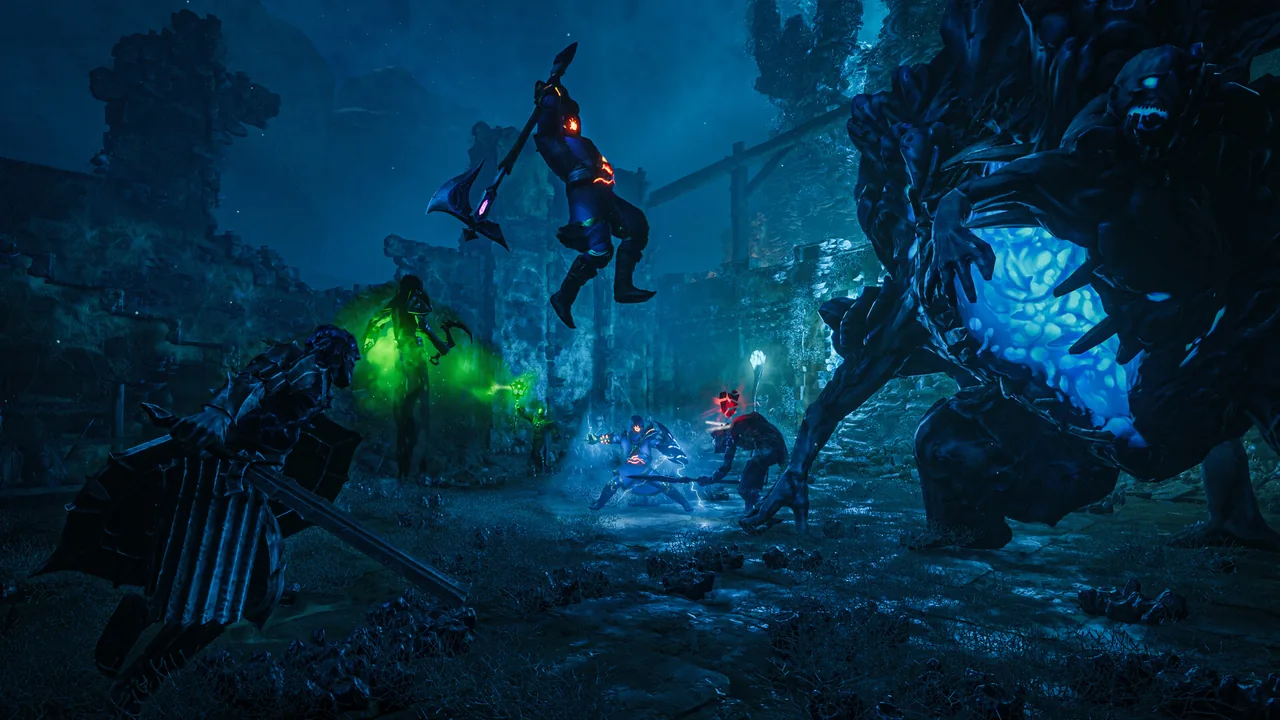
The fog that gives the game its name — the Shroud — covers large stretches of the map in a toxic haze filled with hostile monsters. Enter it and a timer starts; stay too long and your character dies. That single rule reframes exploration for the entire game. You don't wander into unfamiliar territory the way you would in an open-world RPG, weighing loot against difficulty. You wander in against a clock, and every decision to push one more room deeper is a bet against a countdown you can't see without checking. It's a simple mechanic, and it's the best thing in the game.
Does the RPG half talk to the survival half?
This is the question worth actually answering, because it's easy to build a survival game with an RPG coat of paint and call the mechanics finished once both exist. Enshrouded mostly earns the combination. Flame altars — placed at fixed points around the world — serve triple duty as fast travel, respawn points and the thing that physically pushes the Shroud's boundary back, which means the survival act of establishing a base and the RPG act of unlocking new areas to level in are the same action. You're not building a base and separately grinding a skill tree; placing an altar is how you earn the right to specialise further, because it's how you buy time inside the next patch of fog.
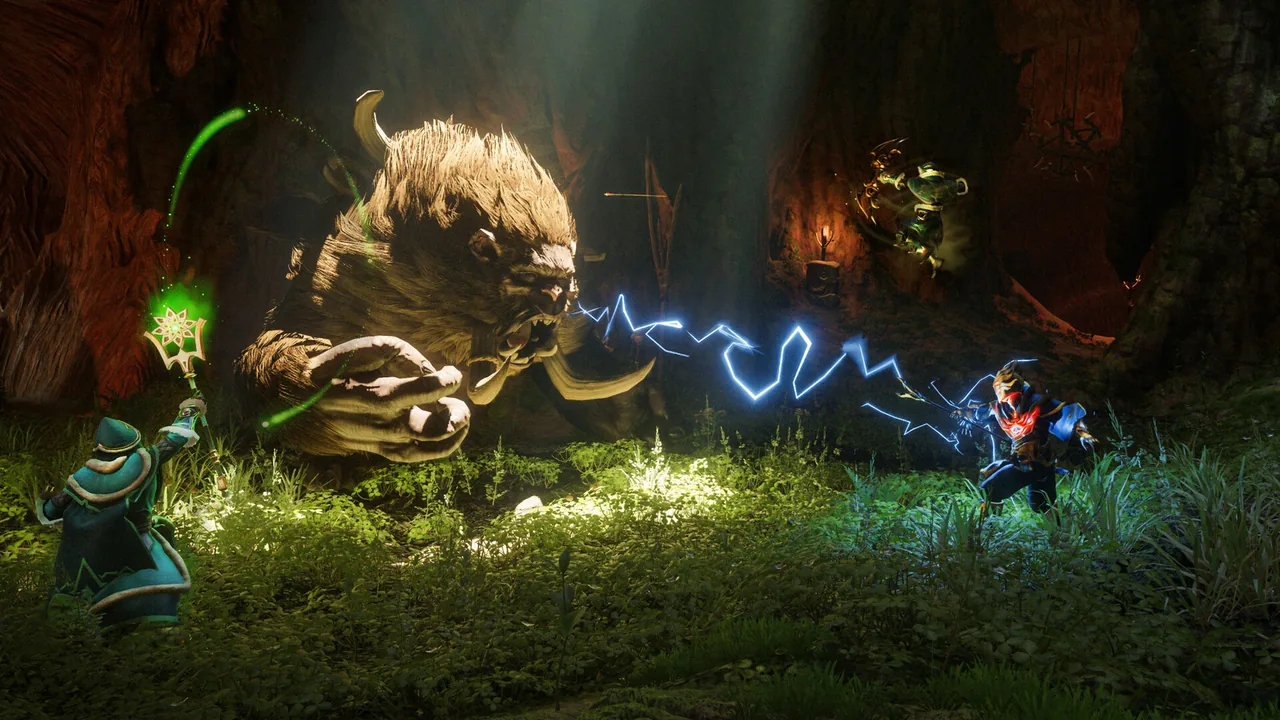
Where the two halves stop reinforcing each other is combat itself. The skill tree promises three distinct identities — a Barbarian who wants to be in melee range, a Wizard who wants distance and elemental combos, a Hunter who wants sightlines and mobility — and the itemisation genuinely supports that split. But the actual swing-block-dodge loop underneath all three still reads as stiffer than the systems wrapped around it, with animation-locked attacks that don't always reward the read-and-react rhythm the skill tree is trying to set up. A heavier weapon commits you to a swing the same way it does in most action RPGs, but the payoff for committing correctly doesn't feel as sharply tuned as the specialisation choice that got you there. The result is a game whose progression systems are more ambitious than its combat systems, which is a good problem to have compared to the reverse, but it does mean the moment-to-moment fighting is the weakest link in an otherwise tightly connected loop.
Building as terraforming, not decorating
Where Enshrouded separates itself most clearly from Valheim, Palworld or Core Keeper is the building tool itself. Those games — even the good ones — treat construction as placing discrete pieces onto terrain you can't meaningfully alter. Enshrouded's voxel engine lets you carve directly into a mountainside, hollow out a cave system for a base, or flatten an uneven plot by hand rather than picking around it. That's a genuinely different design proposition: your base isn't just what you place on the world, it's a permanent edit to the world itself. For players who found Valheim's piece-snapping satisfying but limiting, this is the upgrade that game never shipped.
The cost of that ambition is legibility. A building system this flexible has no natural guardrails — nothing stops you from digging a hole you can't climb out of or hollowing a support you didn't mean to remove — and the tools for navigating a heavily sculpted base can feel less precise than a piece-snapping system's built-in structure. It's a trade most builders will happily make, but it's worth naming as a trade rather than a pure upgrade.
The Shroud's fog problem
The Shroud is the game's best mechanic and its most commonly cited annoyance, sometimes in the same sentence. As pressure, it works: a hard countdown attached to genuinely dangerous enemy density does more to generate tension than most survival games manage with damage-sponge bosses. As presentation, the fog it's built from can obscure the very threats you're supposed to be reacting to, turning a tense encounter into a blind one more often than the design probably intends. Shroud-resistance gear and consumables extend your window as you progress, which is the correct answer to the problem in principle — you're meant to get better at surviving the fog, not just memorise where the monsters are — but the visibility complaint shows up often enough in current player discussion that it reads as a real design tension rather than a one-off gripe.
Progression, and the twelve specialties
Enshrouded's talent structure is its standout feature and the section of the review that most deserves the word "generous." Three archetypes — Melee Focused, Ranged Focused and Magic Focused — each branch into four specialties, giving twelve distinct builds with their own weapon affinities and passive identities rather than twelve names slapped on the same three stat curves. Confirmed specialties like Barbarian, Hunter and Wizard each pull you toward a different loadout, and switching between them costs enough that the choice feels like a commitment rather than a toggle you flip between fights. That's the right amount of friction: enough to make specialisation meaningful, not so much that experimenting with a second build feels like starting over.
The early hours strain under a familiar survival-game tax, though — a stretch of repeated resource runs and base-tier crafting before the more interesting nodes on the tree actually open up. It's not a fatal problem, and it's shorter than the equivalent grind in most of Enshrouded's competitors, but new players expecting the archetype system to matter from minute one will spend a few hours gathering fibre and stone before it does.
Performance, and what "Early Access" still means here
Enshrouded launched into Early Access on 24 January 2024 and, as of this review, is still there — current builds sit around version 0.9.1.x, with Keen Games publicly confirming 15 October 2026 as the 1.0 release date for Windows and PlayStation 5, and early 2027 for Xbox Series X and Series S. That's a real ending in sight, in the same way Valheim's own 1.0 date changed the conversation around that game earlier this year — but it hasn't landed yet, and the label still means something concrete right now: this week's Steam user reviews include GPU crashes, uneven frame pacing and stutter reported on capable hardware, sitting alongside praise for the building and skill systems in the same review threads. Two and a half years of patches have clearly improved the game — the version number and the steady cadence of hotfixes and numbered updates make that plain — but they haven't retired the complaint, and a reviewer writing today has to weigh that against the finished product Keen Games is promising for October.
It's also worth being specific about what's still missing rather than folding it into "Early Access" as a blanket excuse: the game remains Windows-only on Steam today, with no Mac or Linux support, and the console audience has had literally nothing to play while PC has spent two and a half years accumulating content. October closes that gap for PlayStation; Xbox owners wait longer still.
Multiplayer and value
Sixteen-player co-op is a genuinely generous ceiling — most survival games top out at eight or ten — and dedicated server support means a persistent group doesn't need to leave a host's machine running to keep a world alive. Shared bases benefit the most from the voxel building tools, since a group sculpting one large structure together produces something a single-piece-snapping game couldn't replicate as convincingly.
On value, Enshrouded is straightforward in the way this genre rarely is: NZ$42.99 gets you the full game, no premium currency, no battle pass, no loot boxes, and the only paid add-on is an optional soundtrack release that doesn't touch gameplay. Cosmetic items distributed through Twitch Drops cost nothing beyond watching a partnered stream. For a survival RPG with this much building and skill-tree depth already in the box, the asking price looks like fair value even before the October update adds whatever ships alongside 1.0.
Players who like the idea of a skill tree that actually gates what you can survive, rather than one that just pads your numbers, may find something familiar in Wanderer's own progression, even without the digging.
Final verdict
Seven and a half. Enshrouded's core proposition — a real RPG skill tree fused to a voxel survival game whose building tools genuinely outclass the genre standard — is one of the more interesting structural ideas the survival-crafting space has produced in years, and the Shroud's timed pressure is a smart, simple hook that does a lot of work with a little mechanical overhead. What keeps it from scoring higher is the gap between its two best systems and its weakest one: combat hasn't caught up to the ambition of the progression tree wrapped around it, and performance complaints that should have faded by now are still showing up in this week's reviews rather than last year's.
None of that makes this a game to avoid. It makes it a game whose Early Access tag is still doing real work, with a specific, credible end date attached to it for the first time. If you want the building and progression today and can tolerate Windows-only rough edges, there's a strong game here already. If you'd rather meet it once the label comes off, 15 October 2026 is the date to watch.
Price, release-date and platform details checked 30 July 2026.
Pros and cons
Pros
- The voxel engine lets you dig into mountains and reshape terrain directly, not just snap prefab pieces onto a flat plot
- Twelve specialties split across three archetypes give melee, ranged and magic builds genuinely different toolkits rather than reskinned stat sticks
- The Shroud's timed-death pressure turns ordinary exploration into a real risk calculation instead of a checklist
- Flame altars tie fast travel, respawn and Shroud-pushback into a single decision about where to spend your limited placement
- One upfront price with no premium currency, no loot boxes and only an optional soundtrack as paid add-on content
- Co-op scales to sixteen players, well beyond what most survival games budget for a shared world
Cons
- Combat still reads as stiffer than the systems around it, with animation-locked swings that recent balance passes haven't fully resolved
- Performance and stability complaints — stutter, crashes, uneven frame pacing — remain common in this week's user reviews after two and a half years of updates
- Windows is still the only platform live; PlayStation 5 owners wait for October and Xbox owners wait into 2027
- The Shroud's fog can obscure the very threats it's asking you to react to, turning tension into occasional guesswork
- Early hours lean heavily on repeated resource runs before the skill tree's more interesting specialties open up
- The Early Access tag has now covered two and a half years and several delayed roadmap items
Screenshots
-
EnshroudedImage: Keen Games GmbH via Steam -
EnshroudedImage: Keen Games GmbH via Steam -
EnshroudedImage: Keen Games GmbH via Steam -
How the review scores each part of the gameWanderer Editorial -
The short versionWanderer Editorial