Game review
RuneScape: Dragonwilds
7.5 / 10
- Developer
- Jagex Ltd
- Publisher
- Jagex
- Released
- 15 April 2025
- Platforms
- Windows; PlayStation 5 and Xbox Series X|S confirmed for the 1.0 launch
- Genre
- Survival crafting RPG
- Monetisation
- Premium, one-off purchase — no premium currency, no loot boxes, no subscription tied to the base game; the only paid extra on Steam is an optional soundtrack
- Players
- Co-op for up to 4 players per world; dedicated server support added with the Dowdun Reach update
The short version
Dragonwilds takes the biggest risk a spin-off can take — it asks whether RuneScape's skill icons mean anything once you strip away the MMO around them — and mostly wins that argument. Magic reframes gathering as something closer to a puzzle than a chore, and the building tool is genuinely one of the best in the genre. What it hasn't solved after fifteen months is pace: a punishing death system and an update cadence that still ships bugs with almost every patch keep this from being an easy recommendation at full price.
Biggest strengths
- The construction tool's magic-assisted placement and free-flight mode make building genuinely enjoyable rather than a means to an end
- Utility spells like tree-felling and remote building turn gathering into a small puzzle instead of a repetitive animation loop
- Dowdun Reach added dedicated servers, a raised level cap and a genuinely dangerous new region in one update, proof the roadmap can deliver more than filler
Biggest weaknesses
- Death can strand a grave behind a monster or a locked door, occasionally with no way to recover the gear inside it
- Balance and control changes have shipped in recent patches without enough testing, breaking controller bindings for some players mid-run
- Combat's magic and ranged branches are still visibly unfinished next to melee
Who it's for: Survival-crafting fans who want a skill-driven alternative to Valheim, and RuneScape players curious whether the numbers on those familiar icons still mean something outside the MMO.
Our recommendation: Worth playing now if you can tolerate Early Access rough edges; wait for the September 2026 1.0 launch if you want the console version or a more finished death system.
7.5 / 10
Familiar icons, unfamiliar demands
Every skill in Dragonwilds carries a name and an icon a RuneScape player has seen a thousand times — Woodcutting, Mining, Fishing, Runecrafting — and for the first few hours that familiarity does a lot of heavy lifting. You know what a woodcutting axe is for. You know a higher Mining level means faster ore. The trouble is that RuneScape's skilling was always built around a very specific kind of attention: click something, tab away, check back in a minute. Old School RuneScape turned that into a whole culture of afk multitasking, and RuneScape never really abandoned it either. Dragonwilds throws that model out entirely. Every swing of the axe, every ore vein, every fish is a real-time action performed by a character standing in a world that can and will attack back. One negative Steam reviewer put it bluntly: this "doesn't feel like Runescape at all," because you can't text a friend back while mining anymore. That's not a bug, it's the entire premise of the game — and whether it lands depends entirely on what a player wanted from the name on the box.
Judged as its own thing rather than as nostalgia bait, the skilling holds up better than the complaint suggests. Eleven skills are live so far, each capped at 99 in the RuneScape tradition, and each one unlocks spells and gear tiers as it levels rather than just making the existing loop marginally faster. That's the real test of whether a survival game's skill system has teeth, and Dragonwilds mostly passes it. Where it doesn't yet pass is combat: melee is the only branch that feels finished, with Ranged and Magic still visibly under construction as offensive options even though Magic is excellent everywhere else.
Magic as a toolbox, not a damage number
The single best idea in Dragonwilds is that magic is primarily a utility system, not a combat stat. Spells tied to gathering skills turn what would otherwise be Valheim's core loop — walk to tree, hold button, walk to next tree — into something with actual decisions in it. A spell that fells several trees in one cast rewards planning which cluster to chop and in what order. A spell that lets you leave your body and place building pieces at a distance solves the single most annoying problem in every voxel-free building game: reaching the awkward corner of a roof without falling off the scaffolding. None of this replaces combat spells, which remain thin, but it means the skill tree's mid-game unlocks change how you play instead of just letting you do the same thing faster. That's a genuinely different design decision from Valheim, where a better axe is still just a better axe, and it's the strongest evidence that Jagex understood what "skilling" needed to become in a real-time game rather than just importing the name.
A building tool that outclasses its inspirations
Construction is the other place where the RuneScape name earns its keep. The piece-snapping is precise without being fiddly, verticality is handled with a free-camera flight mode once it unlocks, and the whole system takes the parts of Valheim's building mode that work — modularity, visible structural logic, a satisfying escalation of materials — without the parts that don't. It's a fair comparison to make, because Dragonwilds is unmistakably reaching for the Valheim audience rather than the RuneScape one on this specific system, and it largely gets there. Compared to Enshrouded's voxel sculpting, which trades precision for total freedom, Dragonwilds trades some of that freedom back for a building tool that never fights the player over alignment. Base-building communities on Steam have started calling it the best non-voxel building system currently shipping, and that's not an exaggeration so much as a fair read of a genuinely well-tuned toolset.
The grave problem
Death is where the game's ambitions and its execution pull apart hardest. Standard mode lets you keep multiple gravestones and reclaim them at leisure with skill experience untouched, which is reasonable. Hard mode allows only one grave, and dying again before recovering it deletes everything in it — a real, permanent loss condition that plenty of survival games are willing to use, Valheim included. What isn't reasonable is the failure state that shows up even outside hard mode: a gravestone spawning behind a monster you just died to, inside a dungeon room you can no longer reach, or destroyed outright by a wandering enemy before you get back to it. Losing an inventory to a fair fight is survival-game grammar everyone understands. Losing it to level geometry is just a bug wearing a difficulty setting's clothes, and it's the single complaint that comes up most consistently in current player feedback — more than balance, more than pricing.
Fifteen months, judged on delivery
Dragonwilds launched on 15 April 2025 at US$29.99, a price that drew real pushback given that both its MMO siblings are nominally free to play. Jagex's answer — that the number came from playtester willingness-to-pay data rather than a boardroom guess — didn't fully quiet the complaints, but the game has at least held that price rather than creeping it upward, and it has stayed clean of the premium-currency and battle-pass instincts that shape RuneScape's own membership model. There's no Bond-equivalent here, no way to buy progression; what you pay at purchase is what you pay.
The update record is the fairer way to judge fifteen months of Early Access, and it's a mixed one. Dowdun Reach, the biggest content drop since launch, added a genuinely dangerous new fortress region, a Mithril gear tier, a raised level cap and — quietly the most consequential change in the list — dedicated server support, which turns co-op from "someone's PC has to stay on" into something closer to how a persistent world is supposed to work. That's a real roadmap delivering real structural improvements, not just reskinned biomes. Set against that is a pattern of patches that ship without enough internal testing: an agility-focused traversal spell nerfed hard enough to draw its own backlash, and — more seriously — a recent update that remapped controller bindings with no way for affected players to restore their old ones. Jagex has a well-earned reputation for listening to its RuneScape community through public polling; Dragonwilds hasn't yet built the same trust that a given patch won't break something on arrival.
Where 1.0 needs to land
A firm date changes how forgiving an Early Access label can be, and Dragonwilds now has one: 15 September 2026, alongside the Scorned Wilderness region and simultaneous console launches on PlayStation 5 and Xbox Series X|S. That's an ambitious finish line — full release and a doubled platform footprint on the same day — and it puts real pressure on the death system and combat's weaker branches to be fixed rather than merely expanded around. The Umbral Sands region, due before 1.0, is the last real test of whether the team can ship a major update clean. If it lands the way Dowdun Reach did, with new systems rather than new coats of paint, this becomes an easy recommendation the day console players can join in. If Umbral Sands repeats the recent pattern of undertested patches, the September deadline will have arrived a content update early.
Verdict
Dragonwilds is the most interesting thing Jagex has done with the RuneScape name in years, precisely because it refuses to just port the MMO's skilling wholesale — it rebuilds gathering around magic-assisted decision-making and backs that up with one of the better building tools in the genre. It earns comparison to Valheim and comes out ahead on construction specifically, while falling short of Valheim's polish everywhere death and stability are concerned. Players drawn to persistent progression systems that respect time invested away from the keyboard, without punishing every mistake with total loss, might also find something to like in Wanderer. For Dragonwilds itself: recommended now to players who can shrug off an occasional broken patch and a harsh death system, and worth a second look in September when the console versions and Umbral Sands either confirm this was worth the wait or expose that fifteen months wasn't enough time to fix what still needs fixing.
Pros and cons
Pros
- The construction tool's magic-assisted placement and free-flight mode make building genuinely enjoyable rather than a means to an end
- Utility spells like tree-felling and remote building turn gathering into a small puzzle instead of a repetitive animation loop
- Dowdun Reach added dedicated servers, a raised level cap and a genuinely dangerous new region in one update, proof the roadmap can deliver more than filler
- The skill tree's late unlocks change how you play rather than just making existing actions faster
Cons
- Death can strand a grave behind a monster or a locked door, occasionally with no way to recover the gear inside it
- Balance and control changes have shipped in recent patches without enough testing, breaking controller bindings for some players mid-run
- Combat's magic and ranged branches are still visibly unfinished next to melee
- The skill-icon nostalgia papers over a much more hands-on, less afk-friendly game than the MMOs it borrows the names from
Screenshots
-
RuneScape: DragonwildsImage: Jagex Ltd via Steam -
RuneScape: DragonwildsImage: Jagex Ltd via Steam -
RuneScape: DragonwildsImage: Jagex Ltd via Steam -
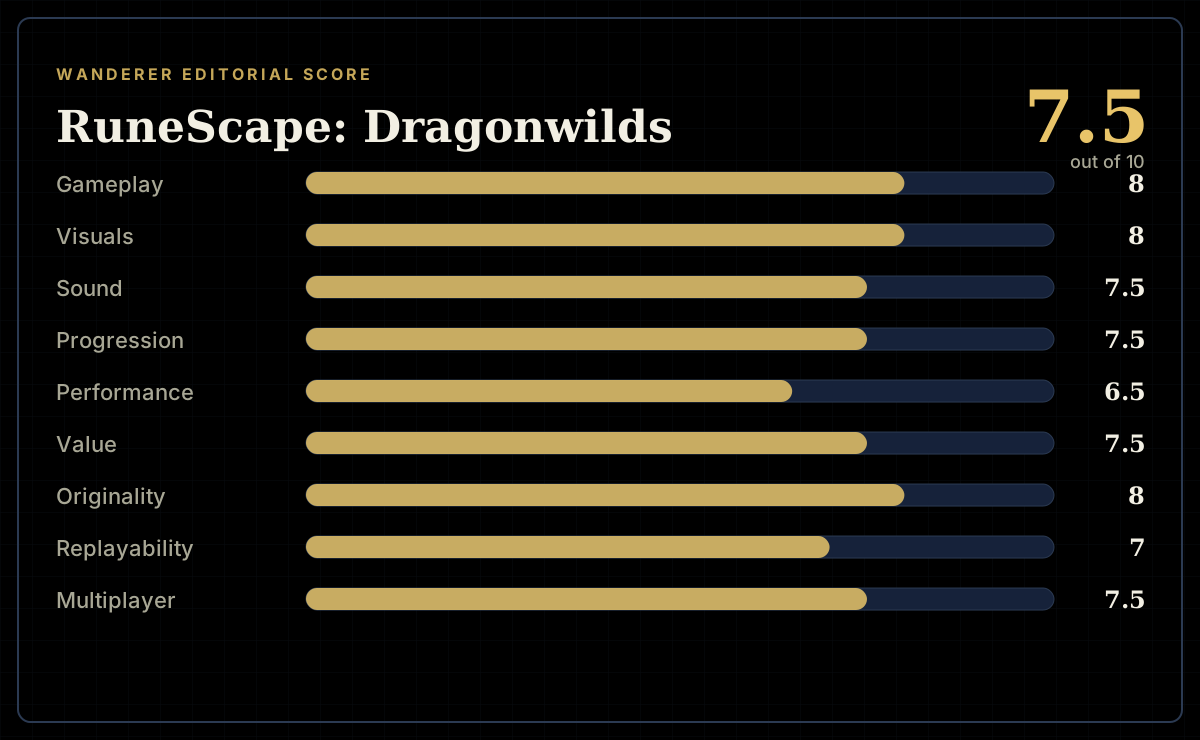
How the review scores each part of the gameWanderer Editorial -
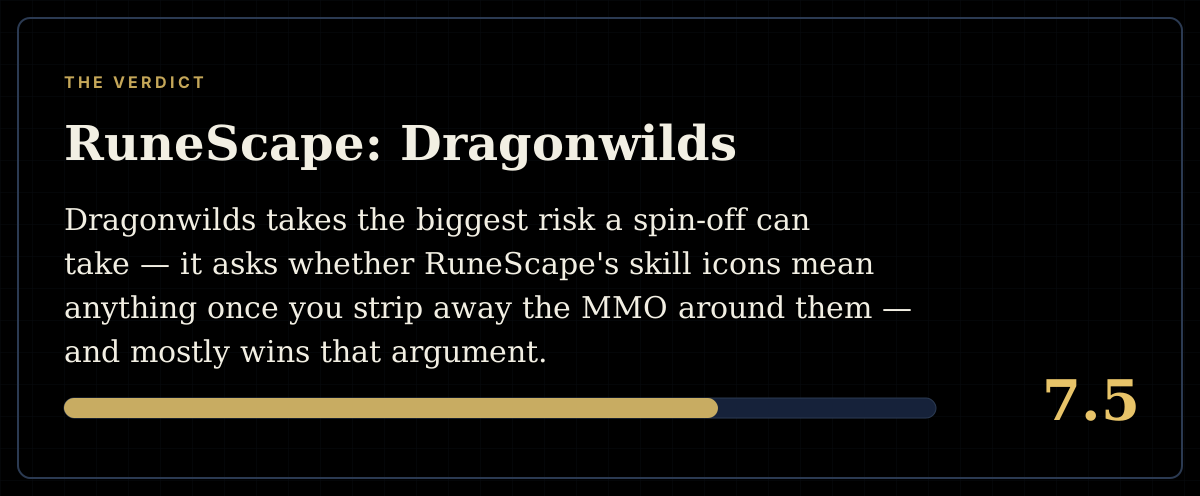
The short versionWanderer Editorial