Game review
RuneScape
7.5 / 10
- Developer
- Jagex
- Publisher
- Jagex
- Released
- 22 July 2013
- Platforms
- Windows, macOS, Android, iOS
- Genre
- MMORPG
- Monetisation
- Free to play with restrictions, unlocked fully by the same paid membership that covers Old School RuneScape; a Marketplace sells cosmetics, bank space and direct XP boosters for RuneCoins, Bonds or cash
- Players
- Massively multiplayer persistent world; most skilling and questing is entirely soloable, combat and bossing scale from solo to full groups
The short version
RuneScape is the version of Gielinor that kept moving: ability-based combat instead of 2007's point-and-click, twenty-nine skills instead of twenty-four, and a story that has actually advanced instead of staying frozen. Jagex spent early 2026 dismantling the loot-box machinery that made this game a cautionary tale for a decade, and that reform is real.
It didn't go all the way. The replacement for Treasure Hunter still sells experience points directly for cash, free-to-play access is far thinner than its sister game's, and the subscription costs exactly the same as the game most players will be comparing it to. This is a genuinely deeper game than Old School RuneScape in almost every system that isn't monetisation, and a noticeably worse one in the system readers care about most.
Biggest strengths
- Ability-based combat gives every weapon type a rotation to learn instead of a single stat comparison
- Twenty-nine skills and a much larger quest log give a subscribed player years of concrete goals
- January 2026's removal of Treasure Hunter ended over a decade of loot-box-style prize gambling
Biggest weaknesses
- Radiant Stars let anyone buy experience points outright with real money, capped but still a direct pay-for-progress mechanic
- Free-to-play access is a level-5 taste of most skills rather than OSRS's genuinely open lower half of the game
- The March 2026 membership price rise applies here too, and it buys a thinner free tier than the sister game charging the same amount
Who it's for: Players who want more skills, more quests and a combat system with actual rotations to learn, and who can look past a still-present pay-for-experience option as long as it's optional. A poor fit for anyone who wants zero pay-for-power in their MMO, full stop.
Our recommendation: Play free first and judge the ability combat and the modern skills — Necromancy, Archaeology, Invention — on their own terms before deciding whether membership and Radiant Stars belong in your budget.
7.5 / 10
RuneScape spent thirteen years being defined by the game it isn't. Old School RuneScape exists because a huge slice of the playerbase rejected where this game was heading in 2013, and every review of that spin-off ends up being partly a review of this one by omission. It's worth doing the comparison properly, because the two are not simply old-version-versus-new-version of the same product. They're separately developed live games, built by the same studio, sharing one account and one subscription, and diverging harder every year. Anyone choosing between them deserves an honest account of what the main game actually offers now — not the 2013 version that drove people away, but the one running today.
Two games, one studio, one bill
Start with the part that gets lost in the rivalry: a single Jagex membership, bought once, works on both RuneScape and Old School RuneScape on the same character. That's not a minor footnote — it means the real choice for most readers isn't "RS3 or OSRS," it's "which game do I actually want to play with membership I'm already paying for." Plenty of long-term players run both, treating OSRS as the disciplined grind and RS3 as the game with more surface area to explore when that grind gets stale. This review assumes a reader deciding where to spend their playtime, not necessarily their only membership dollar, because for most people that's the real decision.
Where the two diverge is everything downstream of the Evolution of Combat, the November 2012 update that rebuilt combat from a single-click, weapon-special-attack system into an ability bar with adrenaline, thresholds and ultimates. It was disastrous at launch — a meaningful share of the playerbase left within months, and Old School RuneScape exists directly because Jagex agreed to run the old client alongside the new one rather than lose that audience outright. Thirteen years on, EoC isn't a controversy any more; it's just what RuneScape's combat is, and on its own terms it's a genuinely well-built system.
Combat rebuilt from scratch
Every weapon style in RuneScape now comes with its own ability kit, arranged across five action bar palettes a player customises directly. Basic abilities build adrenaline, threshold abilities spend a chunk of it for a bigger effect, and ultimates spend the whole bar for a finishing move — and because adrenaline management sits underneath every fight, combat becomes a resource-timing puzzle rather than a stat check. Dual-wielding two one-handed weapons plays completely differently from a two-handed weapon's slower, harder-hitting kit, and switching combat styles mid-fight for elemental weaknesses is expected rather than optional at higher levels. Compare that to Old School RuneScape, where combat power still comes down almost entirely to gear tier and a handful of special attacks, and the gap in mechanical depth is real. It's also the gap that cost RuneScape a chunk of its audience in 2013 — some players want exactly that stat-driven simplicity, and EoC will never give it to them.
The tradeoff is a genuinely steep interface to climb before any of this clicks. A new account faces an action bar, ability unlocks tied to level thresholds, a separate defensive ability set, and combat-style-specific rotations, all before understanding why any of it matters. RuneScape has never solved the problem of teaching this system gracefully — the tutorial explains the buttons, not the reasons — and players coming from OSRS or from outside the RuneScape ecosystem entirely tend to bounce off the first few hours harder than the actual skill ceiling justifies.
More of everything, thinner at the door
RuneScape currently runs twenty-nine skills against Old School RuneScape's twenty-four, and the newest of them, Necromancy, launched in August 2023 as the first skill built around a 120 level cap rather than 99 — itself part of a broader Combat Style Modernisation that pushed Attack, Strength, Ranged and Magic up to 120 in March 2026. Archaeology, Invention and Necromancy don't exist in OSRS at all, and the quest log, membership content alone, runs well past a hundred quests deep on top of what free accounts can already reach. For a player who wants a skilling web with more strands to pull, this is simply a bigger, more actively developed game than its sister.
Free-to-play access doesn't match that generosity, and this is the least forgiving comparison in the whole review. Where OSRS hands non-members a clean fifteen of twenty-four skills at full depth, RuneScape lets free accounts dabble in almost every skill but caps most of them at level 5 — a taste, not a slice. A few skills stretch to level 20, the four core combat stats reach their full 120 cap even for free accounts, and membership unlocks eight additional skills outright along with the deeper end of everything else. Jagex's own framing puts free accounts at roughly a fifth of the total game. It's not dishonest — nobody markets this as a full free game — but next to OSRS's genuinely playable non-paying tier, it reads as a demo with combat attached rather than a real alternative to subscribing.
What Treasure Hunter actually sold, and what replaced it
This is the section that matters most for anyone weighing RS3 against its sister game, so it's worth being precise rather than gesturing at "microtransactions" as a vague negative.
From February 2014 until 19 January 2026, Treasure Hunter was RuneScape's daily loot-box system: players earned a small number of keys for free through login rewards, quests and daily challenges, and could buy far more in bundles of up to 450 with real money. Opening a chest handed out a random prize from a pool that ran from cosmetic overrides and small currency drops up to experience lamps that could dump enormous amounts of XP directly into a skill of the player's choice. That last category was the actual complaint, repeated by players and critics for over a decade: a system with real-money odds could hand a paying account a meaningful skill-level shortcut that a free player simply could not match through play alone. It survived multiple promised course-corrections, a 2017 backlash over gambling-adjacent "Prize Pool" mechanics, and a 2025 player survey about advertising and further monetisation that triggered its own review-bomb on Steam. None of that made it disappear until a formal poll finally took it down in January 2026, with Solomon's General Store — the parallel cosmetic-and-convenience shop — following it out the door that April.
What replaced both is a single unified Marketplace, restructured the same week Treasure Hunter closed. It sells cosmetic outfits, animations, titles, pets and overrides for RuneCoins, plus bank space expansions, memberships and Bonds — priced and purchased directly, with no randomness involved. That part of the reform is unambiguous progress: nobody is gambling real money for a chance at anything any more.
The part that keeps this from being a clean win is Radiant Stars, the item that inherited Treasure Hunter's most contested job. A Radiant Star is bought outright — from £4.99 for five up to bulk bundles that bring the per-star price down substantially — and redeemed for bonus experience in a skill of the player's choice, scaling with that skill's level. Jagex built in real limits: stars stop working once a skill passes 100 million experience, they can't push a skill past the standard 99-level cap into 120-level territory, and Ironman accounts — RuneScape's self-sufficiency mode, where trading and most external assistance are disabled by design — are blocked from buying them entirely. Those caps matter and deserve credit; this is not the uncapped, account-warping XP dump that Treasure Hunter's rarest lamps occasionally produced. But the underlying mechanic hasn't actually changed: a player with a credit card still buys levels that a free player has to earn by playing, whether the delivery mechanism is a loot box or an itemised storefront listing. Old School RuneScape sells nothing that touches experience gain, full stop. RuneScape, even after its most significant monetisation reform in over a decade, still does. That single fact is the most defensible reason to prefer OSRS if pay-for-power of any kind is a dealbreaker, and the most defensible reason RuneScape earns a meaningfully lower monetisation score than its sister game in this review.
What membership actually costs
Because the subscription is shared, the number is identical to Old School RuneScape's: US$14.99 for one month or US$131.88 for twelve, which on Steam's storefront comes to NZ$21.95 and NZ$191.88 respectively, following the same 10 March 2026 price increase that hit both games at once. There's no RS3-specific surcharge — a subscriber gets both games for that price, which is genuinely strong value for anyone who plays both. Judged purely as the cost of entry into RuneScape alone, though, it's the same bill as OSRS for a noticeably smaller free tier and a storefront that still sells experience. Cosmetic RuneCoin bundles sit on top of that subscription entirely optionally, running from roughly NZ$8 to NZ$32 on Steam for currency spent on outfits and overrides — ordinary cosmetic monetisation that doesn't touch this review's central concern.
Same account, smaller screen
RuneScape's native mobile clients have run since June 2021, sharing the same account, bank and quest progress as desktop, and there's no separate mobile-only economy layered on top. The full ability bar, all twenty-nine skills and the entire Marketplace are present on a phone, which is more than plenty of MMOs with a mobile port can claim. The honest caveat is that RS3's interface was never simple even on a full monitor — five customisable action bar palettes, a busy inventory and a skill list nearly twice OSRS's size all have to fit on a touchscreen, and the result asks more of a small phone than the interface pass OSRS's mobile client received in late 2024. Committed players adapt; anyone trying RuneScape for the first time on a phone will find the learning curve from the previous section steeper still with fewer pixels to work with.
Picking a side
Choose RuneScape over Old School RuneScape if what you actually want is more systems: ability combat with a real skill ceiling, twenty-nine skills instead of twenty-four, modern additions like Necromancy and Archaeology that don't exist on the older client, and a story that has kept moving instead of staying preserved. Choose Old School RuneScape instead if a zero-tolerance stance on pay-for-power matters more to you than any of that, or if you want the free-to-play tier to be a genuinely complete game rather than a preview of one. Committed players increasingly don't have to choose at all — the shared subscription means trying both costs nothing extra once you're paying for either — and that's arguably the most player-friendly thing about how Jagex runs this particular rivalry.
Verdict
RuneScape in 2026 is a better-built, more ambitious game than the one that drove a chunk of its own playerbase into building a rival client thirteen years ago, and January's removal of Treasure Hunter closes out the single ugliest chapter in this game's monetisation history. Ability combat rewards genuine mechanical investment, the skill catalogue dwarfs the competition, and the pace of new systems — Necromancy, the March 2026 combat modernisation — shows a studio still actively building rather than maintaining a museum piece. What keeps the score below its sister game is specific and fixable in principle: Radiant Stars still sell experience for cash, free-to-play remains a taste rather than a real on-ramp, and the subscription asks the same price for noticeably less free content. This is the RuneScape to pick if depth and ongoing development matter more to you than a spotless monetisation record. It is not yet the RuneScape to pick if that record is the whole point.
Players drawn to a long, steady climb that keeps running even when they log off might also want a look at Wanderer — no ability bars to master and nothing in the shop that touches experience gain, ever.
Pros and cons
Pros
- Ability-based combat gives every weapon type a rotation to learn instead of a single stat comparison
- Twenty-nine skills and a much larger quest log give a subscribed player years of concrete goals
- January 2026's removal of Treasure Hunter ended over a decade of loot-box-style prize gambling
- Membership doubles as an Old School RuneScape subscription, so committed players effectively get two games for one price
- Mobile carries the full skill list and combat system on the same account as desktop
Cons
- Radiant Stars let anyone buy experience points outright with real money, capped but still a direct pay-for-progress mechanic
- Free-to-play access is a level-5 taste of most skills rather than OSRS's genuinely open lower half of the game
- The March 2026 membership price rise applies here too, and it buys a thinner free tier than the sister game charging the same amount
- Two decades of accumulated interface, ability bars and menus can overwhelm a new account before the tutorial even ends
- Recent Steam sentiment has slipped from the game's usual strongly positive standing
Screenshots
-
RuneScape ®Image: Jagex Ltd via Steam -
RuneScape ®Image: Jagex Ltd via Steam -
RuneScape ®Image: Jagex Ltd via Steam -
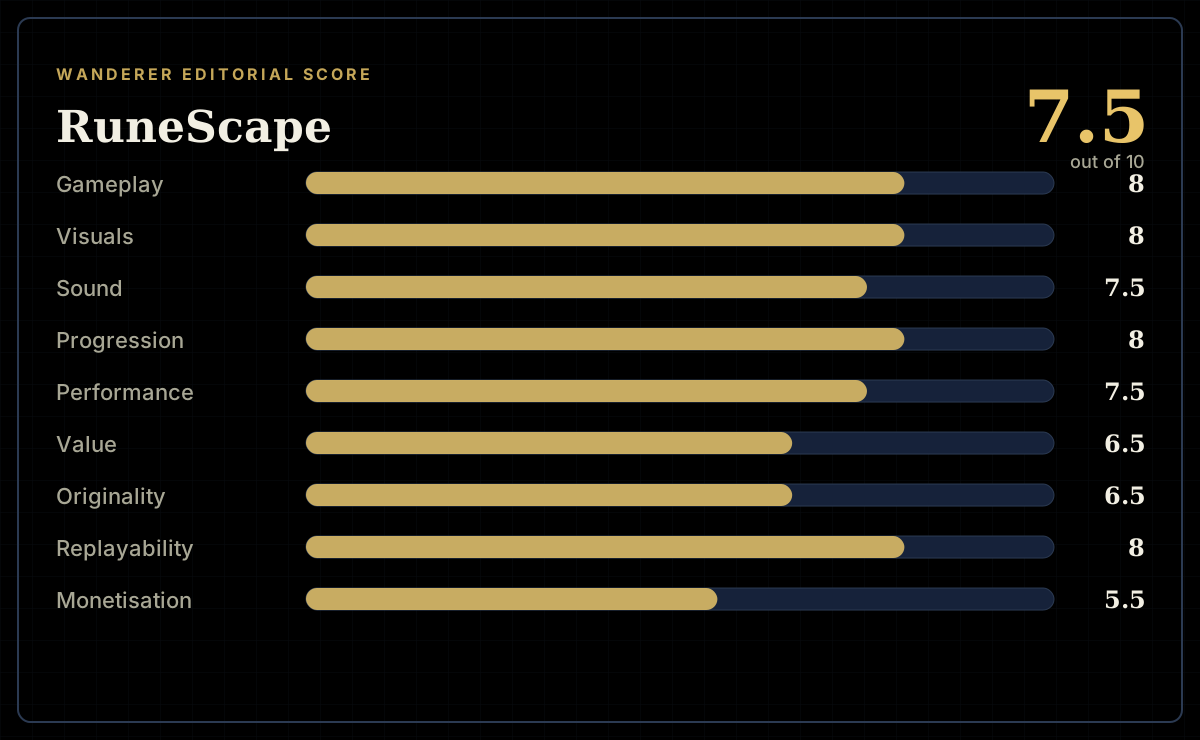
How the review scores each part of the gameWanderer Editorial -
The short versionWanderer Editorial