Game review
Final Fantasy XIV Online
8.5 / 10
- Developer
- Square Enix
- Publisher
- Square Enix
- Released
- 27 August 2013
- Platforms
- Windows, PlayStation 5, PlayStation 4 — no Xbox release
- Genre
- MMORPG
- Monetisation
- One-time purchase plus a mandatory ongoing subscription; the cash shop sells cosmetics, mounts and account services only — no gear, no experience boosts, and job-level boosts don't shorten the mandatory story
- Players
- Massively multiplayer persistent world with instanced dungeons, raids and open-world content; almost the entire main story is now soloable against AI companions for players who don't want to group
The short version
Final Fantasy XIV is still the best-argued case in the genre for a single subscription buying one character that can be every job, and for a story campaign treated as the main event rather than a levelling chore bolted onto the real game. Patch 7.55 lands with the same steady cadence the game has kept for a decade, and the free trial remains one of the most generous doors any MMO has ever left open.
It is also, by design, a game that asks a 2026 newcomer to treat hundreds of hours of mandatory story as a toll before the current patch even becomes visible, and Dawntrail's own reception — the softest of the five expansions — is a reminder that the formula isn't bulletproof. None of that changes what this game is at its best; it changes how much patience buying in requires.
Biggest strengths
- Any single character can eventually learn all twenty-one standard jobs just by changing weapon, so there's no alt-army tax to try a different playstyle
- The free trial covers four entire expansions to level 80 with no expiry date, easily the most generous entry point of any subscription MMO
- Duty Support AI companions now cover nearly the whole main scenario, so solo players can finish story dungeons and trials without ever queuing for a group
Biggest weaknesses
- Reaching current content from a fresh account means clearing hundreds of hours of mandatory main scenario quest with no skip, whatever your subscription tier
- Dawntrail's story pacing drew the softest critical reception of any FFXIV expansion to date, and director Naoki Yoshida has publicly acknowledged the pacing complaints
- Subscribing on top of an already-paid expansion is a genuinely unusual ask in 2026, when most of the genre has moved to free-to-play or buy-to-play models
Who it's for: Players who want an MMO built around a long, authored story rather than a loot treadmill, and who don't mind one character carrying every class instead of an army of alts. A poor fit for anyone who wants to be at the current content within a weekend, or who resents being asked to sit through a game's growing pains to reach its strongest chapters.
Our recommendation: Use the free trial properly before paying anything. It runs to level 80 across four full expansions with no time limit, which is enough content to know whether the story-first structure works for you long before a subscription becomes relevant.
8.5 / 10
Final Fantasy XIV asks something almost no other MMO still asks in 2026: pay for the base game, pay every month after that, and then sit through a story campaign that has been growing since 2013 before the game will let you anywhere near its current patch. That it still works — that the subscriber numbers have held for over a decade and the game just shipped its latest content drop, patch 7.55, on 28 July — is down to two ideas the rest of the genre has spent years failing to copy convincingly: one character can be every job, and the story isn't a wrapper around the levelling, it's the reason to keep levelling.
One character, every job
Most MMOs solve the "I want to try a different class" problem by making you build a new character from scratch. Final Fantasy XIV solves it by making job identity a matter of which weapon is in your hand. A single character can pick up a sword and be a Paladin, put it down and pick up a bow to be a Bard, then switch to a book and cast spells as a White Mage — all on the same save file, all sharing the same unlocked mounts, glamour wardrobe, retainers and Grand Exchange-equivalent market access. Across the game's twenty-one standard jobs, spread over the usual tank, healer, melee DPS, physical ranged and magical ranged roles, there's no separate account, no alt-levelling grind duplicated five times, and — practically speaking — no reason the Entry subscription tier's one-character limit should feel as punishing as a single-character cap sounds. In most MMOs, one character means one build. Here it means access to the entire class roster.
Dawntrail added two more jobs to that roster on release: Viper, a dual-blade melee DPS built around escalating combo chains, and Pictomancer, a ranged magic DPS that paints its damage-dealing canvases mid-fight. Both slot into the existing framework cleanly rather than reinventing it, which is both a compliment and a mild criticism — Final Fantasy XIV's job design is mature enough now that new jobs tend to fill a gap in an established taxonomy rather than break new mechanical ground. A limited job, Beastmaster, is still coming later in the Dawntrail patch cycle, following the game's long-standing pattern of adding one experimental, non-standard job partway through each expansion rather than at launch.
The toll before the door
The flip side of "one character, every job" is that the game gates almost everything behind a single, mandatory, unbroken thread: the Main Scenario Quest. You cannot skip it by paying more, you cannot bypass it by picking a harder difficulty, and a job-level boost purchased from the cash shop raises your combat level without advancing your place in the story one inch — you'll still be sitting through every story beat at the pace the MSQ delivers it, just with a maxed-out job while you do. For a player starting today, that means clearing A Realm Reborn, Heavensward, Stormblood, Shadowbringers, Endwalker and Dawntrail's own story in full — well over two hundred hours of cutscenes and story dungeons by most veteran estimates, before side content, before optional job quests, before a single raid tier — just to be standing where the patch 7.55 crowd already is.
That's not a hidden cost. It's the design. Square Enix has never pretended Final Fantasy XIV is a game you can jump into at endgame, and the studio has spent real effort softening the early hours rather than shortening them: Duty Support, the AI companion system that started covering Shadowbringers and Endwalker story dungeons in 2022, has since been extended backward across Stormblood, Heavensward and the original A Realm Reborn content, so a solo player can now clear nearly the entire main scenario's combat content without ever queuing into a group of strangers. That matters enormously for how approachable the toll actually feels, even if it does nothing to shorten it. Whether two hundred-plus hours of pre-2024 story is a feature or a wall depends entirely on whether you came here for the story in the first place — and that's the honest dividing line for this game more than any mechanical system.
Dawntrail, and the patch after it
Dawntrail is the current expansion, and it will remain the current expansion for a while yet: the next one, codenamed Evercold, isn't due until January 2027, which puts Dawntrail's patch cycle squarely in its back half. Patch 7.55, released 28 July 2026, adds North Horn to the Occult Crescent — the expansion's large-scale, multiplayer field-content zone in the lineage of Stormblood's Eureka and Shadowbringers' Bozja — alongside the conclusion of the Phantom Weapons relic questline, more Hildibrand comic-relief content, and the capstone quests for the expansion's Allied Society reputation grind. That's a fairly typical Final Fantasy XIV patch: one big multiplayer system getting its next slice, a story-adjacent side questline wrapping up, and a long-tail reputation grind reaching its finish line, all landing roughly on the three-to-four-month cadence the game has held to since 2013.
The expansion's reception, though, has been the softest of the five. Dawntrail sits at 79 on Metacritic — respectable, but the only one of the five expansions not to land in the high 80s or 90s that Heavensward, Stormblood, Shadowbringers and especially Endwalker achieved. The complaints cluster around pacing: the new setting of Tural gets an unusually thorough, slow introduction, and several major beats that longtime players expected to matter took a back seat to material Yoshida himself has since said might have worked better as optional side quests. He's been candid about it publicly, acknowledging the frustration around the new character Wuk Lamat's characterization specifically. None of that has stopped Dawntrail from picking up Game Awards nominations in both 2024 and 2025, and the graphics overhaul that shipped alongside it — new character models and improved lighting, explicitly framed by Yoshida as "phase one" of a longer visual modernisation — is a genuine, visible step forward even if huge swathes of the older zones still look exactly like they did in 2013. It's not a disaster of an expansion. It's a good one that happens to be a noticeable step down from three exceptional ones in a row, and it's worth knowing that going in rather than expecting Endwalker's reception to repeat automatically.
What a year actually costs
Buying in has two separate price tags, and conflating them is how newcomers get an unpleasant surprise. The one-time cost is the Complete Edition — US$59.99 direct from Square Enix, bundling the base game with every expansion through Dawntrail, or NZ$69.90 through Steam's regional pricing (Steam also sells a bare Starter Edition, base game only, for NZ$15.95, if you'd rather buy expansions separately later — though at US$56.99 for Dawntrail alone on Steam, that route ends up more expensive than the bundle unless you're certain you won't want the newer content). Neither purchase gets you playing indefinitely. Every edition except the free trial requires an active subscription, and that's the second, recurring cost: Entry tier at US$12.99 a month restricts you to one character per service account, Standard tier at US$14.99 a month allows up to eight, and both get cheaper the longer you commit upfront — US$13.99 a month billed quarterly, US$12.99 a month billed twice yearly. A new subscriber who buys the Complete Edition once and immediately commits to the cheapest six-month Standard plan is still looking at roughly US$138 in the first year and about US$78 a year after that, before a single cosmetic purchase. That's meaningfully more than most of the genre now asks for, at a moment when free-to-play and buy-to-play have become the default expectation for a new MMO.
What that subscription doesn't buy is anything approaching pay-to-win. The Mog Station cash shop sells mounts, minions, glamour outfits, orchestrion tracks and account services — name changes, world and data centre transfers, the Fantasia appearance-change potion — and nothing that touches combat power. Job-level boosts exist, but as covered above, they don't advance the story gate that actually controls your access to content, which makes them close to the least exploitable kind of convenience purchase a subscription MMO can sell. If you're going to pay a recurring fee for an MMO in 2026, Final Fantasy XIV is at least honest about what that fee buys: access, not advantage.
Endgame, and the calendar it asks for
Once the story catches you up, the subscriber's actual week looks like most modern MMOs': weekly raid lockouts on the current Savage difficulty tier, an Ultimate-difficulty raid tier for the players chasing the hardest fixed fights in the genre, alliance raids and normal-mode raids that stay soloable-adjacent via matchmaking, PvP modes that exist but have never been the game's main draw, and — currently — the Occult Crescent's open-zone grind as the big multiplayer side project running alongside all of it. It's a healthy, varied endgame loop by MMO standards, and the three-to-four-month patch cadence means there's reliably something new to chase without demanding daily log-ins the way some live-service competitors do. The trade-off is the one every subscription MMO makes: between major content drops, the loop is repetition of systems you've already learned, and whether that repetition feels comfortable or stale is going to depend far more on whether you like these specific raid teams and these specific job rotations than on anything this review can settle for you.
Interface, controller support and stability
One place Final Fantasy XIV has quietly stayed ahead of most of the genre is controller support. The UI is built around cross hotbars and radial menus designed for a gamepad first, not retrofitted onto one, and playing entirely on a controller — chat aside — is a genuinely comfortable, complete experience rather than a compromise. Performance is generally stable during normal play; the more visible stress points show up at launch windows for major patches, when login queues and instance congestion on busy worlds are a predictable, if temporary, part of the ritual the community has long since made peace with. The engine underneath all of it is still showing its age in places — loading screens between zones remain a fact of life the phase-one graphics update hasn't touched — but nothing about current stability suggests a game in decline.
Final verdict
Final Fantasy XIV in mid-2026 is the same game it's been for most of the last decade at its core, which is both the highest compliment this review can pay it and the honest source of its cost. The job system remains the smartest structural idea in the genre for letting one character be everything without punishing the player for wanting variety, the free trial is still one of the most generous doors any subscription game has ever left open, and the cash shop's refusal to sell power keeps the monthly fee feeling like what it claims to be. Dawntrail's softer reception and the genuinely long mandatory story that stands between a new subscriber and patch 7.55 are real costs, not marketing spin to wave away — they're the specific price of a game that has never stopped treating its story as the product rather than the packaging around one. Start with the free trial, decide honestly whether two hundred-plus hours of story sounds like a toll or an invitation, and let that answer — not the subscription price on its own — decide whether this is your MMO.
Readers who like the idea of long, authored progression but want it to keep ticking along without a subscription meter running might also want to look at Wanderer — a much smaller game, built around the same instinct that a journey is worth taking slowly.
Pros and cons
Pros
- Any single character can eventually learn all twenty-one standard jobs just by changing weapon, so there's no alt-army tax to try a different playstyle
- The free trial covers four entire expansions to level 80 with no expiry date, easily the most generous entry point of any subscription MMO
- Duty Support AI companions now cover nearly the whole main scenario, so solo players can finish story dungeons and trials without ever queuing for a group
- The cash shop sells cosmetics, mounts and account services only — there is no purchasable gear, no experience potion, and boosts don't shorten the mandatory story
- The orchestral soundtrack, largely still Uematsu- and Soken-led, is consistently ranked among the best original scores in the genre
Cons
- Reaching current content from a fresh account means clearing hundreds of hours of mandatory main scenario quest with no skip, whatever your subscription tier
- Dawntrail's story pacing drew the softest critical reception of any FFXIV expansion to date, and director Naoki Yoshida has publicly acknowledged the pacing complaints
- Subscribing on top of an already-paid expansion is a genuinely unusual ask in 2026, when most of the genre has moved to free-to-play or buy-to-play models
- Older zones and NPC models from the 2013 relaunch still sit visibly behind Dawntrail's graphics update, which so far only covers character models and select assets
- No Xbox release after years of on-again, off-again talk leaves one entire console audience locked out
Screenshots
-
FINAL FANTASY XIV OnlineImage: Square Enix via Steam -
FINAL FANTASY XIV OnlineImage: Square Enix via Steam -
FINAL FANTASY XIV OnlineImage: Square Enix via Steam -
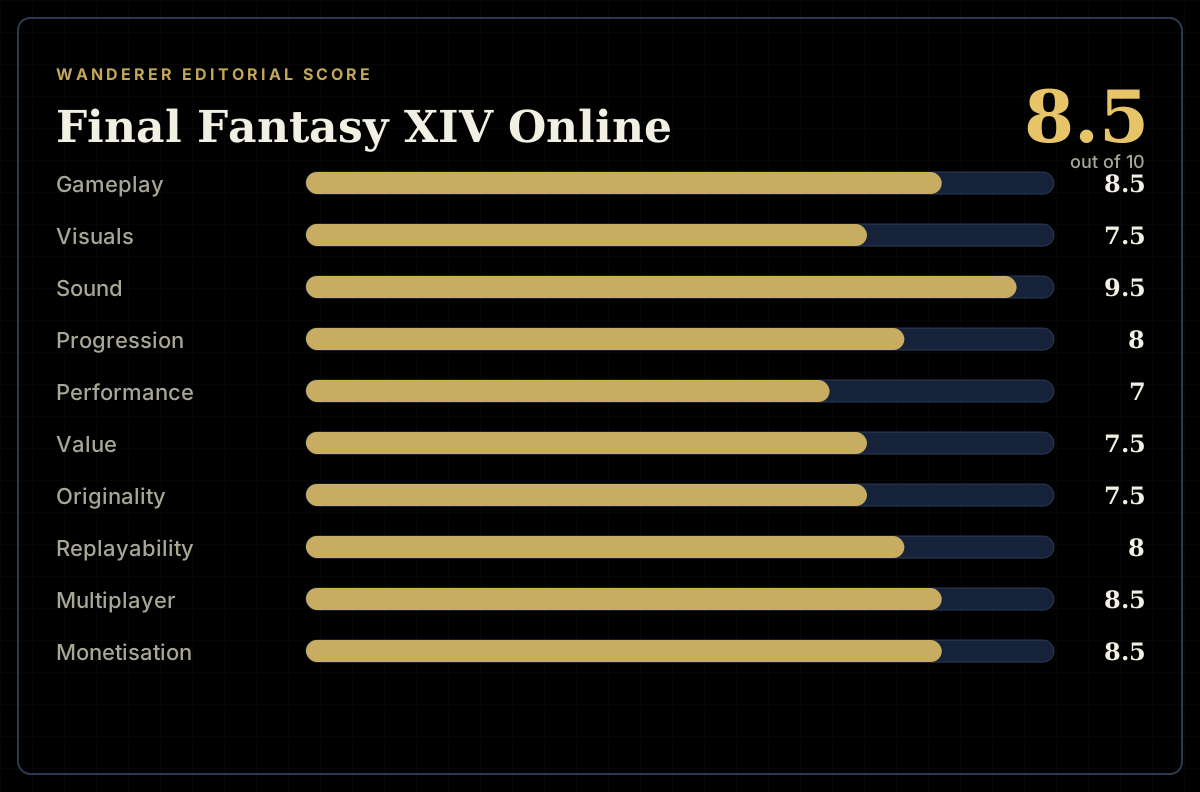
How the review scores each part of the gameWanderer Editorial -
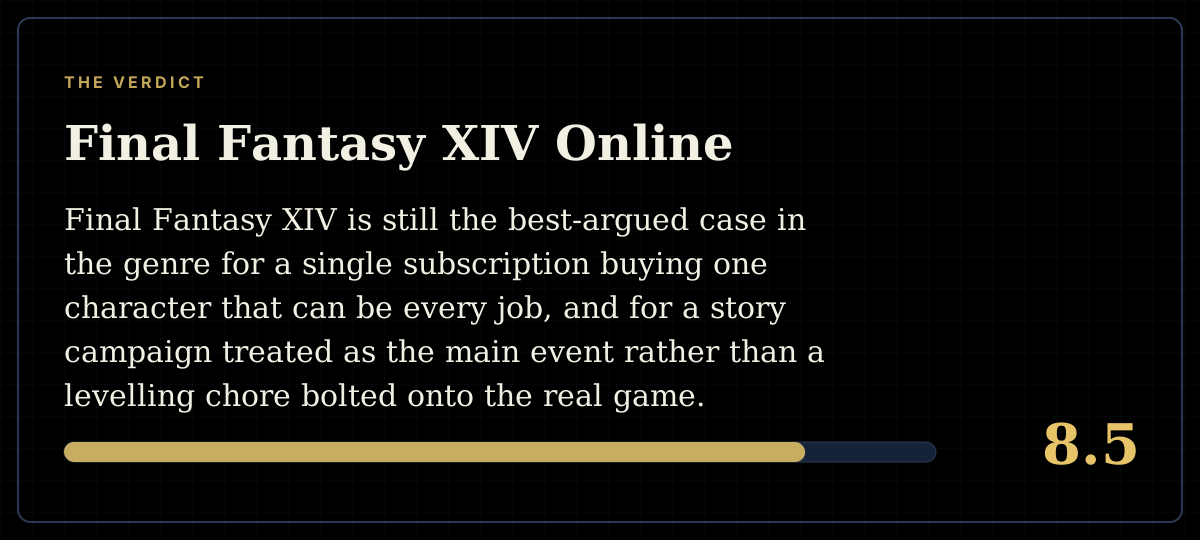
The short versionWanderer Editorial