Game review
World of Warcraft
7.5 / 10
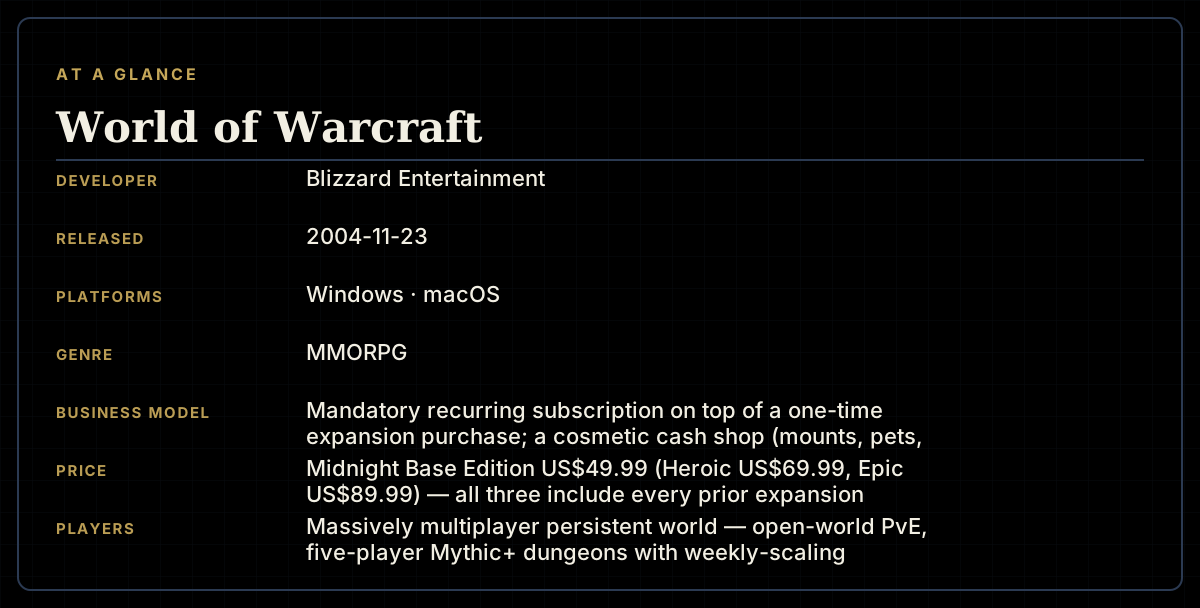
- Developer
- Blizzard Entertainment
- Publisher
- Blizzard Entertainment
- Released
- 23 November 2004
- Platforms
- Windows, macOS
- Genre
- MMORPG
- Monetisation
- Mandatory recurring subscription on top of a one-time expansion purchase; a cosmetic cash shop (mounts, pets, transmog, character services) sells for real money; the Trading Post sells a rotating monthly catalogue for Trader's Tender, a currency that is nominally free but tied to an active subscription; WoW Tokens convert real money into either subscription time or auction-house gold; the new Player Housing system layers in Hearthsteel, a premium currency for some decor
- Players
- Massively multiplayer persistent world — open-world PvE, five-player Mythic+ dungeons with weekly-scaling keystones, raiding across LFR/Normal/Heroic/Mythic difficulties, structured and open-world PvP, and now player housing neighbourhoods shared with guildmates and friends
The short version
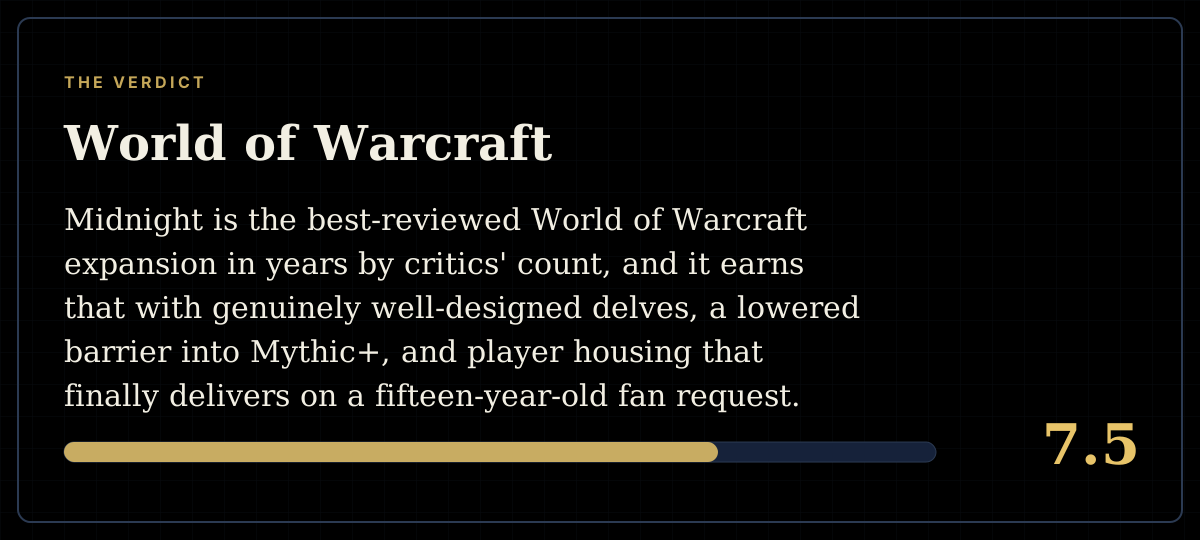
Midnight is the best-reviewed World of Warcraft expansion in years by critics' count, and it earns that with genuinely well-designed delves, a lowered barrier into Mythic+, and player housing that finally delivers on a fifteen-year-old fan request. None of that changes what it costs to actually be here: an expansion purchase, a mandatory subscription with no ceiling in sight, and a cosmetic shop plus a housing currency that keep finding new ways to ask for more on top of both.
This is still one of the deepest, best-designed combat and class systems in the genre, sitting inside one of its most expensive live-service stacks — and the gap between Midnight's 82 Metascore and its rough 4.5 user score on the same site is a fair summary of how split that verdict actually is among the people paying for it.
Biggest strengths
- Delves and the lowered Mythic+ entry bar in Midnight give solo and casual players real access to endgame-quality loot without needing a raid guild
- Player housing finally arrived with genuine depth — house plots, neighbourhoods and a decor system built for creativity rather than gated behind loot RNG
- A single subscription now unlocks every expansion back through The War Within, so returning players aren't asked to buy a decade of old boxes just to log back in
Biggest weaknesses
- A brand-new character's route to the current level cap is a scattered mix of Exile's Reach, Chromie Time old-expansion options and a Dragonflight redirect, with no single authored path the way rival MMOs offer
- Hearthsteel, the new premium currency gating some housing decor, undercuts Blizzard's own pre-launch promise that housing wouldn't be paywalled
- The subscription plus a US$50-90 expansion purchase plus an optional cosmetic shop adds up to one of the more expensive ongoing live-service stacks in the genre, before a single mount is bought
Who it's for: Players who want the deepest class and endgame systems the MMO genre has ever built, and who are fine paying a recurring fee for that depth indefinitely. A poor fit for anyone hoping to reach current content in a weekend, or who resents a subscription model stacked with an additional cosmetic shop and a housing currency on top.
Our recommendation: Try the free trial to level 20 first — it costs nothing and shows you Exile's Reach, the actual combat and quest design, before any purchase decision. Decide separately, and honestly, whether the ongoing subscription is worth it for you; the expansion purchase only matters once that answer is yes.
7.5 / 10
Twenty-one years after launch, World of Warcraft is still adding entire systems it never had. Player housing — a feature fans have asked for since roughly the Wrath of the Lich King era — shipped for the first time this March, inside the game's eleventh expansion. That a game this old can still land a genuinely new pillar system, and land it well enough to pull a "Generally Favorable" 82 Metascore from critics, says something about how much runway Blizzard still sees in the subscription model most of the genre has spent the last decade abandoning. That the same expansion sits at a rough 4.5 out of 10 from its own players on that same site says something else entirely, and reconciling that gap is the actual question this review has to answer: not whether World of Warcraft is still a well-made game — it obviously is — but whether what it costs to keep playing it in 2026 is still a fair trade.
Where the story is right now
Midnight is current. It launched worldwide on 2 March 2026 as the second chapter of the Worldsoul Saga, the three-expansion arc Blizzard announced back in 2023 running from The War Within (August
- through Midnight to a still-in-development third chapter, The Last Titan, set in Northrend.
The pitch this time pulls the story back to Quel'Thalas: Xal'atath, the Harbinger who closed out The War Within as the new primary antagonist, tears open a Void incursion that threatens the blood elf and high elf homelands, the level cap rises to 90, and four zones — Eversong Woods, Zul'Aman, Harandar and the new Voidstorm — carry most of the new content across eight dungeons, three raid tiers and ten delves. A new allied race, the Haranir, and a third Demon Hunter specialisation, Devourer, round out the systems additions.
None of that needs to be taken on faith from Blizzard's own marketing. Independent critic coverage across two dozen-plus outlets landed the expansion at 82 on Metacritic, and the specific praise is consistent across most of it: delves feel genuinely redesigned this time, not recycled, several running closer to compact single-player dungeon crawls than the "generic instanced content" delves launched as in The War Within; Mythic+'s entry barrier has been meaningfully lowered, opening the mode to players who'd previously bounced off its reputation; and the opening raid tier is broadly regarded as solid, if not among the genre's best in recent memory. The counterweight is that same 82-versus-4.5 critic/player split, and it's worth being precise about what that split is actually measuring rather than dismissing it as review-bombing. A 155-review user sample on one aggregator is small next to a playerbase in the millions, and it skews toward people motivated enough to leave a negative rating — which usually means monetisation complaints, server stability gripes during launch weeks, and long-standing grievances that predate this specific expansion. It is not, by itself, proof the expansion plays badly. It is proof that a meaningful, vocal slice of the existing playerbase feels like the deal they're being offered has gotten worse even while the content on top of it has gotten better — and both halves of that sentence turn out to be true.
A new character's actual road to today
Start a fresh account in mid-2026 and the first thing you'll experience is Exile's Reach, a short, well-made solo tutorial zone that takes a new character to roughly level 10 while explaining class basics without any subscription requirement at all. Everything up to level 20 is free to any account, full stop — no trading, no auction house, no guilds, but a genuine, unrestricted taste of questing and combat. Push past level 20 and the game asks for a subscription or purchased game time, and here the path gets genuinely confusing in a way Blizzard hasn't fully solved. A new character is nudged toward Dragonflight zones to continue levelling to 80, but the game also offers Chromie Time — a system letting you level through the story of almost any past expansion instead — alongside the option to simply buy a Level 80 Character Boost outright as part of a Midnight purchase. That's three different roads to the same number, with no single authored thread the way Final Fantasy XIV structures its entire pre-endgame around one Main Scenario Quest, or the way a newer MMO would build a curated new-player critical path. Flexibility is the intended selling point — you can level through whichever old expansion's story actually interests you — but the practical effect for someone who has never played WoW before is a menu of unfamiliar proper nouns (Chromie Time, Dragonflight, Warbands) with no obvious "correct" choice, at exactly the moment a new player needs the game to be legible rather than customisable.
The genuinely good news buried in that mess: since late 2021, every expansion purchase plus an active subscription now unlocks the entire back catalogue through the previous expansion, not just the newest one. A returning or brand-new subscriber isn't being asked to separately buy Wrath of the Lich King, Cataclysm, Mists of Pandaria and eight more boxes just to see them — Midnight alone grants everything back through The War Within. That's a real improvement over the WoW of a decade ago, and it's the one part of the onboarding story that has unambiguously gotten better rather than more complicated.
What the subscription and expansion actually cost
The subscription itself has a genuinely unusual pricing story. In the US, the monthly rate has reportedly sat at US$14.99 for well over two decades without a base increase — a striking piece of pricing stability in an industry that raises subscription tiers on nearly everything else on a regular cadence. New Zealand hasn't been so fortunate: the local monthly rate rose to NZ$26.99 in February 2025 (from NZ$23.99), alongside similar increases across several other regions, and further increases landed in the UK, Turkey, Georgia and Kazakhstan in June 2026. Three- and six-month commitments knock the effective monthly rate down a little in every region — NZ$75.57 for three months, NZ$140.34 for six, working out to roughly NZ$23.39 a month on the longest plan — but there's no version of this subscription that gets meaningfully cheaper the way some competitors' does, and there's no free-to-play tier beyond level 20 at all.
On top of that recurring cost sits the expansion purchase itself: US$49.99 for the Base Edition, climbing to US$69.99 (Heroic) and US$89.99 (Epic) for cosmetic mounts, transmog sets and bonus Trader's Tender, plus a US$139.99 Collector's Edition for physical goods. Every tier includes an Enhanced Level 80 Character Boost — which is worth pausing on, because a purchasable full-level boost is, functionally, a pay-to-skip-the-game option sold at the front door of an MMO whose entire genre identity is built around earned character progression. It's not new to Midnight, and it's not disguised as anything else, but it's also not nothing: a returning player with a maxed-out credit card can walk in at endgame-adjacent power on day one, while a player without one grinds through content the boost-buyer skipped entirely.
Then there's the WoW Token, priced at NZ$36 / US$20 as of this review. A Token is a real-money purchase that converts, at the buyer's choice, into either subscription time or gold sold on the in-game auction house at a player-driven exchange rate. It's a legitimate, Blizzard-sanctioned alternative to third-party gold-selling sites, and by that measure it's a genuine consumer protection — but it also means the game runs a live, official market where real money quietly becomes in-game purchasing power for anything gold can buy, including carries, boosts and crafted gear from other players. That's a different kind of monetisation pressure than a cosmetic shop, and it's worth knowing it exists before assuming "subscription MMO" means gold has stayed purely a gameplay reward.
The Trading Post, and now Hearthsteel
Layered on top of the subscription is the Trading Post, a rotating monthly catalogue of mounts, transmog, pets and toys purchasable with Trader's Tender — a currency nominally earned through play rather than bought outright, tied to having an active subscription and completing a short monthly checklist. In principle, that's close to the more honest end of live-service monetisation: nothing purchasable is stat-bearing, and a subscribed player who logs in regularly earns enough Tender to grab most months' rotation for free. In practice, the system has drifted since its 2022 introduction in ways players have kept flagging: real-money bundles now sell supplemental Tender directly, and even a genuine cash purchase can leave a buyer short of what a single premium cosmetic costs — reporting from February 2026 found a US$25 spend still landing short of covering multiple anniversary items in that month's catalogue. A system explicitly framed at launch as an alternative to a cash shop has been quietly growing features of the cash shop it was meant to replace.
Midnight adds a second premium currency on top: Hearthsteel, spent on some housing decor. Blizzard had explicitly said before launch that Player Housing wouldn't be paywalled, and the result — a housing system that's overwhelmingly earnable through play, with a smaller premium-currency slice sitting alongside it — is a real compromise of that promise even if it's a soft one. It doesn't gate the core of the system, but "we said this wouldn't happen and then it happened a little" is exactly the kind of monetisation drift that erodes trust in a subscription game faster than an honest cash shop that never claimed otherwise would.
Delves, Mythic+ and raiding: three doors into the same house
The actual endgame structure in Midnight is genuinely well laid out for different kinds of players, and this is where the critic praise is easiest to agree with. Delves are solo-to-small- group instanced content, scalable in difficulty, that reward gear competitive with the lower raid tiers without requiring a guild, a scheduled raid night, or even a second player — several of Midnight's new delves are maze-like enough to function as compact solo dungeon crawls in their own right, a real step up from The War Within's more repetitive first pass at the format. Mythic+ sits above that: five-player scaling dungeons on a weekly keystone system, and Midnight specifically lowered the skill and gear floor to enter it, opening a mode that had built a reputation as gatekept and stressful to a wider slice of the subscriber base. Raiding tops the structure across the usual LFR, Normal, Heroic and Mythic difficulties, feeding the Great Vault — a weekly loot-choice system that rewards whichever of these activities you actually did that week rather than forcing raid attendance for the best gear.
The catch, and it's a real one, is the calendar attached to all of it. Season 2 opens 11 August 2026 — ten days after this review was written — with a full item-level reset: Great Vault rewards jump a full track across every difficulty, bonus-roll costs drop, and Season 1's Heroic and Mythic gear, which represented real weekly time investment for months, becomes outclassed within the first weeks of the new tier. That's standard practice across the genre's seasonal-content model at this point, and Blizzard runs a Turbulent Timeways catch-up event (30 June through 11 August 2026) specifically to soften the transition for players who fell behind — but it's still the honest shape of the deal: progress here has an expiry date set by Blizzard's content calendar, not by anything the player controls, and a subscriber who takes a season off returns to find last season's proudest gear functionally a levelling stepping-stone.
Housing, finally, mostly done right
Player Housing is the single biggest new pillar in Midnight, and on the design fundamentals it's been received as a genuine success — a system built for actual creative expression rather than a shallow cosmetic add-on, with house plots, neighbourhoods shared with friends and guildmates, and a decor catalogue deep enough that reviewers have compared the ceiling to dedicated building/decoration games. The friction that's emerged since launch is less about the system's design and more about its pacing: a genuinely large decor collection sitting behind a genuinely long grind, and — as covered above — a small slice of that catalogue behind Hearthsteel rather than pure play-time. Judged purely as a feature, housing is exactly the kind of system that makes subscribing feel like it's still buying meaningful new things this many years in. Judged as part of the wider monetisation picture, it's one more system that started with a clean promise and has already picked up a premium-currency asterisk within its first few months.
Combat, class design and where the interface still leads the genre
None of the above changes the fact that class and combat design remain World of Warcraft's clearest claim to still being the genre's technical leader. Across roughly forty specialisations spanning thirteen classes, the differences aren't cosmetic — a Fire Mage and a Frost Mage share a class name and almost nothing else about how they play, and that depth of differentiation, refined over two decades of balance patches, has no real equal among current MMOs. The interface built around all of that — action bars, unit frames, raid-cooldown tracking, a mature and deep addon ecosystem that effectively lets players build their own UI from parts — remains genuinely best-in-class for players willing to invest the time to configure it, even if that same depth is exactly what makes the default new-player experience feel cluttered. Sound design and music have been a consistent strength since the original 2004 release and Midnight doesn't break that streak; the game's orchestral score is still routinely cited as one of the best in the genre, expansion after expansion.
Verdict
Midnight earns its 82 Metascore honestly. Delves are better designed than they've ever been, Mythic+ finally opened its door to more of the subscriber base, the raid tier is solid, and player housing is a legitimately deep new pillar that took the game somewhere it had genuinely never been before. None of that is marketing spin — it's the part of this review that critic consensus and this analysis agree on completely.
What keeps the score from climbing higher is everything sitting underneath that content: a subscription with no ceiling and rising in several regions even while the US rate holds, an expansion purchase on top of it that itself contains a pay-to-skip levelling boost, a Trading Post that keeps finding new ways to ask a subscriber for more real money than the "earn it free" pitch implies, a new housing currency that broke its own pre-launch promise within months, and a seasonal gear reset that quietly expires months of a subscriber's own weekly effort on a schedule they don't control. Individually, none of these is unique to World of Warcraft — plenty of live-service games run some version of each. Stacked together, on top of the deepest and most expensive commitment the MMO genre still asks for, they're the honest reason a game this well-reviewed by critics can sit at a 4.5 with the people actually paying the bill.
If you want the deepest class design and endgame structure the genre has ever built, and you're comfortable with an open-ended monthly cost that keeps finding new ways to grow, Midnight is a genuinely strong version of World of Warcraft to start or return with. If what you want is a clean, predictable, honestly-priced MMO subscription, look at what it actually costs before you commit — because the number on the box has stayed the same for twenty years, and almost nothing built around it has.
For readers comparing the whole subscription-MMO field rather than just this one entry, Wanderer's reviews of Final Fantasy XIV and Guild Wars 2 are worth reading alongside this one — both land on noticeably more contained cost structures than the one described above, for very different reasons. Players who'd rather their progression kept ticking along without any subscription meter running at all might also want to look at Wanderer itself.
Pros and cons
Pros
- Delves and the lowered Mythic+ entry bar in Midnight give solo and casual players real access to endgame-quality loot without needing a raid guild
- Player housing finally arrived with genuine depth — house plots, neighbourhoods and a decor system built for creativity rather than gated behind loot RNG
- A single subscription now unlocks every expansion back through The War Within, so returning players aren't asked to buy a decade of old boxes just to log back in
- Class and combat design remain the deepest and most varied in the genre, with dozens of specialisations that play nothing alike from one to the next
- Twenty-one years of accumulated systems mean there is always something running, from daily world quests to weekly Mythic raid progression
Cons
- A brand-new character's route to the current level cap is a scattered mix of Exile's Reach, Chromie Time old-expansion options and a Dragonflight redirect, with no single authored path the way rival MMOs offer
- Hearthsteel, the new premium currency gating some housing decor, undercuts Blizzard's own pre-launch promise that housing wouldn't be paywalled
- The subscription plus a US$50-90 expansion purchase plus an optional cosmetic shop adds up to one of the more expensive ongoing live-service stacks in the genre, before a single mount is bought
- Season 1 gear is largely obsolete the moment Season 2's Great Vault reset lands on 11 August, so months of raid and Mythic+ progress reset on Blizzard's calendar, not the player's
- Midnight's Metacritic user score sits far below its critic score, and recurring player complaints about Trading Post currency value have carried over from previous expansions unresolved
Screenshots
-
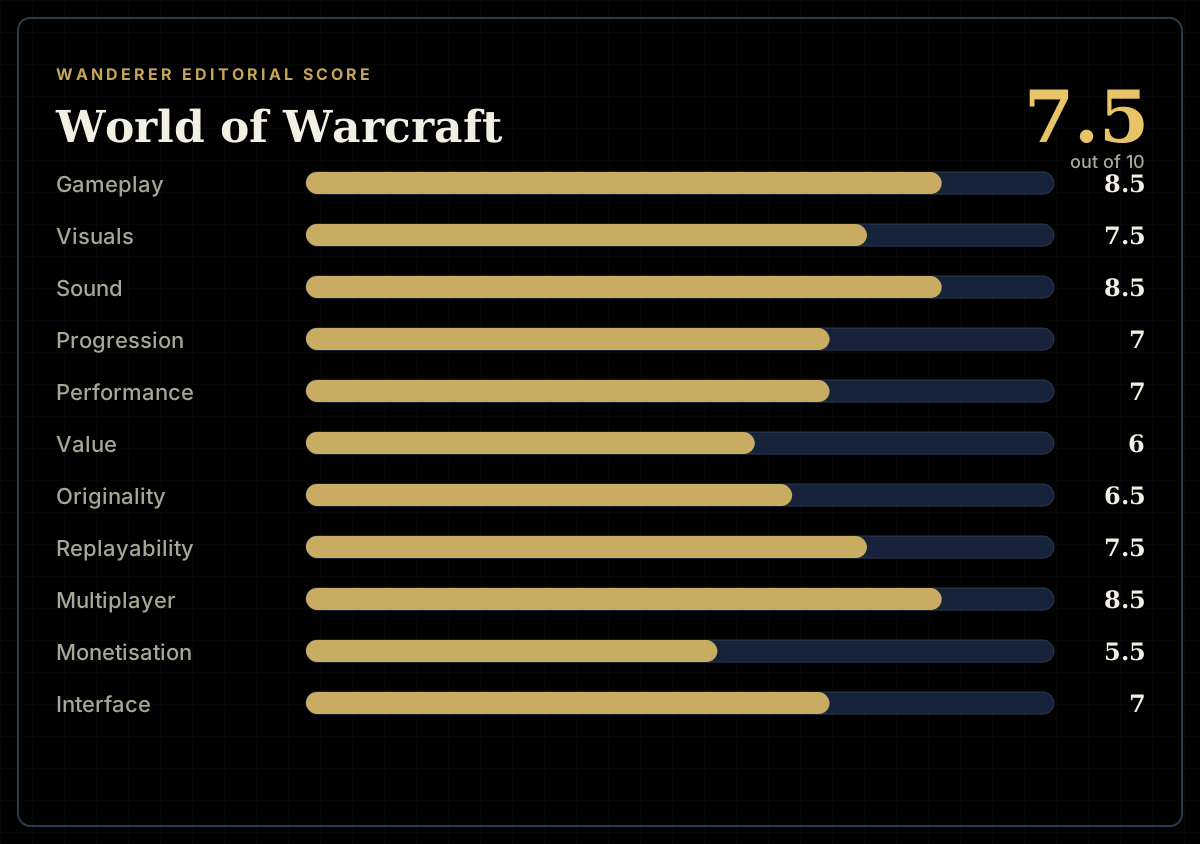
How the review scores each part of the gameWanderer Editorial -
The game at a glanceWanderer Editorial -
The short versionWanderer Editorial