Game review
Guild Wars 2
8.5 / 10
- Developer
- ArenaNet
- Publisher
- ArenaNet, NCSOFT
- Released
- 28 August 2012
- Platforms
- Windows
- Genre
- MMORPG
- Monetisation
- Buy-to-play per expansion, no subscription ever; a free account exists but is meaningfully restricted; the Gem Store sells cosmetics, convenience and account unlocks for real money or gold-purchased gems, never player power
- Players
- Massively multiplayer persistent world — open-world PvE with public dynamic events, five-player instanced fractals, ten-player raids, structured 5v5 PvP and large-scale WvW
The short version
Guild Wars 2 has spent fourteen years proving that an MMO doesn't need a rising level cap or a subscription to keep people playing, and the mastery system it built instead — horizontal, account-wide, never obsolete — is still the smartest piece of long-term design the genre has produced. Six expansions and a genuinely restricted free tier make the honest 2026 buy-in more expensive and more confusing than the "no subscription" pitch suggests, but nothing it sells touches player power, and almost nothing else in the genre matches its open-world combat.
Biggest strengths
- No subscription and no separate power-selling cash shop — every expansion purchase is permanent and never expires or downgrades
- Horizontal mastery progression means a character finished during Heart of Thorns is still fully competitive in Visions of Eternity's endgame
- Dynamic events scale to however many players show up and never wall anyone off into a private instance to progress the story
Biggest weaknesses
- A free account is a real restriction, not a light one — level-gated maps, a Trading Post limited to a fixed item list and throttled whispers make the opening hours feel closer to a demo than the pitch admits
- Owning all six expansions individually runs to roughly US$135 / NZ$211 before a single gem is spent, and the two oldest only come bundled together
- WvW's World Restructuring has run as an "always-on beta" since June 2024, and the Alliances phase it was building toward still hasn't shipped
Who it's for: Players burned out on gear treadmills and monthly fees, who want an MMO where a character built in 2015 is still exactly as strong as one built last week. A poor fit for anyone who wants a rising number to chase, or who expects the free version to be the whole game.
Our recommendation: Play the free account first — it's genuinely capped, but the raptor mount, core maps and five professions are enough to know whether the combat and the open-world event loop click. If they do, the Starter Pack is the cheapest way to remove the friction before committing to an actual expansion.
8.5 / 10
Guild Wars 2 has been sitting at level 80 since August 2012, and that single, stubborn refusal is still the most consequential decision in a genre built on selling players the same numbers again every twelve to eighteen months. Six expansions and thirteen years later, the level cap hasn't moved, gear power topped out at Ascended years ago, and the character you finished during Heart of Thorns is not weaker than the one you rolled last week for Visions of Eternity. Everything ArenaNet has added since launch — mounts, masteries, elite specialisations, entire new regions — has gone sideways instead of up. That bet is the reason this is still one of the most respected MMOs on the market, and it's also the reason a genuinely new player in 2026 faces a strange, layered decision about what to actually buy.
Horizontal progression, stress-tested for a decade
"Horizontal progression" gets thrown around loosely enough that it's worth being precise about what Guild Wars 2 actually built. Mastery points, not experience, drive post-80 advancement: you earn them from story chapters, world exploration and expansion-specific content, then spend them on permanent, account-wide unlocks — gliding from Heart of Thorns, the mount roster built out across Path of Fire and End of Dragons, fishing and jade-tech piloting, Secrets of the Obscure's flight training, Janthir Wilds' warclaw and homesteading, and now Visions of Eternity's Castoran survivalist and wild magic lines. None of it makes your character numerically stronger against a given enemy. All of it makes the world bigger — new verticality, new traversal, new ways to reach a vista or start a fight — and all of it stays relevant forever, because there's no higher tier of mount speed waiting in the next expansion to make last year's unlock feel obsolete.
The real test of that design isn't whether it sounds good on paper — it's whether a lapsed player can come back after two years and still matter. They can. Gear caps at Ascended, a tier introduced alongside fractals over a decade ago and never superseded, and the 2021 Legendary Armory turned legendary weapons and armour from a per-character grind into an account-wide unlock shared across every alt. A returning player's biggest problem is remembering which mastery lines they haven't finished, not regearing from scratch. Almost no other major MMO can make that claim, and it's the single strongest argument for playing this over something with a rising cap: the hundreds of hours you spend here don't quietly devalue every time the developer wants to sell you the next tier.
What horizontal progression doesn't give you is momentum in the traditional sense. There's no number climbing in the corner of the screen to chase between sessions, and new players used to gear-score MMOs sometimes bounce off the opening hours precisely because nothing feels like it's going up. The payoff arrives once mastery lines start compounding — once gliding, a mount, and a map-specific ability combine to open a route that was invisible an hour earlier — but that payoff takes longer to land than a level-up chime, and the game is honest about that being the deal.
Combat and an open world that doesn't wait for you
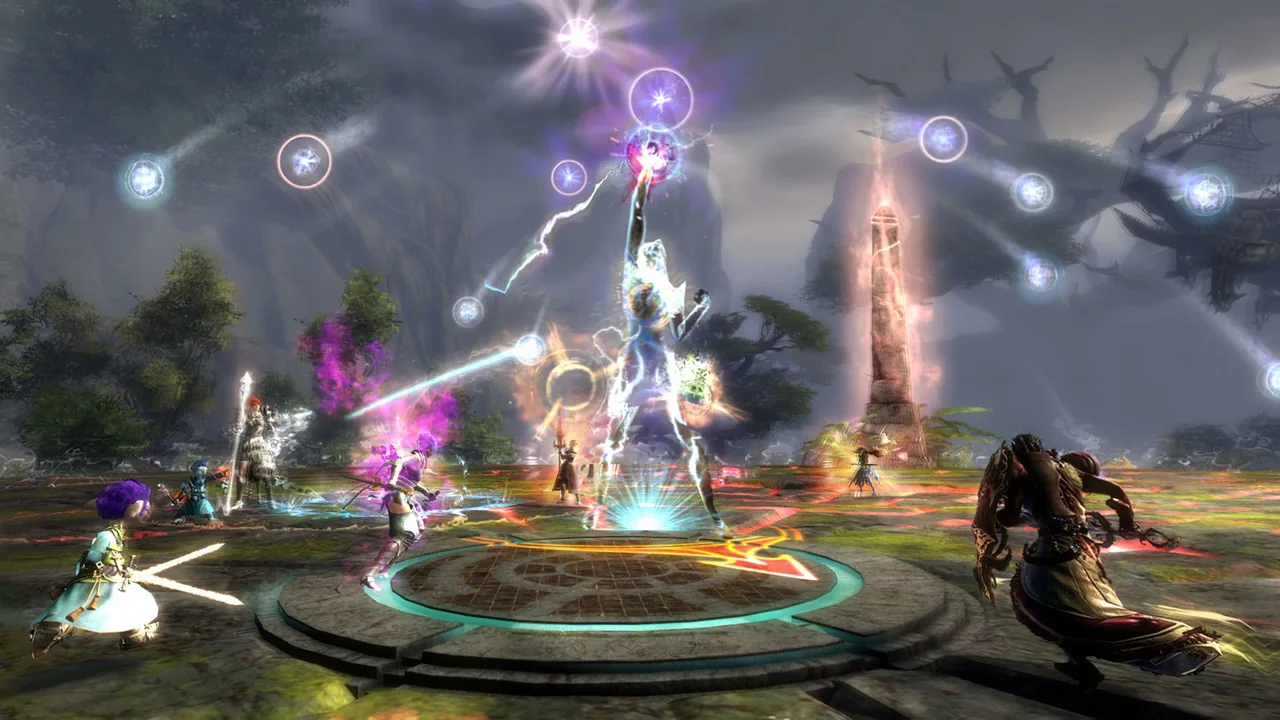
Dynamic events are still Guild Wars 2's best idea, and the fact that competitors have spent over a decade failing to copy them properly says something about how hard they are to get right. There's no quest giver handing out a solo instance; a bandit camp assault, a dragon-touched incursion or a world boss simply starts, scales to however many players show up, and keeps running whether you join or not. Nobody is locked out of anyone else's progress, nobody needs to "tag" a kill before someone faster does, and the reward structure — participation-based, not first-hit-based — means groups form and dissolve without the passive-aggressive scramble that defines shared-world content elsewhere. Visions of Eternity's Castora, launched with two of its four planned regions and the rest staggered across the year, runs on the same event spine as every zone before it, which is either comfortingly consistent or a sign the format hasn't meaningfully evolved since 2012, depending on how many hours you already have in the game.
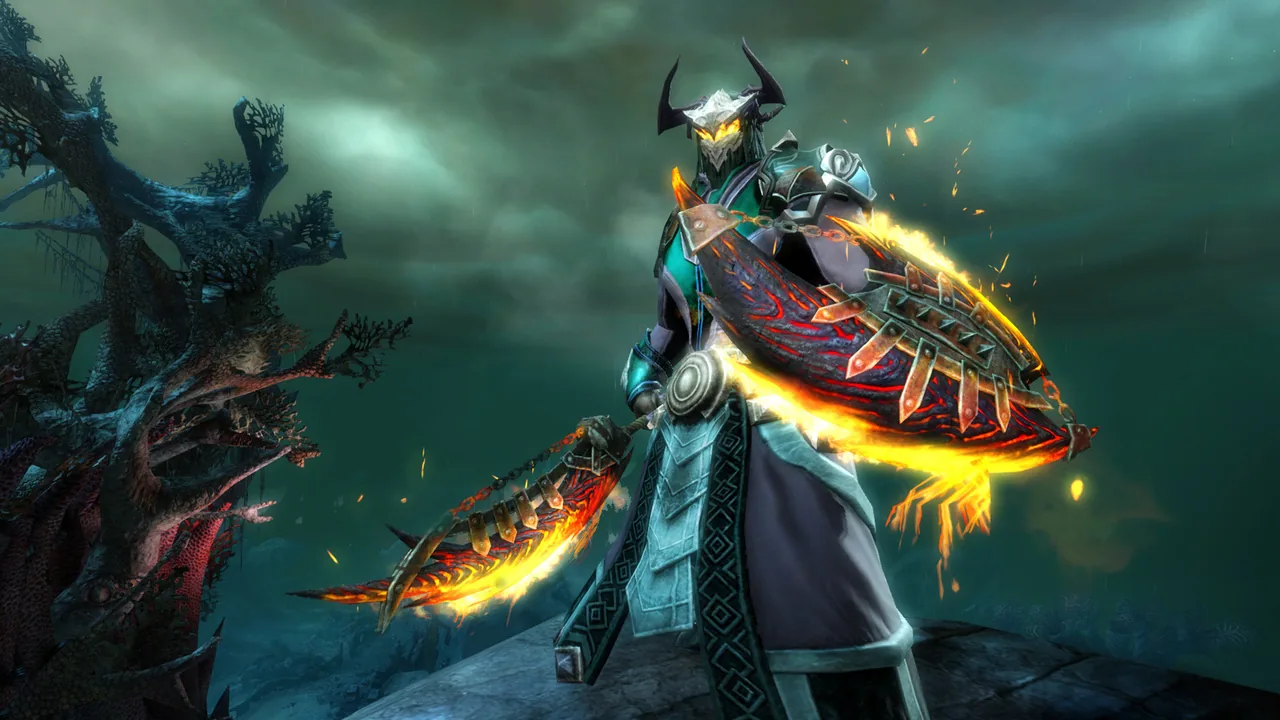
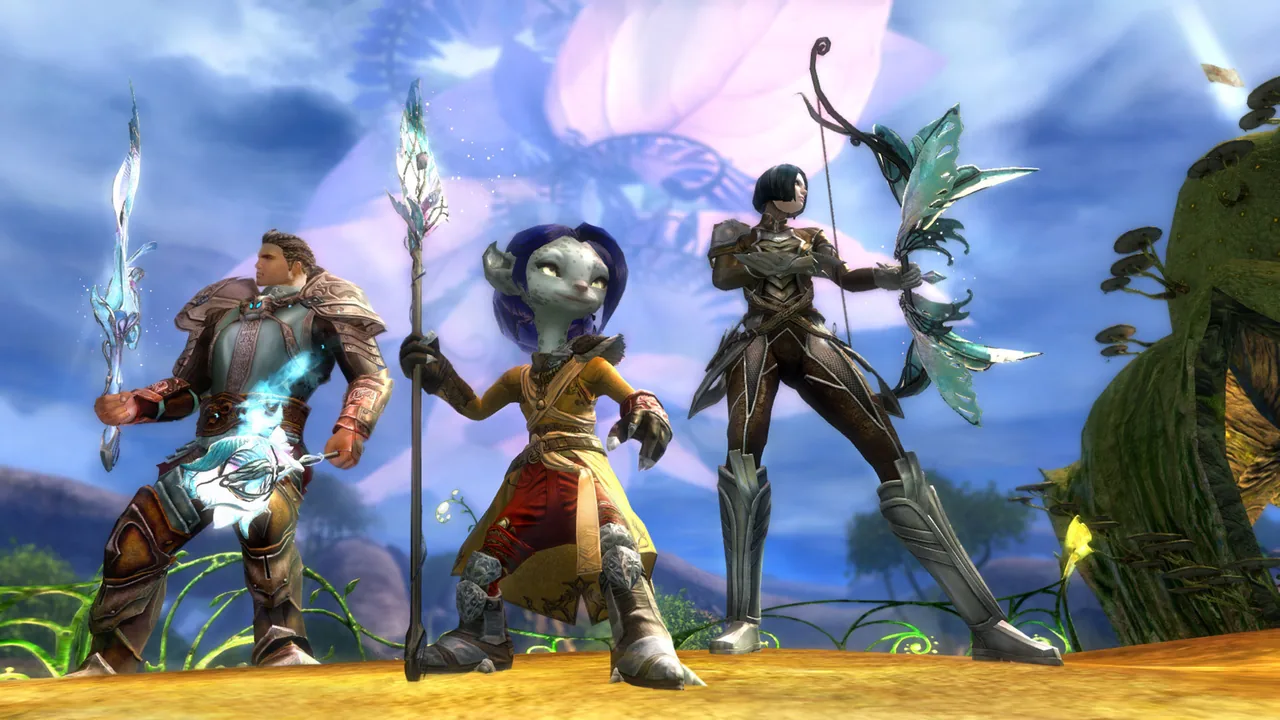
Combat itself rewards movement more than most action MMOs bother to. Dodge rolls consume a finite endurance bar, skills have real cast times and combo fields, and nine professions each carry several elite specialisations that change their entire kit rather than adding a new button to the same rotation — Visions of Eternity's nine new specialisations are the first full wave since End of Dragons, and notably arrive without new weapon types, leaning instead on reworking what existing weapons do. The skill ceiling is real: a well-played group chaining combo fields and boon uptime clears content a undercoordinated one can't, and that gap is legible even in open-world zergs, which is more than can be said for MMOs where rotation depth only shows up in raid logs nobody outside the guild ever reads.
Structured PvP and a WvW that's still finding its feet
Structured PvP is the game's most self-contained mode — everyone hits level 80 with full stats the moment they queue, so a brand-new account competes on build knowledge and mechanical skill rather than gear, which is close to the fairest starting line the genre offers anywhere.
World vs World is a rockier story to tell honestly in 2026. The old server-based world system was retired in favour of World Restructuring, which reassigns players to matchmaking teams built around guild membership rather than a fixed home server — a genuinely better idea for population balance, since it stops a single dominant server from steamrolling a match for a full season. The catch is that it's been running as an "always-on beta" since June 2024, and Alliances, the second phase meant to let allied guilds guarantee they land on the same team, still hasn't shipped. Two years is a long time for a core game mode to sit in a labelled-beta state, and it's a fair complaint from WvW veterans that the mode they care about most has been mid-transition for longer than some entire expansions take to release.
Free account, core account, full account
This is where the "no subscription" pitch needs the most unpacking, because a free Guild Wars 2 account is not the full game with a few features greyed out — it's a genuinely bounded slice. Only starter maps are reachable until level 10, Lion's Arch stays locked until level 35, WvW doesn't open until level 60, character slots are capped at two of five, bag slots drop to three, the Trading Post only buys and sells from a fixed list of basic materials, whispering strangers is throttled to one new person every thirty seconds, and in-game mail is limited to mutual friends with a weekly cap on coin received. None of that is hidden or dishonest, but it does mean the free tier functions as a long, generous trial rather than the complete horizontal-progression experience the marketing leans on — you can't actually reach WvW, the mode this review just spent two paragraphs discussing, without either levelling to 60 or paying for an unrestricted account.
The December 2025 Starter Pack exists specifically to solve that gap without asking a new player to commit to an expansion. For NZ$34.99 / US$19.99 it converts a free account into an unrestricted "core" account — full Trading Post access, all five character slots, social features, guild participation — and throws in early access to the raptor mount and gliding, a bag slot expansion, a bank tab and a full character makeover kit. It's a smart, honestly-priced product: it removes almost every point of friction a new player actually complains about without pretending to be content they haven't earned yet. Buying straight into an expansion instead gets you the same core unlock automatically, so the Starter Pack only makes sense as a cheaper stopgap for someone not yet sure they want to commit further.
What owning everything actually costs in 2026
Add it up and the "buy-to-play, no subscription" line does real work but doesn't tell the whole story. A newcomer who wants the complete modern game — every mastery line, every elite specialisation, every current map — is looking at Heart of Thorns plus Path of Fire bundled at NZ$45.61 / US$29.99, End of Dragons at NZ$45.61 / US$29.99, and Secrets of the Obscure, Janthir Wilds and Visions of Eternity at NZ$39.99 / US$24.99 apiece: roughly NZ$211 / US$135 total, checked 30 July 2026, before touching the Gem Store or any past Living World season (which unlock individually with gold-purchased gems, or were free to anyone logged in during their original release week). That's not unreasonable next to a year of a competitor's subscription, and unlike a subscription it never lapses — but it's also not the frictionless "just play" pitch the free tier implies, and a player working through six years of expansions in release order will spend a genuinely long time deciding which purchases actually matter to what they want to do first.
The Gem Store, honestly assessed
Gems are Guild Wars 2's premium currency, sold in tiers from roughly US$5 to US$100, and they are also earnable entirely through play by converting gold via the Trading Post — the same mechanism that lets a patient free-to-play-adjacent player fund an expansion purchase without ever entering a card number, not unlike a Bond in other buy-to-play MMOs. What the store actually sells holds up under scrutiny: skins, outfits, dyes, glider and mount appearances, character and bag slots, boost items and convenience passes. None of it is stat-bearing gear, none of it is a power tier unavailable through play, and thirteen years in there's still no loot box mechanic gating the good cosmetics behind randomised keys the way plenty of "no subscription" competitors eventually introduced. It is, by a wide margin, one of the more honest cash shops left in a genre that frequently isn't.
An engine showing its age, mostly gracefully
Guild Wars 2's art direction has aged far better than its engine has performed. Zone design is still genuinely gorgeous — vertical, colour-confident, willing to build an entire map around a single striking landmark rather than filling space — but the underlying tech is thirteen years old and it shows exactly where you'd expect: large WvW battles and crowded world-boss meta events can drag frame rates down hard on anything short of a strong modern rig, in a way zone design alone never would. It's a known, long-standing limitation rather than a new complaint, and it's the clearest place where the game's age costs it something visitors from newer MMOs will notice immediately.
Verdict
Guild Wars 2 is still the best working argument that an MMO doesn't need a rising number to keep mattering, and the systems built to prove it — masteries, the Legendary Armory, a genuinely cosmetic-only Gem Store — have survived six expansions and fourteen years without needing a fundamental rework. What keeps it from scoring higher isn't the design, which remains close to the best in the genre; it's the gap between the "no subscription" pitch and what a 2026 newcomer actually has to navigate to get the full experience — a real restricted tier, a six-expansion buy-in that adds up fast, and a WvW mode still labelled beta two years into its own overhaul. None of that touches player power, and none of it is dishonest. It just means the free version is a trial, not the whole game, and knowing that going in is the difference between a smooth first month and a frustrating one.
Players who like the idea of progress that never expires but would rather it kept ticking along without a raid roster or a guild to coordinate might also want to look at Wanderer — a much smaller game built around the same instinct that levels shouldn't have to reset for the next update to matter.
Pros and cons
Pros
- No subscription and no separate power-selling cash shop — every expansion purchase is permanent and never expires or downgrades
- Horizontal mastery progression means a character finished during Heart of Thorns is still fully competitive in Visions of Eternity's endgame
- Dynamic events scale to however many players show up and never wall anyone off into a private instance to progress the story
- The Legendary Armory shares crafted legendary gear account-wide, ending the old grind of duplicating the same weapon for every alt
- Nine professions and dozens of elite specialisations produce genuinely different combat identities rather than reskinned hotbars
Cons
- A free account is a real restriction, not a light one — level-gated maps, a Trading Post limited to a fixed item list and throttled whispers make the opening hours feel closer to a demo than the pitch admits
- Owning all six expansions individually runs to roughly US$135 / NZ$211 before a single gem is spent, and the two oldest only come bundled together
- WvW's World Restructuring has run as an "always-on beta" since June 2024, and the Alliances phase it was building toward still hasn't shipped
- Large-scale WvW battles and crowded meta events can bring the thirteen-year-old engine to visibly reduced frame rates on modest hardware
- Legendary crafting is a genuinely enormous, multi-hundred-hour commitment that the horizontal-progression pitch doesn't fully prepare newcomers for
Screenshots
-
Guild Wars 2®Image: ArenaNet® via Steam -
Guild Wars 2®Image: ArenaNet® via Steam -
Guild Wars 2®Image: ArenaNet® via Steam -
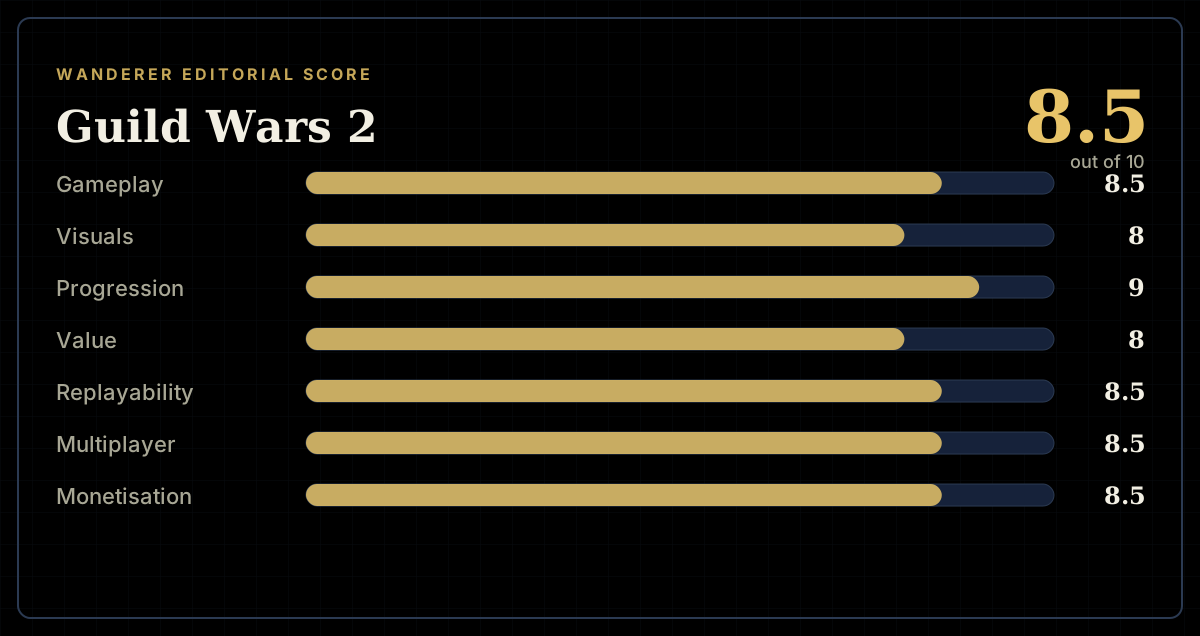
How the review scores each part of the gameWanderer Editorial -
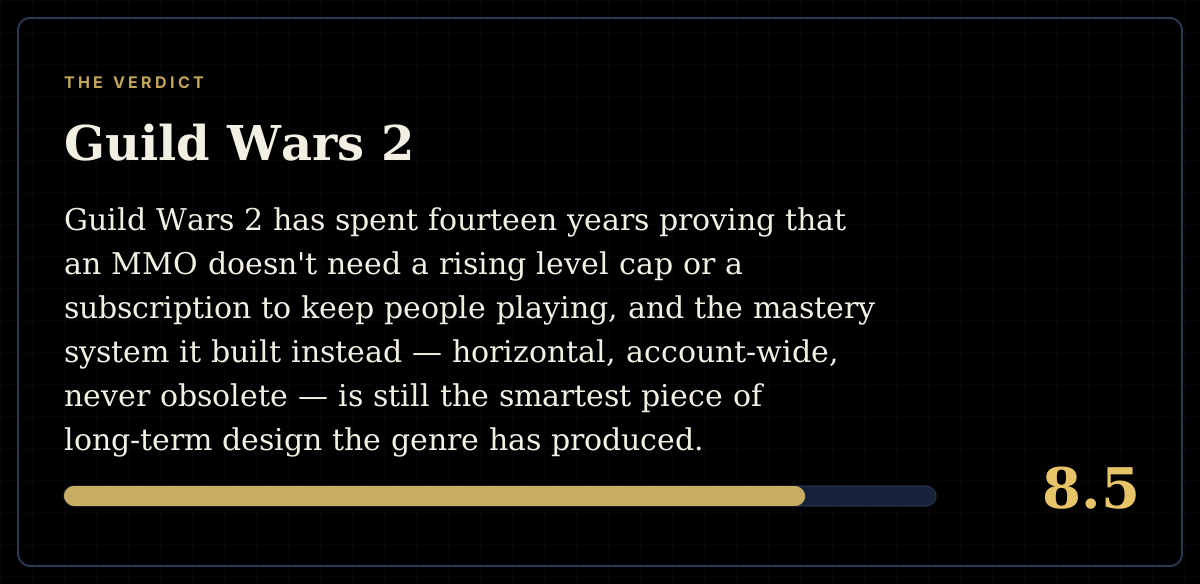
The short versionWanderer Editorial