Game review
Agari — Riichi Mahjong Review
7 / 10
- Developer
- Ryan Sullenberger
- Publisher
- Ryan Sullenberger
- Released
- 12 June 2026
- Platforms
- ["Windows", "macOS", "Linux"]
- Genre
- Strategy
Riichi Mahjong Without The Gacha
Agari is a $6.99 Riichi Mahjong client built and published solo by developer Ryan Sullenberger, released on Steam on June 12, 2026 with a clean history of steady point updates ever since, no prior early access, no demo-only pre-release. Its entire pitch is right there in its own marketing copy: "No gacha. No fan service. No login walls. No in-game payments. Buy it once, play it anywhere." That's a pointed jab at the anime-mobile-gacha aesthetic that dominates most digital riichi clients, and with 22 English reviews three months after launch, 21 of them positive, the small but opinionated review pool largely agrees that Agari delivers exactly the stripped-down, no-nonsense mahjong experience it promises, even if a few players think "stripped-down" occasionally tips into "underbaked."
A Full Ruleset, Built By Someone Who Clearly Plays
Agari implements the complete standard riichi ruleset, all 41 yaku, every yakuman, proper han and fu scoring, pao, ippatsu, rinshan kaihou, haitei, chankan, and abortive draws, and the scoring engine behind it is open source, published on GitHub as a standalone Rust crate that anyone can audit. Reviewers who've spent real time with other riichi software notice the difference. "It's fast, clean, and simple, has most of the features of the most popular clients without any of the frills," wrote one reviewer, while a reviewer with over 50 hours logged called it "a very simple, basic even from the point of view of a player, mahjong riichi game. There's nothing spectacular about it and that's exactly the best thing about it," going on to praise the roughly 100MB install size, the negligible CPU/GPU footprint, and clean native Windows, Linux, and Mac builds with no crashes.
AI Opponents With Actual Personality Settings
Rather than one generic difficulty slider, Agari lets players set each of the three AI opponents to one of four personality modes, Offensive, Balanced, Defensive, or Menzen, individually or all at once, alongside a separate overall difficulty setting. Reviewers are divided on how strong the bots actually are, but generally positive about the customization itself. "Intelligent Ai with customizability," wrote one reviewer with 40 hours logged, while another described the bots more cautiously: "The bots are not exceptionally strong but are still fun to play against and provide a challenge at an intermediate" level, adding that the developer's public roadmap lists tougher bots as a coming priority. That combination, solid-but-not-elite AI today with a transparent roadmap toward stronger opponents, seems to be earning the developer real patience from this review pool rather than frustration.
Voices That Used To Be AI-Generated, And No Longer Are
One detail surfaces from two independent reviewers that's worth calling out directly: the game originally shipped with AI-generated voice lines for its riichi calls, and the developer replaced them in a later update after community pushback. One reviewer noted plainly that "they pushed an update that removed the AI generated voices," while a separate, more critical reviewer complained more broadly about "a pervasive AI-assisted carelessness from menus to manual to mat," arguing the whole package feels "barely well enough" rather than genuinely polished. The current store page now explicitly advertises "all real human voice acting" for every chi, pon, kan, riichi declaration, and ron, several distinct voice characters split by gender, which lines up with the account of the AI voices being swapped out. It's a small but concrete example of a solo developer responding to review feedback rather than shipping and walking away, even if it also validates that at least one corner of the original release leaned on AI-generated content before launch-window criticism pushed a change.
Minimalist By Design, Occasionally To A Fault
The dominant praise across this pool is for restraint: no battle passes, no premium currency, no distracting anime mascots competing for attention with the tiles themselves. "Finally, a Mahjong game that's not plagued by anime girls and ads," wrote one reviewer, and another put it just as bluntly: "I really just wanted a pure version of the game that was easy to use and very readable and playable. This is it." But the one detailed negative review in the pool, comparing Agari point-by-point against established riichi software like Tenhou, Maru-Jan, and the free Riichi Advanced and Mattari clients, argues that minimalism sometimes just means missing features: "New players will find no teaching tools or tutorials, not even a rules leaflet," and controller support, replays, and richer rule-variant options are recurring wishlist items across multiple reviews, not just that one. For a $6.99 solo project competing against decades-old free incumbents, that's a fair tension to sit with, rather than a reason to dismiss either side of the argument.
Private Multiplayer And A Daily Puzzle, No Public Matchmaking
Beyond solo play against AI, Agari supports private online multiplayer through simple room codes, no accounts required, plus a Daily Wall mode that deals the same tile wall to every player worldwide once a day so results can be compared. Multiple reviewers specifically praise playing with real friends and family this way. "I've played a bunch of games with my wife on my laptop and hers," wrote one reviewer, while another highlighted the format's core limitation: it currently supports online play with friends and CPU-filled seats, but "you can't play with randoms," unlike public-queue platforms such as Tenhou. One of the more heavily-upvoted reviews frames that as the single feature likely to define Agari's ceiling going forward: "if this ends up having an online queue to play with randoms... it'll probably be the best riichi game barring tenhou for english-speakers," a genuinely compelling roadmap item that simply isn't built yet.
Verdict
Agari is a focused, transparently-built riichi mahjong client from a solo developer who is clearly a mahjong enthusiast first and a game designer second, and its small, largely positive review pool backs that read up: a complete, auditable open-source ruleset, genuinely customizable AI personalities, and a refreshing total absence of gacha mechanics or premium currency, undercut only by real gaps in onboarding, matchmaking, and (for now) top-tier AI strength that its own harshest reviewer argues keep it from matching more established free alternatives. The story of its AI-generated voice lines being swapped for real human voice acting after community feedback is a small but telling signal about how this developer responds to criticism, and it's the kind of detail this review pool was uniquely positioned to catch. At $6.99 with no recurring costs, it's an easy recommendation for anyone who wants a clean, no-frills way to play riichi with a private group or against customizable bots, but players hoping for public matchmaking against strangers or built-in tutorials for total beginners should know those pieces aren't here yet.
Screenshots
-
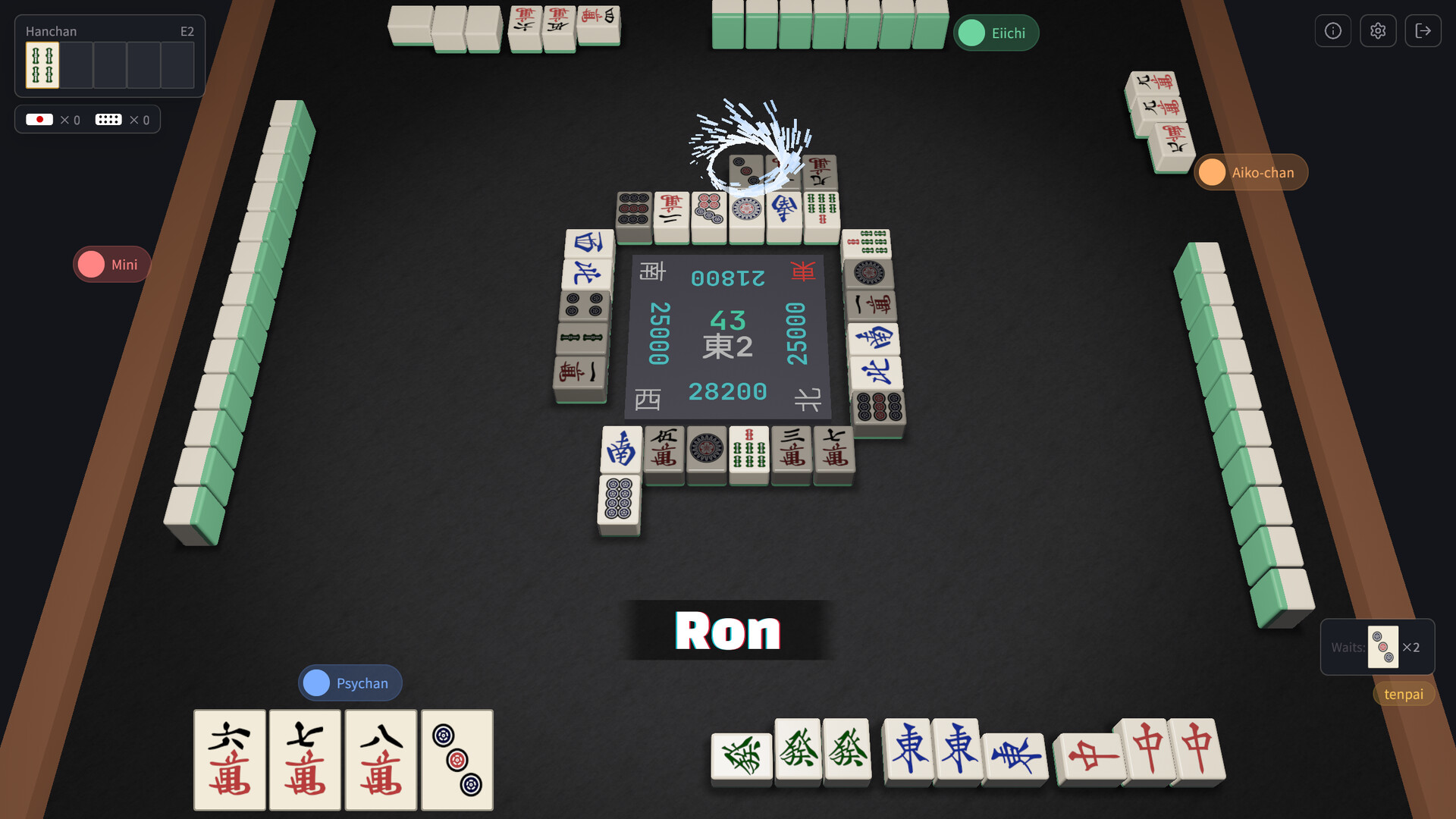
A round ending in Ron, with named AI opponents around the table and a waits indicator confirming the winning hand was tenpai.Image: Ryan Sullenberger via Steam -
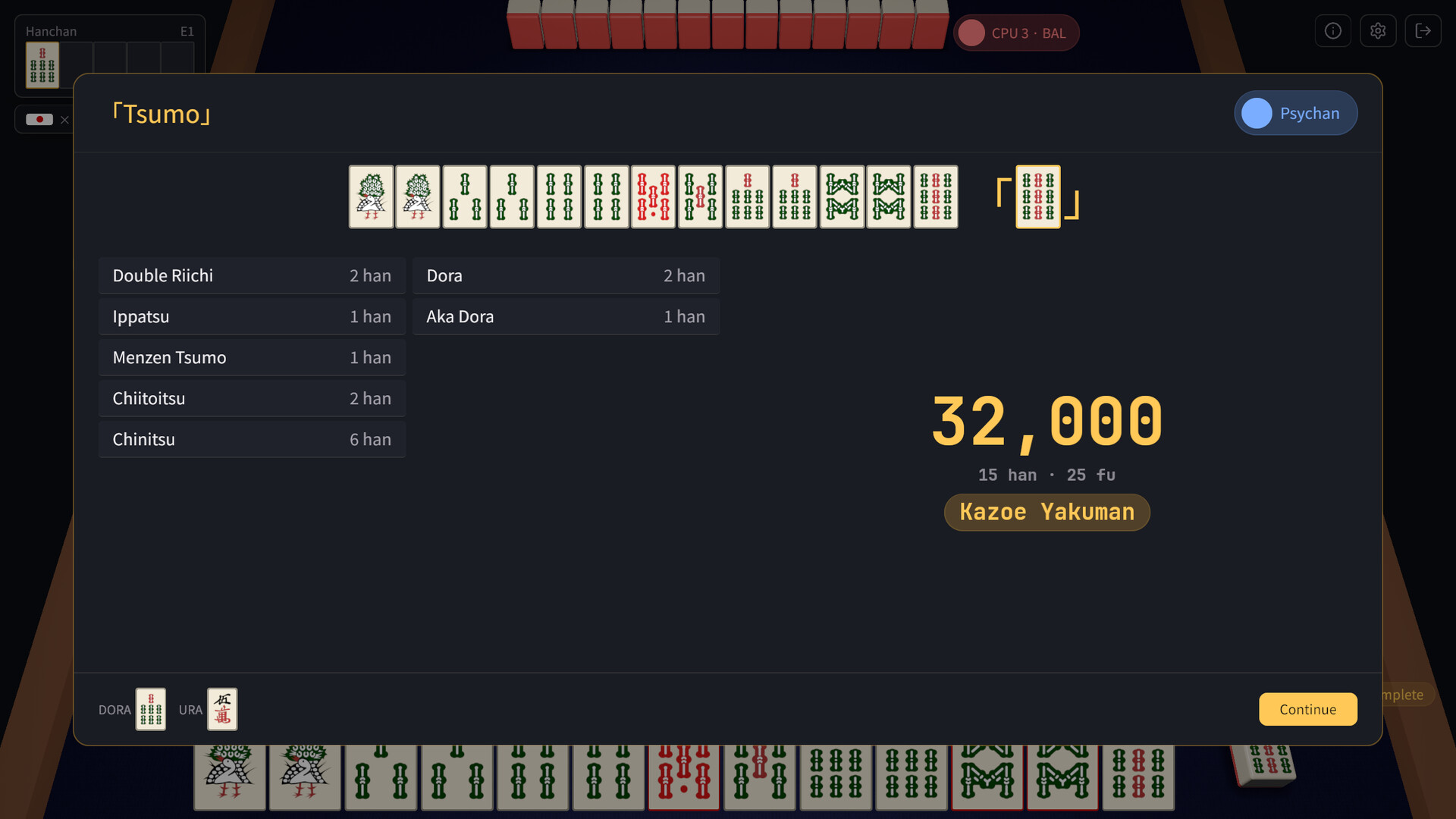
The scoring breakdown after a big Tsumo win, every yaku itemized down to the han and fu, exactly the kind of transparency the open-source scoring engine is built to guarantee.Image: Ryan Sullenberger via Steam -
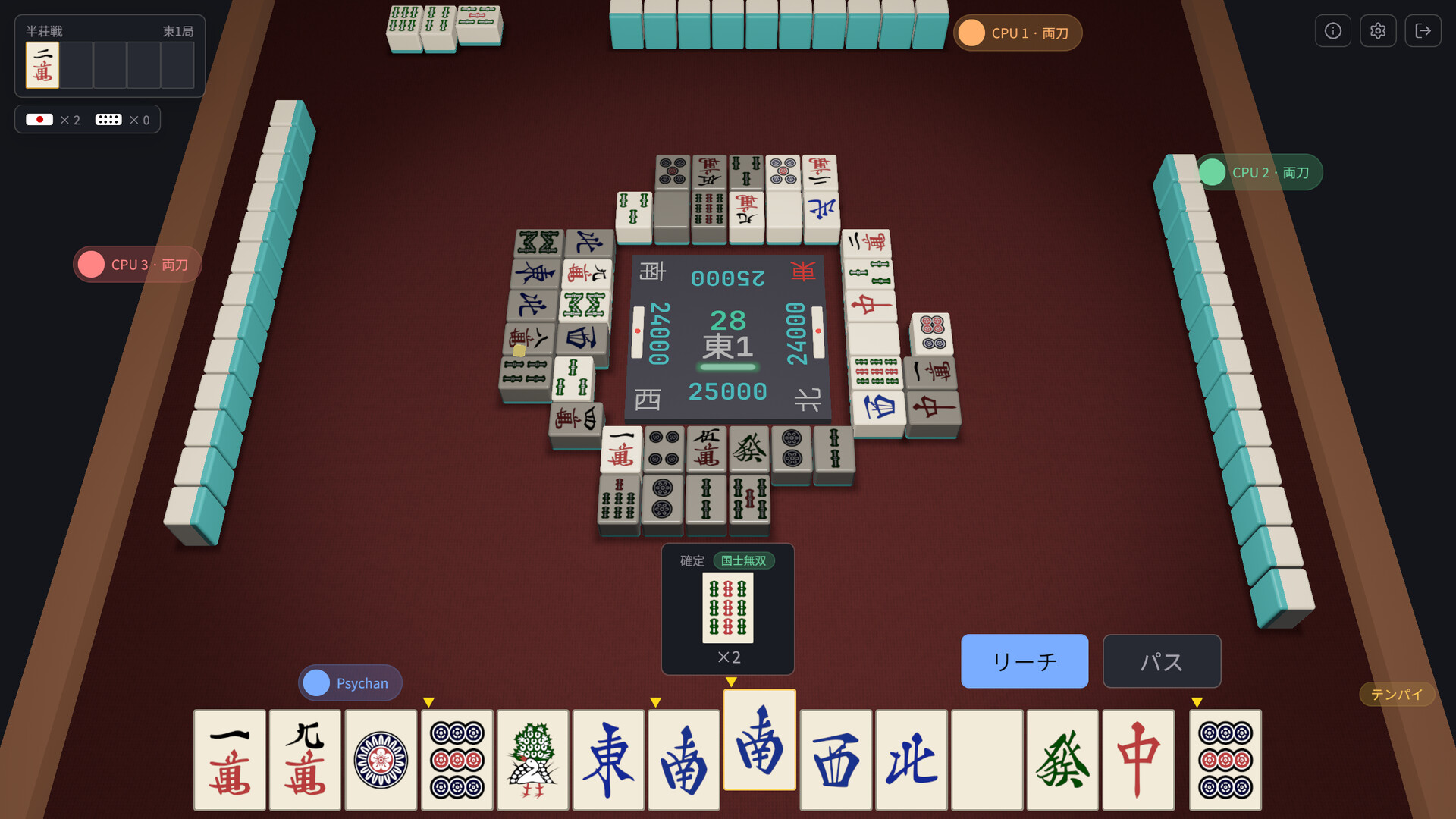
A live decision point: declare riichi or pass, with the table's Japanese-language UI and named CPU opponents on full display.Image: Ryan Sullenberger via Steam