Game review
Factorio
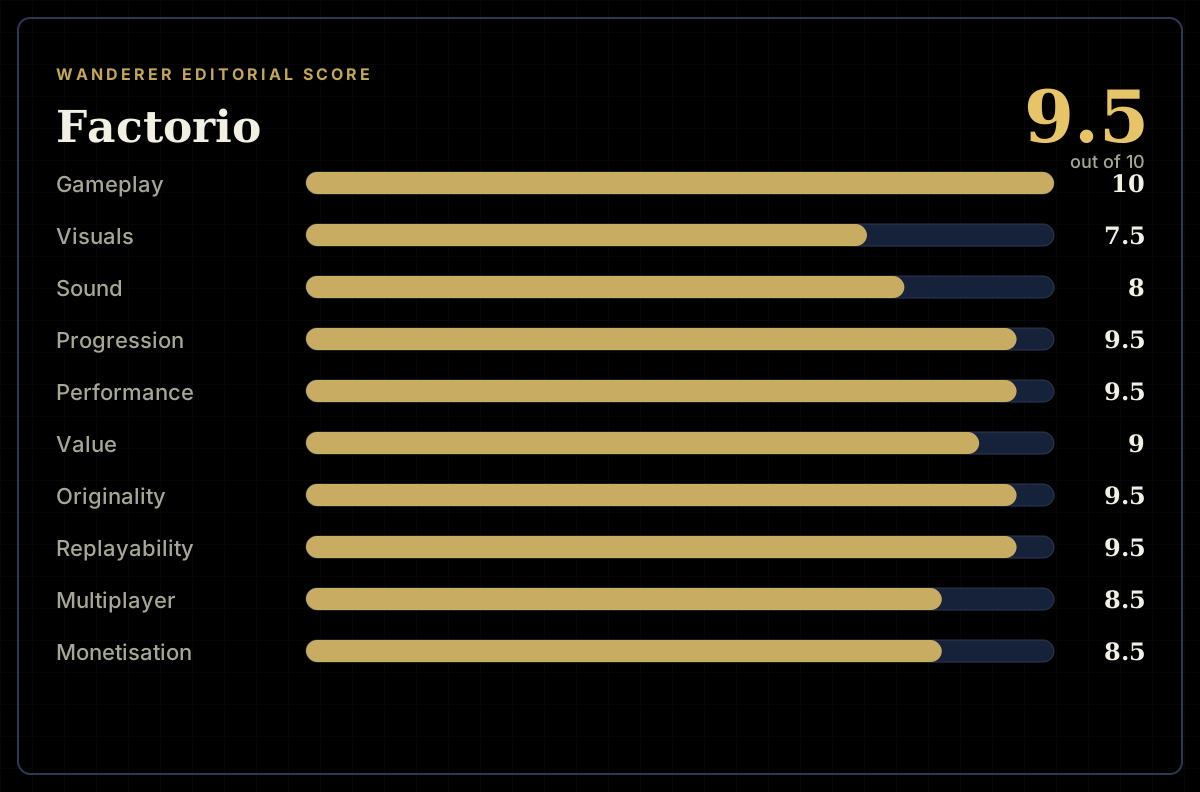
9.5 / 10
- Developer
- Wube Software LTD.
- Publisher
- Wube Software LTD.
- Released
- 14 August 2020
- Platforms
- Windows, macOS, Linux, Nintendo Switch, Nintendo Switch 2 Edition
- Genre
- Factory automation and construction strategy
- Monetisation
- Premium, one-off purchase — no in-game purchases, no premium currency, no subscription, no ads. Wube has stated publicly since Friday Facts #140 that it has no plans to ever discount Factorio, and it has kept that promise through two price rises since Early Access ($20 to $30 at the 1.0 launch, then $30 to $35 USD in January 2023, both framed by Wube as inflation adjustments rather than value changes). Space Age is a separate paid expansion at the same price as the base game, plus two optional soundtrack DLCs
- Players
- Co-op and shared-world multiplayer via deterministic lockstep networking, with no hard player cap enforced by the client; dedicated headless servers are supported and commonly used for long-running community bases
The short version
Factorio is the clearest expression there is of automation as a genre unto itself: a game built entirely out of ratios, throughput and the itch to make a number slightly bigger than it was five minutes ago, running on an engine so precisely optimised that a base with a million entities on it still ticks at sixty updates a second. Almost nothing about it is aimed at a casual audience, and it doesn't apologise for that.
The cost is real: an onboarding cliff the tutorial doesn't fully soften, combat that exists mostly to interrupt your production line rather than complement it, and a time commitment measured in hundreds of hours before a single base is finished. None of that is a flaw so much as the entry fee for the deepest, best-engineered automation game on the market.
Biggest strengths
- The ratio-and-throughput core loop turns simple arithmetic into constant, meaningful decisions from your first coal-fired miner to a megabase moving tens of thousands of items a minute
- Blueprints let you save and stamp out your own designs, turning the mid-game into systems engineering rather than repetitive manual building
- The tech tree paces new machines and mechanics precisely enough to keep introducing fresh problems instead of just bigger numbers on old ones
Biggest weaknesses
- The opening hours ask you to learn resource ratios, power, logistics and base defence all at once, and the in-game tutorial doesn't fully prepare you for what comes after it ends
- Combat against biters plays like a tower-defense minigame bolted onto a production game, and a large share of experienced players simply turn enemy aggression down or off
- The interface front-loads dense grids, tooltips and keybinds with little on-ramp for a genre newcomer beyond community wikis and video guides
Who it's for: Systems thinkers, automation and incremental players, and anyone who has ever rearranged a spreadsheet for fun. Less suited to players who want combat, story or a game that can be finished in an evening.
Our recommendation: Worth the full price without waiting for a sale that will never come. Buy the base game first — it is a complete, self-sufficient hundred-plus-hour experience — and treat Space Age as a second purchase once you've actually launched a rocket and want somewhere new to point it.
9.5 / 10
There is a particular kind of silence that settles over a Factorio session a few hours in: no music cue, no level-up chime, just the quiet mechanical hum of belts moving and the faint, growing awareness that your green circuit line is nine items a second short of what your red science needs. Nothing in the game told you to notice that. You noticed it because the game has, by then, rewired how you look at numbers. That rewiring — not the biters, not the space rockets, not even the factory itself — is what Factorio actually sells, and it is why a niche Czech studio's decade-old strategy game is still the reference point every other automation title gets measured against.
Wube Software's Factorio spent four and a half years in Early Access before its 1.0 release on 14 August 2020, and it has spent the years since adding to a game that was already, by most measures, finished. The free 2.0 update and the paid Space Age expansion arrived together on 21 October 2024, overhauling trains, adding a quality system and an in-game encyclopaedia called Factoriopedia, and extending the endgame across three new planets. None of that changed the fundamental proposition. You still start with nothing, you still end (if you get there) launching rockets, and everything in between is still built out of the same two operations: figure out a ratio, then automate it.
The purest number-go-up design there is
Strip away the pixel art and the biters and Factorio is arithmetic with consequences. A furnace smelts one plate every 3.2 seconds. A mining drill extracts at a fixed rate. An assembler needs a specific ratio of inputs to hit full output. None of this is hidden behind a levelling curve or a loot table — it's printed on the tooltip, and the entire game is the process of noticing a bottleneck, doing the division, and building the exact number of machines the math demands.
That's a genuinely unusual thing to build a AAA-adjacent commercial hit out of, and it's why Factorio reads as kin to the incremental and idle genre even though nothing about it looks idle. The satisfaction isn't combat mastery or narrative payoff. It's the moment your green-circuit throughput finally matches your red-science consumption and the whole line stops stalling — a purely quantitative win, delivered with no fanfare, that nonetheless produces the same dopamine hit as watching a big number tick over in any incremental game. The difference is that here, you built the multiplier yourself, tile by tile, and you can see exactly why it works.
From building to systems engineering
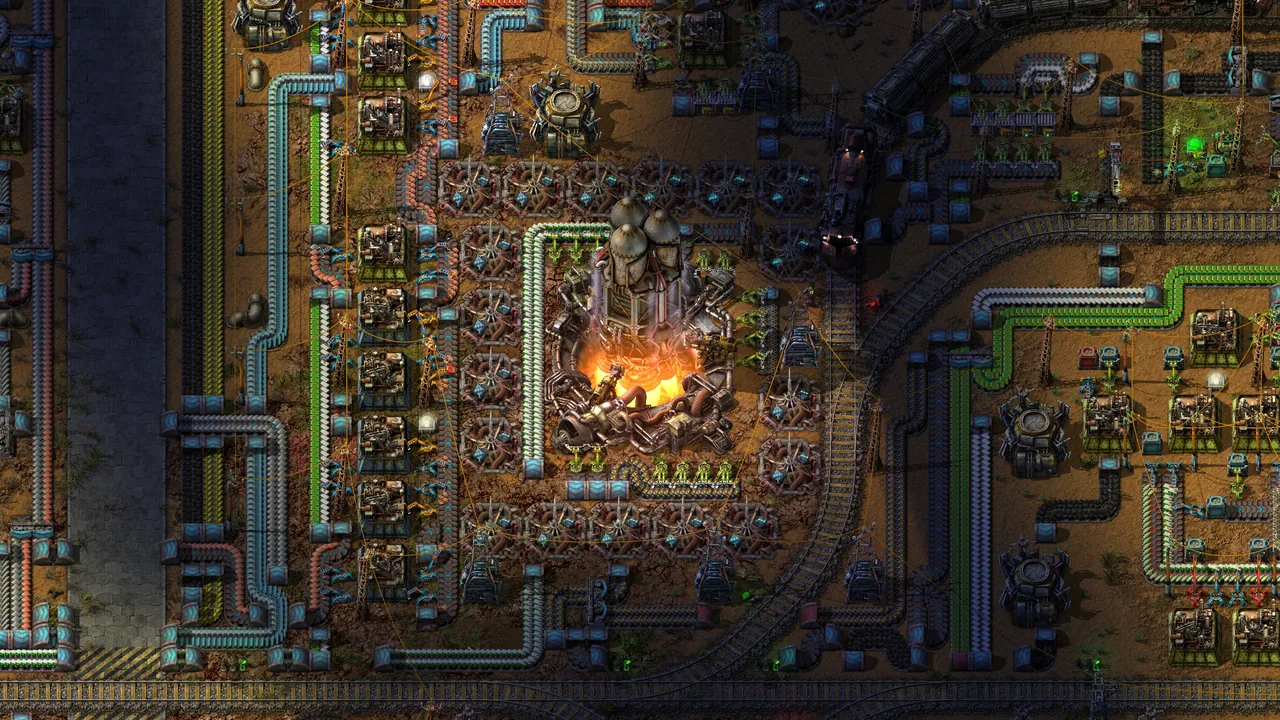
The single most important tool in the game isn't a weapon or a vehicle — it's the blueprint. Once unlocked, you can select any section of your factory, save it as a reusable stamp, and drop identical copies anywhere else on the map. That single feature is what turns Factorio from a building game into a systems-engineering game somewhere around hour fifteen or twenty. Early on you're placing individual assemblers by hand. By the midgame you're designing a single "green circuit block" once, testing it, and then stamping out forty of them across a rail network, at which point the actual skill being tested stops being manual dexterity and becomes architecture: how do you lay out city blocks, route trains without gridlock, and balance a bus of raw materials across dozens of parallel production lines that all need to hit the same number at the same time.
This is also where the community's megabase culture comes from — bases pushing thousands of science packs per minute, built from tileable, parameterised blueprint books that strangers share freely on sites like Factorio Prints and the official forums, each one a small essay in production theory that other players study, adapt and improve on. It's rare for a single-player game to generate this much shared design culture, and it's a direct result of blueprints being genuinely expressive rather than a convenience feature bolted on afterward.
A tech tree that paces discovery instead of just scaling numbers
Where a lot of automation games fall apart is the midgame plateau — you've learned the loop, and everything after that is just bigger versions of the same machine. Factorio's tech tree avoids this by consistently unlocking new problems rather than new multipliers. Logistics robots don't just speed up construction, they change how you think about supply entirely. Trains don't just move more material, they introduce signal blocks, junction design and scheduling as genuinely new disciplines. Oil processing forces you to solve a byproduct problem — cracking heavy oil into light, light into petroleum — that has nothing to do with anything you've built before it. Even late-game modules and beacons aren't just "+15% production" stickers; they force a real trade-off between space, power and throughput that changes how you'd redesign an existing block.
Space Age extends that same principle rather than abandoning it. Vulcanus, Fulgora and Gleba aren't reskinned versions of the home planet — each one inverts a core assumption the base game trained into you (Gleba's produce rots, so "store excess for later" stops being a valid strategy; Fulgora runs on scrap recycling instead of ore, so your entire early-game intuition about mining is useless there). That's a legitimately well-designed piece of paid content: it doesn't pad the existing loop, it makes you re-learn parts of it under new constraints, which is exactly the trick that kept the base game interesting for a hundred-plus hours in the first place.
Biters: pressure, not partnership
Combat is the one major system that doesn't share that pedigree. Alien "biters" nest around your factory and grow more aggressive as your pollution cloud spreads, which is a genuinely clever piece of systemic design on paper — your own industrial output is the thing provoking the threat, so expansion and defence are supposed to be in constant tension. In practice, combat itself is thin: you point, you shoot or you lay a wall of turrets, and the actual decision-making happens in the factory that supplies your ammunition rather than on the "battlefield." It functions as pressure — a reason to keep your perimeter maintained and your power grid resilient — rather than as a system with its own depth, and a large share of the playerbase treats it exactly that way, dialling aggression down or switching biters off entirely in the game's own settings so they can focus on the production puzzle without an interruption layer on top of it. That's not really a bug in the design. It's an honest admission that Factorio's combat was always meant to create stakes for the automation game, not to be a second game living alongside it, and it mostly succeeds at that narrower job.
An engine built for a different scale of problem
The reason any of this holds together at the scale players actually push it to is a genuinely unusual piece of engineering. Factorio runs on deterministic lockstep networking — every client simulates the entire world independently from the same inputs rather than a server streaming state around — which is what lets multiplayer bases with enormous entity counts stay playable without a beefy dedicated backend doing the heavy lifting. Wube has spent years of public Friday Facts posts walking through the consequences of that choice: multithreading has to be bit-for-bit reproducible across every player's hardware or the simulation desyncs, so performance work here means profiling down to the level of belt-segment memory layout and inserter update ordering, not just throwing more threads at the problem. The payoff shows up directly in play — a megabase with millions of entities still runs at a steady 60 updates per second on hardware that would choke running a fraction of that in most other simulation games, and that headroom is the entire reason a genre built around "how big can you make this" is even possible here.
Multiplayer, modding, and a decade of transparency
Multiplayer inherits the same engine advantages: dedicated headless servers, no hard player cap, and communities that have run persistent shared bases for years at a time. It's not frictionless — hosting a large session still asks something of your connection and your host's hardware, and there's no built-in matchmaking beyond the Steam friends list and community server browsers — but the foundation is sound enough that it rarely gets blamed when a session goes badly.
The mod scene is arguably even more impressive. Wube ships an open Lua API and has published a weekly Friday Facts development blog since 2015, an unusually sustained level of public engineering transparency for a studio this size, and the modding community has responded with everything from quality-of-life tweaks to total conversions that rebuild the tech tree from scratch. Very few premium, non-open-source games earn this level of trust from their own modders, and it's a direct dividend of a decade spent explaining, in public, exactly how the engine works and why.
Presentation is functional, not the point
Visually, Factorio has never chased spectacle, and it shows in the score here more than anywhere else in the review. The art is clean, readable and consistent — every machine, resource and belt colour is legible at a glance, which matters enormously once your screen is showing four thousand of them at once — but it isn't going to win anyone over on screenshots alone, and the presentation hasn't fundamentally evolved since Early Access beyond incremental sprite and lighting passes. The sound design does more of the heavy lifting than the visuals: the layered hum of a working factory, building in complexity as your base grows, is one of the most quietly effective ambient soundscapes in strategy gaming, and it's doing real work signalling factory health without a single UI element.
The onboarding cliff, honestly assessed
It would be dishonest to write nine thousand words of praise and skip past the game's biggest practical problem: getting into it is hard, and the built-in tutorial doesn't fully close that gap. The campaign and tutorial scenarios teach individual mechanics competently, but the jump from "I understand how an assembler works" to "I can plan a base that won't collapse under its own logistics in six hours" is not one the game bridges well on its own. A meaningful share of new players bounce off entirely in the first few hours, not because the systems are poorly designed but because there's very little scaffolding between "here is a drill" and "now balance eleven interlocking production ratios." The people who push through tend to do so with a wiki tab open, and that's a real cost for a genre newcomer who just wants to try the thing everyone talks about without homework attached.
The interface compounds it. Every panel is dense, every recipe has a tooltip worth reading, and the keybind list is long enough that efficient play basically requires memorising a second language of shortcuts. None of it is badly built — it's some of the most information-dense, functional UI design in strategy gaming once you know it — but "once you know it" is doing a lot of work in that sentence.
Value, and a price that will never move
Factorio's monetisation is about as clean as premium PC gaming gets: one purchase, no microtransactions, no premium currency, no live-service pressure of any kind. What makes the value conversation interesting is Wube's public stance, first laid out in Friday Facts #140, that the studio doesn't want to run a sale — ever — because it considers price cuts a way of telling long-term customers they overpaid. The company has kept that promise since 2016, even through two price increases it has openly framed as inflation adjustments rather than value changes. That's a rare kind of pricing honesty, and for a game that regularly returns hundreds of hours per purchase, NZ$50 is not a hard number to justify. It does mean there's genuinely no way to catch this one on sale, which is worth knowing going in if you were planning to wait.
Space Age complicates that math slightly. It's priced identically to the base game rather than as a smaller add-on, and reaching it requires having already finished the base game's own hundred-plus hour arc. Judged purely as an expansion it's excellent — three planets that each rewrite a core assumption rather than padding the existing loop — but buying both, at full price, with no discount ever offered on either, is a genuinely larger ask than most premium releases make of a player before they've even reached the "new content" part of the experience.
Players who like the idea of production numbers climbing steadily in the background, without needing to hand-place every belt themselves, may find a gentler cousin of that same appeal in Wanderer's own gathering and crafting loops.
Verdict
Nine and a half. Factorio's core loop — read a ratio, solve it, automate the solution, watch the next bottleneck appear — is about as purely and confidently executed as game design gets, and the engineering underneath it is good enough that the game barely slows down no matter how hard players try to break it. The tech tree, the blueprint system and the Space Age expansion all extend that idea rather than diluting it, which is the rarest kind of ten-years-later follow-through in this industry.
What keeps it from a perfect score is honest, not manufactured: combat is thin by design, the onboarding cliff is real and the tutorial doesn't fully solve it, the interface asks a lot before it gives anything back, and the price — full, permanent, and now doubled if you want Space Age too — is a real number to weigh against a real time commitment. None of that changes what the game is at its best. It changes who should walk in expecting it.
If you already know you like production puzzles, buy it today; there is no sale coming, and there never will be. If you're not sure whether you're that kind of player, that uncertainty is itself the answer — Factorio rewards people who already know they like turning problems into ratios, and it will not spend much effort convincing anyone else.
Price and platform details checked 30 July 2026.
Pros and cons
Pros
- The ratio-and-throughput core loop turns simple arithmetic into constant, meaningful decisions from your first coal-fired miner to a megabase moving tens of thousands of items a minute
- Blueprints let you save and stamp out your own designs, turning the mid-game into systems engineering rather than repetitive manual building
- The tech tree paces new machines and mechanics precisely enough to keep introducing fresh problems instead of just bigger numbers on old ones
- A multithreaded, deterministic-lockstep engine keeps thousands of belts, inserters and trains ticking at 60 updates per second even on bases with millions of entities
- A decade of public Friday Facts development blogs and an open Lua mod API have built one of PC gaming's most active and most trusted modding communities
- Space Age's three new planets and the 2.0 update's overhauled trains, quality system and Factoriopedia meaningfully extend a base game that was already complete on its own
Cons
- The opening hours ask you to learn resource ratios, power, logistics and base defence all at once, and the in-game tutorial doesn't fully prepare you for what comes after it ends
- Combat against biters plays like a tower-defense minigame bolted onto a production game, and a large share of experienced players simply turn enemy aggression down or off
- The interface front-loads dense grids, tooltips and keybinds with little on-ramp for a genre newcomer beyond community wikis and video guides
- A single serious playthrough commonly runs past 100 hours before the first rocket launches, which is either the whole appeal or a hard barrier depending on how much time you have to give it
- Wube's refusal to ever discount the game means there is no way to try it cheaper than full price, unlike almost every other decade-old PC release
- Space Age is sold as a separate NZ$50 purchase on top of the NZ$50 base game, so the full 2.0-era experience costs double what early buyers originally paid
Screenshots
-
FactorioImage: Wube Software LTD. via Steam -
FactorioImage: Wube Software LTD. via Steam -
FactorioImage: Wube Software LTD. via Steam -
How the review scores each part of the gameWanderer Editorial -
The short versionWanderer Editorial