
Game review
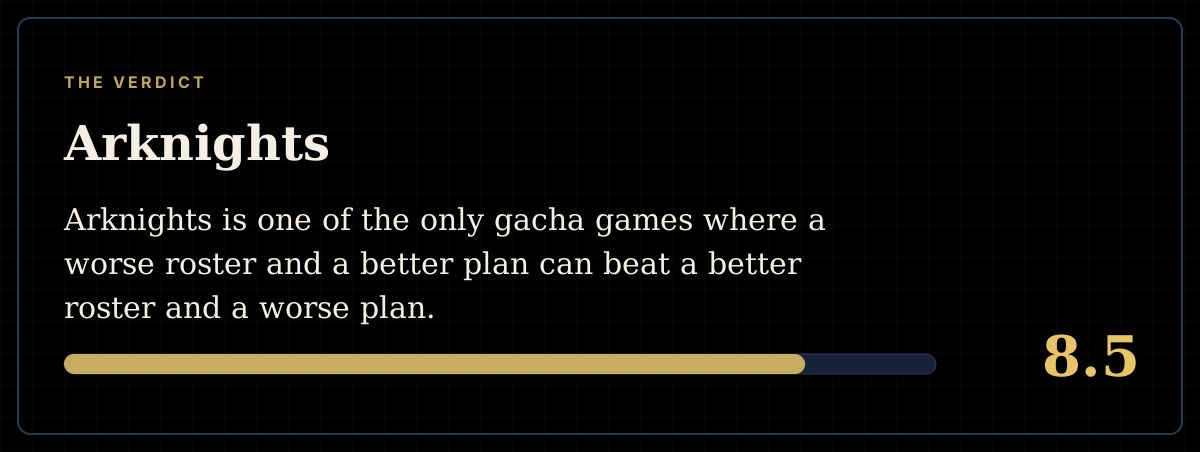
Arknights
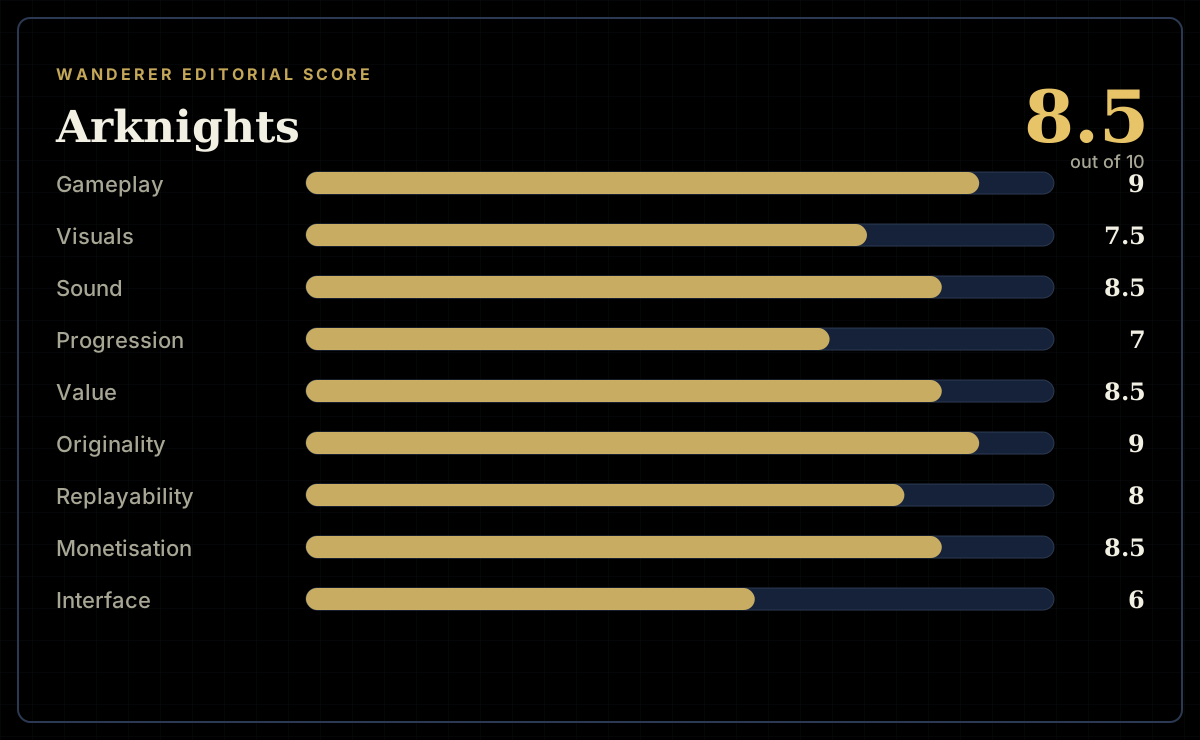
8.5 / 10
- Developer
- Hypergryph / Studio Montagne
- Publisher
- Yostar (worldwide English release); Hypergryph publishes in mainland China, Gryphline handles Taiwan, Hong Kong and Macau
- Released
- 1 May 2019
- Platforms
- iOS, Android, Windows
- Genre
- Tactical Tower Defense RPG
- Monetisation
- Free to play with a headhunting (gacha) system for Operators, a Sanity stamina cap gating stage attempts, and direct top-ups of Originium (premium currency) alongside monthly card subscriptions and seasonal passes
- Players
- No PvP and no real-time co-op — social play is limited to asynchronous Friend support-unit slots and shared Integrated Strategies leaderboards
The short version
Arknights is one of the only gacha games where a worse roster and a better plan can beat a better roster and a worse plan. Every stage is a hand-built puzzle with deployment costs, DP economy, blocking counts and facing rules, and that structure genuinely lets tactical skill substitute for pulled power in a way almost nothing else in the genre allows. The headhunting system backs that up with numbers most competitors won't publish — a 2% base rate on its best Operators, a hard pity that guarantees one by pull 99, and a Sanity bar that refills itself faster than most players can spend it. What it doesn't do is make itself easy to love. The writing is dense to the point of opacity for newcomers, promotion materials for endgame Operators demand a grind that outlasts the goodwill of anyone who wandered in expecting a typical mobile RPG, and the interface never once apologises for assuming you're staying.
Biggest strengths
- Every stage has a fixed layout, enemy path and DP budget, so clearing it is a puzzle you can genuinely solve with cheap Operators rather than a stat check you fail without expensive ones
- The published headhunting rates (2% base for 6-star Operators, guaranteed 5-star or better within the first ten pulls, hard pity by pull 99) are unusually transparent for the genre
- Sanity regenerates at a flat rate regardless of spending and refills to full on every level-up, which caps how much real-money purchases can accelerate stage-clearing progress
Biggest weaknesses
- The setting drops new players into faction names, political factions and lore terminology with minimal onboarding, and the story's pacing rewards patience the tutorial doesn't earn
- Elite 2 promotion for top-tier Operators demands stacks of rare, drop-rate-gated materials that turn late-game roster investment into one of the slower grinds in mobile gaming
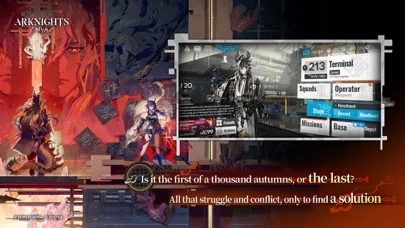
- The interface is dense by design — full Operator and stage information is there, but it's laid out for players who already know what they're looking for
Who it's for: Tactics and strategy players first, gacha veterans second. Anyone who enjoyed the puzzle-box structure of a Plants vs. Zombies or a Kingdom Rush and can tolerate a live-service RPG's trappings around it will find a genuinely different game here. A poor fit for anyone who wants their gacha experience to be primarily about story immersion or fast, disposable sessions — Arknights asks for patience before it explains itself.
Our recommendation: Download it and play the first two chapters properly instead of skipping through them — that's where the deployment-cost, DP-economy and blocking mechanics actually teach themselves, and skipping the tutorial stages is the single biggest reason new players bounce off. Spend nothing for the first month; the free Sanity, Orundum and recruitment income are enough to judge whether the tactical loop is for you before any purchase becomes relevant.
8.5 / 10
What Arknights actually is
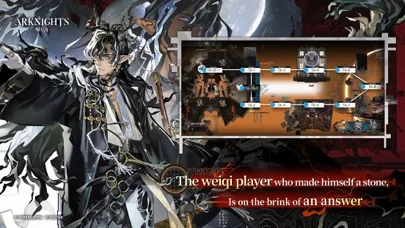
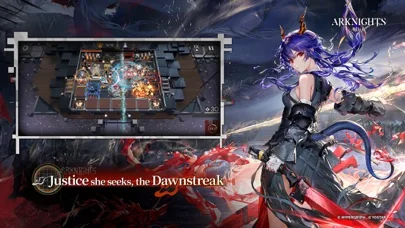
Strip away the character banners and Arknights is a tower defense game with genuine design integrity. Every stage is a fixed grid with a defined enemy path, a Deployment Point economy that refills over time, and tile-by-tile placement rules that care about facing, elevation and whether a tile is "high ground" or "low ground." Operators aren't stat sticks you drop anywhere — a Guard's melee arc matters, a Sniper's range matters, a Defender's block count determines how many enemies physically queue up against it before it buckles. You lose stages not because your roster's combat power number was too low, but because you put the wrong unit on the wrong tile, or you ran out of DP two enemies before the wave ended.
That's the entire pitch, and it's a legitimately different one from every other gacha RPG on the market. Genshin Impact's overworld is the best traversal system in the genre, but its combat is still an action game where numbers eventually win fights numbers alone can't. Summoners War and Raid: Shadow Legends both bury genuinely deep itemisation systems under turn-order math that a big enough stat advantage simply overrides. Arknights doesn't work that way. Its hardest campaign stages, its Contingency Contract seasonal challenges and its Challenge Mode variants are puzzles with an intended solution, and a well-drilled squad of cheap three- and four-star Operators can clear content that would eat a roster of unoptimised six-stars alive.
How far "skill over roster" actually goes
It's worth interrogating that claim rather than just repeating it, because it isn't unconditional. Skill substitutes for roster power within a band, not without limit. A new account with a handful of low-rarity Operators genuinely can clear most of the main campaign and a meaningful slice of side content — that's well documented across the community and it's the single most distinctive thing about this game. But the top end doesn't fully surrender to it. Challenge Mode variants of story stages, the hardest tiers of Contingency Contract and the deepest floors of Integrated Strategies increasingly gate around specific Operator kits: a particular kind of crowd control, a specific ranged-DPS ceiling, an ability that removes an otherwise unavoidable debuff. You can often route around a missing tool with enough cleverness, but "often" isn't "always," and there's a real ceiling where the puzzle stops having a solution built entirely from what a free account happens to own.
The honest framing is that Arknights compresses the power gap between whales and free players far more than its competitors do, rather than eliminating it. A three-star Operator with a correctly timed skill activation can outperform an undeployed six-star sitting in storage. That's not true of a Summoners War rune sweep or a Raid gear roll, where the top of the ladder is structurally unreachable without years of accumulated investment. It is still true, however, that Hypergryph designs its hardest content with its own flagship Operators in mind, and eventually you will want some of them.
The gacha, and why the numbers matter
Hypergryph publishes its headhunting probabilities in-game, and they're worth stating plainly because they're genuinely better than the genre's norm rather than just differently marketed. The base rate for a 6-star Operator sits at 2% per pull, with 5-star at 8%, 4-star at 50% and 3-star at 40%. Any of the first ten pulls on a banner is guaranteed to surface at least a 5-star Operator. If fifty consecutive pulls pass without a 6-star, the rate climbs by 2 percentage points per pull afterward, reaching a hard 100% guarantee by pull 99 — meaning no player can ever go more than 99 pulls without a top-rarity Operator. Limited banners add a further layer: the first 6-star pulled after 150 attempts is guaranteed to be the specific rate-up unit, and a separate Spark system means every pull banks toward a guaranteed copy of that unit at 300 total pulls (or 200 for older banners).
None of that is charity — a full 300-pull spark on a limited banner is still a serious currency outlay. But compare it to Raid: Shadow Legends' shard system, where no published pity floor exists at all, or Summoners War's decade-old Mystical Scroll rates that only added a hard guarantee years into the game's life, and Arknights looks like a publisher that decided transparency was a selling point rather than a liability. It also matters that the currency funding those pulls, Orundum, comes from playable content — daily missions, event stages, base production and story clears — rather than sitting almost entirely behind a paywall the way premium currency does in weaker implementations of the model.
Sanity is the real limiter, not your wallet
The stamina system, Sanity, regenerates at a flat one point every six minutes — ten per hour — independent of anything you spend. Maximum capacity grows slowly with player level, topping out at 180 at level 117, and every level-up refills your current Sanity by that new maximum minus 45, which functionally rewards you for spending it down before levelling rather than hoarding it. Stages cost between roughly six and thirty-six Sanity depending on difficulty, and several of the game's most valuable modes — training stages, Integrated Strategies, Contingency Contract, story interludes — don't touch the bar at all.
The practical effect is that Arknights caps how much a purchase can accelerate you. You can spend real money to refill Sanity through Originite Prime, but you're refilling to the same capacity everyone eventually reaches for free, on a system that already regenerates faster than most casual sessions can burn through it. That's the opposite of Genshin's Resin, which gates the specific farmable domains you actually need for endgame builds, or Raid's energy cap, which throttles the one activity — dungeon farming — that free accounts depend on most. Sanity respects a short daily check-in far better than it rewards binge sessions, and that's a defensible design choice for a mobile game rather than a monetisation trick dressed up as one.
The base layer deserves real attention
Rhodes Island's base management — officially the Rhodes Island Infrastructure Complex, unlocked after an early campaign stage — is the system Wanderer's readers will recognise fastest, because it's genuinely an idle-adjacent resource loop sitting inside a much bigger game. Ten facility types across twenty-one rooms produce currency, leveling materials and premium Orundum while you're away: Trading Posts convert stored goods into LMD or Orundum, Factories churn out battle records and upgrade shards, Power Plants keep everything else running, and Dormitories restore the Morale that every working Operator burns down over time. Assign the wrong mix of Operators — skill bonuses matter here as much as raw stats — and the whole complex under-produces; get the layout right and a base can genuinely fund a good chunk of a player's daily Orundum income without a single combat stage cleared.
It isn't idle in the incremental-game sense of running forever unattended — Morale caps out, facilities need re-staffing, and the system wants a check-in every twelve to twenty-four hours to stay efficient. But as an integration of "away-from-keyboard progression" into a combat-focused gacha, it's more thoughtfully built than the token idle-currency taps most competitors bolt onto their menus, and it rewards the same kind of optimisation-puzzle thinking the combat does.
Presentation and writing: serious, and sometimes too serious
Arknights commits to a tone almost nothing else in the genre attempts: a grim, politically dense setting about a world ravaged by a mineral-borne infection and the discrimination faced by the Infected who carry it. The character writing, when it lands, is genuinely more adult than the genre's default — Operators have real motivations tied to Terra's geopolitics rather than existing purely as banner fodder with a backstory paragraph attached. The problem is accessibility. New players are dropped into faction names, historical events and political factions with almost no onboarding, and the game trusts you to either already know the lore or piece it together from item descriptions and event dialogue. That trust is admirable and also a real barrier; plenty of capable players bounce off the story chapters before the writing has a chance to earn the investment it's asking for. Visually, the 2D sprite work and painted key art are consistently strong, but combat itself plays out through small in-stage sprites and a UI dense with numbers rather than the cinematic set-piece animations something like Genshin leads its marketing with. The soundtrack is a genuine strength across the board — event themes and boss tracks routinely outclass what the genre typically budgets for audio.
Integrated Strategies and the endgame
Integrated Strategies is Arknights' roguelike mode, and it's the clearest evidence that the tactical combat system was built to be reused rather than just to carry a campaign once. Runs recruit a temporary squad from scratch using an in-run currency, climb six floors of branching nodes, and end in a boss encounter with multiple possible outcomes depending on choices made along the way. Meta-progression comes through unlockable passive collectibles and rising difficulty tiers rather than power creep, which keeps runs feeling like puzzles rather than gear checks. Seven themed seasons have shipped since 2020, and all but the first remain permanently playable — a genuinely unusual amount of durable, replayable content for a gacha's endgame, most of which don't bother building anything beyond an infinite tower of the same fight with bigger numbers.
Verdict
Arknights earns its place above the rest of this library's gacha coverage on structure, not polish. The tower-defense core genuinely lets tactics substitute for roster spending within a real and honestly-drawn boundary, the published pity rates and self-refilling Sanity bar make it one of the least exploitative energy-and-gacha combinations reviewed here, and the base-management layer is a legitimately interesting idle system for readers who came from Wanderer looking for more of that. The cost is accessibility — the writing assumes commitment from the first hour, promotion grinding at the top end is a genuine time sink, and the interface has never once been simplified for a newcomer's benefit. That's a fair trade for the audience it's built for and a real one for everybody else. Players who want their gacha experience to be effortless from minute one should look elsewhere in this genre; players who want the genre's most legitimately skill-respecting combat system, wrapped in a fair (if demanding) economy, won't find a better one currently on mobile.
Readers who enjoy Rhodes Island's base-management puzzle should also look at Wanderer's own offline progression systems — persistent progress that continues whether or not you're actively playing is the same idea in a different genre. For more on how Arknights' economy compares to the rest of the field, see our reviews of Genshin Impact, Summoners War: Sky Arena, and Raid: Shadow Legends; for a hero-collector built around a gentler formation-combat loop, see AFK Journey.
Pros and cons
Pros
- Every stage has a fixed layout, enemy path and DP budget, so clearing it is a puzzle you can genuinely solve with cheap Operators rather than a stat check you fail without expensive ones
- The published headhunting rates (2% base for 6-star Operators, guaranteed 5-star or better within the first ten pulls, hard pity by pull 99) are unusually transparent for the genre
- Sanity regenerates at a flat rate regardless of spending and refills to full on every level-up, which caps how much real-money purchases can accelerate stage-clearing progress
- The Rhodes Island Infrastructure base layer turns idle time between sessions into a genuine resource-management puzzle, not just a numbers-go-up timer
- Integrated Strategies rebuilds the entire tactical toolkit from scratch each run, giving the core combat system a second life outside the main campaign
Cons
- The setting drops new players into faction names, political factions and lore terminology with minimal onboarding, and the story's pacing rewards patience the tutorial doesn't earn
- Elite 2 promotion for top-tier Operators demands stacks of rare, drop-rate-gated materials that turn late-game roster investment into one of the slower grinds in mobile gaming
- The interface is dense by design — full Operator and stage information is there, but it's laid out for players who already know what they're looking for
- No real-time or cooperative multiplayer exists; social features are limited to borrowing a single Friend support unit and comparing scores after the fact
- Character art leans heavily on static portraits and small in-stage sprites rather than the cinematic combat animation some rival gachas lead with
Screenshots
-
ArknightsImage: YOSTAR (HONG KONG) LIMITED via the App Store -
ArknightsImage: YOSTAR (HONG KONG) LIMITED via the App Store -
ArknightsImage: YOSTAR (HONG KONG) LIMITED via the App Store -
How the review scores each part of the gameWanderer Editorial -
The short versionWanderer Editorial