
Game review
Genshin Impact
8 / 10
- Developer
- miHoYo
- Publisher
- HoYoverse
- Released
- 28 September 2020
- Platforms
- Windows, PlayStation 4, PlayStation 5, Xbox Series X|S, Android, iOS
- Genre
- Open-World Action RPG
- Monetisation
- Free to play with a two-currency wish (gacha) system for characters and weapons, a resin stamina cap on the domains that drop farmable gear, a monthly subscription, a per-patch battle pass and direct premium-currency top-ups
- Players
- Open-world co-op for up to four players and some multiplayer-only combat modes; no PvP
The short version
Genshin Impact's open world earns every comparison to a premium single-player RPG. Climbing has no real ceiling, gliding turns exploration into its own reward, and the elemental reaction system does something few action games manage — it makes the same core mechanic serve both combat and puzzle-solving without either side feeling like a compromise. None of that requires spending a cent, and six years of regional expansion have made the free campaign genuinely enormous.
The gacha layer sitting on top of it is honest about its own math, at least. HoYoverse publishes its rates, and a 50/50 with guaranteed follow-up isn't the worst structure in the genre. But "you can finish the story for free" and "you can compete at the top of the Abyss for free" are two different claims, and the gap between them is exactly where resin caps, artifact RNG and constellation pulls live.
Biggest strengths
- Climbing and gliding have no artificial wall past the early hours, and each new region adds its own traversal layer on top (Fontaine's underwater diving, Snezhnaya's rail network)
- Elemental reactions are one system that does double duty as a combat mechanic and an exploration puzzle language, which very few action RPGs manage convincingly
- The entire main story, all four-star characters, and every region's exploration content are completable without spending or pulling a single gacha banner
Biggest weaknesses
- Original Resin caps at 200 and regenerates at one point per eight minutes, so the domains that drop the artifacts and ascension materials you actually want are rationed no matter how much free time you have that day
- Getting one well-rolled artifact means running a single domain dozens of times and hoping the set, the slot, the main stat and four substats all land together
- A character's constellations, which meaningfully change what their kit can do, sit behind the same 50/50 pull as the base copy, so "finishing" a favourite can mean five or six more 5-star pulls after the first
Who it's for: Open-world and action RPG players who want a genuinely deep free game and are willing to draw their own line on how far to chase the competitive endgame. Less suited to anyone who finds stamina systems or gacha pulls a dealbreaker on principle.
Our recommendation: Download it for the world and the combat system alone — that part of the pitch is real. Decide early whether you're playing for story and exploration or for Spiral Abyss leaderboard damage, because only one of those is actually free.
8 / 10
Six years in, it's still the world that sells this game
Genshin Impact has been running long enough that its own launch trailer looks dated, and the conversation around it long ago calcified into two camps: people who think it's a masterpiece and people who think it's a slot machine wearing an anime skin. Neither camp is being fully honest, and the game itself is more interesting than either position gives it credit for.
Start with the part that isn't in dispute: Teyvat is one of the best-built open worlds outside a full-price single-player game, and you can experience essentially all of it without paying anything. That's not a caveat or a marketing line — it's the actual shape of the free product, and it's worth taking seriously before getting into the part that costs money.
Traversal that never stops opening up
Most open-world games hand you a stamina bar and call it exploration. Genshin's climbing and gliding systems do something more interesting: they turn the map itself into a puzzle about where your stamina will run out and what you'll do about it. Early on that's a real constraint — you'll eye a cliff edge and calculate whether you'll make it. By the midgame, food buffs, stamina-reduction artifacts and a glider that catches thermals turn the same terrain into something closer to a 3D playground, and the game keeps giving you reasons to want that freedom: a floating island visible from three regions away, a chest wedged into a cliff face that requires a very specific climb-glide-climb chain to reach, a waypoint that only makes sense once you've unlocked the swimming or diving upgrade for that region.
Each new nation adds its own traversal verb instead of just reskinning the last one. Inazuma added a wind-current network for gliding between islands. Sumeru added a proper stamina-free glide upgrade and later a jungle canopy you climb through rather than around. Fontaine — the most structurally ambitious region so far — is built partly underwater, with a full diving kit that turns entire zones into three-dimensional spaces rather than a flat map with hills. Snezhnaya, arriving with Version 7.0 on 12 August 2026, adds a rail system and a new tool for interacting with the environment, which suggests HoYoverse still isn't content to let traversal plateau six years in. That's an unusually long track record of a live-service game continuing to invest in the part of itself that doesn't generate a single pull.
Elemental reactions: one system, two jobs
The mechanical idea that actually elevates Genshin above "pretty gacha RPG" is the elemental reaction system, and it's worth being specific about why it works. Seven elements — Pyro, Hydro, Cryo, Electro, Anemo, Geo and Dendro — interact according to a fixed, learnable rule set. Wet an enemy and hit them with fire, you get Vaporize, a straight damage multiplier. Freeze a wet target with Cryo, and they're locked in place. Swirl an elemental status with Anemo and it spreads to every nearby enemy, turning single-target application into crowd control. Since the Dendro element arrived, wet-and-charged foliage can Bloom into damage-over-time cores that themselves chain into further reactions.
What makes this more than a combat gimmick is that the exact same rule set governs the game's puzzles. A shrine gated behind a frozen lake wants Cryo applied to Hydro, precisely the reaction you'd use to lock down a boss in combat. A field of dry grass that needs burning to reveal a chest is teaching you the interaction you'll rely on for Pyro application against Dendro-slathered enemies. Wanderer's own audience — used to systems that reward understanding a formula rather than mashing a button — will recognise the appeal here: mastering elemental reactions makes you better at two ostensibly different parts of the game at once, and that's a rarer design achievement than the genre gets credit for.
Combat itself is a party-of-four action system with instant character swapping, and the interplay between four kits and seven elements is genuinely deep team-building space — closer in spirit to NTE: Neverness to Everness's parry-and-dash combat than to a turn-based gacha RPG, though Genshin's reaction chemistry gives it a tactical layer NTE never quite matches.
The gacha, properly explained
This is the section that actually matters, so the numbers need to be right rather than remembered. Genshin runs two simultaneous gacha economies under one currency (Primogems, convertible to the premium currency Intertwined and Acquaint Fate for character and weapon pulls respectively).
Character banners. The base rate for a 5-star pull is a published 0.6 percent per wish, flat until wish 74, after which the odds climb sharply toward a hard pity guarantee at wish 90 — you will never go more than 90 pulls without a 5-star. On the limited "Character Event" banner, that guaranteed 5-star has a 50 percent chance of being the featured character; lose that coin flip and your next 5-star on that banner is guaranteed to be the one you wanted. Since the Version 5.0 "Capturing Radiance" mechanic, losing that 50/50 also raises your odds on the next roll — roughly 55 percent instead of a flat coin flip, with the chance of losing twice in a row down to about 22.5 percent from the old 25. It's a real improvement, disclosed openly, and it's more transparent than most of the genre's black-box pull systems.
Weapon banners. These run separately, with an 80-pull hard pity and their own Epitomized Path system: you nominate which of two featured weapons you want, and any 5-star that isn't your pick banks a Fate Point that guarantees your choice on the very next 5-star. Worst case, two 5-stars and you have both weapons; best case, you get your pick outright.
What none of that math answers is the question that actually decides whether this game is worth your time as a free player, and it has two different answers depending on what you mean by "finish." You can complete the entire main story, every region's exploration content, every world quest and the overwhelming majority of the game's puzzle and reward design using nothing but the Traveler and free 4-star characters. That's not a technicality — 4-star units in Genshin are frequently better at specific team roles than their 5-star counterparts, and the story campaign is tuned around what a non-spending, non-gacha account can field.
Competing at the top of Spiral Abyss — the game's rotating 12-floor combat gauntlet and the closest thing it has to a hard damage check — is a different question. The last two or three floors are tuned around teams with strong artifact investment and, realistically, characters with kits the free roster doesn't have. It's possible to clear floor 12 without spending, and plenty of guides walk through exactly which free-to-play teams can do it, but "possible with near-perfect play and artifact luck" is a meaningfully different claim from "the content is designed for you." That's the honest line: the story game doesn't need the gacha, the leaderboard game does.
Anyone who's read our review of AFK Journey will recognise a familiar shape — a documented pity system and a genuinely playable free tier, undercut by a competitive layer that quietly becomes the actual monetisation engine. Genshin's version of that problem is gentler, because Spiral Abyss resets to zero difficulty every two weeks and offers no resource reward beyond bragging rights and a fixed pool of Primogems either way. Nobody is actually gated out of resources for not clearing it. But the psychological pull toward "just one more constellation" to clear that last floor is the same mechanism AFK Journey's ranked ladder runs on, dressed in nicer clothes.
Resin: the daily leash
If there's one system that defines how Genshin actually feels to play long-term, it's Original Resin, not the wish banners. Resin caps at 200 and regenerates at a flat rate of one point every eight minutes — about 180 points of natural regeneration a day, or roughly 26 hours and 40 minutes to refill from empty. Nearly everything that matters for character progression — artifact domains, weekly boss drops, talent-book domains, mob drops for ascension materials — costs resin to attempt. Story content, exploration, most bosses and world quests don't.
That split is the actual monetisation design, and it's worth being precise about what it does rather than reflexively calling it predatory. Resin doesn't gate you out of the game — it gates you out of grinding the game, which sounds like a mercy until you realise the grinding is where all the meaningful power growth lives. You can log in, blow through your daily 200 in twenty minutes hitting one artifact domain, and then the rest of your session is exploration, story or nothing at all, unless you spend Primogems (the same currency you'd otherwise save for wishes) on a refill, or Fragile Resin from events and the Battle Pass. It's a retention mechanic first — it guarantees you can't burn through a month of content in a weekend — and a monetisation lever second, since every refill you buy is Primogems you didn't save toward a banner. Compare it to Idle Heroes' star-fusion economy, which consumes your own roster as fuel: both systems exist to slow down progression on purpose, but resin at least does it with a visible, honestly-labelled cap rather than a hidden cost curve.
Artifact farming is the real endgame, and it's brutal
If resin is the leash, artifacts are what you're leashed to. Every domain drops artifacts from one of two possible 5-star sets, each with five equipment slots. The flower and feather pieces always roll the same main stat; the sands, goblet and circlet pieces roll their main stat randomly from a pool that includes flat stats nobody wants alongside the Crit Rate, Crit Damage or Elemental Damage bonus everybody's chasing. A 5-star artifact starts with three or four random substats — with a documented roughly 80 percent chance of the better four-substat roll from domains, dropping to about two-thirds from weekly bosses — and each level-up has a chance to upgrade one of those substats further, again randomly.
Stack those layers and you get what the community routinely calls the worst RNG in the genre: set, then slot, then main stat, then which substats you got, then which ones upgraded. Getting a single goblet with the right elemental main stat can take dozens of domain runs; getting one with the right main stat and Crit-favoured substats can take months of daily resin spent nowhere else. This is not an exaggeration for effect — it's the single most consistent complaint from the game's own long-term playerbase, and it's the actual reason "optimising a character" in Genshin means something closer to a part-time hobby than a weekend project.
The patch treadmill
Genshin ships new content on a five-to-six-week cadence that hasn't meaningfully slowed in six years: a new banner pair, a story quest chapter, a limited-time event with its own reward track, and periodically a new region entirely. Version 7.0's Snezhnaya launch on 12 August 2026 is the seventh nation since 2020, following Fontaine and Natlan, and each region has arrived with new traversal mechanics, a new reaction interaction and a meaningful chunk of story advancing the Fatui/Archon plotline that's been building since launch.
That cadence is both the game's strongest retention tool and its most legitimate criticism. The story pacing genuinely rewards playing it as it releases — Teyvat's political intrigue only really lands if you're not trying to marathon six years of patches back to back — but it also means falling behind two or three patches turns catching up into a chore rather than a pleasure, and the event-reward treadmill (log in daily or miss free Primogems permanently) is a soft form of pressure that a lot of the playerbase has simply made peace with rather than enjoys.
Performance across a genuinely wide platform spread
Few free games run credibly across as many platforms as Genshin does — Windows, PS4, PS5, Xbox Series X|S, iOS and Android, with cross-save between all of them. On PC and current-gen console, it's a legitimately good-looking game, with lighting and water rendering that punch well above what "mobile game" implies. On mobile, the story is more mixed: flagship phones handle it at 60fps with settings turned up, but budget and older devices need render resolution, shadows and effects dropped to their floor and frame rate capped at 30 to stay stable, and Elemental Sight-heavy fights with several reaction particles on screen at once remain the game's most demanding moment on weaker hardware. It's playable further down the price ladder than most games this visually ambitious, which is a real achievement, but "playable" and "the experience the art team designed" diverge noticeably once you're a few years off the newest chipsets.
Final verdict
Genshin Impact earns its reputation as one of the best free open-world games available, and it earns that on mechanical merit rather than scale alone — the traversal system and the elemental reaction language it built around combat are genuinely excellent design, not just generous production values. The story campaign, the exploration, and the vast majority of what makes Teyvat worth visiting cost nothing and were never designed to cost anything.
The honest complaint isn't that the game charges money — it's that the systems governing how far you can push a character (resin's daily ration, artifact RNG's compounding odds, constellations sitting behind repeat 5-star pulls) turn the last stretch of progression into either a very long grind or a spending decision, with very little space in between. HoYoverse deserves real credit for publishing its rates and for tuning the free game so the story never needs the gacha. It deserves the criticism it gets for building an endgame where "free" and "competitive" stop meaning the same thing.
Players who want a beautifully realised world to explore, a combat system with real depth, and a story worth following patch to patch will get all of that without spending a cent. Players chasing Spiral Abyss clear times or a fully-built constellation roster are signing up for a different game underneath the same launcher, and that one asks for either patience most people don't have or money most people shouldn't spend without knowing exactly what they're buying. Wanderer's audience — used to systems that respect time without pretending progression is free — will find plenty here to admire and one very clear line to watch for.
Pros and cons
Pros
- Climbing and gliding have no artificial wall past the early hours, and each new region adds its own traversal layer on top (Fontaine's underwater diving, Snezhnaya's rail network)
- Elemental reactions are one system that does double duty as a combat mechanic and an exploration puzzle language, which very few action RPGs manage convincingly
- The entire main story, all four-star characters, and every region's exploration content are completable without spending or pulling a single gacha banner
- HoYoverse publishes its wish rates directly (0.6 percent base 5-star chance, 90-pull hard pity, an 80-pull hard pity on the separate weapon banner) rather than hiding the math
- Six years of original orchestral scoring across seven regions is a genuinely rare level of investment for a mobile-first live-service game
Cons
- Original Resin caps at 200 and regenerates at one point per eight minutes, so the domains that drop the artifacts and ascension materials you actually want are rationed no matter how much free time you have that day
- Getting one well-rolled artifact means running a single domain dozens of times and hoping the set, the slot, the main stat and four substats all land together
- A character's constellations, which meaningfully change what their kit can do, sit behind the same 50/50 pull as the base copy, so "finishing" a favourite can mean five or six more 5-star pulls after the first
- Clearing the last floors of Spiral Abyss without spending is possible but demands near-optimal artifact investment and specific team comps, not just enthusiasm
- Mobile performance still tracks device tier closely; budget and older phones need render resolution and effects dropped hard to hold a stable frame rate
Screenshots
-
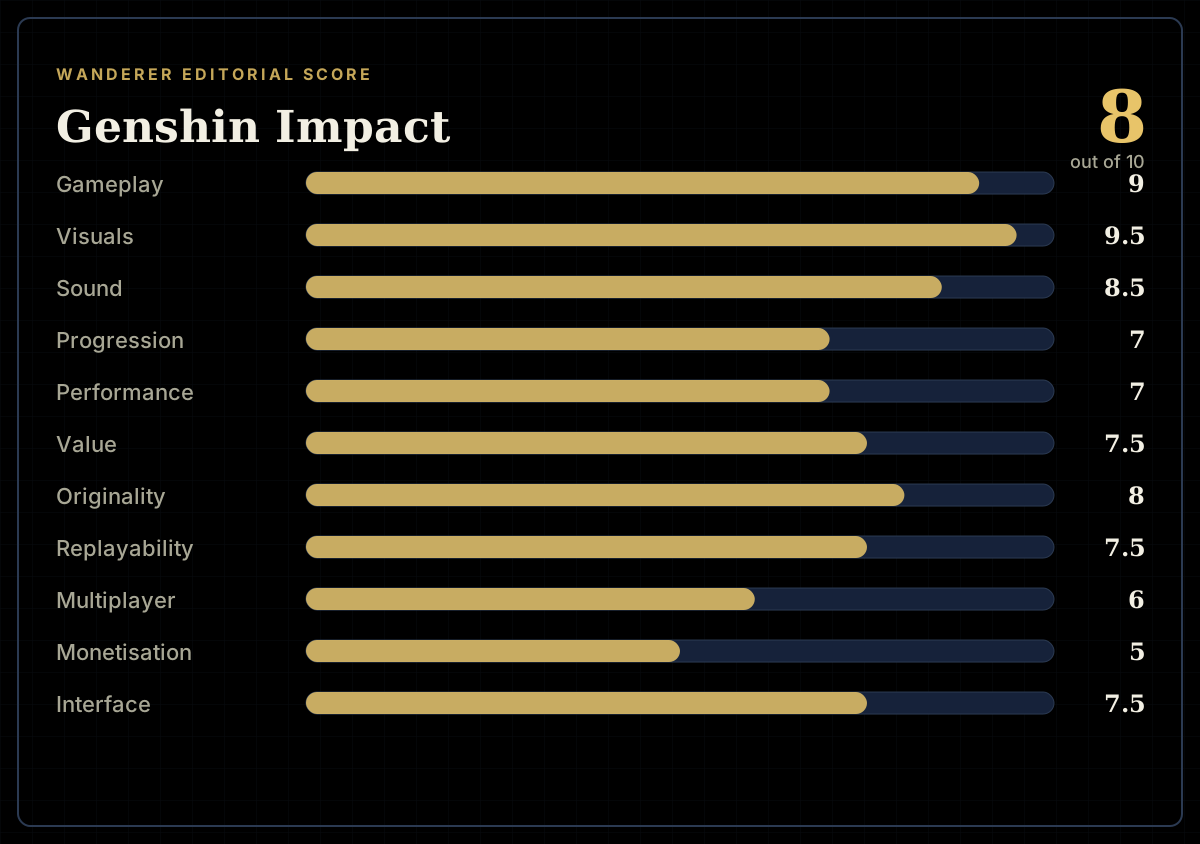
How the review scores each part of the gameWanderer Editorial -
The short versionWanderer Editorial