Game review
Dyson Sphere Program
7.5 / 10
- Developer
- Youthcat Studio
- Publisher
- Gamirror Games
- Released
- 20 January 2021
- Platforms
- Windows
- Genre
- Factory automation, construction and space simulation
- Monetisation
- Premium, one-off purchase — no in-game purchases, no premium currency, no subscription, no ads. Two optional paid add-ons exist, a soundtrack and a digital art book, both cosmetic and unrelated to gameplay
- Players
- None officially. Youthcat Studio has stated it intends to keep developing the game as a single-player experience. The fan-made Nebula mod adds unofficial co-op and is maintained by a community team, but it is not built or supported by the developer
The short version
Dyson Sphere Program has the single best endgame image in the automation genre: a literal megastructure, built node by node out of light sails you launched yourself, slowly wrapping a star. Getting there means genuinely escalating from a hand-built workshop to an interstellar supply chain, and for a long stretch the scale feels earned rather than decorative.
It stops feeling earned around the point interplanetary logistics take over the game, and it hasn't fully recovered since. Five and a half years into Early Access, with no 1.0 date, a combat system that splits its own audience and an interface that never quite grew to match the scope, DSP is a genre landmark that is still, honestly, unfinished.
Biggest strengths
- The escalation from a single planet to a multi-star supply chain is a genuine structural shift, not just bigger numbers on the same machines
- Building the Dyson Sphere itself is a real, hands-on design act — choosing shell layouts, node patterns and orbit rings rather than watching a progress bar fill
- The tech tree keeps introducing new problems (oil refining, ray receivers, mecha logistics) well past the point most automation games start repeating themselves
Biggest weaknesses
- Interstellar logistics vessels turn the mid-game into a scheduling and routing puzzle that many players find tedious rather than clever, and the game gives you little help managing it at scale
- The "Rise of the Dark Fog" combat update divides its own audience — some players enjoy the added stakes, others experience it as an interruption to a game they bought specifically because it wasn't about combat
- The soundtrack is a short, repeating loop that several long-session players single out as the game's weakest piece of presentation
Who it's for: Factory-automation veterans who've already worn out Factorio and want a premise that goes somewhere Factorio structurally can't. Less suited to anyone who wants a finished game with a visible ending, or who needs combat and multiplayer as core pillars rather than optional layers.
Our recommendation: Worth buying at NZ$24.79 even in its current state — the core loop alone clears that bar comfortably. Go in expecting an ambitious, still-moving target rather than a finished game, and be ready for the mid-game logistics stretch to test your patience before it pays off.
7.5 / 10
Most factory games end the way they begin: with a number. You automate long enough, the number gets big enough, and eventually you stop, because the number was always the point. Dyson Sphere Program tries something structurally different. Its endgame is an object — a physical shell of light-sail nodes wrapped around a star, visible from orbit, that you designed one ring at a time. It's the most romantic premise the automation genre has, and it's why a small Chinese studio's Early Access game has spent five and a half years being talked about in the same breath as Factorio despite never technically finishing.
Youthcat Studio's Dyson Sphere Program entered Early Access on 20 January 2021 and is, as of this writing, still there. That single fact does more to shape how you should read this review than anything else about the game, and it's worth sitting with before getting into what DSP actually does well — because a lot of it does genuinely work.
From a workshop to a star
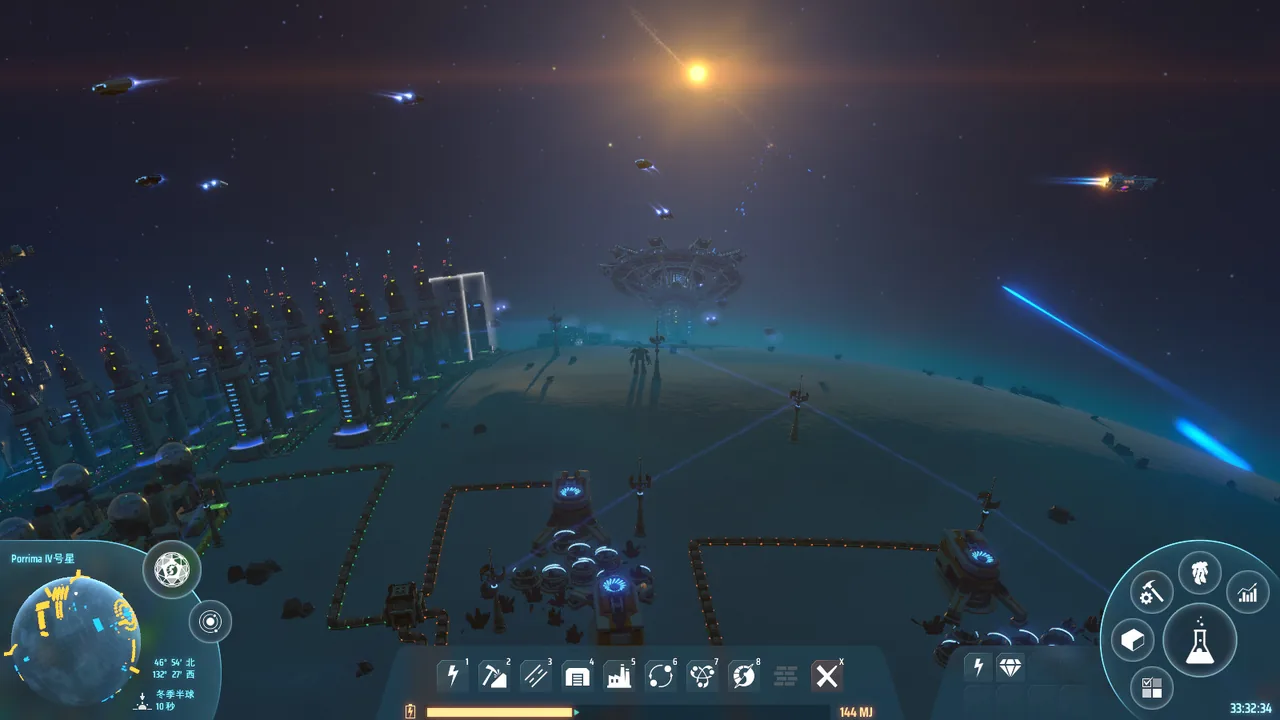
The opening hours are recognisable to anyone who's played an automation game before: mine ore by hand, smelt it, build your first assembler, watch belts start doing the work your mouse used to do. What DSP does differently, and does well, is refuse to let that stay the whole game. Once you unlock interstellar logistics stations and start shipping resources between planets and then between star systems, the game doesn't just hand you bigger versions of the same problem — it hands you a genuinely different one. Planetary factories are a belt-and-sorter puzzle. Interstellar supply is a network-design puzzle, with travel time, vessel capacity and warp distance all competing for your attention at once. Very few automation games manage even one real structural shift in scale over their runtime. DSP manages two, and the second one — planet to galaxy — is the more interesting of the pair.
That escalation is also where the Dyson Sphere itself stops being an abstraction. You're not unlocking it from a tech tree screen; you're launching light sails from ray receivers, choosing how many shell layers to build, deciding what pattern each layer's nodes should form. It's one of the only "endgame megastructure" goals in the genre that's actually built by hand rather than generated by a formula once you hit a resource threshold, and the first time a shell closes around a star it delivers on the promise the box art has been making the entire time.
The logistics wall, and whether the scale is real
Here's the harder question, and the one this review exists to answer honestly: does that escalation stay earned, or does it eventually become a longer number wearing a more impressive skin?
For the first stretch of interplanetary play, it's earned. Routing your first interstellar logistics vessel and watching it actually solve a supply problem you'd been stuck on for an hour is one of the best moments the genre has to offer. The trouble starts once you're running a dozen of those routes simultaneously across a growing number of star systems, because the tools for managing that complexity haven't scaled with the complexity itself. Vessel counts, dispatch priorities and warp distances all live in menus that were clearly designed for a smaller version of the problem they're now being asked to solve. A meaningful share of long-time players describe the exact same arc: the early interstellar game is magic, the mid interstellar game becomes a second, less interesting job layered on top of the first one, and getting through it is what separates the people who finish a Dyson Sphere from the people who quietly stop playing with two hundred hours logged and a half-built shell they never returned to.
That's the honest answer to the thesis question. The scale is real in the sense that it changes what kind of problem you're solving — this isn't padding in the Cookie Clicker sense of just multiplying an existing number. But it stops being fun scale somewhere in the middle, becoming a scheduling chore the interface doesn't help you with, before the payoff at the far end makes it worthwhile again. The Sphere earns its ending. The road to it has a genuine pothole in the middle that the game has not, after five years, fully paved over.
Rise of the Dark Fog: welcome addition, or a second game bolted on
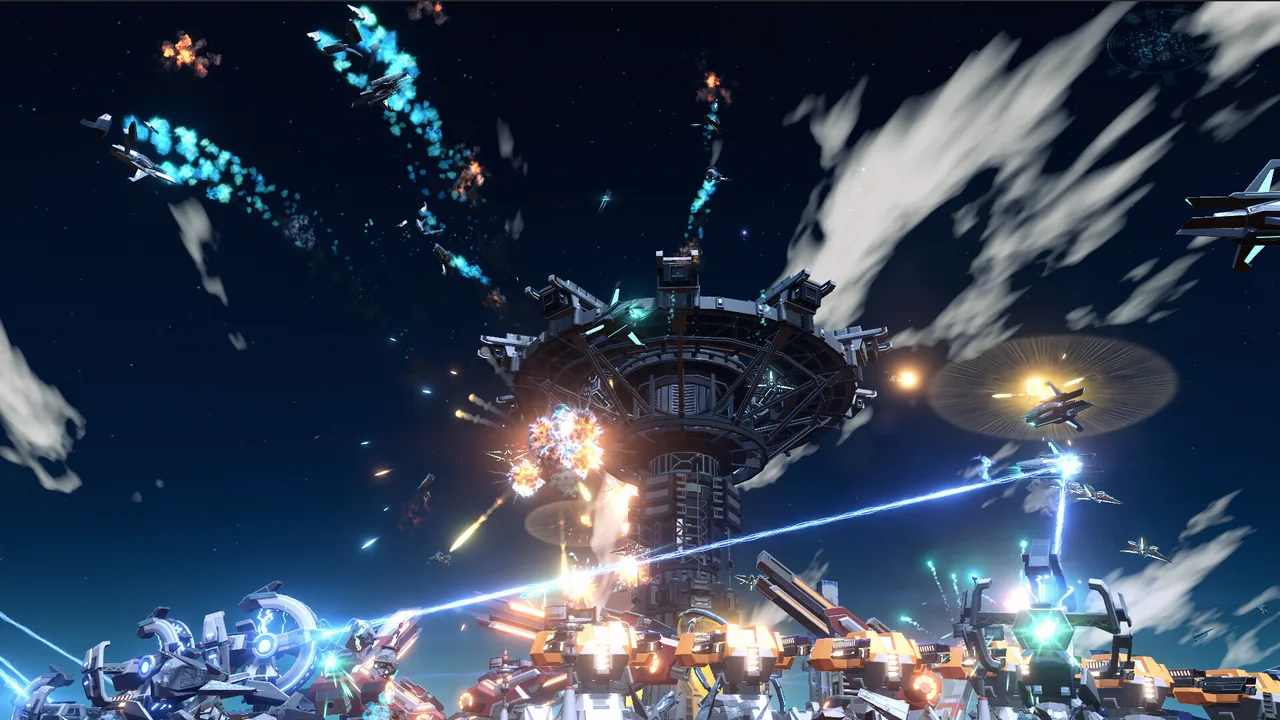
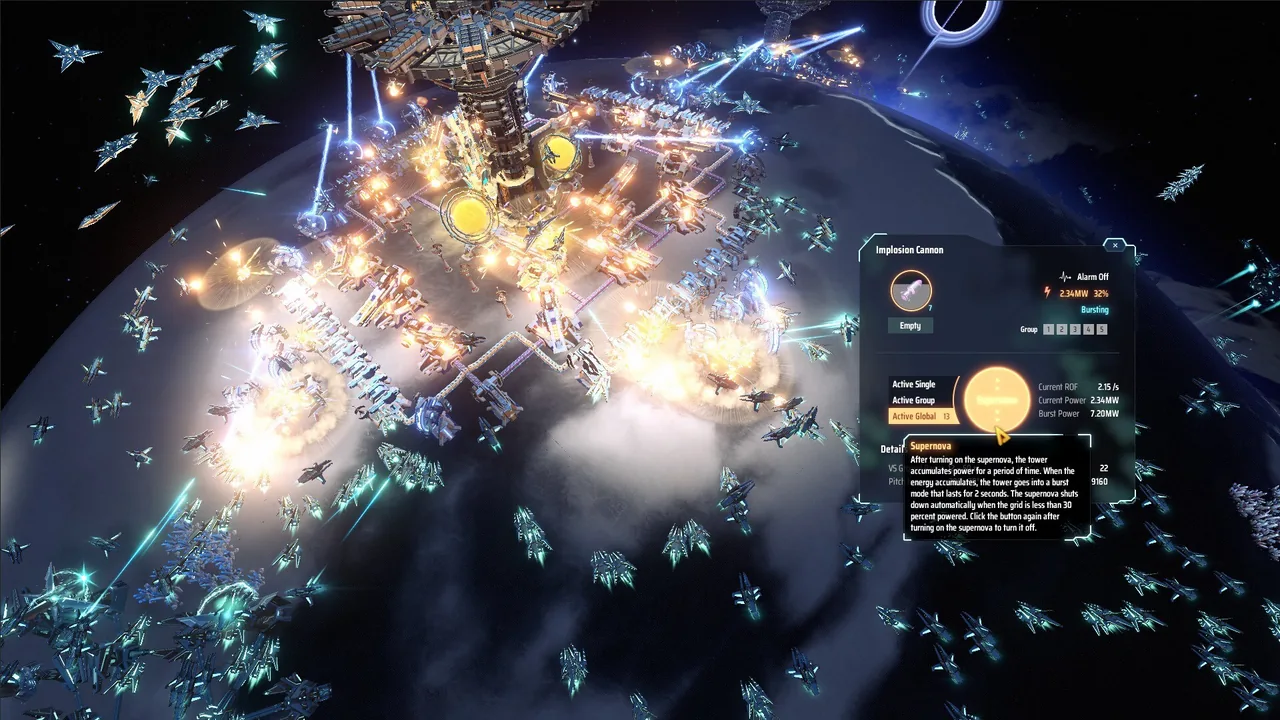
Combat arrived late and deliberately. "Rise of the Dark Fog," the update most players had been waiting for since launch, went live in December 2023 — nearly three years into Early Access — and it gave the Dark Fog enemy faction actual teeth: bases to destroy, defensive turrets to build, and a threat level that scales with how much pollution your factory is generating.
It's a legitimately clever piece of systemic design on paper, echoing the same "your own output creates the pressure" idea Factorio uses with biters. In practice, it's the single most divisive addition in the game's history, and the split is worth taking seriously rather than waving away. Some players wanted exactly this — stakes, a reason to defend territory, a combat layer that makes expansion feel risky instead of purely additive. Others bought Dyson Sphere Program specifically because it wasn't a combat game, and experience Dark Fog attacks as an interruption to a production puzzle they'd rather solve without an enemy AI setting the pace. Both reactions are reasonable. The game does let you tune Dark Fog aggression down, which is the right call, but the fact that a major, years-in-the-making update needed that escape hatch from day one tells you how unevenly it landed with the existing audience.
Presentation: gorgeous machinery, one thin soundtrack
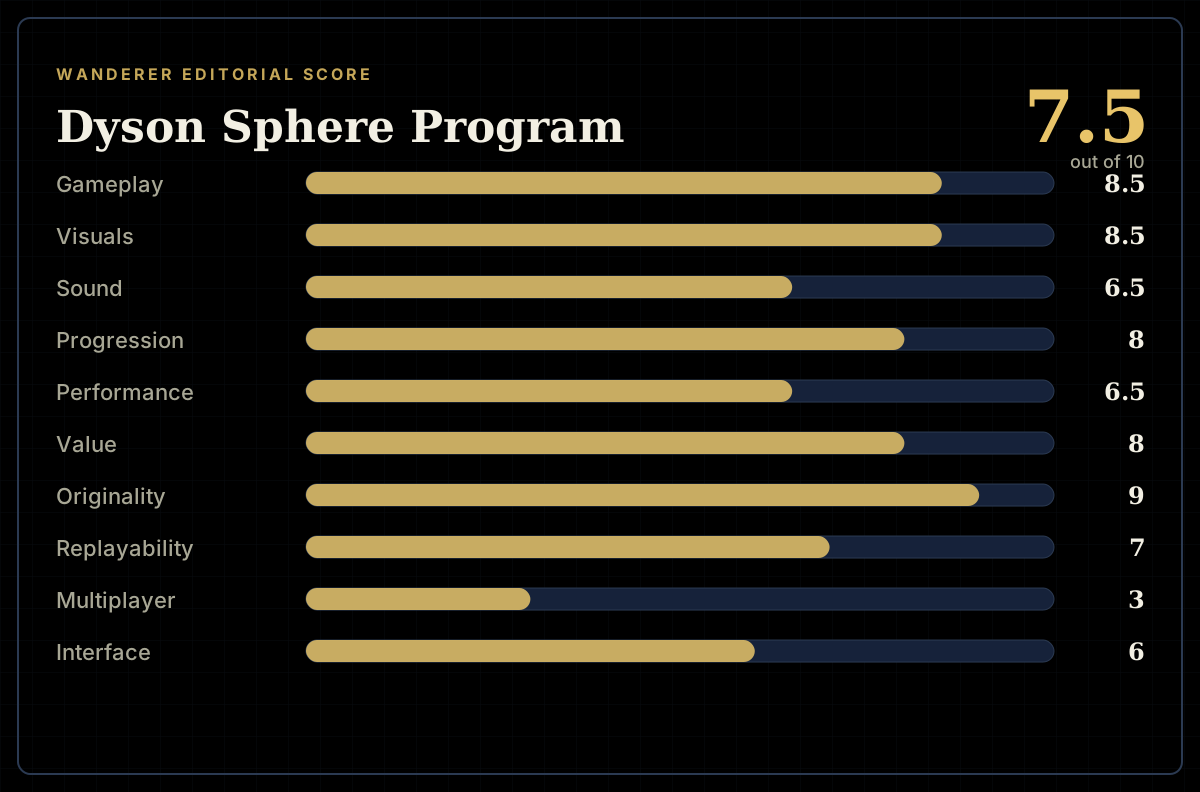
Visually, DSP earns its score. Planets are rendered with real orbital mechanics and day-night cycles, belts and sorters read clearly even when a factory sprawls across a screen, and the Dyson Sphere construction sequence — sails launching, nodes connecting, a shell slowly closing around a sun — is the best-looking moment in the automation genre, full stop. Mecha customisation and the variety of planet types (gas giants, ocean worlds, tidally locked deserts) give the galaxy a sense of place that flat 2D factory games can't match.
The audio side doesn't keep pace. The ambient soundtrack is short and loops noticeably during long sessions, and it's one of the most consistent complaints from players with hundreds of hours logged — a game this focused on long, meditative sessions needed more than a handful of tracks cycling on repeat, and it still doesn't have them.
Performance: better than it was, still the limiting factor late
Youthcat has done real engineering work here, rebuilding the game's threading model to spread factory-tick processing across cores rather than choking a single thread. It shows: multithreading improvements have measurably cut logic-processing time in developer-published tests. What it hasn't done is fully solve the problem. A save with hundreds of thousands of assemblers still visibly slows frame rate as the game works through them, the engine tends to lean on a handful of CPU cores no matter how thread settings are configured, and a built-in option to hide the Dyson Sphere's render entirely — because looking at it costs performance — is a pragmatic fix that also tells you plainly where the ceiling still sits. If you intend to build a genuine megabase here, budget for it costing more frame rate than an equivalent Factorio base would.
Five years in Early Access, and what that costs
This is the fact the brief for this review insisted on, and it deserves its own honest paragraph rather than a caveat buried in the value section: Dyson Sphere Program has been in Early Access since January 2021. It passed its fifth anniversary in January 2026 with a "5th Anniversary" update that teased, rather than shipped, the long-requested Vehicle System meant to smooth over exactly the mid-game logistics friction described above. There is still no announced 1.0 date.
Judged generously, that's a small studio taking the time to get an ambitious, structurally unusual game right rather than rushing a version 1.0 that locks in the mid-game's rough edges permanently. Judged less generously, it's five and a half years without the developer solving the single most commonly cited weakness in their own game, across a userbase large enough and vocal enough that the problem cannot be a surprise to them. Both readings are fair, and neither one should be dressed up as the other. What's not really in question is that a buyer picking this up today is buying an unfinished game — one whose best systems are genuinely excellent, and whose worst friction has had five years to get fixed and hasn't been.
Value, and the multiplayer feature that isn't coming
At NZ$24.79 with a single-player campaign that comfortably runs past a hundred hours for anyone who gets hooked, the value case is straightforward and doesn't need much defending. There are no microtransactions to weigh, no premium currency, and the two paid add-ons — a soundtrack and a digital art book — are exactly what they say on the tin, entirely optional, and don't touch gameplay.
The one gap in that clean picture is multiplayer, and it's worth being direct about it rather than soft-pedalling. Youthcat has been consistent that the game is being built and will stay single-player focused. The community answer is Nebula, a fan-built mod maintained by a team that, by player accounts, is considerably larger than Youthcat's own, and it does add functional co-op play. But an unofficial mod filling a five-year-old feature request is a workaround, not a feature, and anyone buying this expecting to build a Dyson Sphere with friends out of the box is going to be disappointed by the base game as sold.
Players who like the idea of a production system that keeps running and rewarding you without needing every action performed manually may find a gentler, more forgiving cousin of that same idea in Wanderer's own gathering and crafting loops — though nothing there approaches the scale of wrapping a star.
Verdict
Seven and a half. Dyson Sphere Program's central idea — an automation game whose endgame is a physical, hand-designed megastructure rather than a bigger number — is genuinely the best premise the genre has, and for long stretches the game around it delivers on that promise. The planet-to-galaxy escalation is real structural progression, not padding, and actually building the Sphere is one of the best sustained payoffs in strategy gaming.
What keeps it from sitting alongside the genre's very best is that the road to that payoff has a real pothole in it — an interstellar-logistics mid-game the interface hasn't caught up to — and that five and a half years of Early Access haven't closed it. Combat splits the audience it was built for, performance still buckles under the largest factories despite real engineering effort, and multiplayer remains a fan-made workaround rather than a shipped feature. None of that erases what the game gets right. It does mean the honest verdict on a five-year Early Access title has to weigh the unfinished parts as seriously as the finished ones, and that's exactly what keeps this score short of the very top of the genre rather than at it.
If you already know you want to build a star-eclipsing megastructure with your own hands, buy it — the core loop justifies the price on its own, and the mid-game friction is a real but survivable cost for one of the best endgames in the genre. If you're waiting for a finished, fully realised version of that idea, the honest answer after five and a half years is: not yet.
Price, platform and Early Access status checked 30 July 2026.
Pros and cons
Pros
- The escalation from a single planet to a multi-star supply chain is a genuine structural shift, not just bigger numbers on the same machines
- Building the Dyson Sphere itself is a real, hands-on design act — choosing shell layouts, node patterns and orbit rings rather than watching a progress bar fill
- The tech tree keeps introducing new problems (oil refining, ray receivers, mecha logistics) well past the point most automation games start repeating themselves
- Blueprint saving turns repetitive factory design into stamped, reusable modules once you unlock it
- A premium price under NZ$25 with no in-app purchases, no ads and no live-service pressure of any kind
- A dedicated Steam userbase measuring their save files in hundreds of hours, with 97% of roughly 91,300 reviews positive
Cons
- Interstellar logistics vessels turn the mid-game into a scheduling and routing puzzle that many players find tedious rather than clever, and the game gives you little help managing it at scale
- The "Rise of the Dark Fog" combat update divides its own audience — some players enjoy the added stakes, others experience it as an interruption to a game they bought specifically because it wasn't about combat
- The soundtrack is a short, repeating loop that several long-session players single out as the game's weakest piece of presentation
- Large factories with hundreds of thousands of buildings still visibly slow down despite years of multithreading work, and the game only really uses a handful of CPU cores regardless of settings
- No official multiplayer after five-plus years in development, despite it being one of the most requested features since launch
- Still in Early Access with no announced 1.0 date, and major systems like the Vehicle System remain partially previewed rather than shipped
Screenshots
-
Dyson Sphere ProgramImage: Gamirror Games via Steam -
Dyson Sphere ProgramImage: Gamirror Games via Steam -
Dyson Sphere ProgramImage: Gamirror Games via Steam -
How the review scores each part of the gameWanderer Editorial -
The short versionWanderer Editorial