Game review
Satisfactory
9 / 10
- Developer
- Coffee Stain Studios
- Publisher
- Coffee Stain Publishing
- Released
- 10 September 2024
- Platforms
- Windows, PlayStation 5, Xbox Series X|S
- Genre
- First-person factory automation and construction
- Monetisation
- Premium, one-off purchase — no in-game purchases, no premium currency, no subscription, no ads. The only add-on is an optional soundtrack DLC. FICSIT Coupons, the in-game currency used at the AWESOME Shop, are earned entirely through play and cannot be bought with real money
- Players
- Co-op for up to four players by default, extendable to far larger sessions through a dedicated server or config edit; crossplay across PC, PlayStation 5 and Xbox Series X|S
The short version
Satisfactory takes the ratio-and-throughput core of factory automation and rebuilds it in first person, in three dimensions, on an alien planet you have to actually walk across to survey. That choice changes what the genre asks of you: belts stop being lines on a schematic and become things you climbed a scaffold to route, and a finished factory reads as architecture rather than a diagram. Five years after leaving its Epic exclusivity deal behind, and a year on from a 1.0 release that finally gave the tech tree an ending, it's one of the best-looking, best-feeling automation games available.
The cost of that first-person, 3D framing is real: building at scale is physically slower than clicking a blueprint stamp, verticality turns into spaghetti before you've learned to plan for it, blueprints themselves don't unlock until you're well into the mid-game, and a sprawling late factory can genuinely bring a strong CPU to its knees. Combat is also the thinnest system here by a wide margin. None of that unseats what the game does better than anything else in its genre.
Biggest strengths
- Building in first person and full 3D turns factory design into genuine architecture, with vertical stacking, catwalks and sightlines that a top-down automation game simply cannot offer
- Massage-2(AB)b is a real, hand-crafted alien world with distinct biomes worth exploring for their own sake, not just a resource grid dressed up with scenery
- The milestone-gated tech tree paces new logistics tools precisely — trucks, trains, pipelines and drones each arrive with enough space between them to actually master the last one
Biggest weaknesses
- Blueprints don't unlock until Tier 4 of the HUB, so the first stretch of the game is manual placement with no shortcut, right when a new player most wants one
- Vertical building is genuinely rewarding once you've learned it, but the early habit of stacking machines wherever space allows produces belt spaghetti that later has to be torn out and replanned
- Factory simulation runs primarily on a single high-priority CPU thread, and a sprawling late-game base can push frame rates down hard regardless of GPU horsepower
Who it's for: Automation and logistics players who want the throughput puzzle of Factorio with a body attached to it, plus anyone drawn to exploring a genuinely alien world rather than a procedurally tiled grid. Less suited to players who want combat depth or a factory game they can zoom out and manage from a top-down overview.
Our recommendation: Worth the full price, and worth buying on PC over console if you have the choice — the extra horsepower matters more here than in almost any other genre once your factories get large. Console players get a legitimately complete version of the same game, just with a lower ceiling before performance becomes the limiting factor.
9 / 10
Every automation game eventually asks the same question: is this belt carrying enough iron plates to keep the next machine fed? Satisfactory asks that question too, but it makes you climb a scaffold to find out. That's the entire pitch, and it's a better one than it sounds on paper — take the ratio-and-throughput puzzle that Factorio and its imitators solved from a god's-eye view, put the camera at eye level, and let players build up as freely as they build out. Coffee Stain Studios spent five and a half years proving that idea works, first as an Epic Games Store exclusive from 19 March 2019, then on Steam from 8 June 2020 once that exclusivity period lapsed, and finally as a finished, 1.0 product from 10 September 2024. PlayStation 5 and Xbox Series X|S owners joined the party considerably later, on 4 November 2025, with full crossplay against the PC version. What they're all playing is, structurally, the same game: an open-world automation sandbox that treats its alien setting, and its extra spatial dimension, as the whole reason to exist rather than a gimmick layered on top of a genre that already worked fine in 2D.
The dimension that changes everything
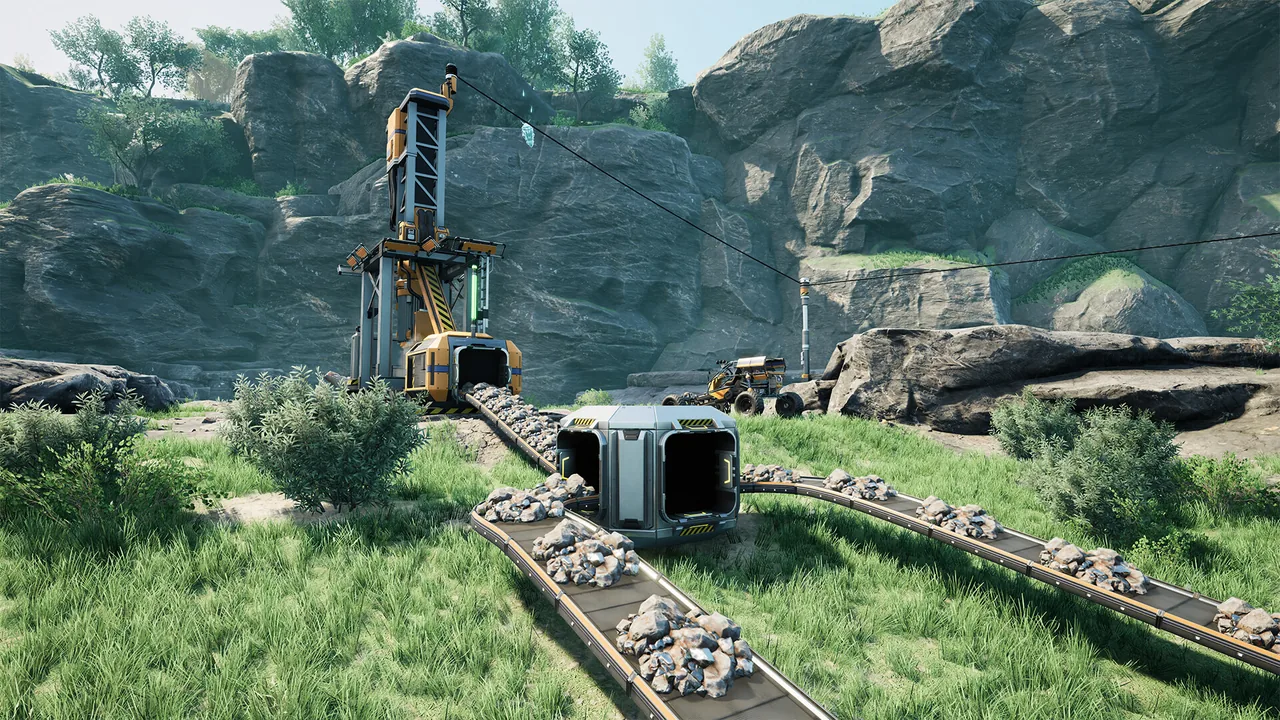
Strip Satisfactory down to its arithmetic and it looks a lot like every other factory game. Miners extract at a fixed rate, smelters convert ore to ingots on a timer, assemblers need specific input ratios to hit full output, and the entire mid-game is the process of noticing a bottleneck and building enough machines to clear it. None of that is new, and none of it is meant to be — Satisfactory isn't trying to out-math Factorio.
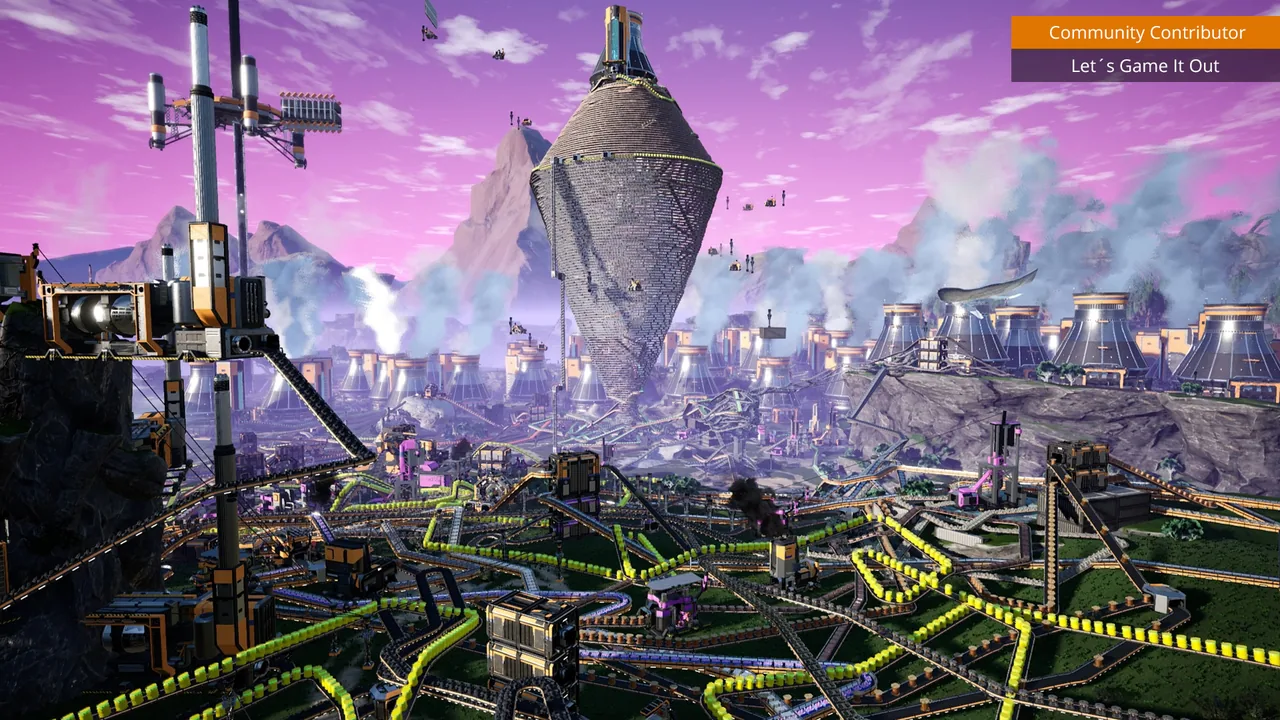
What it's doing instead is asking what happens when that same arithmetic has to be solved by a body standing in the world, rather than a cursor hovering above it. A belt run in a top-down automation game is a line you draw. A belt run in Satisfactory is a structure you build, tile by tile, often ten storeys in the air, with a jetpack strapped on because the alternative is climbing down and back up every time you need to check a splitter. That difference sounds like a convenience cost, and it partly is — placing a hundred-belt run by hand, walking its length, is slower than clicking a blueprint stamp in a 2D equivalent. But the same physicality is what turns a finished factory into something closer to a building than a diagram. You can walk inside it, look up at your own conveyor gantries crossing overhead, and feel the scale of what you made in a way no top-down camera angle replicates. Factorio's satisfaction is intellectual: the moment two numbers finally match. Satisfactory's satisfaction has a spatial, almost architectural component layered on top of that same math, and it's a genuinely different feeling, not just a reskin of the same one.
A world worth walking, not just mining
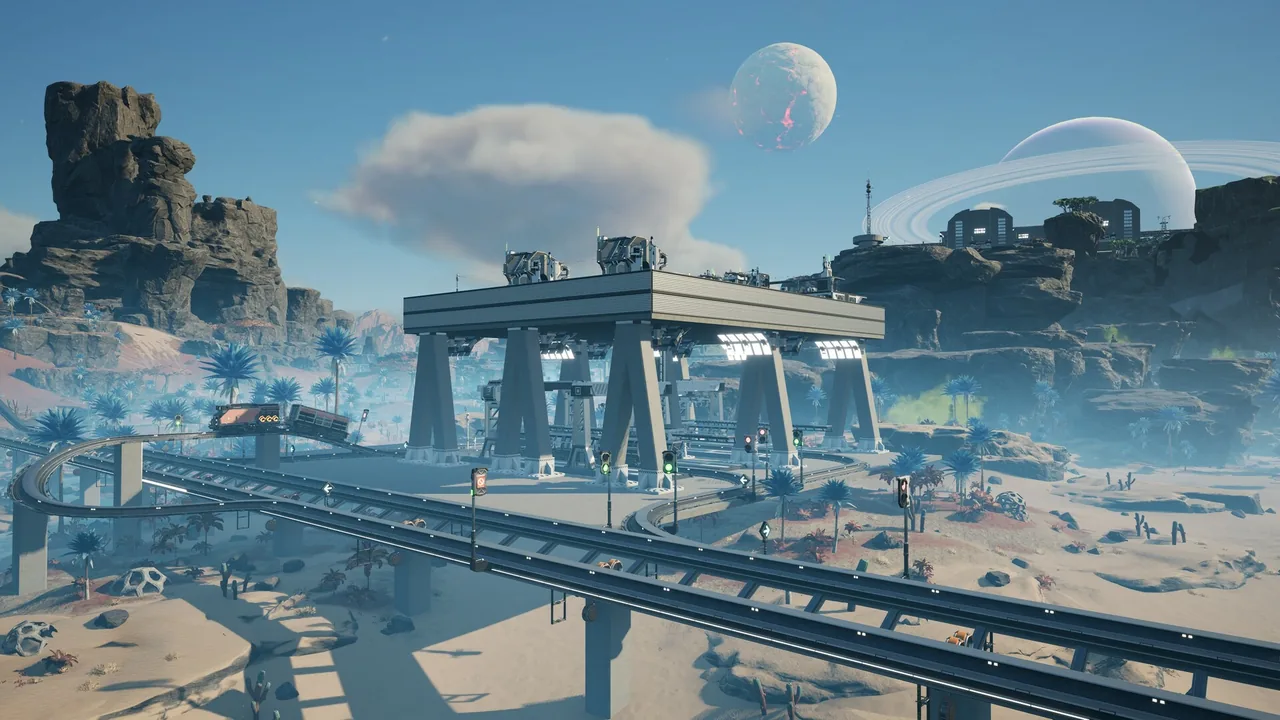
The other consequence of first-person 3D is that Massage-2(AB)b has to actually be a place, not a tile grid with resource icons stamped on it. It mostly succeeds. The planet's biomes — grassy plains, red jungle canyons, a mushroom-choked swamp, a permanently frozen tundra reached later in the tech tree — are hand-authored rather than procedurally generated, and each one asks something different of a factory built inside it: uneven terrain that forces creative foundation work, aggressive local wildlife that makes early exploration genuinely tense, resource nodes tucked into cliff faces that reward the jetpack and grapple gear you unlock over time. Exploration is rewarded with more than just ore, too — hard drives found in crashed pods grant alternate crafting recipes, giving you a real reason to leave the factory floor and go look at the planet you're supposedly terraforming.
The honest tension is that the better you get at the game, the more of that planet you pave over. A mature save file tends to be a lattice of foundations, pipes and conveyor belts stretching across biomes that were, a hundred hours earlier, worth stopping to look at. Coffee Stain clearly built a world meant to be appreciated on its own terms, and then built a game whose entire win condition is covering as much of it as efficiently as possible. That's not really a contradiction the developers could have avoided — it's baked into what factory games are — but it's worth naming as the quiet cost sitting underneath all the biome variety: the more you succeed, the less of the original planet is left to look at.
The tech tree as a logistics ladder
Satisfactory's Tier and Milestone system does the pacing work that a lot of automation games struggle with, specifically by staggering new transport tools rather than just new machines. Conveyor belts carry you through the opening hours; trucks arrive around Tier 3 once you need to move goods further than a belt can reasonably reach; rail and freight cars follow a few tiers later for genuinely long-haul logistics between distant outposts; pipelines show up alongside oil processing to solve the same problem for liquids; and drones, unlocked well into the back half of the tree, offer point-to-point air freight for low-volume, high-distance runs where laying track isn't worth the effort. Each one solves a genuinely different logistics problem rather than being a strictly-better version of the last, so a late-game factory typically runs several of these systems at once rather than replacing belts with trains outright — which is exactly the kind of layered complexity that keeps a hundred-hour game from plateauing into "bigger version of the same machine" the way weaker automation titles do.
Blueprints are the one place this pacing works against new players. The Blueprint Designer, which lets you save a built section and stamp out copies of it elsewhere, doesn't unlock until the FICSIT Blueprints milestone in Tier 4 — which means the entire early game, the stretch where players are least confident about their own factory layouts and most likely to want a do-over, is manual placement with no shortcut at all. By the time blueprints arrive, a lot of players have already built and torn down their starter base once or twice by hand. That's not necessarily bad design — it forces you to actually learn placement before automating it — but it's a real onboarding cost worth knowing about going in, and it's a sharper contrast with genre peers than the marketing suggests, since a game this friendly on the surface still asks you to earn its most convenient tool the hard way.
Verticality is a skill, and it has to be learned the hard way
The freedom to build up is Satisfactory's headline feature, and it's also where the game is most willing to let new players hurt themselves. Nothing stops you from stacking machines wherever floor space allows in your first few hours, routing belts up and over each other because it's easier than planning ahead, and ending up with what the community affectionately calls spaghetti — a factory that functions but that nobody, including its builder, can read at a glance six tiers later. Learning to build in clean vertical layers, with dedicated belt levels and predictable machine rows, is a real skill the game teaches only by consequence: your own past mess gets in your own way until you develop better habits. Experienced players talk about this as part of the fun, and there's truth to that — untangling your own spaghetti is a satisfying kind of problem-solving in its own right — but it's fair to say the game could do more to teach clean vertical planning before letting you build several storeys of chaos. Compare this to a top-down automation game, where a messy factory is at least visible as a single flat mess you can screenshot and study; a messy 3D factory is something you often can't see all of at once, which makes diagnosing it a genuinely harder task.
Combat exists to interrupt, not to compete
Wildlife and the occasional larger threat give Satisfactory some combat, but it's clearly the system that got the least design attention, and it shows. Early creatures are more nuisance than threat, later ones hit harder without gaining much in the way of new attack patterns to read, and the weapon and equipment progression exists mostly to make exploration survivable rather than to build a fighting system with its own depth. That's a defensible choice — this was never meant to be a combat game, and padding it out with a full RPG-style weapon tree would have pulled resources away from the parts of the game that actually matter — but it does mean combat reads as friction to clear on the way to the next resource node rather than a system worth engaging with for its own sake, and players who want a factory game with teeth in its danger will find this one has a fairly soft bite.
Where the CPU starts to lose the argument
The most consequential technical fact about Satisfactory is one that only shows up after dozens of hours: the factory simulation runs primarily on a single high-priority CPU thread, and unlike most open-world games, it keeps simulating everything you've built regardless of whether you're standing nearby. That design choice is what makes the game trustworthy — walk away from a smelting line for an hour and it's still smelting when you get back — but it's also the reason a sufficiently sprawling late-game base can bring frame rates down hard even on strong hardware, because the bottleneck isn't your graphics card, it's how much of your CPU's single-core boost clock is left over after the simulation itself. Coffee Stain has kept optimising throughout Early Access and since 1.0, and sensible layout habits — enclosed, segmented factory sections, fewer redundant belt paths, keeping detail-distance settings realistic — genuinely help. But there's a real ceiling here that a sufficiently ambitious megabase will eventually hit, and it's worth factoring into any plan to build something enormous: this is a game where your factory's design efficiency is, eventually, also a performance optimisation exercise, whether you wanted it to be one or not.
Presentation that actually earns the exploration
Visually, Satisfactory is doing something Factorio never attempted: making its world genuinely beautiful to walk through, not just legible to manage. Unreal Engine lighting, weather that shifts across biomes, and machine and belt models with real weight and detail all sell the fiction that you're an engineer on an alien planet rather than a player moving icons around a spreadsheet. The FICSIT-branded UI carries the same care — a corporate-parody aesthetic that's funny without undercutting the genuine satisfaction of watching your own throughput numbers climb. The soundtrack, composed by Jannik Reuterberg, leans into ambient synths that suit long building sessions without demanding attention, and it's good enough that Coffee Stain sells it as a standalone release for players who want it separate from the game.
Multiplayer that scales past its own default
Co-op officially supports four players out of the box, but that number undersells what's actually possible — a dedicated server or a straightforward config edit raises the practical ceiling well beyond that for groups willing to host their own persistent world, and PC, PS5 and Xbox Series players can now all share one session through full crossplay. Shared building holds up better here than in a lot of co-op survival games specifically because the core loop is inherently collaborative — dividing up a factory's subsystems between players and watching them link together is one of the better shared-project feelings available in games right now. The console launch coming more than a year after the PC 1.0 release is a real gap for anyone who wanted to build alongside PlayStation or Xbox friends earlier, but crossplay support at launch at least means that gap, once closed, was closed properly rather than leaving console players in their own isolated version of the game.
Value, and what full price actually buys
At NZ$56.99, Satisfactory sits at the higher end of the automation genre's pricing, but the value case is straightforward: one purchase, no monetisation of any kind beyond an optional soundtrack, and a tech tree deep enough that most serious playthroughs run well past a hundred hours before the space elevator's final shipment goes out. FICSIT Coupons, spent at the in-game AWESOME Shop for cosmetics and quality-of-life unlocks, are earned entirely through milestones and never sold — there is no premium currency to buy with real money here, and the game never once asks. Coming out of Early Access with a confirmed, shipped 1.0 rather than an open-ended promise also matters more than it might for a genre where several high-profile competitors are still mid-development years after launch. This is a complete game, not a work in progress you're funding.
Players who like the idea of a production loop that keeps running while they're away, without needing to physically walk every belt into place themselves, might find a gentler cousin of that same satisfaction in Wanderer's own gathering and crafting systems.
Verdict
Nine out of ten. Satisfactory's core bet — that an automation game gains something real by being played in first person and in three dimensions, rather than losing something by abandoning the top-down clarity the genre was built on — pays off. Building becomes physical and occasionally architectural, the planet is a place worth exploring rather than a texture on a grid, and the milestone-gated logistics ladder paces new tools about as well as anything in the genre. Blueprints arriving too late for new players, verticality that has to be learned through your own early mistakes, thin combat, and a CPU ceiling that a sufficiently large factory will eventually find are all real costs, not manufactured ones for the sake of balance — and they're the honest reason this isn't higher.
None of that changes what the game is at its best: the automation genre's most convincing argument yet that throughput puzzles and physical space belong in the same building, and a genuinely finished, generously priced 1.0 that took its five and a half years in development seriously. If you already know you like watching a production line come together, buy it and expect to lose a few hundred hours to it. If you've only played automation games from a god's-eye view before, this is the one worth finding out what changes when you climb down into the factory yourself.
Price and platform details checked 30 July 2026.
Pros and cons
Pros
- Building in first person and full 3D turns factory design into genuine architecture, with vertical stacking, catwalks and sightlines that a top-down automation game simply cannot offer
- Massage-2(AB)b is a real, hand-crafted alien world with distinct biomes worth exploring for their own sake, not just a resource grid dressed up with scenery
- The milestone-gated tech tree paces new logistics tools precisely — trucks, trains, pipelines and drones each arrive with enough space between them to actually master the last one
- The Blueprint Designer turns repetitive building into stamped, reusable modules once it unlocks, which meaningfully cuts the manual-placement grind in the second half of the game
- Co-op holds up well for shared building projects, with dedicated server support letting a group maintain one persistent factory well beyond the four-player default
- One clean premium purchase with no in-game shop, no premium currency and no monetisation pressure of any kind
Cons
- Blueprints don't unlock until Tier 4 of the HUB, so the first stretch of the game is manual placement with no shortcut, right when a new player most wants one
- Vertical building is genuinely rewarding once you've learned it, but the early habit of stacking machines wherever space allows produces belt spaghetti that later has to be torn out and replanned
- Factory simulation runs primarily on a single high-priority CPU thread, and a sprawling late-game base can push frame rates down hard regardless of GPU horsepower
- Combat against the planet's wildlife and the occasional set-piece enemy is functional at best, closer to an obstacle you clear once than a system with its own depth
- Building physically, camera in hand, is slower than clicking a blueprint icon in a top-down game, and there's no way around that cost even once you're experienced
- Console versions arrived over a year after the PC 1.0 release, so anyone who wanted this on PS5 or Xbox waited considerably longer than PC players did
Screenshots
-
SatisfactoryImage: Coffee Stain Publishing via Steam -
SatisfactoryImage: Coffee Stain Publishing via Steam -
SatisfactoryImage: Coffee Stain Publishing via Steam -
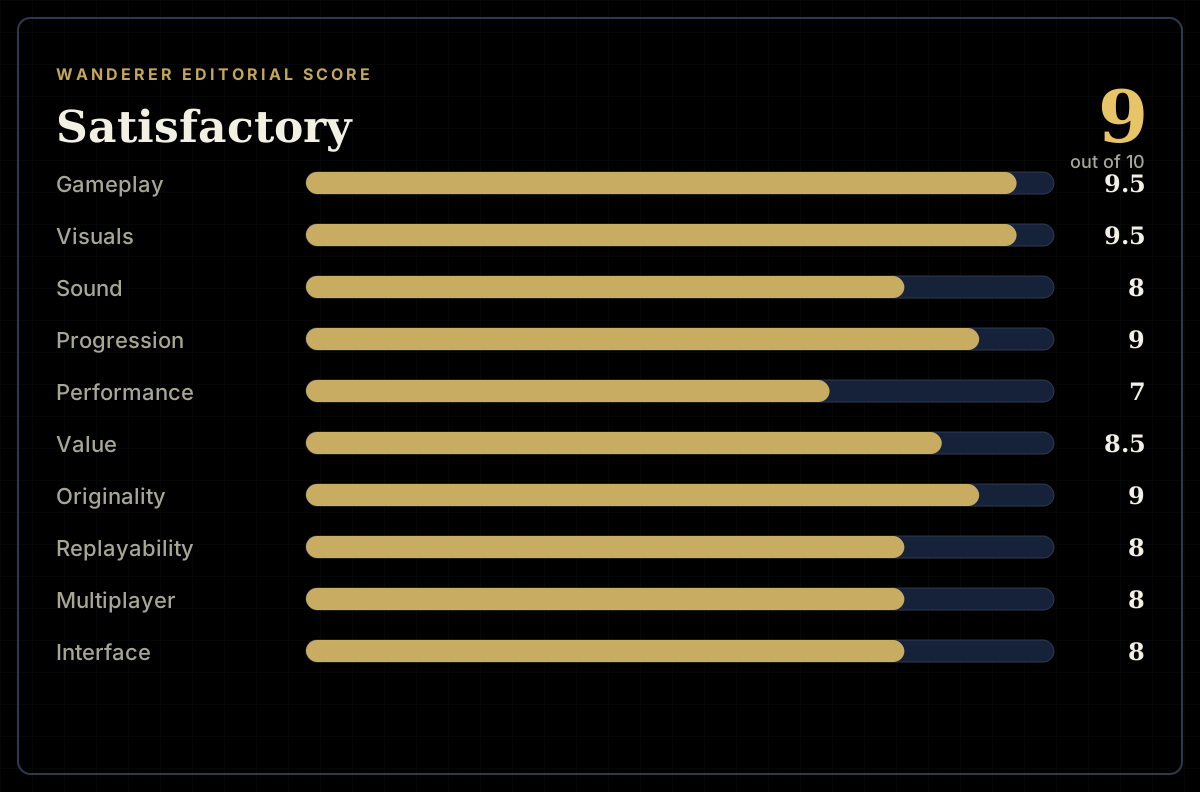
How the review scores each part of the gameWanderer Editorial -
The short versionWanderer Editorial