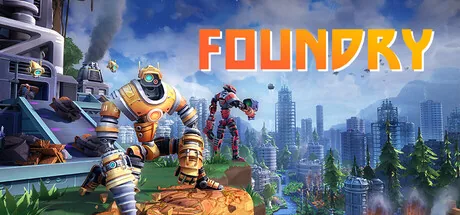
Game review
FOUNDRY
7 / 10
- Developer
- Channel 3 Entertainment
- Publisher
- Paradox Interactive
- Released
- 2 May 2024
- Platforms
- Windows
- Genre
- Factory automation, construction and simulation
- Monetisation
- Premium, one-off purchase. No in-game purchases, no premium currency, no ads, no subscription. A separate Founder's Edition Upgrade DLC exists for players who bought the base edition and want the cosmetic extras bundled into the pricier tier
- Players
- Online co-op and LAN co-op, in addition to solo play. Foundry also installs the Paradox Launcher alongside the game, which several early reviews flagged as an unwanted third-party dependency even though it doesn't require signing in to play
The short version
FOUNDRY takes the Factorio-style automation loop into first-person and full 3D, and the actual building — snaking conveyors and pipes through a voxel world with no grid limits on where you place things — is genuinely satisfying to construct. What it hasn't found, more than two years into Early Access, is much reason to exist that Factorio, Satisfactory or Dyson Sphere Program don't already cover, and the friction that makes those games tense is largely absent here.
It's a pleasant, good-looking factory game rather than a essential one. Update 4's addition of trains is a real structural improvement, and the developer's cadence of free content updates is a point genuinely in its favour. But the core identity problem — a very competent version of a loop you can already play elsewhere, in a world several reviewers have called quiet to the point of lifeless — hasn't been solved yet.
Biggest strengths
- Building with no grid limits on where machinery goes lets factories sprawl underground, across cliffs and into the sky in ways flat 2D factory games can't match
- Update 4's trains give long-distance logistics a genuinely different tool than the belt-and-pipe systems the early game runs on
- Weekly developer blogs and a steady run of free content updates since May 2024 show real, sustained support rather than a launch-and-abandon Early Access pattern
Biggest weaknesses
- A large share of negative reviews describe it as "Factorio but 3D" without bringing enough new ideas to justify choosing it over the games it's borrowing from
- No combat, tight time pressure or hostile world design means very little pushes back against the player, and several reviewers single out the resulting lack of friction as the game's biggest weakness
- Global achievement data shows a steep drop after the early game — the top achievement sits around 24%, while high-tier robot production and endgame "market dominance" goals fall below 1%, matching player complaints that momentum stalls once the initial research tree empties out
Who it's for: Automation fans who specifically want a first-person, voxel-based factory game with co-op built in from day one, and who don't mind that the challenge curve is gentler than Factorio's. Less suited to players chasing survival stakes, tight resource pressure, or something meaningfully different from the genre's established leaders.
Our recommendation: A fair purchase at NZ$47.99 if the first-person voxel angle and co-op specifically appeal to you, with the caveat that it's still Early Access two years on and the mid-to-late game runs thinner than the opening hours promise. Automation veterans who already own Factorio, Satisfactory or Dyson Sphere Program should treat this as a pleasant variation rather than a must-have.
7 / 10
Most automation games make their world hostile on purpose. Factorio has biters eating your perimeter the moment your pollution cloud drifts too far. Satisfactory drops you on a planet that actively wants to kill you before you've built your first smelter. FOUNDRY doesn't bother with any of that. You land on an empty, procedurally generated voxel planet with an AI companion named Carl, and nothing in the world is trying to stop you from building. That choice is either the game's best decision or its biggest problem, and honestly, after two years of Early Access, it's still a bit of both.
Developed by Channel 3 Entertainment and published by Paradox Interactive, FOUNDRY entered Early Access on 2 May 2024. It is, as of this writing, still there — more than two years later, with no 1.0 date on the horizon. That's worth stating plainly up front, the same way it needs to be stated for any Early Access automation game this deep into development, because it shapes how fair it is to judge what's currently missing.
The pitch: Factorio, but you're standing in it
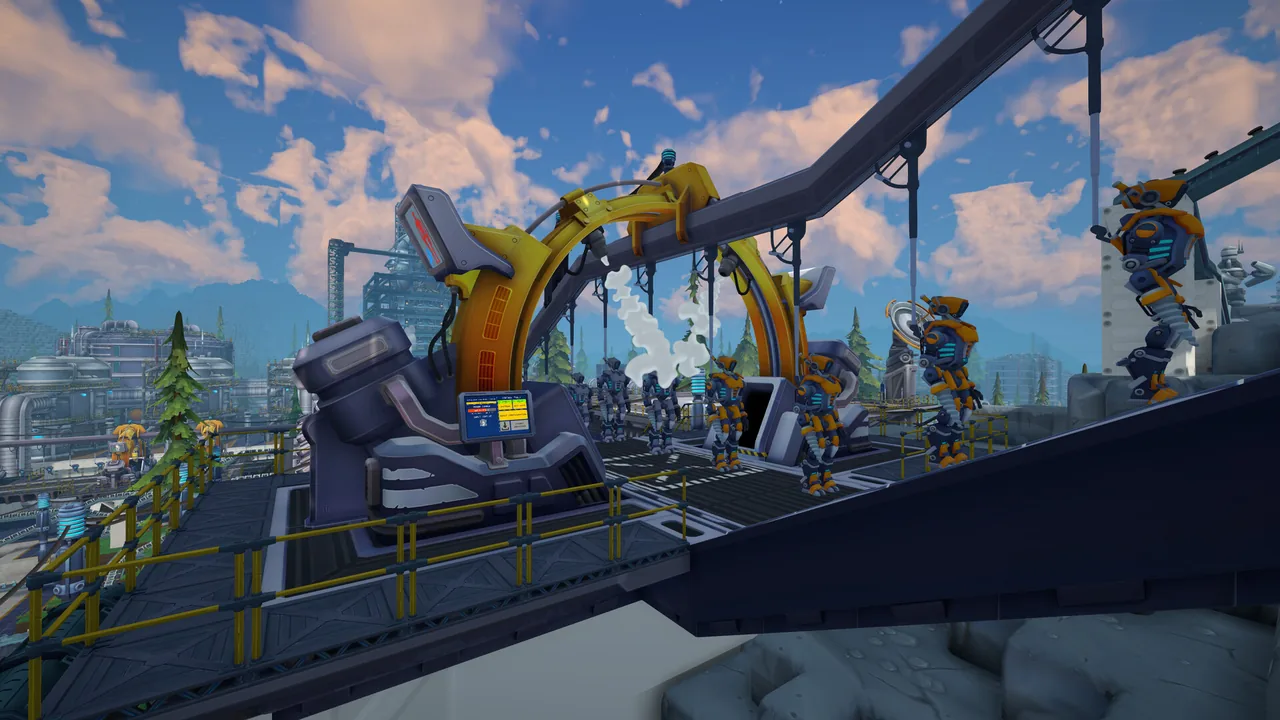
FOUNDRY's core loop will be instantly familiar to anyone who has played Factorio, Satisfactory or Dyson Sphere Program: mine resources, smelt them, feed them into assemblers, connect everything with conveyor belts and pipes, and gradually replace your own hands with automated machinery. What FOUNDRY changes is the camera and the canvas. You play in first person, walking your robot avatar through a voxel world with no grid restrictions on where you can build — machines can go underground, into cliff faces, stacked into the sky, wherever the design calls for it. The result is that factories in FOUNDRY tend to look less like flat blueprints and more like actual architecture, wrapping around terrain instead of flattening it.
That's a real and specific selling point, and it's the part of the game that reviewers consistently praise regardless of how they feel about everything else. Watching a factory grow organically through a landscape, rather than across a bulldozed grid, gives FOUNDRY a sense of place that Factorio's top-down 2D view was never trying to have. The building tools themselves are polished — placing and connecting machinery feels precise rather than fiddly, which matters enormously in a genre where a clumsy building interface can sink an otherwise good game.
Where the friction went
The trouble is what FOUNDRY did with the rest of the formula. Automation games generate tension from constraint: not enough power, not enough space, not enough time before something goes wrong. FOUNDRY removes most of those pressures. There's no combat, no hostile wildlife worth worrying about, and comparatively generous starting conditions. PC Gamer's assessment — calm and pleasant, but hurt by "too many conveniences that removed any friction from the building process" — lines up closely with what shows up across the Steam review corpus: players who specifically wanted the genre's characteristic tension find themselves building in a vacuum instead.
That's a legitimate design choice, not an accident. A more relaxed automation game aimed at players who find Factorio's biters stressful rather than exciting is a real audience, and FOUNDRY is clearly built for them. The problem is that removing pressure without replacing it with something else — a stronger narrative hook, a more demanding logistics puzzle, a reason to keep optimizing past "good enough" — tends to leave a game with less to hold onto in its second half than its first. A meaningful number of negative reviews describe exactly that arc: strong opening hours, then a mid-game where the loop stops introducing anything new to think about.
The "Factorio but 3D" problem
The single most common complaint across FOUNDRY's negative reviews isn't a bug or a balance issue — it's a comparison. "It's Factorio but 3D," "if you've played Satisfactory, don't bother," "clunky and very bland compared to the games it's copying" — versions of that sentence appear over and over in the negative review sample, from players who otherwise clearly like the genre and have hundreds or thousands of hours in its established leaders. That's a harder problem to solve than any single system, because it isn't about whether FOUNDRY's belts work well (they do) or whether its factories look good (they do) — it's about whether the game gives automation veterans a reason to choose it over three or four extremely well-regarded alternatives that already exist.
To be fair to Channel 3, the first-person voxel angle and native co-op are real differentiators, not nothing. But two years into Early Access, "it's the one you can play in first person with a friend" is still doing most of the work of the pitch, and that's a thinner hook than the genre's best games are built on.
Robots, research, and where the endgame goes thin
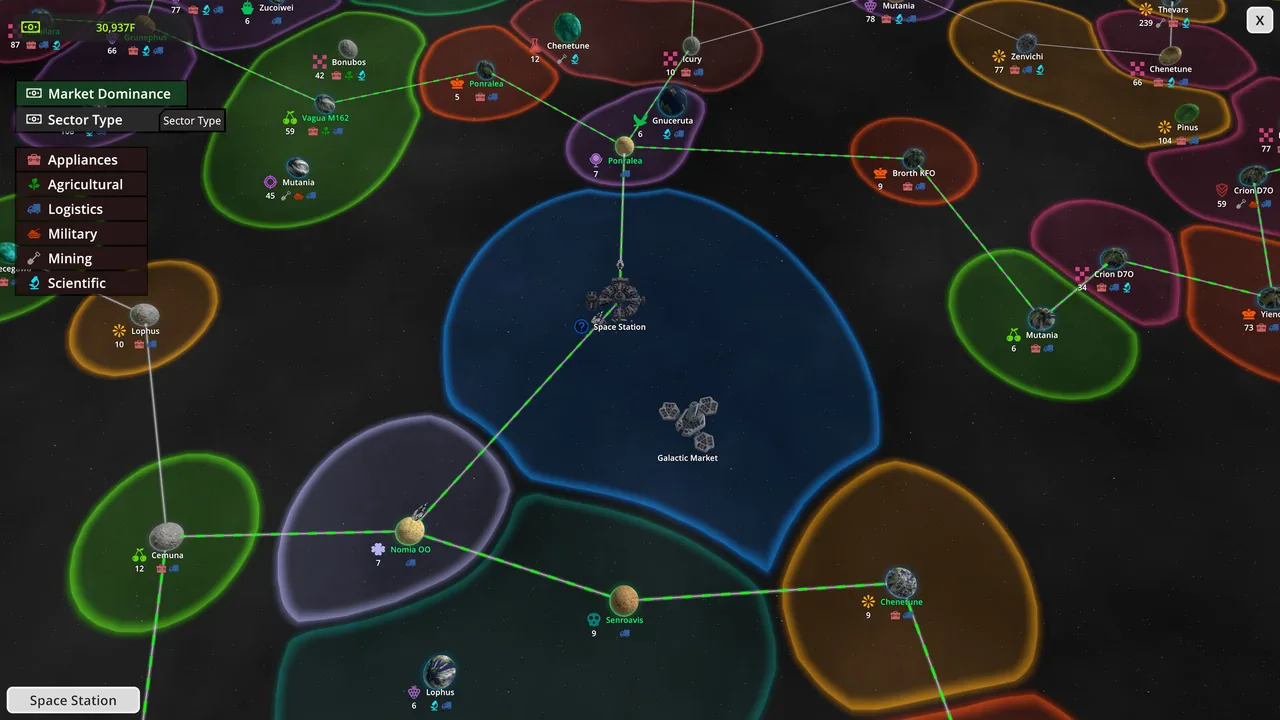
The stated goal — building an automated facility that manufactures and sells robots through interplanetary trade to achieve "galactic industrial domination" — gives FOUNDRY's research tree a clear throughline for a long stretch of play. Early- and mid-game progression, unlocking new production chains and more advanced machinery, is where the game is at its strongest: there's a steady drip of new problems to solve, matching the genre's best pacing.
Global Steam achievement data backs up where that momentum runs out. The most commonly earned achievement sits at roughly 24% of the playerbase, which is unremarkable on its own — plenty of games have a soft opening achievement most players clear. What's more telling is the bottom of the list: achievements tied to the game's later robot tiers and its "market dominance" endgame goals sit below 1%, several under 0.5%. That's a steep enough cliff to corroborate, with real numbers, what a number of long-session reviewers describe in their own words — that the further you get into FOUNDRY, the more the game narrows down to "the same loop again, with a longer supply chain," and the less it offers to justify pushing through to the very end. One reviewer with over 5,000 hours logged put it almost exactly that way: the more they progressed, the more the returns thinned out.
Update 4 and the case for staying in Early Access
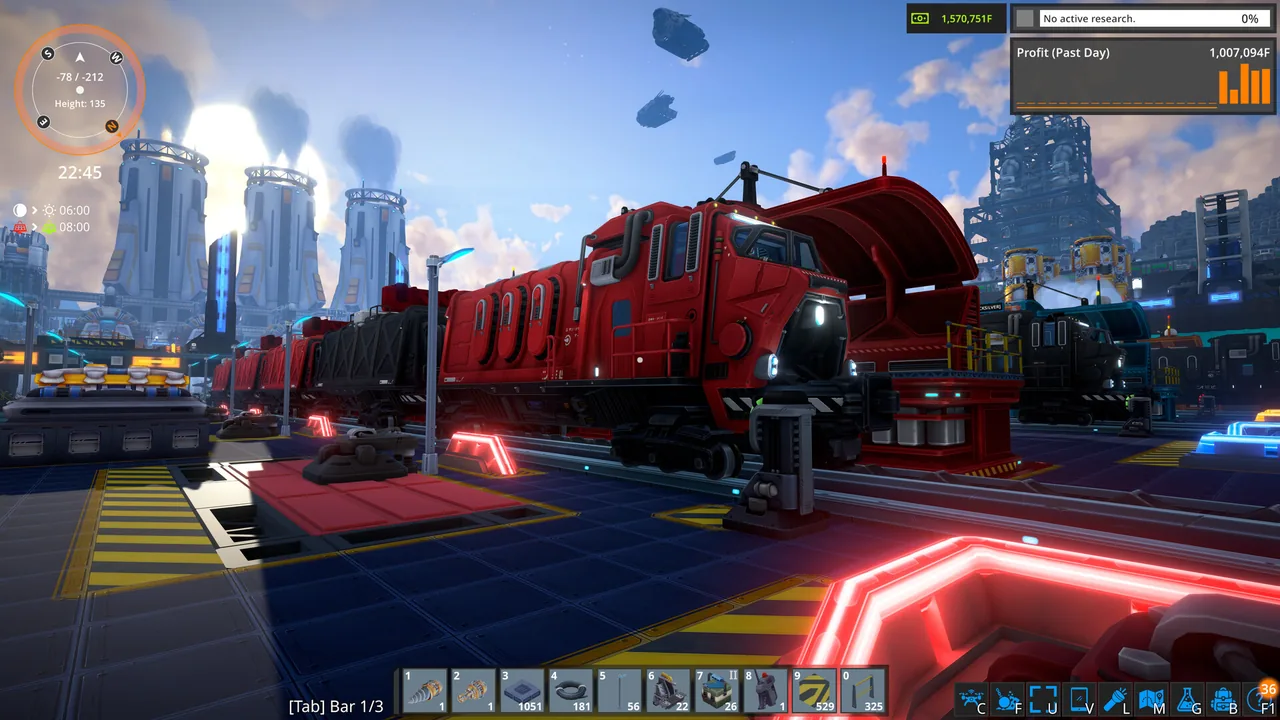
The fairest thing to say about FOUNDRY's two-plus years in Early Access is that the studio has kept working the whole time. Weekly "Foundry Fridays" devblogs have run continuously since launch — past entry 100 as of April 2026 — and the game has received a steady sequence of numbered content updates rather than going quiet after its first few months, which is the far more common failure mode for Early Access automation games. Update 4, "Rails & Reactors," shipped on 28 April 2026 and added trains: a genuinely useful new logistics layer for moving large volumes of resources across long distances, distinct in feel from the belt-and-pipe systems that carry the early game. It's exactly the kind of system that can extend an automation game's mid-to-late structure, and it's a concrete, positive sign that Channel 3 is still trying to solve the problems reviewers have been raising since 2024.
Whether that's enough, two years on with no 1.0 date announced, is a fair question to leave open rather than answer for the player. A buyer today is still buying an unfinished game, and one whose most consistent criticism — that it runs dry once the initial research tree empties out — hasn't been fully addressed by two years of otherwise genuine, active development.
Co-op, the launcher, and value
FOUNDRY's online and LAN co-op are built into the base game rather than patched on later, and it's one of the areas where player sentiment shifts noticeably more positive — factory games are frequently better with a second pair of hands dividing up the build list, and FOUNDRY supports that cleanly.
The one recurring irritant worth naming directly is the Paradox Launcher, which installs alongside the game and triggered a wave of complaints around launch, several one- and two-star reviews citing it specifically as their reason for refunding. It's worth being precise about what that complaint actually is: the launcher does not require a Paradox account to play, and functions largely as a pass-through to the game itself. But an unrequested third-party launcher appearing at first boot is a real friction point regardless of how harmless it turns out to be, and it's clearly cost the game some early goodwill that a cleaner install wouldn't have.
At NZ$47.99, FOUNDRY sits squarely in line with the genre's premium pricing, and there's no microtransaction layer, premium currency or subscription to weigh against it — just a base game and an optional Founder's Edition upgrade for cosmetic extras. For players who specifically want the first-person, voxel, co-op version of this loop, that's a fair price for a game that's already received two-plus years of free content on top of it.
Players who like factory games where the reward is watching a system run cleanly without babysitting every step of it may find a gentler cousin of that idea in Wanderer's own automated gathering and crafting loops — though Wanderer never asks you to route a supply chain between planets.
Verdict
Seven out of ten. FOUNDRY does the thing it set out to do — a first-person, voxel-based automation game with no grid limits on construction and co-op built in from the start — competently and often beautifully. The building itself is a genuine pleasure, Update 4's trains show a studio still solving real problems, and the pace of free content since 2024 is a better track record than most Early Access games in this genre can claim.
What keeps it from climbing higher is that, two years in, it still hasn't answered the question its own players keep asking in the negative-review pile: what does this do that Factorio, Satisfactory or Dyson Sphere Program don't already do better? The lack of friction that makes it calm also makes it forgettable past the midpoint, and the achievement data backs up the complaint that momentum runs out once the research tree empties. If the first-person, voxel, co-op angle is specifically what you're after, FOUNDRY delivers it well. If you're automation-agnostic and just want the best version of this loop, the genre's older leaders still have the stronger claim.
Price, platform and Early Access status checked 3 August 2026.
Pros and cons
Pros
- Building with no grid limits on where machinery goes lets factories sprawl underground, across cliffs and into the sky in ways flat 2D factory games can't match
- Update 4's trains give long-distance logistics a genuinely different tool than the belt-and-pipe systems the early game runs on
- Weekly developer blogs and a steady run of free content updates since May 2024 show real, sustained support rather than a launch-and-abandon Early Access pattern
- Online and LAN co-op are built in from the start rather than bolted on, and reviewers who play it with friends consistently rate it higher than the solo experience
- The voxel world's lighting and factory silhouettes read as some of the best-looking machinery in the genre, even when the terrain around them is sparse
Cons
- A large share of negative reviews describe it as "Factorio but 3D" without bringing enough new ideas to justify choosing it over the games it's borrowing from
- No combat, tight time pressure or hostile world design means very little pushes back against the player, and several reviewers single out the resulting lack of friction as the game's biggest weakness
- Global achievement data shows a steep drop after the early game — the top achievement sits around 24%, while high-tier robot production and endgame "market dominance" goals fall below 1%, matching player complaints that momentum stalls once the initial research tree empties out
- The Paradox Launcher installs alongside the game and drew a wave of complaints at launch, even though it doesn't require a Paradox account to play
- Still in Early Access more than two years after its 2 May 2024 start, with no 1.0 date announced
Screenshots
-
FOUNDRYImage: Paradox Interactive via Steam -
FOUNDRYImage: Paradox Interactive via Steam -
FOUNDRYImage: Paradox Interactive via Steam -
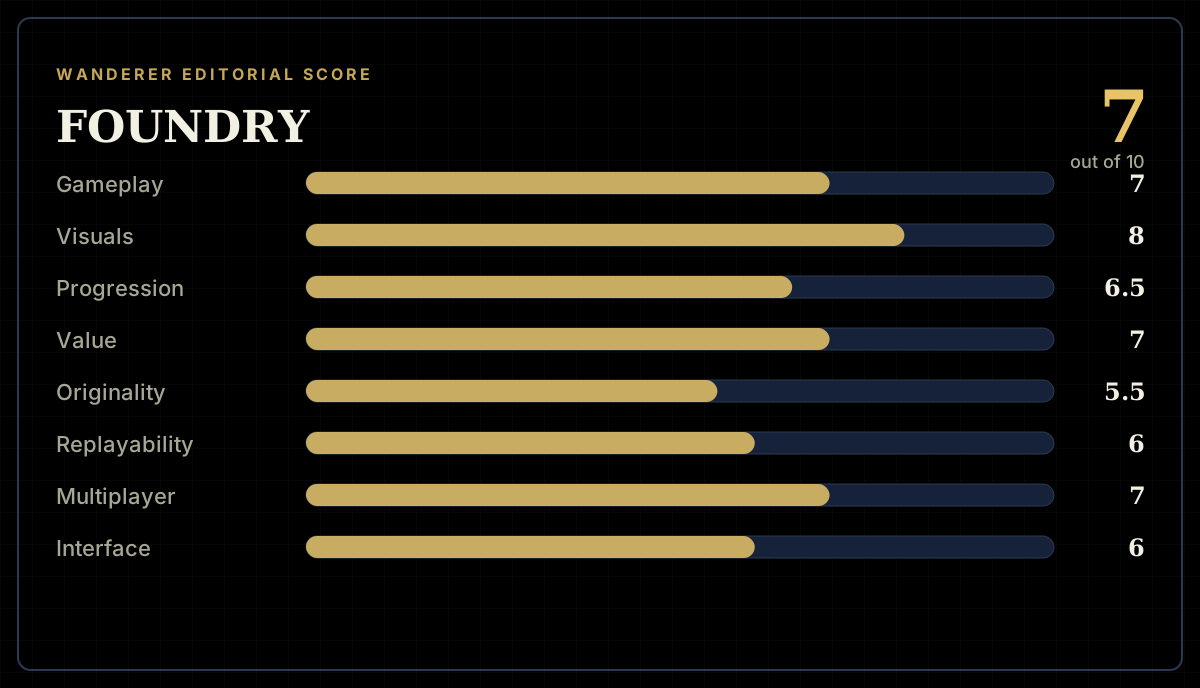
How the review scores each part of the gameWanderer Editorial -
The short versionWanderer Editorial