Game review
Papers, Please
9 / 10
- Developer
- Lucas Pope
- Publisher
- 3909
- Released
- 8 August 2013
- Platforms
- Windows, macOS, Linux
- Genre
- Puzzle Simulation
- Monetisation
- One-time purchase, NZ$14.75. No microtransactions, no DLC.
- Players
- Single-player only
The short version
Papers, Please puts you behind a border checkpoint desk in the fictional, grim state of Arstotzka, checking passports and documents against a growing list of rules while your family's rent and food depend on how many people you correctly process each day. It is, by design, a simulation of a monotonous, thankless job — and 97.3% of 79,927 reviewers agree it's one of the best games of its decade anyway. One of the most-upvoted reviews in its history puts the paradox plainly: "Papers, Please has no right to be as fun as it is."
Read the negative reviews and a genuinely honest, consistent criticism emerges alongside a wave of in-character joke reviews written as Arstotzkan propaganda. The real complaint isn't about bugs or broken promises — it's players saying the tedium the game deliberately simulates is, for them, simply tedious rather than meaningful. That's a fair criticism of a game built entirely around making a boring job feel weighty, and it lands differently depending on the player.
Biggest strengths
- A genuinely original premise, unmatched by anything since — turning document-checking into a tense, consequence-driven puzzle
- Real moral weight built into ordinary mechanical decisions, with multiple endings that respond to choices made under financial and time pressure rather than a single dialogue-tree branch
- Widely and consistently praised writing and vignette storytelling delivered almost entirely through the small interactions at the checkpoint window
Biggest weaknesses
- The core criticism, consistent across every year since release, is that the deliberate tedium of the job simulation genuinely isn't fun for some players, regardless of how well-executed it is — a fair mismatch of taste rather than a flaw to argue away
- The negative-review sample is inflated somewhat by in-character joke reviews written as Arstotzkan propaganda, which register as thumbs-down but aren't genuine criticism
- Once the rules and rhythm are learned, the moment-to-moment gameplay doesn't meaningfully vary — the tension comes entirely from narrative and financial pressure layered on top
Who it's for: Players open to a slow, mechanically repetitive game carrying real narrative and moral weight — this is closer to a thoughtful short story than a conventional game. Less suited to anyone who needs constant mechanical variety, since the core loop of checking documents never fundamentally changes, only the rules layered on top of it.
Our recommendation: Buy it — at under $15 for a complete, singular experience with multiple endings and branching outcomes based on your choices, it remains one of the best value propositions in this library regardless of genre. Give it the first two or three in-game days before deciding whether the tedium is working for you or against you; the rules and moral weight both compound quickly once you're past the tutorial-like opening.
9 / 10
Some games get more dated with time. Papers, Please, by its own creator's account, has gone the opposite direction — and he's on record calling that "a tragedy," not a compliment.
A job that shouldn't work as a game
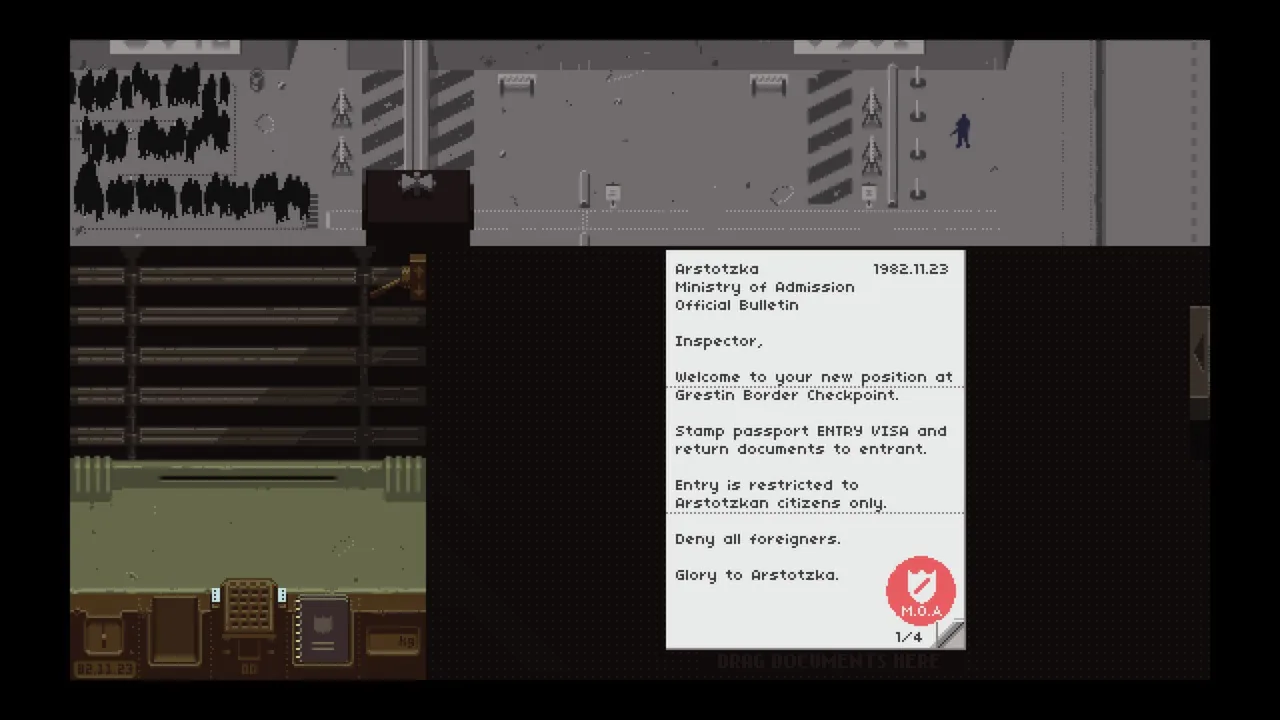
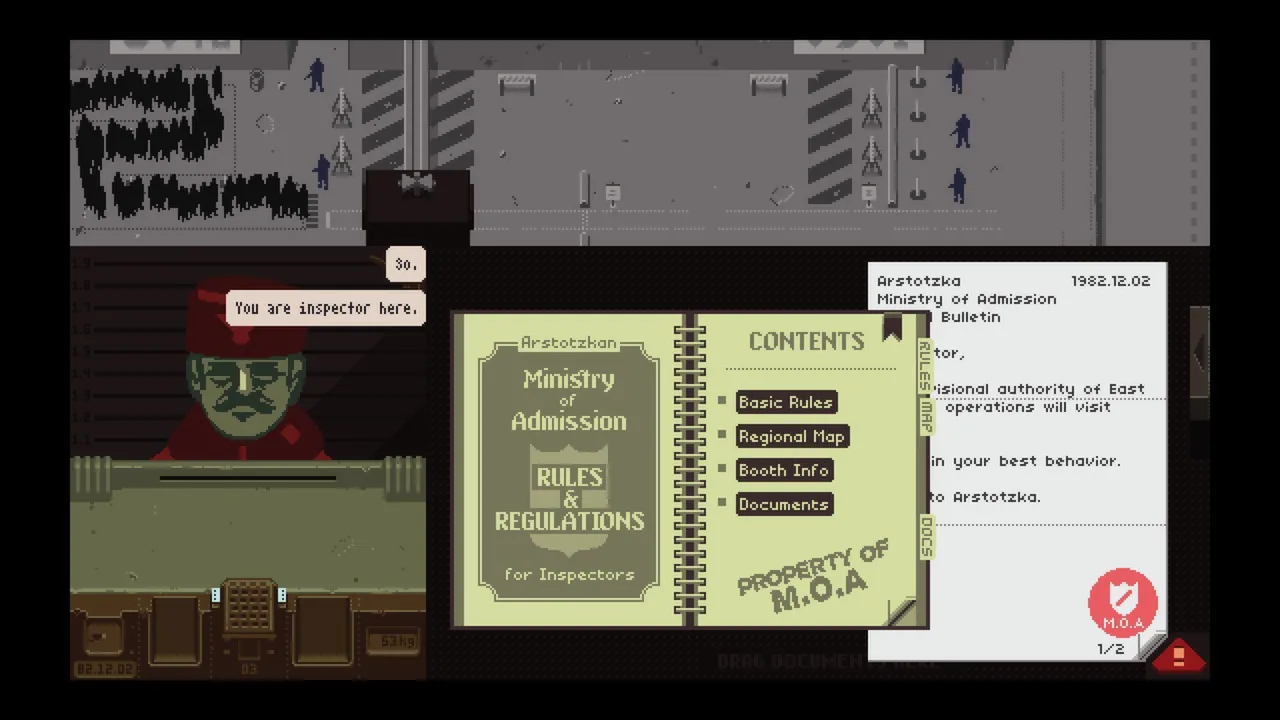
You are an immigration inspector at the border of Arstotzka, a fictional, grey, Soviet-adjacent state, checking passports and travel documents against a rulebook that grows more complicated day by day. Approve the wrong person and you're fined. Take too long and your family goes hungry. The premise is, on paper, a simulation of the most tedious job imaginable, and the reviews return to that paradox constantly. "In theory Papers Please should not be a fun game," one reviewer with 26 hours logged writes. "It is literally a simulation of performing a monotonous, tedious and thankless job. But the game is definitely a good game." The most-upvoted review in the game's history states the same idea more bluntly: it "has no right to be as fun as it is."
What makes the tedium work is that every mechanical decision carries real weight. Approving or denying a traveler isn't just a pass/fail check — it's a moral and financial decision made under genuine time pressure, and the game's writing delivers whole small stories through single interactions at the checkpoint window: a man who returns the next day with a hastily forged correction, a woman pleading for her family, officials who ask you to look the other way. None of it is delivered through cutscenes. All of it comes through the paperwork itself.
The honest criticism, and the joke reviews sitting next to it
Read the negative-review corpus and two very different things are mixed together, and it's worth separating them. The genuine criticism is consistent across every year since 2013: some players find the deliberate tedium simply tedious, not meaningful. "I found it a little too stressful and repetitive," one reviewer writes, going out of their way to say the game isn't bad, just not for them. Another describes it feeling "too much like an actual job" — which, notably, is exactly what the game is trying to be, and this reviewer is honest that the design succeeding at its goal doesn't make it fun for everyone. That's a fair, mature criticism worth taking at face value rather than arguing someone out of.
Sitting alongside those honest reviews, though, is something else: a recurring wave of joke reviews written in-character as Arstotzkan state propaganda — "You are under arrest for looking at negative reviews for this game... Glory to Arstotzka" — which register as thumbs-down in the aggregate score despite being affectionate tributes rather than criticism. It's a fun, low-stakes quirk of this game's specific fandom, and worth knowing about so the negative-review count isn't read as more substantive dissent than it actually represents.
Why it hasn't dated
This is the part worth dwelling on. In interviews around the game's anniversary, creator Lucas Pope has said directly that Papers, Please's themes — border control, family separation, authoritarian bureaucracy — have only become more resonant with real-world events since 2013, and that this isn't something he's happy about: "you want your work to be relevant, but at the same time, wow, I really wish it was not that relevant." That's an unusually candid thing for a creator to say about his own decade-old work, and it explains something the review corpus reflects on its own: this isn't a game people return to out of nostalgia. It's one whose subject matter keeps finding new reasons to matter.
Reading the completion data
The achievement curve traces the game's branching structure directly. Early-country milestones — first interactions with travelers from specific nations — sit between 36% and 58% of the player base. The rarest achievement, tied to one of the game's harder-to-reach endings, sits at 7.3%, consistent with a game whose multiple endings are meant to reward different playthroughs and choices rather than a single definitive completion.
9 out of 10. Papers, Please remains one of the most singular games ever made — a mechanical premise that shouldn't work turned, through writing and moral pressure, into something genuinely gripping. It loses a point only to what it openly admits about itself: the tedium at its core is deliberate, and for a real minority of players that tedium never converts into the tension it's built to create. That's not a flaw so much as the cost of an idea this uncompromising, and thirteen years of relevance the developer himself wishes had faded suggest the idea was worth the risk.
Pros and cons
Pros
- A genuinely original premise, unmatched by anything since — turning document-checking into a tense, consequence-driven puzzle
- Real moral weight built into ordinary mechanical decisions, with multiple endings that respond to choices made under financial and time pressure rather than a single dialogue-tree branch
- Widely and consistently praised writing and vignette storytelling delivered almost entirely through the small interactions at the checkpoint window
- Exceptional value at under $15 for a complete, replayable experience with no DLC or microtransactions ever added
- The developer's own reflection — that the game's themes have only grown more relevant with time rather than aging into irrelevance — is borne out by how the game continues to resonate more than a decade later
Cons
- The core criticism, consistent across every year since release, is that the deliberate tedium of the job simulation genuinely isn't fun for some players, regardless of how well-executed it is — a fair mismatch of taste rather than a flaw to argue away
- The negative-review sample is inflated somewhat by in-character joke reviews written as Arstotzkan propaganda, which register as thumbs-down but aren't genuine criticism
- Once the rules and rhythm are learned, the moment-to-moment gameplay doesn't meaningfully vary — the tension comes entirely from narrative and financial pressure layered on top
- A minority of reviewers with professional document-verification backgrounds note the underlying simulation, while well-realised, doesn't always match how real border processing actually works
Screenshots
-
Papers, PleaseImage: 3909 via Steam -
Papers, PleaseImage: 3909 via Steam -
Papers, PleaseImage: 3909 via Steam -
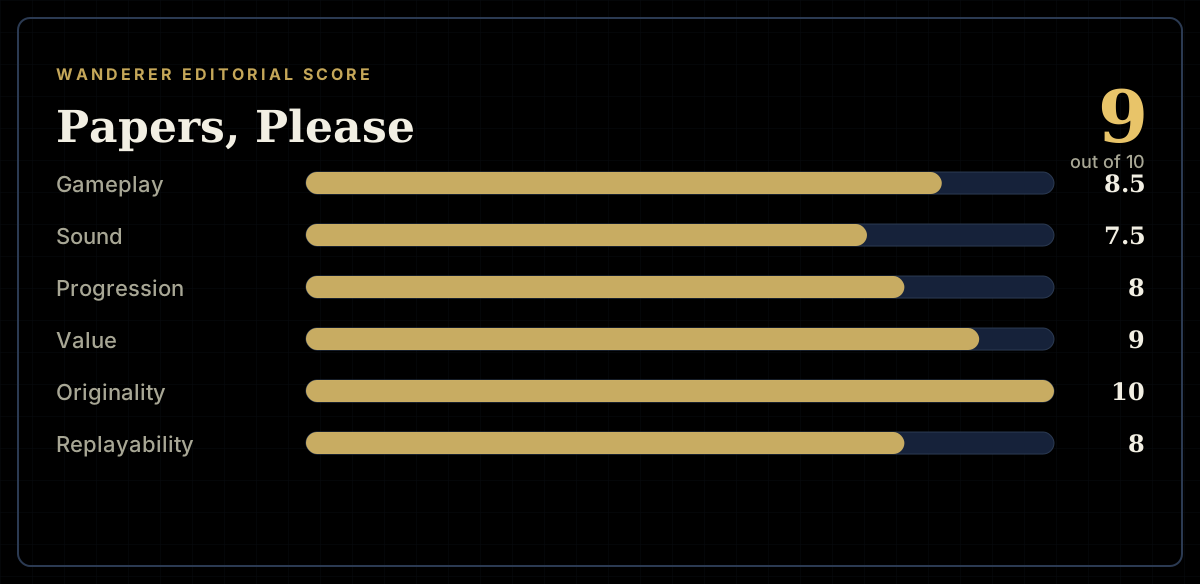
How the review scores each part of the gameWanderer Editorial -
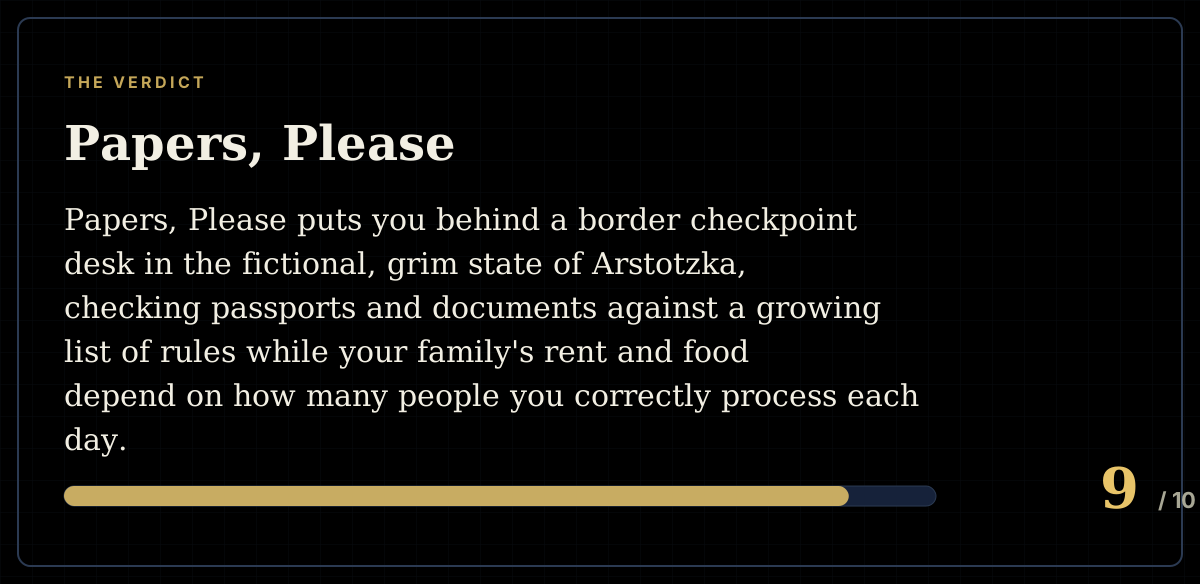
The short versionWanderer Editorial