
Game review
Click To Continue
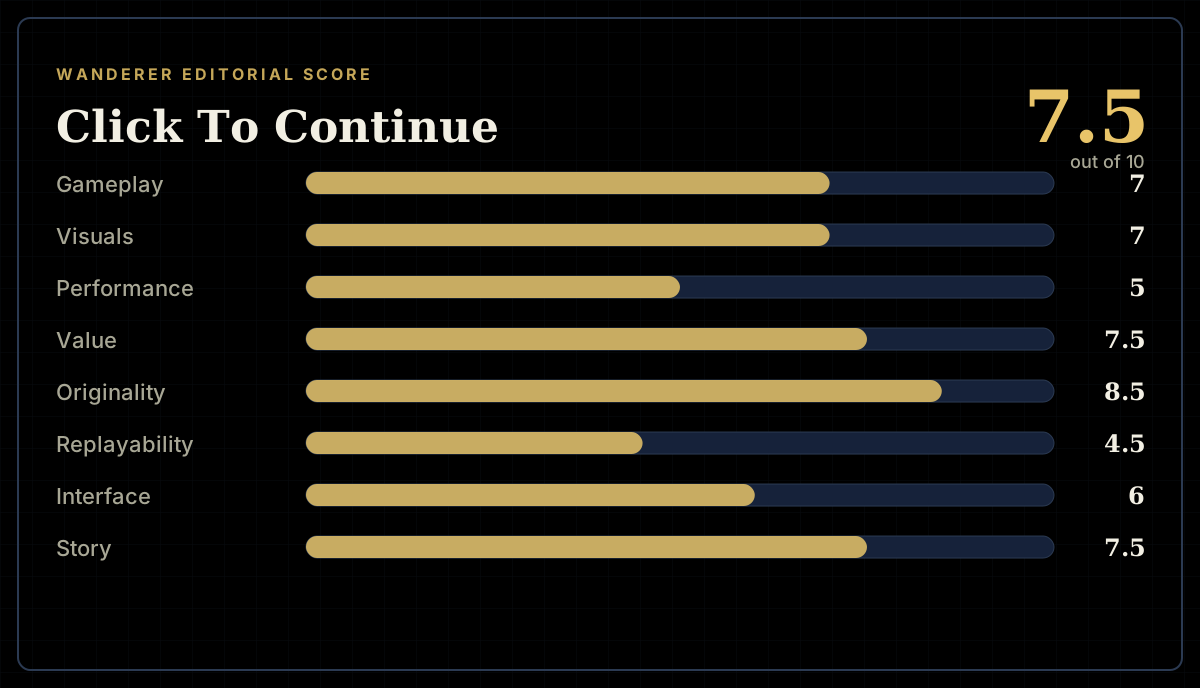
7.5 / 10
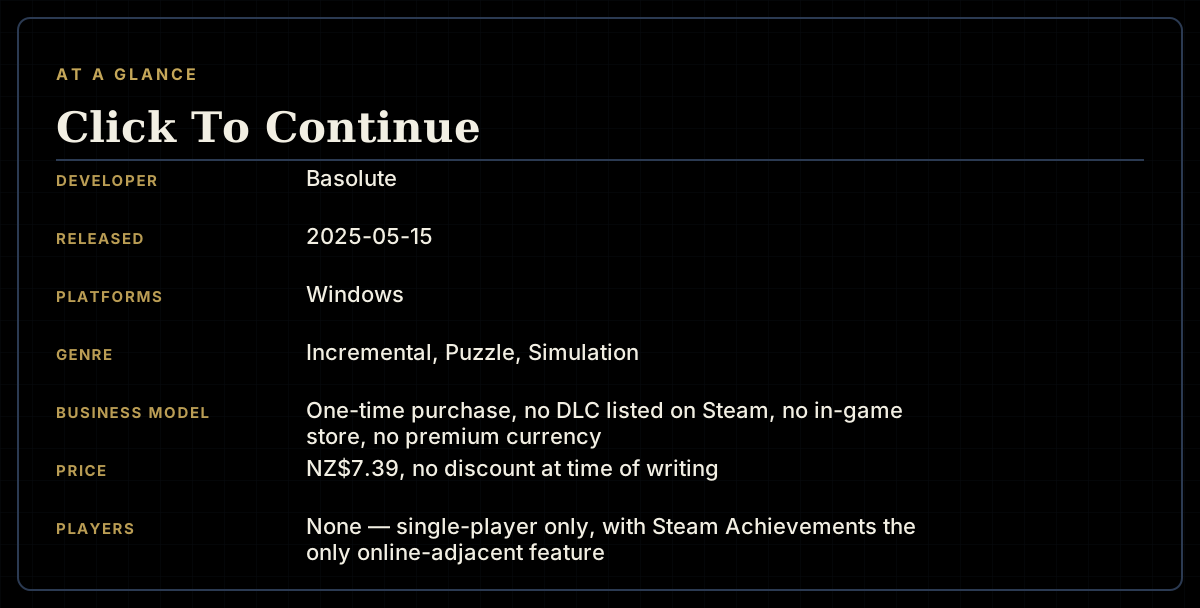
- Developer
- Basolute
- Publisher
- Basolute
- Released
- 15 May 2025
- Platforms
- Windows
- Genre
- Incremental, Puzzle, Simulation
- Monetisation
- One-time purchase, no DLC listed on Steam, no in-game store, no premium currency
- Players
- None — single-player only, with Steam Achievements the only online-adjacent feature
The short version
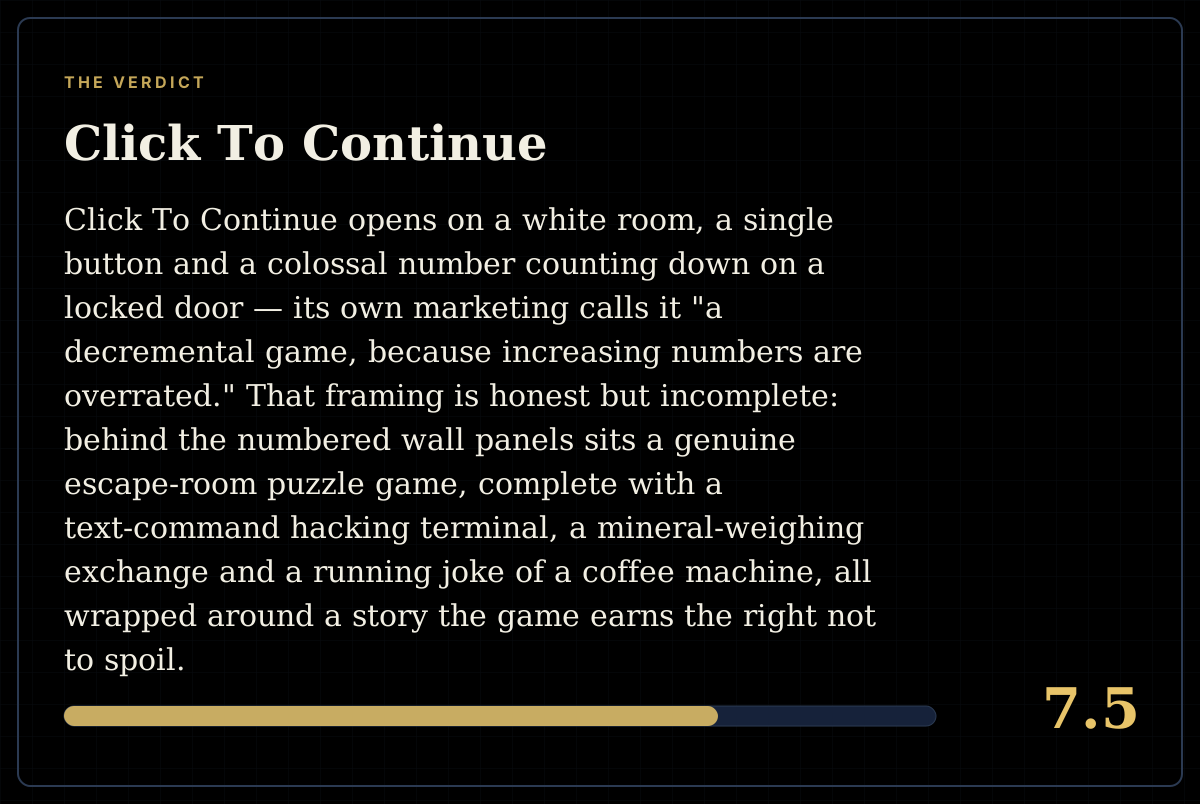
Click To Continue opens on a white room, a single button and a colossal number counting down on a locked door — its own marketing calls it "a decremental game, because increasing numbers are overrated." That framing is honest but incomplete: behind the numbered wall panels sits a genuine escape-room puzzle game, complete with a text-command hacking terminal, a mineral-weighing exchange and a running joke of a coffee machine, all wrapped around a story the game earns the right not to spoil. Community tag votes back this up directly — Incremental leads at 54 votes, but Puzzle sits right behind at 42, ahead of the bare "Indie" genre Steam's own storefront assigns it. The catch is a real one: Steam's own achievement data shows barely one buyer in nine ever reaches what looks like the true ending, and a persistent, never-quite-fixed performance problem — GPU and CPU spikes on a game built almost entirely from grey cubes — has been reported from launch week through as recently as May 2026, on a title whose developer stopped patching in September 2025.
Biggest strengths
- The "decremental" hook is more than a marketing line — the core loop genuinely counts a giant number down to zero rather than up, subverting the genre's most basic convention from the first screen
- Behind the click-driven wall panels sits a real escape-room structure, including a text-command hacking terminal with /identify, /ping, /scan and /override commands, not just cosmetic upgrade icons
- Reviewers who finish it are close to unanimous that the game's writing and dark humour — a "Coffee 24/7" vending machine, a fire extinguisher branded "Hyperventilate" — earns comparisons to Please Don't Touch Anything and other clicker-adjacent puzzle games rather than to Cookie Clicker
Biggest weaknesses
- GPU and CPU spikes on a game rendered almost entirely from flat grey geometry are reported from launch week (July 2025) through as recently as May 2026, with several reviewers questioning why a game this visually simple needs Unreal Engine at all
- Global achievement data shows a steady taper rather than a plateau — 92.3% of tracked players reach an early click milestone, but only 11.2% reach the achievement that looks like the true ending, and just 6.1-6.7% ever attempt the post-completion Hard or Speedrun modes
- The text-command hacking terminal is the single most divisive system in the game — several reviewers call it the best puzzle in the package, several others call it tedious enough to justify a refund
Who it's for: Clicker and incremental fans curious about a finite, story-driven take on the genre, plus puzzle-game players who don't mind a few hours of number-watching on the way to the real content.
Our recommendation: Worth its NZ$7.39 for the three to six hours most finishers report, provided your PC can handle a minimalist white room drawing more GPU load than it has any right to — check that before buying if you're on older or laptop hardware, since the complaint has never fully gone away. Go in expecting a genuinely inventive structure and a story worth not spoiling for yourself, not an endless idle game to leave running in the background.
7.5 / 10
Click To Continue's own store page calls it "a decremental game," and dares you to care: "because increasing numbers are overrated. Watch numbers go down instead!" It's a good joke, and an easy one to mistake for the whole pitch. It isn't. Strip away the deadpan marketing and what's actually sitting behind that white room and its single button is a genuine escape-room puzzle game with a text-command hacking terminal, a resource economy and a story most of its players are careful not to spoil for the next person. Steam's own vote-weighted tags back that reading directly — Incremental leads with 54 votes, but Puzzle sits right behind it at 42, well ahead of the flat "Indie" genre the storefront itself assigns the game. This is a clicker, but not the endless kind Wanderer's readers usually meet in this section. It has an ending, and reaching it is harder than the premise suggests.
A button, a door, and a number that only goes one way
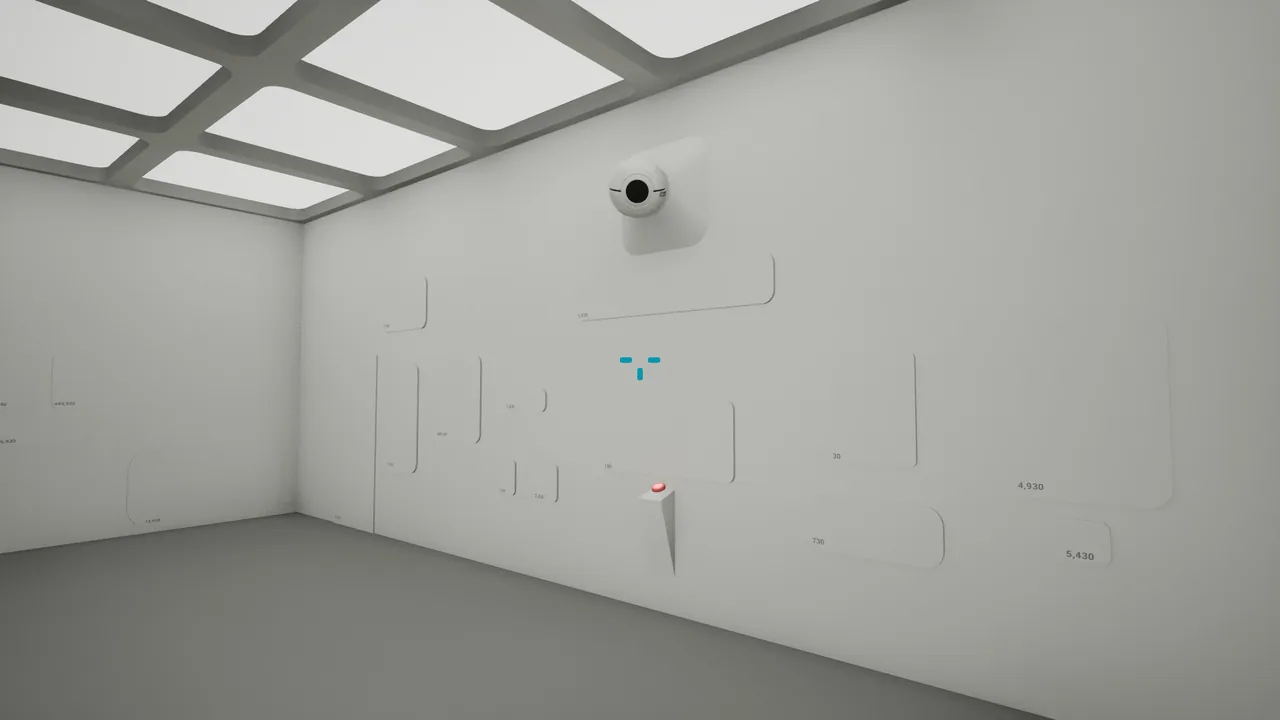
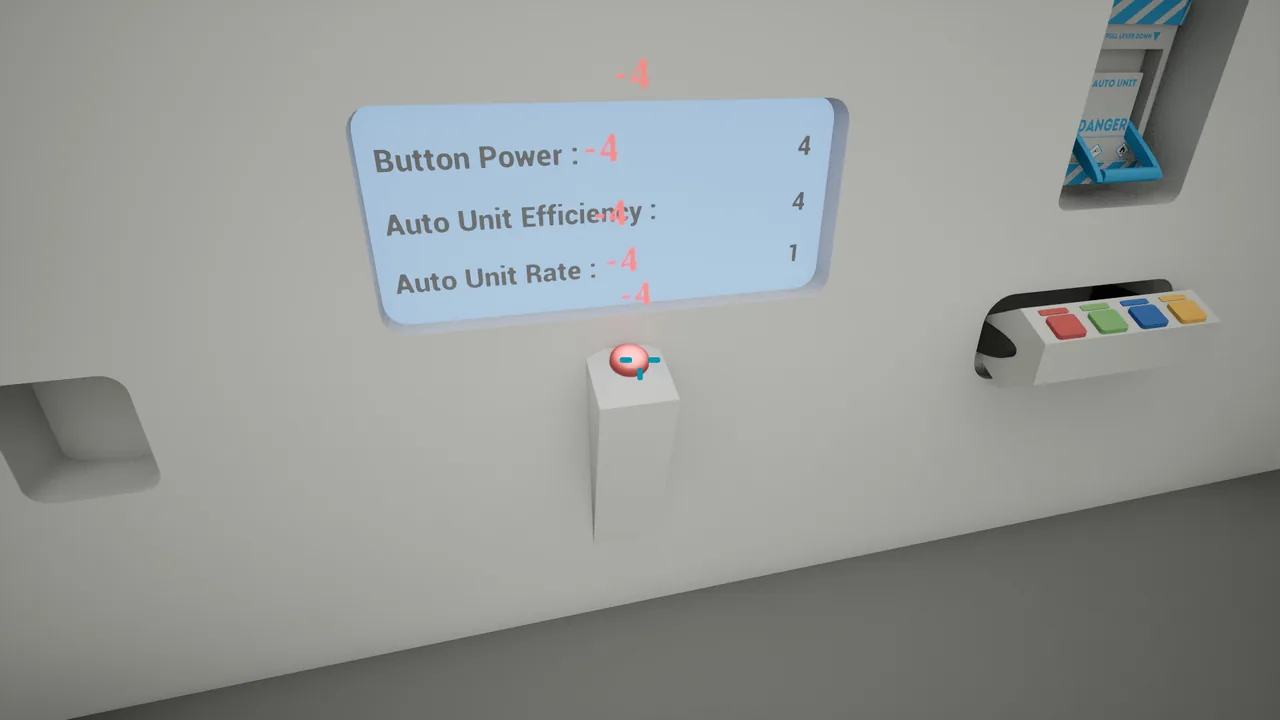
The setup is the whole opening pitch: a featureless room, a single button, and — per multiple players who described it independently — a massive locked door with an even larger number scrawled across it. Press the button and the number ticks down by one. Keep pressing, and the wall around you starts filling with more panels, more numbers, and more questions about what any of it is counting toward. It's a clean subversion of the genre's most basic assumption, and it's mechanically real, not just a reskinned "number go up" loop wearing a red herring: several official screenshots show wall readouts stacked with six-figure totals ticking downward, alongside a "Button Power / Auto Unit Efficiency / Auto Unit Rate" panel that reads exactly like a standard clicker upgrade screen — until you notice every value on it is falling instead of climbing.
The escape room hiding behind the panels
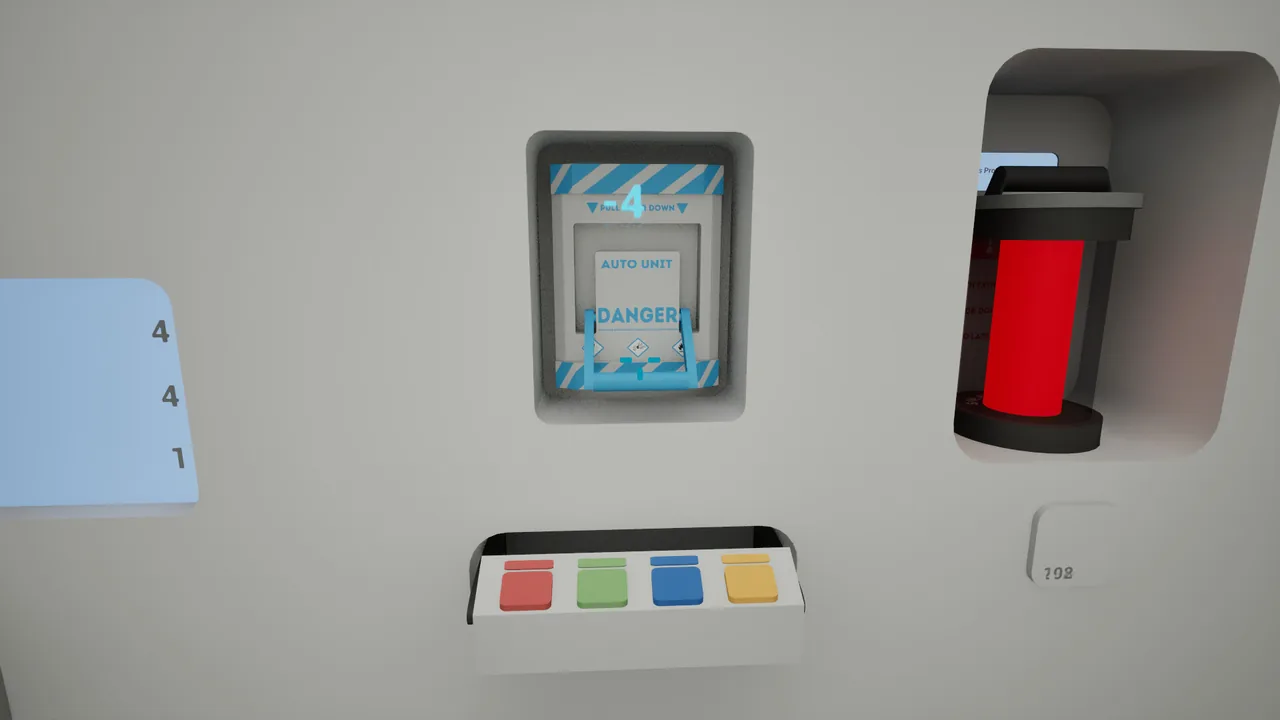
What separates Click To Continue from a joke with a UI is how much genuine puzzle design sits behind those wall panels once they unlock. A green-on-black terminal, visible directly in the official screenshots, runs a real command set — /identify, /ping, /scan, /override, /inject_clicks — that reviewers either praise as the smartest system in the game or curse as borderline impossible, with almost no middle ground between the two camps. Elsewhere, a "Rock Bottom Exchange" station asks players to weigh minerals and sell them off, and a "Coffee 24/7" vending machine sits beside a fire extinguisher dryly rebranded "Hyperventilate" — the game's sense of humour running through its environment art as much as its text. One reviewer, discovering all this only after buying it on the strength of the premise alone, put it plainly: "This isn't a clicker game. It's a clicker experience." Another called it "sorta a clicker mixed with an escape room," and that's about as precise a genre label as this game is going to get.
A story worth not spoiling
The store page promises a "hidden truth" without naming it, and the reviews that mention the story at all are almost unanimous about protecting that same silence. What can be said without ruining anything: the game changes tone and structure more than once on the way to its ending, a September 2025 update ("1.2 UPDATE") specifically reworked how that ending plays out and added a new one alongside it, and the surprise is well enough regarded that a completionist run — chasing the small number of players who bother — is treated by its fans as worth protecting rather than worth explaining. If you're the kind of reader who wants a clicker's usual spreadsheet transparency, be warned there's more narrative structure here than the premise lets on, and going in blind is clearly part of the intended experience.
Only one buyer in nine reaches the end
The most useful evidence this review found wasn't a review at all — it was Steam's own achievement data. Early click-count milestones are close to universal: 92.3% of the tracked population hits the first one, 82.3% the second. From there the curve tapers steadily rather than falling off one cliff — puzzle and story beats sit in the mid-40s to high-50s percent range, hacking-related unlocks drop into the 20-30% band — before landing on an achievement that reads, by name and by position in the list, like the true ending: 11.2%. Read generously, that means roughly one buyer in nine who's earned any achievement at all ever sees how the game actually finishes, and the post-completion Hard and Speedrun achievements sit lower still, at 6.7% and 6.1%. For a game whose own reviewers describe a normal run as three to six hours, that's a striking amount of attrition — and it lines up with the playtime split in the review corpus itself: negative reviewers logged a median 2.3 hours before writing theirs, against 5.3 hours across a positive sample, suggesting the split runs largely along who stuck around long enough to reach the good part.
The performance problem nobody's fixed
Set against a game built almost entirely from grey cubes and blank walls, the most persistent complaint in Click To Continue's negative reviews is a genuine surprise: a meaningful share of players report their GPU or CPU spiking hard while the game is simply sitting open. Six of the 26 English negative reviews on record — 23% — raise optimisation, frame-rate or hardware-load complaints specifically, and unlike most launch-week jank, these aren't confined to the first few weeks: the earliest dates to 24 July 2025, nine weeks after release, and the most recent to 21 May 2026, nearly a year later. More than one reviewer independently guesses the game is doing something it shouldn't with their hardware — one is convinced it's mining cryptocurrency, another calls it "100%" certain — which is very likely a misread of an unusually GPU-heavy Unreal Engine build rather than anything malicious, but a review corpus can't audit that, and the accusation showing up unprompted from multiple separate players says something about how the load actually feels. One reviewer's question is the fair one to leave standing: given how simple the visuals are, why does this need Unreal Engine at all?
Text that's easy to unlock and hard to read
A smaller but real complaint cluster concerns legibility. Several of the 26 English negatives — about one in six — specifically mention wall-panel and terminal numbers blurring when they update, or text sized too small to comfortably read. Unlike a number of idle and incremental games this library covers, Click To Continue's Steam listing carries none of the usual accessibility categories — no listed colourblind mode, no text-scaling option, nothing to point to as a counterweight. For a game whose entire interface is numbers on walls, that's a real gap rather than a minor one.
A developer who finished strong, then went quiet
The Steam news feed tells a clean story of its own: roughly fifteen posts between the 17 May 2025 launch and 23 September 2025, most of them patch notes, plus a "5,000 copies sold" milestone post on 18 August 2025 confirming a real, sizeable buyer base rather than a niche curiosity. The last substantial one, the 10 September 2025 "1.2 UPDATE," was not a small patch — it reworked the ending, added new panels and introduced a new late-game mechanic. Then, nothing. Eleven months have passed with no further post of any kind, meaning the optimisation complaints above, along with at least one report of a save becoming unloadable mid-run, have gone unaddressed for essentially the game's entire second year on sale. That's not the five-year silence this library has flagged as abandonment elsewhere, but for a title that shipped this actively for its first four months, the contrast is hard to miss.
Final verdict
Click To Continue earns its price on the strength of an idea most clickers never attempt: building a real, finite puzzle game underneath a joke about a genre convention, and having the nerve to let the number count down instead of up from the very first screen. The escape-room structure hiding behind the wall panels is genuinely clever, the hacking terminal genuinely divides opinion rather than boring everyone equally, and the story is well enough regarded that its own fans keep quiet about it on your behalf. Where it loses ground is concrete and unresolved: a performance problem that shouldn't exist on a game built from flat grey geometry, an achievement curve that says most buyers never see the ending its marketing is built around, and a developer who delivered a strong, complete experience through September 2025 and then stopped talking. At NZ$7.39 for what most finishers call a three-to-six-hour experience, the risk is modest and the idea is worth the price on its own. Just check your hardware handles it before you commit, because on the evidence here, that's not a given.
Pros and cons
Pros
- The "decremental" hook is more than a marketing line — the core loop genuinely counts a giant number down to zero rather than up, subverting the genre's most basic convention from the first screen
- Behind the click-driven wall panels sits a real escape-room structure, including a text-command hacking terminal with /identify, /ping, /scan and /override commands, not just cosmetic upgrade icons
- Reviewers who finish it are close to unanimous that the game's writing and dark humour — a "Coffee 24/7" vending machine, a fire extinguisher branded "Hyperventilate" — earns comparisons to Please Don't Touch Anything and other clicker-adjacent puzzle games rather than to Cookie Clicker
- A one-time NZ$7.39 purchase with no DLC, no in-game store and no premium currency anywhere on its Steam listing, priced fairly against the three-to-six-hour runtime most finishers report
- The developer shipped roughly fifteen patches in its first four months, including a September 2025 update that added new panels and reworked the ending rather than treating the game as finished at launch
Cons
- GPU and CPU spikes on a game rendered almost entirely from flat grey geometry are reported from launch week (July 2025) through as recently as May 2026, with several reviewers questioning why a game this visually simple needs Unreal Engine at all
- Global achievement data shows a steady taper rather than a plateau — 92.3% of tracked players reach an early click milestone, but only 11.2% reach the achievement that looks like the true ending, and just 6.1-6.7% ever attempt the post-completion Hard or Speedrun modes
- The text-command hacking terminal is the single most divisive system in the game — several reviewers call it the best puzzle in the package, several others call it tedious enough to justify a refund
- No update has shipped since September 2025, nearly a year before this review, leaving the optimisation complaints and at least one save-corruption report unaddressed
- Wall-panel numbers and terminal text blur when they update and shrink small enough that at least a few reviewers report genuine difficulty reading them, with no text-scaling or colour options listed anywhere on the Steam page to compensate
Screenshots
-
Click To ContinueImage: Basolute via Steam -
Click To ContinueImage: Basolute via Steam -
Click To ContinueImage: Basolute via Steam -
How the review scores each part of the gameWanderer Editorial -
The game at a glanceWanderer Editorial -
The short versionWanderer Editorial