Game review
Antimatter Dimensions
9 / 10
- Developer
- Hevipelle
- Publisher
- Hevipelle
- Released
- 2016 as a free browser game; Steam release 2022-12-17
- Platforms
- Browser, Windows, macOS, Android, iOS
- Genre
- Incremental
- Monetisation
- Free to play everywhere; Steam and the official browser build carry no purchases beyond an optional cosmetic "Support the Developer" tip; the third-party Android/iOS port sells an optional 2x antimatter multiplier
- Players
- Single-player
The short version
Antimatter Dimensions is the incremental genre's reference architecture. It teaches a player how to read a reset ladder — dimensions feeding dimensions, then Infinity, then Eternity, then Reality — almost entirely through the numbers themselves, and every layer it adds changes what the previous layer means rather than just multiplying it. Nothing about it looks expensive, and that's deliberate: the interface is a column of buttons and the presentation is close to none, so the entire budget goes into the systems.
Its cost is late-game density. Somewhere around the Reality layer the game stops explaining itself with the same confidence it showed in the first hour, and staying on top of it means reading external strategy pages or leaning hard on its built-in scripting tool. That's a real tax, but it doesn't undo what the first thirty hours accomplish.
Biggest strengths
- The dimension-into-Infinity-into-Eternity-into-Reality ladder teaches its own logic without a tutorial
- Each prestige layer changes how the previous one is used rather than just resetting it for a bigger number
- Runs on essentially nothing — a ten-year-old laptop handles it without noticing
Biggest weaknesses
- Reality and its Celestials assume a level of system literacy the earlier game never demanded
- Visual and audio presentation is close to nonexistent, which will read as a wall for players outside the genre
- The Automator's scripting syntax is a genuine skill investment layered on top of the game's own systems
Who it's for: Incremental and idle-RPG players who want to understand where the genre's reset-ladder language actually comes from, and anyone who likes systems that reward reading over reflexes.
Our recommendation: Play the free browser or Steam version — they're identical in substance, so pick whichever is more convenient. Treat the mobile port as a separate, lesser product.
9 / 10
Most incrementals borrow their vocabulary from somewhere, whether their developers admit it or not. "Infinity points." "Eternity resets." A layer that unlocks only after you've already reset twice. That vocabulary comes from one game, and it's still free, still actively maintained, and still doing the thing it did in 2016 better than most of the games that copied it.
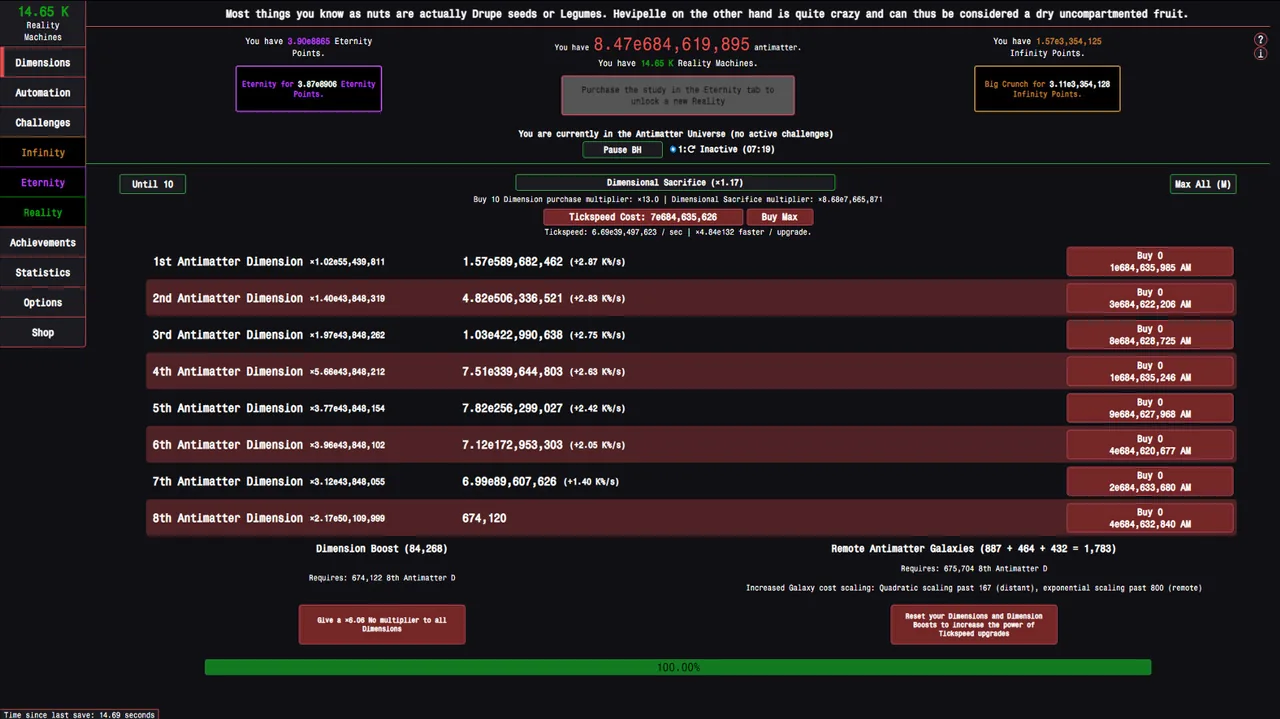
Antimatter Dimensions starts absurdly small. You have antimatter. You buy First Antimatter Dimensions, which produce more antimatter. Eventually you buy Second Dimensions, which produce First Dimensions, which produce antimatter. By the time you're staring at Eighth Dimensions producing Sevenths producing Sixths and so on down the chain, you've already absorbed the game's entire teaching method without anyone telling you it was happening: each tier of abstraction feeds the one below it, and understanding the chain is the actual skill being tested, not clicking speed.
The ladder is the game
Here's the thing that separates Antimatter Dimensions from the hundred games that now look like it: every reset layer recontextualises the one beneath it instead of just multiplying its output.
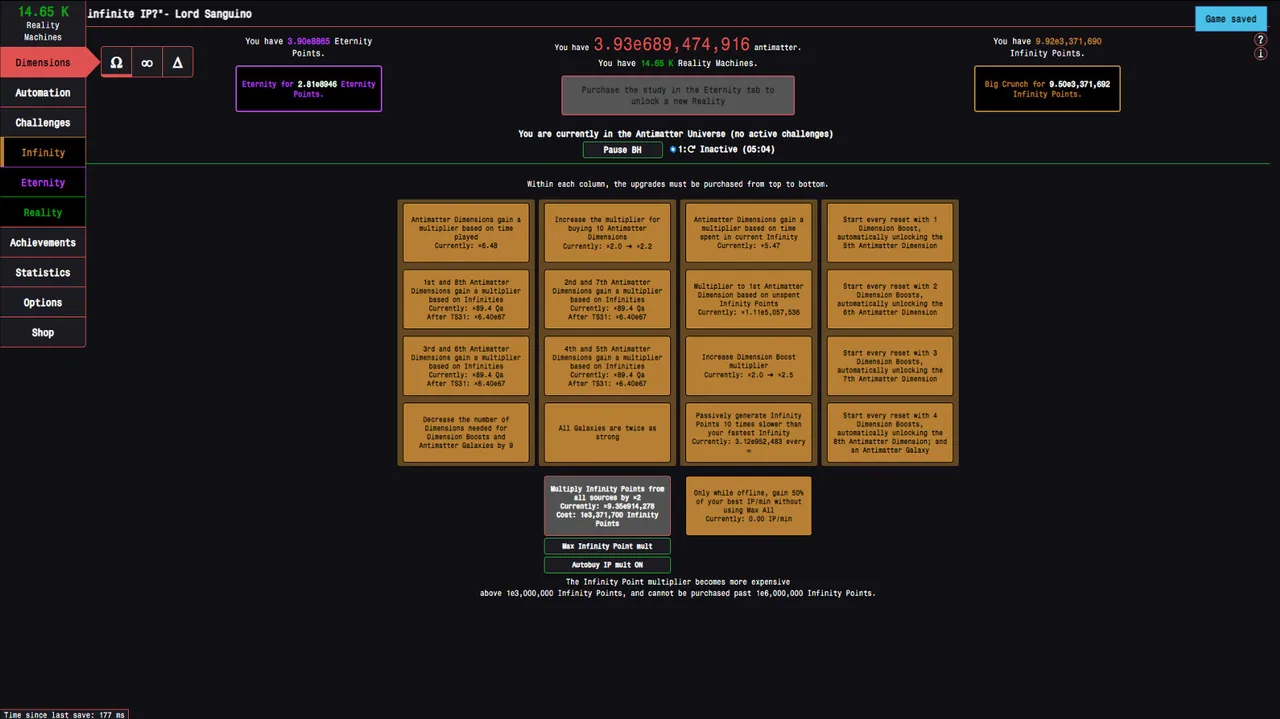
Infinity, the first prestige layer, doesn't just wipe your dimensions and hand you a bigger number — it hands you Infinity Points that buy permanent upgrades, and some of those upgrades change what the base dimension-buying game even is (automated tickspeed, dimension boosts that change the shape of the early curve entirely). Play through it a second time and the same eight dimensions you started with behave like different furniture in the same room.
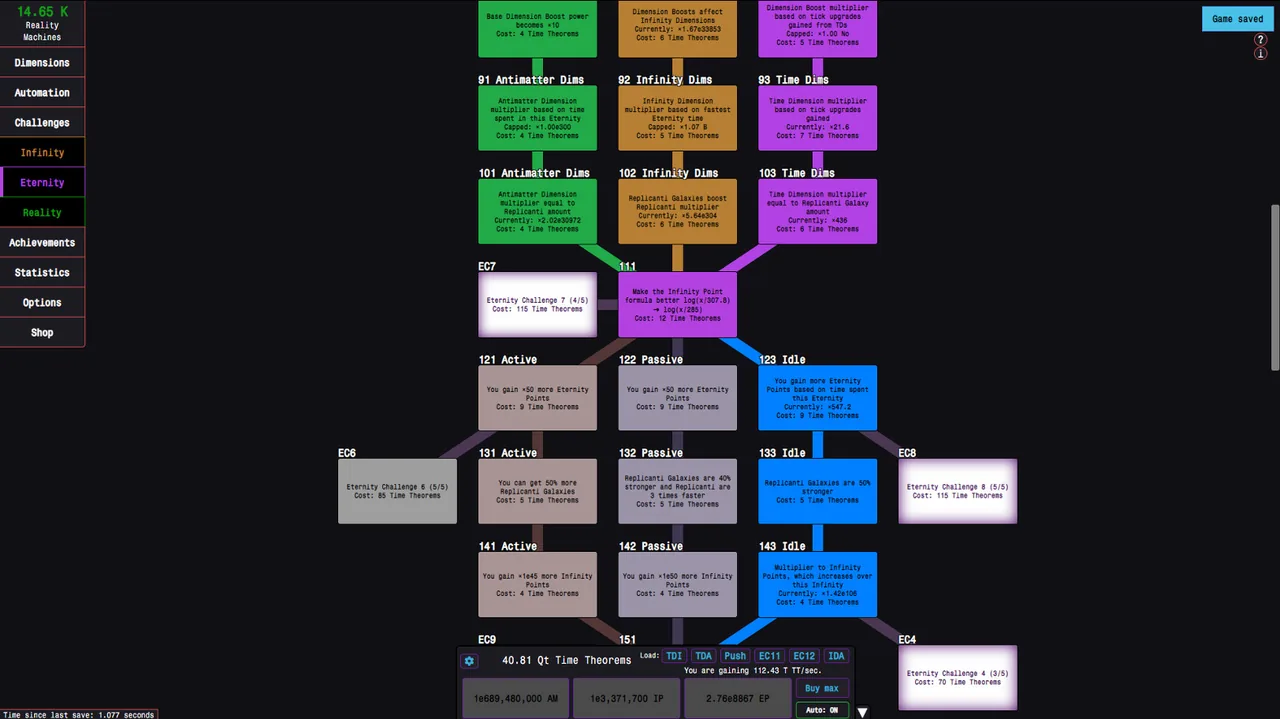
Eternity does it again, and does it more aggressively. Time Studies form a skill-tree-shaped upgrade path rather than a straight purchase list, forcing a real allocation decision instead of "buy everything eventually." Eternity Points don't replace Infinity Points, they sit on top of them, and the Time Dilation subsystem tucked inside Eternity adds a genuine sub-goal most players won't touch until they already understand everything above it.
Then Reality. This is where the game stops being a number generator and starts being closer to a roguelite meta-layer: Glyphs are semi-randomised modifiers you equip, Reality Upgrades and Perks sit above the Eternity/Infinity stack entirely, and the Automator — a scripting tool for programming your own automation sequences — turns "log in and click things" into "write a small program and let it run." The Celestials that gate later Reality progress (Teresa, Effarig, V, Ra, Pelle, and further entities beyond them) aren't spreadsheet walls so much as individual puzzle bosses, each restricting a different mechanic and asking you to solve around the restriction. Ra in particular turns "grinding" into something closer to an unlock-order puzzle.
That's the spine, and it's a genuinely well-built one. Almost every incremental released in the last several years that talks about "resets" or "prestige layers" in this specific dimension-into-Infinity-into-Eternity language is speaking a dialect this game invented. The question worth asking about a nine-year-old game isn't whether it was influential — it obviously was — it's whether the escalation still holds up as design, on its own terms, today. Mostly, it does.
Where the self-teaching stops
The dimension and Infinity layers explain themselves almost entirely through affordance: buttons light up, costs are visible, the next purchase is always the obviously correct one until it isn't. That's the game at its best, and it's also the part every imitator has managed to copy.
Reality is where the self-teaching breaks down. Glyph types, Glyph effects, the specific order in which Celestials expect to be approached, which Time Studies actually matter for a given Celestial's challenge — none of that is communicated with the same clarity the early game used. The wiki and community guides aren't optional flavour reading at this stage, they're closer to required documentation, and that's a real shift in what kind of game this becomes for a player who picked it up expecting the first thirty hours' generosity to continue indefinitely.
The Automator compounds this rather than solving it. It's a genuinely impressive feature — a proper scripting language for automating your own progression logic is not something many incrementals bother building, and dedicated players get real value from it — but it's also a second thing to learn, with its own syntax and its own failure modes, sitting on top of a game that already has a lot of interlocking state to track. It rewards investment and punishes half-attention, which is a fair trade for the player willing to make it and a genuine wall for the player who isn't.
None of this makes the late game badly designed. Each Celestial genuinely is a distinct puzzle rather than a re-skinned grind, and that variety is more than most "endless" incrementals bother with once their headline mechanic runs out of ideas. But the tightness of the first act doesn't survive the transition intact, and a review that only praised the ladder's opening moves would be telling half the story.
Presentation isn't the pitch, and shouldn't be judged like it is
There is close to no art direction here. No animated dimensions, no particle effects worth naming, no music doing emotional work — a column of numbers, buttons and progress bars, rendered in a Vue-based interface that the Reality update rebuilt from scratch mainly for performance and stability rather than for looks. That rebuild did its job: the game runs on essentially any machine that can open a browser tab, uses negligible CPU and memory, and never asks for more than a broadband connection to save progress. For a genre where "clicker" spinoffs increasingly ship particle-heavy, GPU-hungry interfaces, that restraint is a legitimate feature, not a compromise anyone should apologise for on the game's behalf.
It does mean the visuals and sound categories score low here, and they should — but weighting those scores the same as gameplay or progression would be judging a chess set for its finish rather than its rules.
Free everywhere, except where it quietly isn't
Antimatter Dimensions on the official browser build and on Steam is the same game, free, with nothing to buy that changes progression. Steam carries an "In-App Purchases" tag for a purely cosmetic Support-the-Developer option — a tip, not a shortcut — and the store page has never listed paid DLC. There is no separate "paid Steam edition" here worth pricing out: the Steam release's actual value proposition over the browser build is achievements, cloud saves and a desktop shortcut, not extra content.
The Android and iOS ports are a different story and worth flagging clearly, because a reader searching "Antimatter Dimensions mobile" will land on them first. They're built and maintained by a separate developer under license rather than by Hevipelle's own team, and they carry a real cash shop: an optional purchase that doubles antimatter production, and a tiered coin package running up toward the top end of mobile pricing. None of it is required — the game remains completable at a normal pace without spending — but it's a genuine monetisation layer the desktop and browser versions simply don't have, and mobile players should go in knowing the official and unofficial builds aren't quite the same promise.
Verdict
Nine out of ten. Antimatter Dimensions earns the reference-point status the genre has quietly assigned it: the dimension-to-Infinity-to-Eternity-to-Reality ladder is still one of the best-taught escalation structures an incremental has ever shipped, each layer changes the meaning of the one before it instead of just re-skinning the same grind, and it does all of this for free, on a machine that could barely run anything else made this decade. The Celestials keep the endgame from collapsing into pure spreadsheet-reading the way lesser "endless" idlers do.
The half-step it doesn't earn is late-game clarity. Reality and its Celestials ask for outside knowledge and, if you want to keep pace, a working understanding of the Automator's own scripting language — a steeper ask than the elegant early hours ever suggested was coming. That's a real seam in the design, not a minor nitpick, and it's the difference between this being a landmark game and merely a very good one.
If you've played any modern idle RPG or incremental and wondered where the "reset for permanent upgrades, then reset the reset" structure came from, this is the answer, and it costs nothing to find out firsthand. Players who want that same reset-ladder satisfaction wrapped around persistent character progression and a world to walk through, rather than a column of numbers, are exactly the audience Wanderer is built for.
Price and monetisation details checked 30 July 2026.
Pros and cons
Pros
- The dimension-into-Infinity-into-Eternity-into-Reality ladder teaches its own logic without a tutorial
- Each prestige layer changes how the previous one is used rather than just resetting it for a bigger number
- Runs on essentially nothing — a ten-year-old laptop handles it without noticing
- Completely free on browser and Steam, with no currency, energy system or ad ever put in front of a decision
- The Automator gives dedicated players a real scripting tool instead of forcing manual babysitting forever
- Celestials turn the endgame into a series of distinct puzzles instead of one long number
Cons
- Reality and its Celestials assume a level of system literacy the earlier game never demanded
- Visual and audio presentation is close to nonexistent, which will read as a wall for players outside the genre
- The Automator's scripting syntax is a genuine skill investment layered on top of the game's own systems
- Long unattended stretches between meaningful decisions are common once a build settles in
- The Android and iOS port is a third-party build with a real cash shop, which the official versions don't have
Screenshots
-
Antimatter DimensionsImage: Hevipelle via Steam -
Antimatter DimensionsImage: Hevipelle via Steam -
Antimatter DimensionsImage: Hevipelle via Steam -
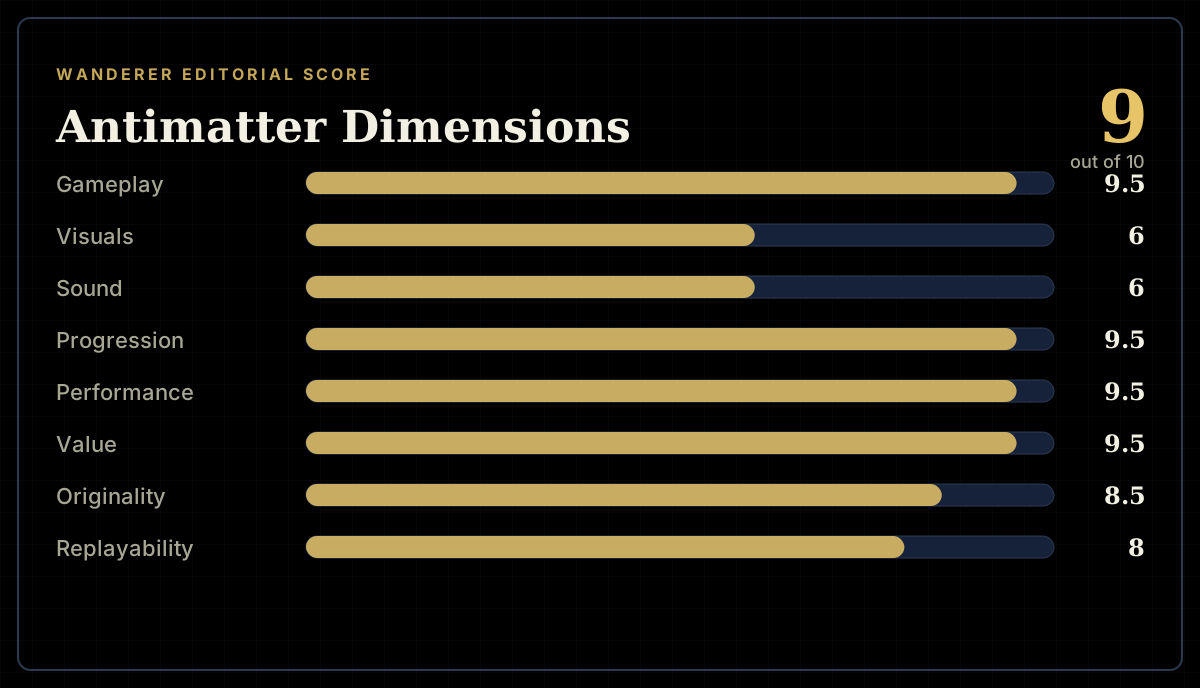
How the review scores each part of the gameWanderer Editorial -
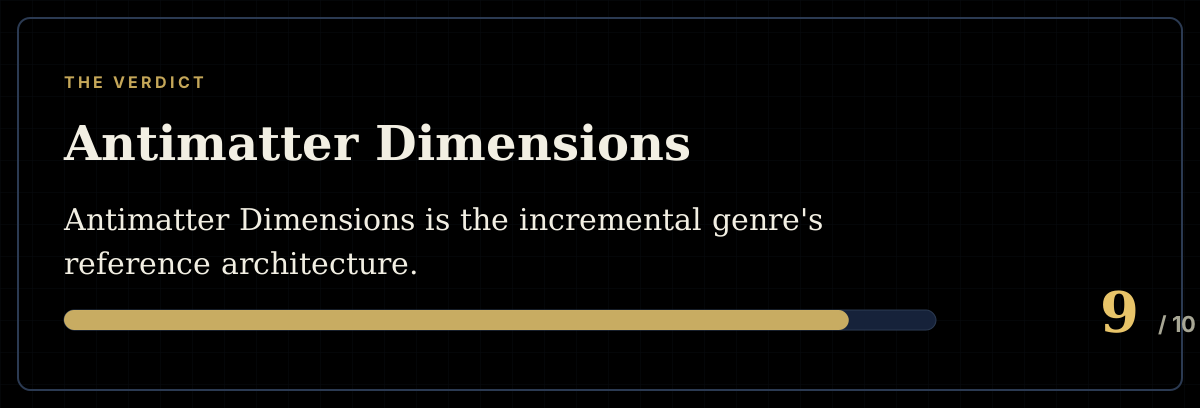
The short versionWanderer Editorial