Game review
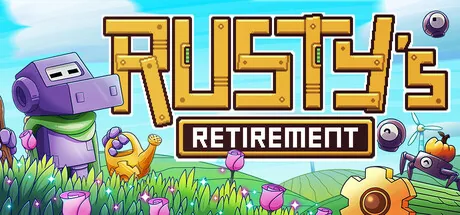
Rusty's Retirement
8.5 / 10
- Developer
- Mister Morris Games
- Publisher
- Mister Morris Games
- Released
- 26 April 2024
- Platforms
- Windows, macOS
- Genre
- Idle Farming Simulator
- Monetisation
- One-time purchase; an optional cosmetic Supporter Pack DLC adds no gameplay advantage
- Players
- None; single-player only
The short version
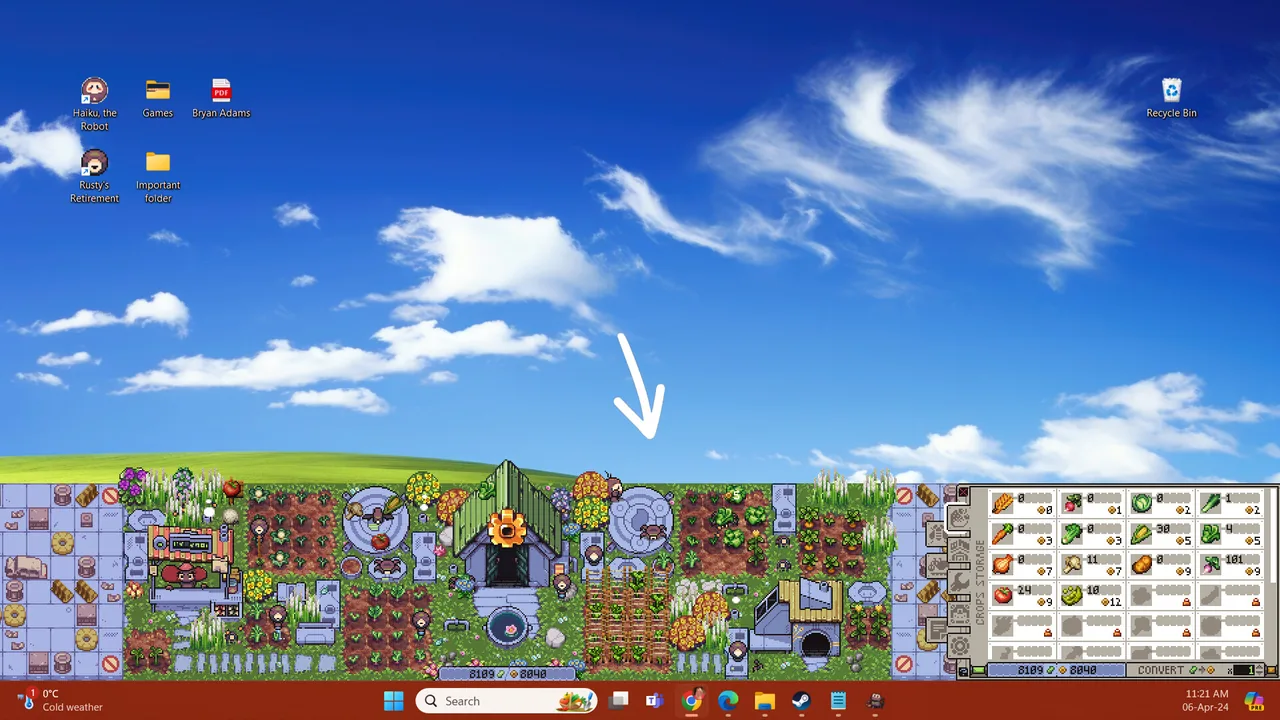
Rusty's Retirement isn't trying to be a game you sit down and play. It's a narrow strip of farm that lives at the bottom or side of your screen while you do your actual work, quietly growing crops, brewing biofuel, and handing out cosmetic robots as rewards for checking in every so often. The idea is so simple it barely sounds like a pitch, and yet it's the reason a whole wave of "desktop idler" games showed up on Steam within a year of its release.
What it isn't is deep. The crop-to-biofuel loop and the robot roster are satisfying to build out over the first several hours, but once the farm is fully upgraded there's very little pulling you back beyond the developer's periodic content drops. That's a fair trade for ten dollars and zero attention-demanding pressure, and the reason it's sitting near the top of Steam's user-review charts.
Biggest strengths
- The desktop-overlay window is the actual design achievement here — it solves idle gaming's oldest problem by removing the temptation to tab back and babysit it
- Focus Mode and the vertical-layout option let you decide exactly how much of your attention and screen real estate the game is allowed to claim
- A one-time NZ$10.49 price with no ads, energy timers or pressure to buy anything mid-session
Biggest weaknesses
- The crop-biofuel-robot loop plateaus hard once the farm is fully built out, and there isn't much of a systemic reason to keep opening it beyond habit or new content drops
- Progression rewards are almost entirely cosmetic — new robot skins and farm decorations rather than new mechanics that change how you interact with the loop
- No Linux build and no controller support, which is a strange gap for a game this lightweight, though it barely matters given how the game is actually used
Who it's for: Anyone who wants ambient, low-commitment company running alongside real work or other games — not players chasing a deep incremental economy with layers of prestige systems to optimise.
Our recommendation: Buy it if the idea of a tiny farm quietly ticking over at the edge of your monitor sounds appealing at all. Skip it if you want an idle game with real mechanical depth to sink your teeth into — that's a different kind of game, and this one was never trying to be it.
8.5 / 10
Most idle games ask you to open them. Rusty's Retirement never really closes. Its entire pitch is a narrow horizontal strip that parks itself at the bottom edge of your monitor — a tiny farm with a little robot in overalls watering rows of carrots while you answer emails, browse, or play something else entirely in the rest of the screen. It sounds almost too slight to be a whole Steam release. It's also the reason a small wave of "desktop idler" games has followed in its wake, and why Steam ran an entire Idler Fest event built substantially around the genre it kicked into gear.
A farm that isn't the main window
The core loop is deliberately unremarkable on paper: plant crops, let your robot workers water, tend and harvest them, feed the harvest into biofuel production, sell the biofuel, and spend the proceeds on more land, more crops and more robots. None of that would sustain a normal idle game for more than an hour of interest. What makes it work is that Rusty's Retirement never asks you to treat it as the main window. You can shrink it to a thin bar, dock it at the bottom of the desktop or flip it into a vertical strip that sits comfortably down one side of the screen instead — useful on an ultrawide monitor or a second display, where a horizontal window would either look silly or get in the way of something more important.
Focus Mode is the detail that shows the developer actually understood the problem this genre has always had. Rather than speeding anything up, it slows every action — watering, growth, harvest — down to half speed. That sounds backwards for an idle game until you notice what it actually solves: the itch to keep glancing over in case a field just finished and is now sitting idle. Halve the cadence and there's no benefit to checking constantly, so the temptation disappears along with the urgency. It's a small piece of design, but it's the difference between a game that respects being ignored and one that's quietly needling you to look back.
Progression that's honest about its ceiling
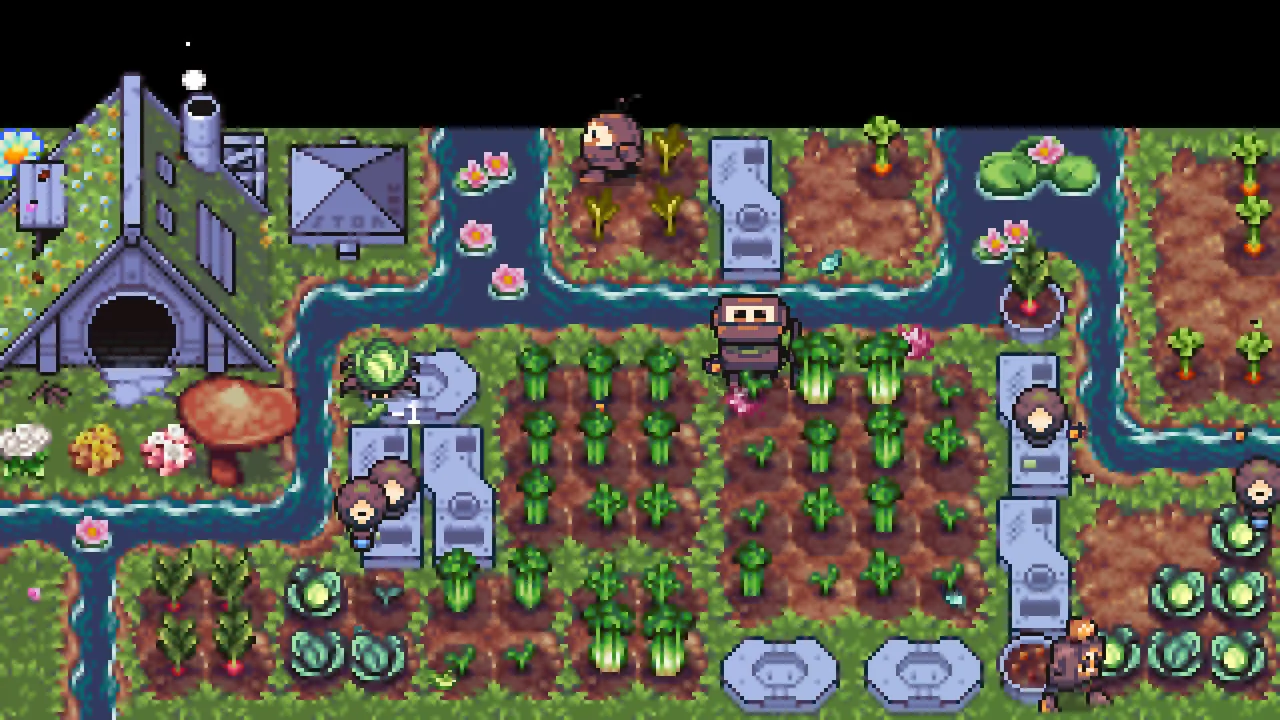
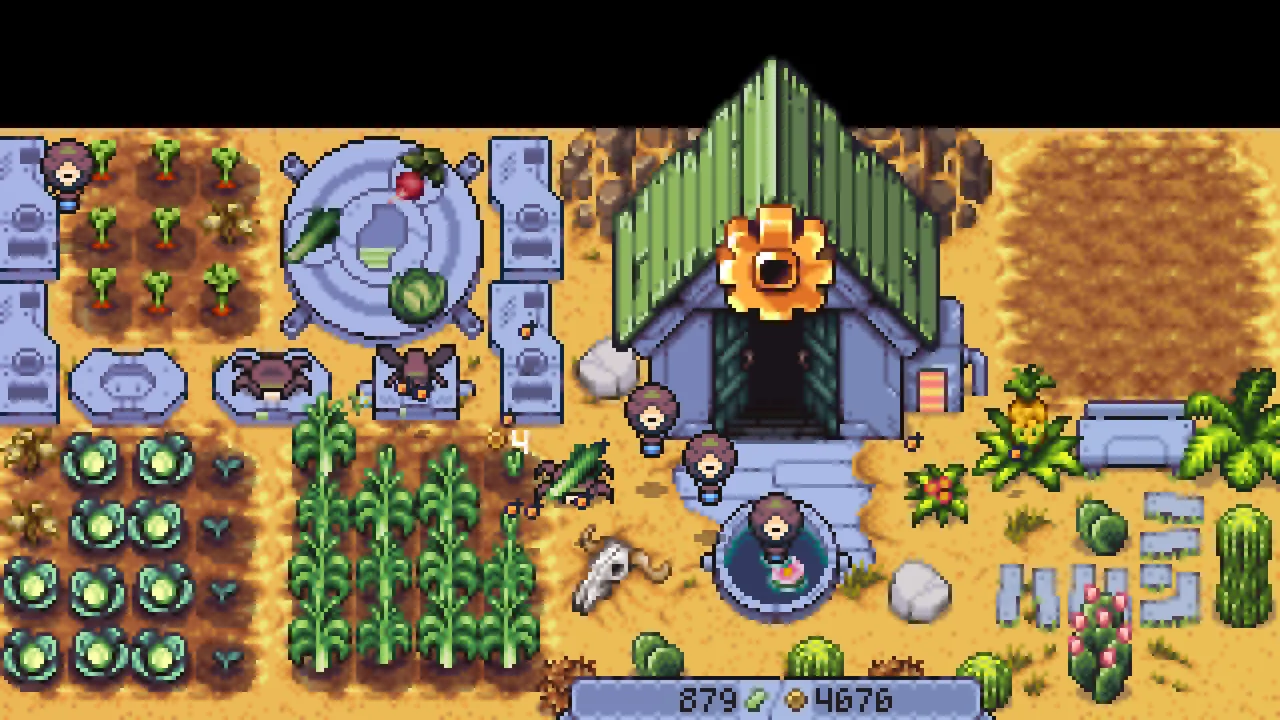
Unlocking new crops, upgrading robot efficiency and customising the little workers with cosmetic gear gives the early hours a real sense of building something. Crops go from crispy carrots through tomatoes, pumpkins and further specialty produce as the farm grows, and a later update added giant crop variants — oversized versions of several vegetables with their own rare drop chance — purely to give long-time players something new to chase without touching the underlying loop. It's a good instinct for a game like this: don't complicate the system, just widen it occasionally.
The honest limitation is that once your farm is fully built out and your robot roster is customised the way you want it, there isn't much of a mechanical reason to keep the game running beyond ambience and habit. There's no prestige layer, no deeper economic system waiting behind the biofuel sale price, and no combat, exploration or narrative to pull you further in. That's not really a criticism of execution — it's a description of what the game is choosing not to be. Compared with idle RPGs that stack automation tiers, ascension systems and combat loops on top of the basic number-go-up structure, Rusty's Retirement stays deliberately shallow. Whether that reads as a strength or a limitation depends entirely on what you came here for.
Presentation that matches the mood
The hand-drawn pixel art gives Rusty and the supporting robot cast real personality in a tiny amount of screen space — a genuinely difficult art problem, since most of the game is viewed as a sliver rather than a full window. The farm itself is bright and inviting without becoming visually noisy, which matters given it's designed to sit in your peripheral vision for hours at a time rather than hold your direct focus. It never asks for sound to carry the experience, which suits a game built to run silently in the background of whatever else you're doing.
Monetisation that stays out of the way
There's exactly one purchase decision here: the base game at roughly ten New Zealand dollars, plus an entirely optional Supporter Pack DLC that adds cosmetic extras and nothing that touches the actual progression. No ads, no energy system, no premium currency, no timers nudging you to spend real money to skip a wait. For a genre that mobile idle games have spent years training players to expect drip-fed monetisation from, a flat one-time price with a purely voluntary cosmetic add-on is refreshingly uncomplicated. It's also just good business — a game this small in scope earns trust by not trying to extract more than the sticker price implies.
Final verdict
Rusty's Retirement succeeds by refusing to be the thing idle games usually are: a tab you feel obligated to keep checking. The overlay window, Focus Mode and vertical layout option all point the same direction — this is a game engineered to be ignored comfortably, and it does that job better than almost anything else on Steam. Robot customisation and crop unlocks give the early hours real texture, and the price is fair for what's delivered.
It settles at 8.5 rather than higher because the loop genuinely plateaus once the farm is built out, and what's left afterward leans on periodic content updates rather than any deeper system underneath. That's a reasonable trade for a ten-dollar game that never once asks for your full attention, but it does mean players hoping for a deep incremental economy should look elsewhere. Anyone who just wants a small, well-made piece of company running quietly at the edge of the screen will get exactly what the pitch promises.
Players who'd rather have that ambient progression happening inside a persistent world with other people in it, rather than a solitary farm, may find Wanderer scratches a similar itch while you're away from the keyboard.
Pros and cons
Pros
- The desktop-overlay window is the actual design achievement here — it solves idle gaming's oldest problem by removing the temptation to tab back and babysit it
- Focus Mode and the vertical-layout option let you decide exactly how much of your attention and screen real estate the game is allowed to claim
- A one-time NZ$10.49 price with no ads, energy timers or pressure to buy anything mid-session
- Robot customisation and crop unlocks give the passive loop a light sense of ownership without ever complicating the core idea
- Regular free content updates (new crops, giant crop variants, seasonal events) have kept the game relevant well past its 2024 launch
Cons
- The crop-biofuel-robot loop plateaus hard once the farm is fully built out, and there isn't much of a systemic reason to keep opening it beyond habit or new content drops
- Progression rewards are almost entirely cosmetic — new robot skins and farm decorations rather than new mechanics that change how you interact with the loop
- No Linux build and no controller support, which is a strange gap for a game this lightweight, though it barely matters given how the game is actually used
Screenshots
-
Rusty's RetirementImage: Mister Morris Games via Steam -
Rusty's RetirementImage: Mister Morris Games via Steam -
Rusty's RetirementImage: Mister Morris Games via Steam -
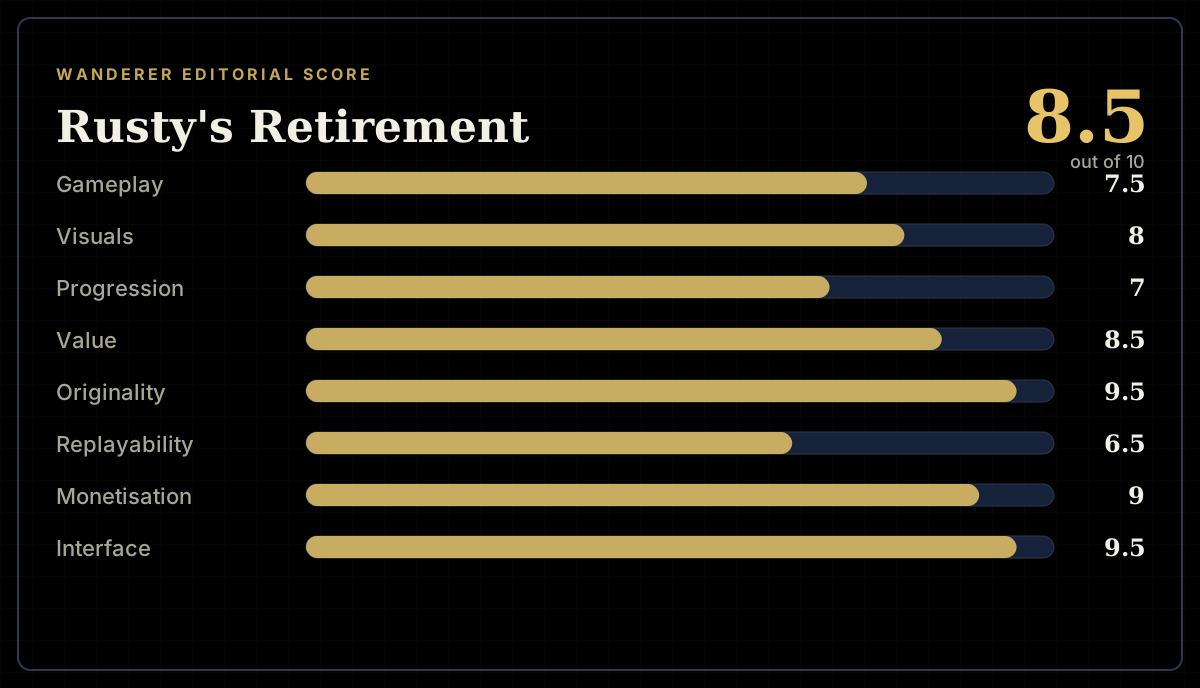
How the review scores each part of the gameWanderer Editorial -
The short versionWanderer Editorial