
Game review
The Board is Yours Review
8.5 / 10
- Developer
- Draelent
- Publisher
- Draelent
- Released
- 29 April 2026
- Platforms
- ["Windows"]
- Genre
- Simulation
A Grains-Of-Rice Fable Turned Into A Genuinely Thoughtful Idle Game
The Board is Yours, the solo debut from developer and publisher Draelent, released on Steam on April 29, 2026, at $2.50. It takes the old fable about a chessboard, a grain of rice, and the terrifying math of doubling squares, and turns it into an incremental game where the board itself is the mechanic: buy squares, place and reposition chess pieces to defend each other and avoid blocking their movement paths, unlock upgrades that rewrite the rules of production, and periodically prestige into a cleared board with permanent bonuses. Of the 26 English reviews read in full here, comfortably past this review's floor, out of an all-language pool of 45 reviews sitting at 98% positive, "Positive" on Steam's own scale, this is a remarkably well-regarded incremental game, and reviewers are specific about exactly why it stands out from a genre many of them are openly tired of.
Reviewers Keep Contrasting It Against The Rest Of The Incremental Genre, By Name
The single most repeated sentiment in this pool isn't just praise, it's praise defined in opposition to what reviewers see as the incremental genre's default state. "It's really fun to try and find the best strat. I hope we had more games like this and instead of the truckload of copy/paste garbage pushed out by devs trying to make a quick buck," wrote one reviewer. Another, reviewing under a curator page dedicated to the genre, put it even more pointedly: "Dev wannabes should take note, this is how you make upgrades: in a way that always bring something new to the gameplay!" A third contrasted it against the genre's laziest tendency directly: "This game is incredibly complex and strategic, especially compared to so many of these recent incrementals where you just click the upgrades in the intended order until you reach the end. Every upgrade or two causes you to re-think and re-optimize." That framing, a genre regular actively surprised by how much genuine strategic thought the game demands, repeats across reviewers with very different playtimes and is the clearest signal in this pool that the chess-board conceit isn't just skin-deep theming.
The Chess Layer Is Structural, Not Decorative, According To Reviewers Who Tested It
Several reviewers specifically walk through why the chess framing changes how the incrementally-scaling numbers actually work, rather than just dressing them up. "Inspired by chess - basically protect your pieces, but try not to block their movement paths. Take advantage of unlockable board and piece synergies on prestige. Once purchased, your chess pieces can be moved at any time," one reviewer explained, describing an "optimizer" tool the game offers early on that "tricks your brain into looking for the optimal setup when it's still somewhat manageable" before it has to be disabled later once the search space grows too large to calculate live. Another reviewer described the resulting feel as genuinely disorienting in a good way: "The pacing is as good as YOU are, or until you'll stumble upon a meta and stick with it until the end of the game... you'll have to adapt towards pushing your income further, reading into upgrades and attempting to break the balancing as hard as you can." A separate reviewer specifically praised the deterministic-but-not-obvious nature of the puzzle: "a seemingly unimportant pawn will double your output when moving it to an innocent-looking tile... It's completely deterministic, meaning you could theoretically find the most optimal position for everything without taking so many shots in the dark, but that becomes more difficult with every tile and piece you purchase."
A Handful Of Specific, Practical QoL Complaints, Mostly Around Prestige
Set against the otherwise glowing consensus, several reviewers converge on the same specific friction point: prestige resets more than reviewers wish it did. "At mid-late prestige starts you'll have to re-purchase the whole starter setup piece by piece, which is a bit annoying, making me wish for a milestone upgrade 'keep the purchased pieces and X board squares.' Game even has save/load slots, which i thought is exactly for that, but they're prestige-session only," wrote one reviewer, a complaint echoed independently by another who called the save-board feature "a little annoying, but understandable" for the same reason. The first reviewer also listed a specific wishlist of interface fixes the game could use: a "buy max" button for upgrades and pawns, a hold-and-swipe way to buy board squares, a way to sell a placed piece or square, and a fix for a reported bug where spamming an autoclicker on a chess piece breaks it (workable around by returning to the menu). None of these complaints stopped any of the reviewers who raised them from recommending the game, but they're specific, fixable interface gaps rather than vague dissatisfaction.
One Detailed Negative Review Flags A Genuine Mid-Game Pacing Risk
Standing apart from the rest of the pool is a single, detailed negative review that takes the same premise seriously and still comes away disappointed. "This game has a fantastic premise: I'd heard the story about grains of rice on a chessboard and exponential growth; turning it into an idle incremental game was a brilliant move. But in my personal experience, the progression wasn't fun. Things slowed way down for me once I was a few hours in, and I lost interest in playing." That specific complaint, a mid-game slowdown, doesn't appear as strongly in the positive reviews, but a few of them describe needing to "adapt" or "break the balancing" to keep momentum going, which suggests the same friction point exists for some players who simply pushed through it rather than stopping. Anyone sensitive to incremental games' typical mid-run lull should treat this as a real, corroborated-in-spirit risk rather than an outlier complaint to dismiss outright.
An Extraordinary Price-To-Depth Ratio Is The Other Constant Across This Pool
Almost every review in this pool, regardless of how much depth or complaint it offers, circles back to the same point: at $2.50, the value on offer here is treated as close to absurd. "I can't believe it's the first game for this solo dev, and that it's only 2,50€ full price (should be at least the double). It's a steal!" wrote one reviewer, while another simply called it "a compact, engrossing Incremental game that costs less than a coffee." Multiple reviewers report finishing the roughly 5-to-8-hour game once and then playing through again, and several specifically recommend trying the free demo first, since progress and a "special code" reportedly carry over into the full release. Combined with confirmed Steam Deck support and a developer actively pushing German localization and QoL patches within weeks of launch, the picture across this pool is of a tiny, focused release punching well above its price point rather than a shallow curiosity riding a clever premise.
Verdict
The Board is Yours takes a genuinely clever hook, a math folktale rebuilt as a chess-flavored incremental, and backs it up with mechanical depth that a notably genre-literate slice of its review pool describes as a cut above the usual copy-paste idle-game formula. The chess conceit is structural rather than cosmetic, forcing real spatial and strategic decisions rather than a simple upgrade queue, and the handful of specific interface and prestige-reset complaints read as fixable rough edges rather than fundamental flaws. One detailed negative review's mid-game slowdown concern is worth taking seriously if that specific incremental-genre fatigue is a known risk for you, but it's a minority view in an otherwise remarkably consistent, specific, and enthusiastic pool. At $2.50, with a free demo to try first, this is an easy recommendation for incremental and chess fans alike, and a genuinely impressive solo debut.
Screenshots
-
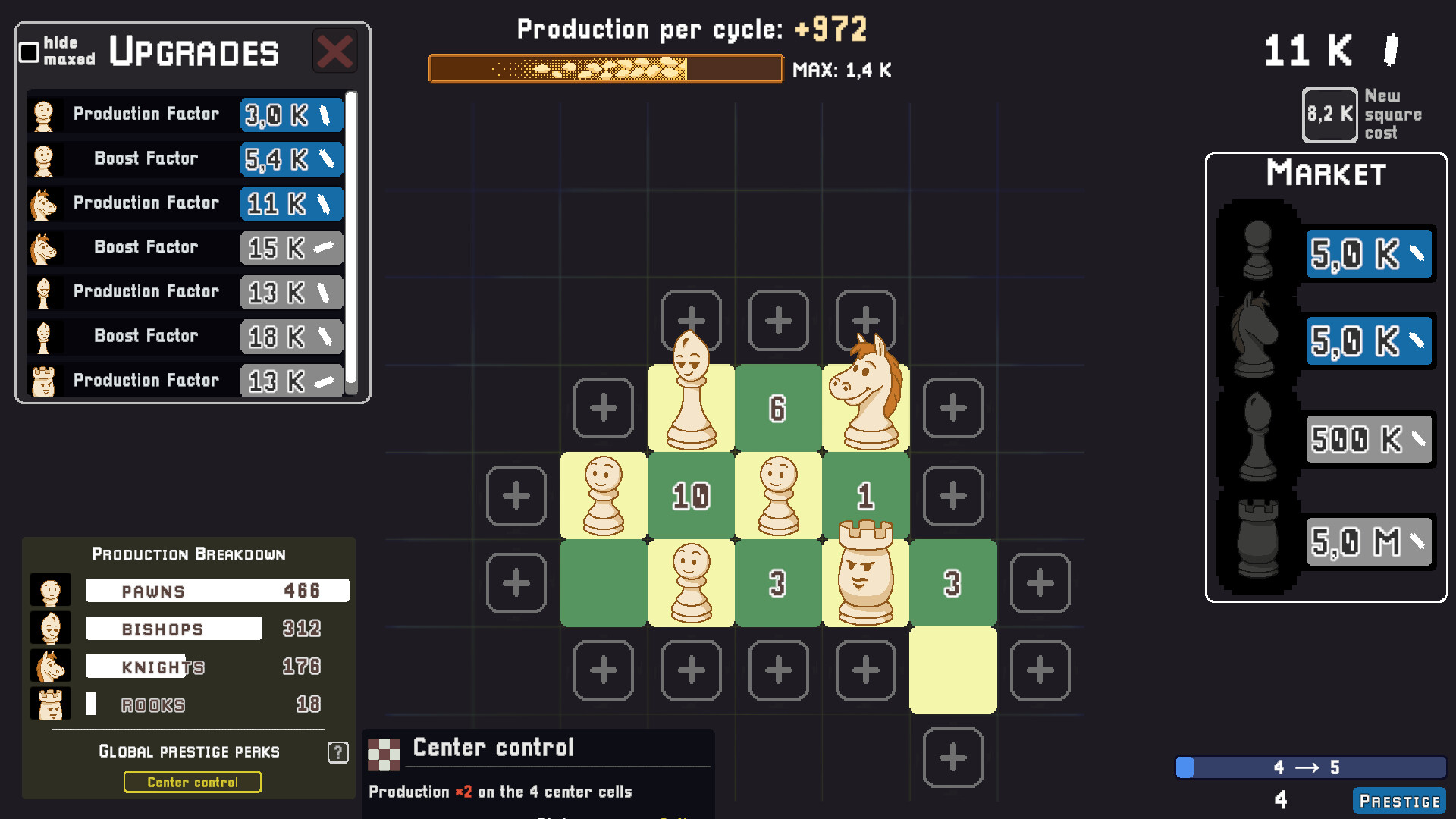
An early board layout, where each placed piece and the numbered cells around it feed into the production-per-cycle total shown at the top.Image: Draelent via Steam -
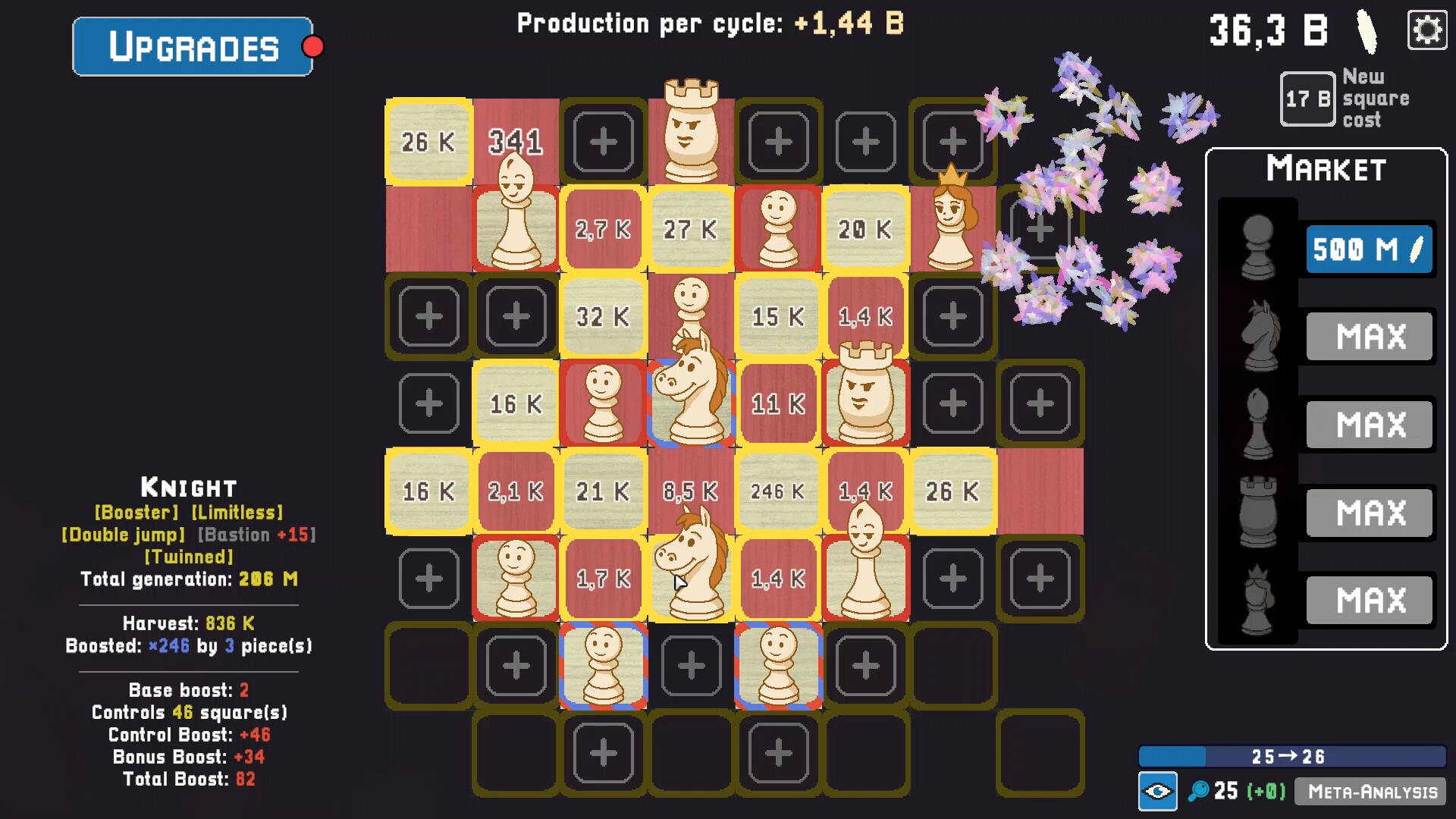
A late-game board dense with pieces and perks, where production has scaled from the early game's low thousands into the billions.Image: Draelent via Steam -
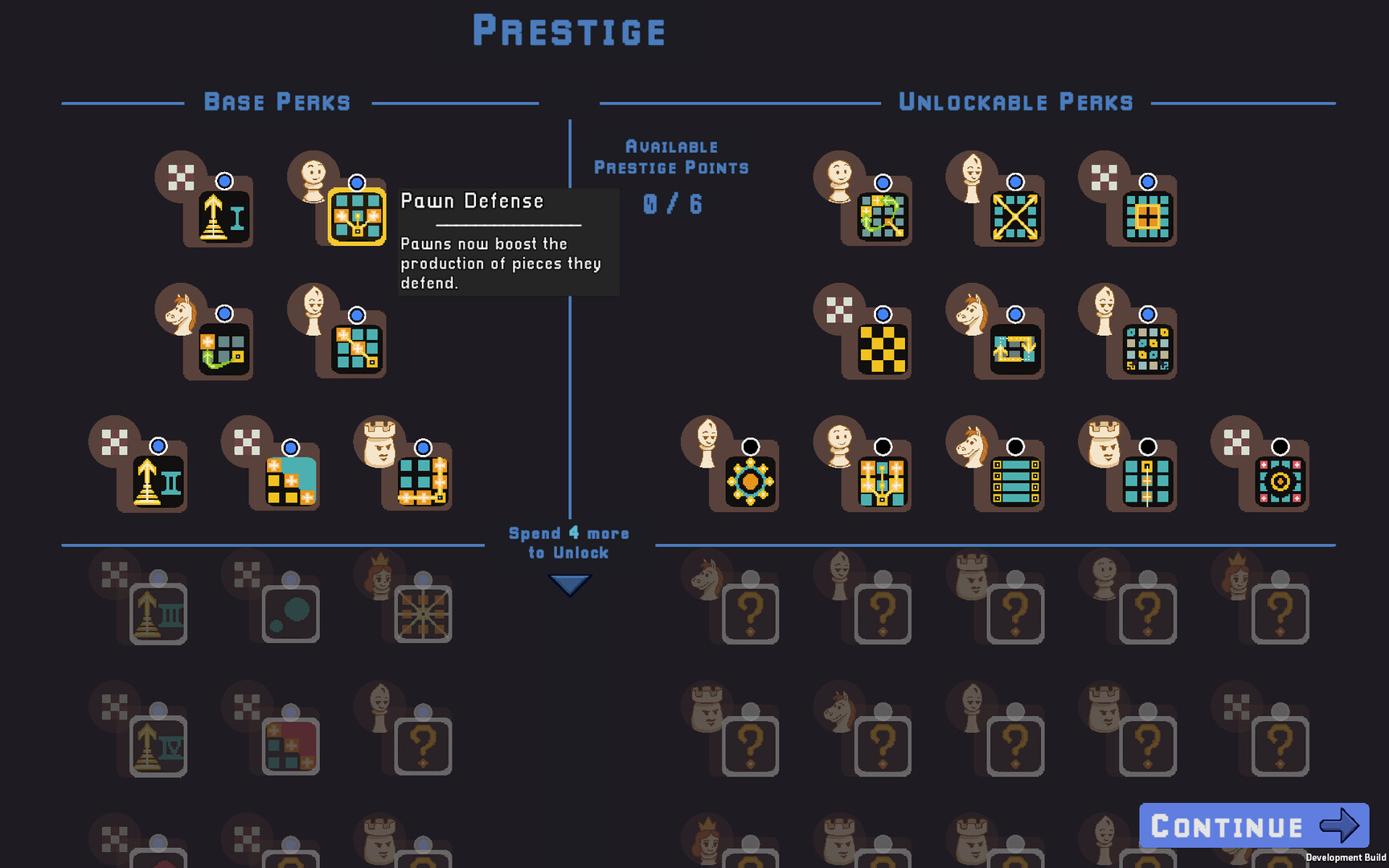
The Prestige screen, where cleared runs unlock permanent perks tied to specific pieces, the system several reviewers wished retained more of a run's board layout.Image: Draelent via Steam