
Game review
Fracture Field Review
6 / 10
- Developer
- Type Ten
- Publisher
- Type Ten / Gamersky Games / Drillhounds
- Released
- 20 April 2026
- Platforms
- ["Windows"]
- Genre
- Simulation
A Single Rock and a Very Long Road to an Industrial Empire
Fracture Field starts small: one rock, one timed swing, one satisfying thwack. Solo developer Type Ten's debut is an idle/incremental quarry-mining game in the well-worn mold of Cookie Clicker descendants like Keep on Mining and Revolution Idle, but with a specific hook — a rhythmic, timed-swing mining mechanic layered underneath the usual upgrade-and-automate loop, and a genuinely unusual two-tier prestige structure that the review pool spends most of its energy arguing about. You shatter Stone, Clay, and Sandstone for resources, sink those resources into upgrades and a fleet of automated mining drones, and eventually blow through entire layers with charge-based bombs once your empire outgrows manual labor.
It's a formula plenty of reviewers know cold, and the ones who came in expecting a short, disposable clicker were often the least happy with what they found. "This type of games are pure addiction numbers," wrote one player who nonetheless recommended it, and that's roughly the pitch: Fracture Field wants your attention for dozens of hours, not a lazy afternoon, and it says so almost immediately once the early slowdown kicks in.
Two Layers of Prestige, and a Community Split Right Down the Middle
The single biggest talking point across the review pool is Fracture Field's decision to stack prestige on top of prestige. "World Fracture" is the first reset layer, familiar enough to anyone who's played an incremental before — cash in your progress for a permanent multiplier and start the grind again, faster. "Reality Shatter" is the second, unlocked much later, and it's the mechanic that either makes or breaks the game for a given player. Several reviewers describe genuine dread the first time they hit it. "Near the end you have to walk into the dark really slowly," isn't a Fracture Field quote, but the sentiment fits: a mid-playthrough review flatly says "the second level of resets are not fun. All that speed and automation? Gone. Got to earn it again," while another calls the currency you get from it "a lot more stingy" than expected for the size of the reset.
On the other side, a large and vocal chunk of the review pool treats the double-prestige system as the game's defining strength rather than its flaw. "Two layers of prestige = bold and scary," wrote one enthusiast, and a self-described idle-game curator called it "a long shot idler with a lot of automation" that deliberately avoids being "a flashy dopamine fiesta." Multiple players explicitly praise Type Ten for shipping something with more depth and length than the sub-ten-hour idlers that dominate the genre on Steam — one reviewer clocked in at 165 hours and called the resulting climb "really what an incremental should be." The developer has also clearly been listening: several reviews reference mid-life balance patches that eased the notorious "iron wall," a difficulty spike right after the early game that a meaningful number of negative reviews cite as the point where they quit. One player who initially left a negative review edited it to positive after that patch landed, which says as much about Type Ten's post-launch support as it does about the pacing itself.
Charming Presentation, Undercut by Real Performance Problems
Where Fracture Field earns unqualified praise is its look and feel. The bright, 16-bit-inspired presentation gets repeatedly singled out as more polished than the genre usually bothers with, and the sound design — described by more than one reviewer as something that "tickles my brain" even played on low volume in the background — clearly landed with its audience. For a solo debut, reviewers are generous about forgiving rough edges in exchange for evident care, and several say outright that they'd buy a follow-up from Type Ten sight unseen.
The performance complaints are harder to wave away, though, and they come from positive reviews as often as negative ones. Multiple players report stuttering and frame drops once the mid-game drone automation ramps up, with one detailing recurring chokes every twenty minutes or so that they attribute to garbage-collection pauses in whatever engine the game runs on. Others report specific UI lag when hovering over ore tooltips late in a run, or general slowdown once achievement counts and on-screen automation pile up. None of it is described as game-breaking, but for a game explicitly designed to be left running in the background for tens or hundreds of hours, recurring stutter is a bigger problem than it would be in a shorter, more actively-played title.
A Long Game That Doesn't Always Justify Its Length
The other recurring negative is more of a genre argument than a bug report: a portion of reviewers, even ones who finished the game and got most of its achievements, feel the back half doesn't introduce enough new ideas to justify its length. "Every tier is an exact replica of the previous one," wrote one 73-hour player, arguing the theme never rises above "rocks" the way Cookie Clicker's cookie theme does. Another completed the game at 60 hours and called the extended playtime the result of "no feeling of reward from making progress" rather than genuinely earned depth, and a handful of the harsher reviews describe the endgame achievement grind — particularly a mechanic requiring 100 repeated Reality Shatters — as closer to a wrist-strain endurance test than meaningful content. One recent review goes further, claiming the game has stopped receiving updates and calling it "abandoned," though the developer's visible patch history through the game's first few months — and the balance changes multiple reviewers credit with saving their runs — cuts against that being the whole picture.
Verdict
Fracture Field is a genre-literate idle game that takes real swings other incrementals don't — a double prestige layer, a longer-than-usual campaign, and presentation well above what a $6.99 solo debut usually manages — and mostly lands them, judging by a Very Positive review pool that skews heavily toward players who finished the whole thing. It's held back by a rough early slog before the pacing clicks, a second prestige tier that frustrates as many players as it excites, and performance hiccups that shouldn't exist in a game built to idle in the background for days at a time. For incremental-game regulars willing to trust the slow start, there's a genuinely substantial game here; players who bounce off idle mechanics generally will find nothing in Fracture Field's theme or story to change their mind.
Screenshots
-
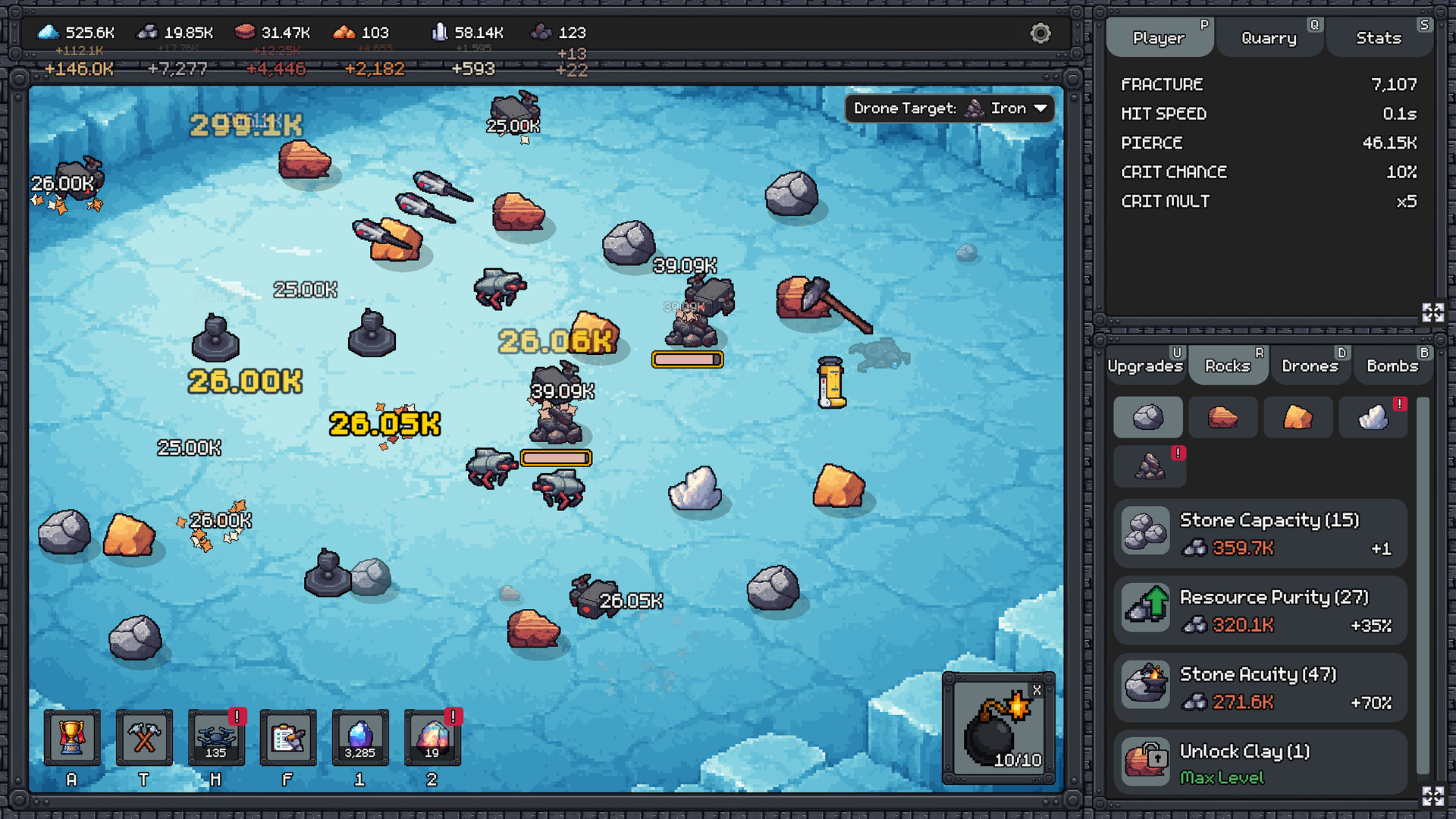
An icy quarry layer worked over by an automated fleet of mining drones.Image: Type Ten via Steam -
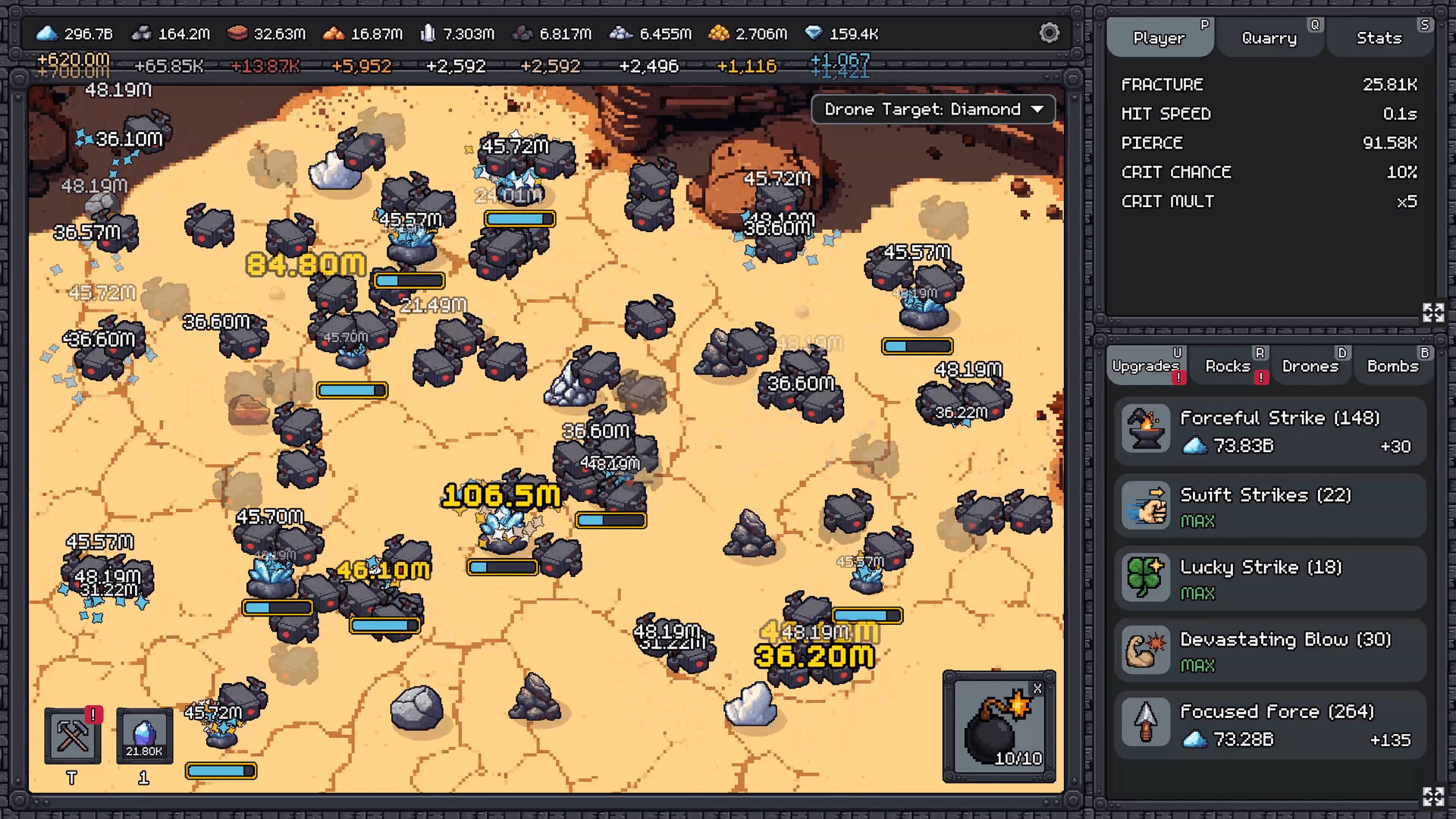
Deep into a run, the drone fleet dwarfs the manual mining that started it all.Image: Type Ten via Steam -
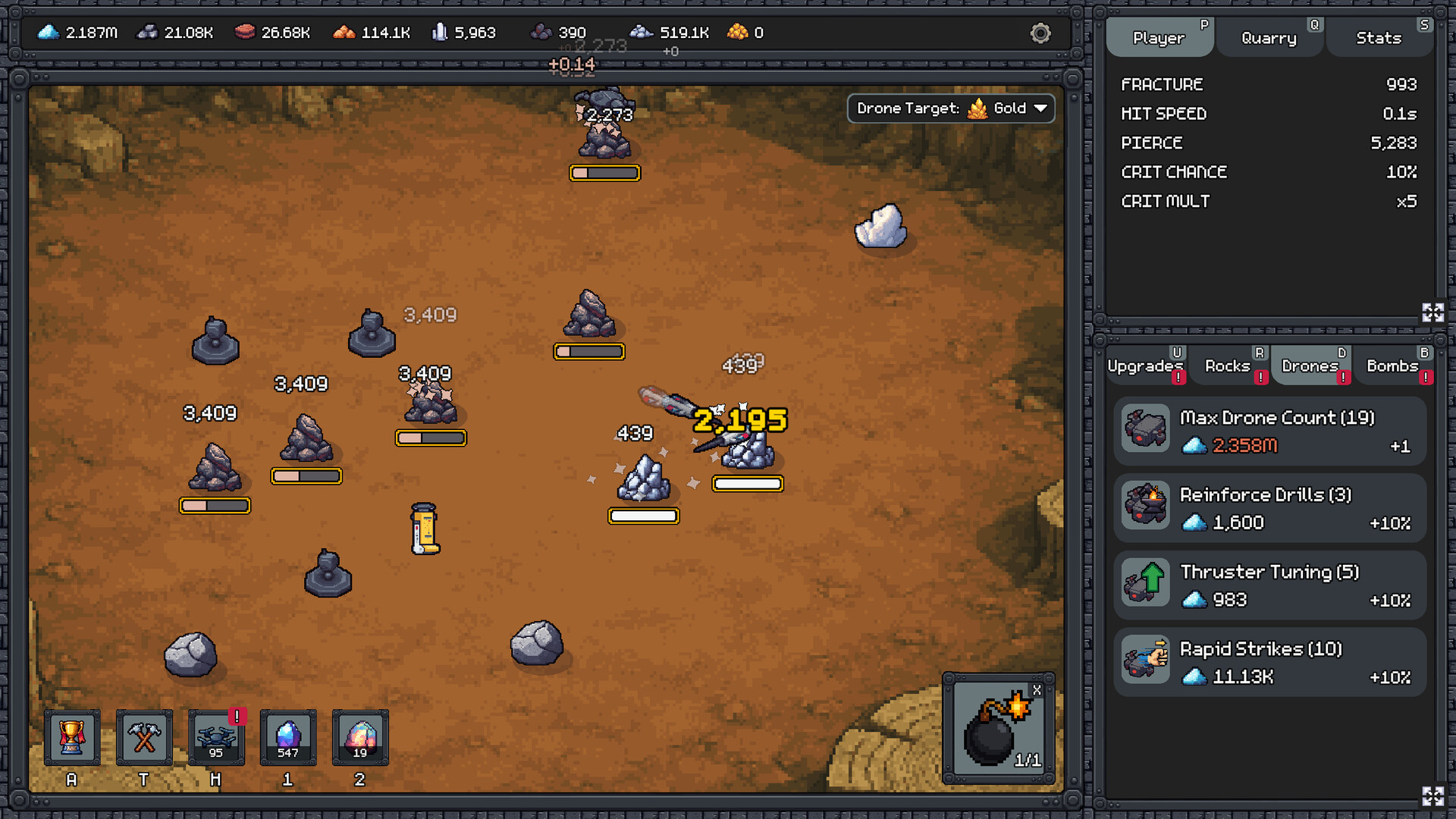
The early game, before automation and prestige resets turn the numbers into millions.Image: Type Ten via Steam