Game review
Bitburner
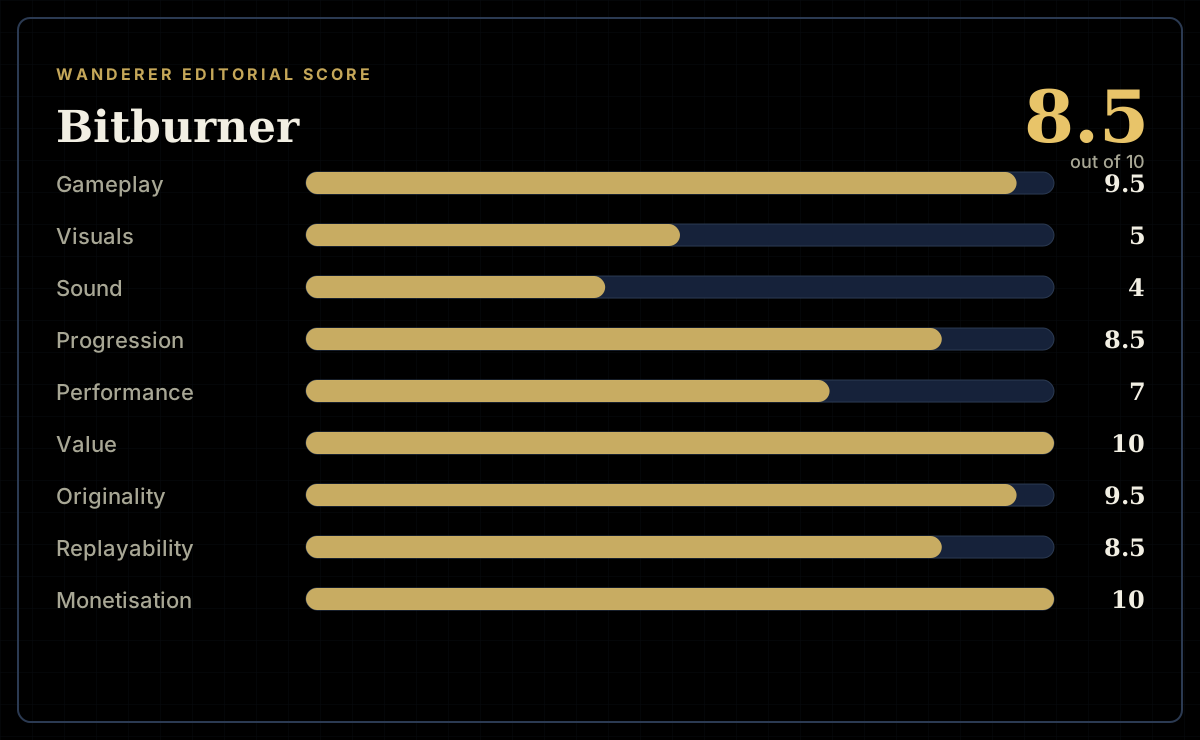
8.5 / 10
- Developer
- Fulcrum Games, Hydroflame, and 250+ open-source contributors
- Publisher
- Fulcrum Games
- Released
- 10 December 2021
- Platforms
- Windows, macOS, Linux, Browser
- Genre
- Programming incremental / hacking simulation
- Monetisation
- Completely free. No ads, no in-app purchases, no premium currency, no DLC — the developer does not accept donations either
- Players
- Single-player
The short version
Most incrementals sell you the fantasy of automating tedious work. Bitburner makes you actually do it — you write real JavaScript against a real, documented API to hack servers, run a gang, play the stock market and eventually try to overthrow the simulation you're standing in. That's either the best hook in the genre or a wall you never get past, and which one it is for you depends entirely on how you feel about a `while` loop.
Biggest strengths
- The core loop is the rare case where the theme and the mechanic are the same thing, not a skin over a spreadsheet
- A genuine, documented Netscript API with autocomplete, TypeScript support and external-editor sync tools built by the community
- BitNodes and Source-Files turn prestige into a real reset with structurally different rules each time, not just a bigger multiplier
Biggest weaknesses
- The tutorial explains the buttons but not the programming concepts underneath them, so non-coders are handed a `while` loop and left to work it out
- Major versions have shipped breaking API changes that stop existing scripts from running, and the game says so bluntly rather than protecting the player from it
- Visual and audio presentation is close to nonexistent — this is a green-on-black terminal, on purpose, with no soundtrack to speak of
Who it's for: Anyone who already writes code, or genuinely wants to learn, and likes the idea of a progression bar that only moves because their script told it to.
Our recommendation: Free, so there's no case against trying it. If the first scripting tutorial clicks, you have hundreds of hours ahead of you at zero cost. If it doesn't, there's no shame in bouncing off — this one was never built to meet you halfway.
8.5 / 10
Every incremental game is secretly about automation. You start clicking, and the entire arc of the genre is the slow removal of your own hand from the loop — buy the auto-clicker, hire the manager, unlock the passive multiplier, until the number goes up whether you're at the keyboard or not. Bitburner just stops pretending that's a metaphor. You automate the game by writing the automation, in JavaScript, against an API the developers actually documented, and the game only ever moves as fast and as cleverly as the code you gave it.
That's the whole pitch, and it's a better one than it sounds. It also means Bitburner isn't really competing with other incrementals so much as with a programming exercise that happens to have a progression bar attached — which makes it one of the most interesting design experiments in the genre and, depending entirely on who's playing, either a revelation or a locked door.
The loop, and who it actually serves
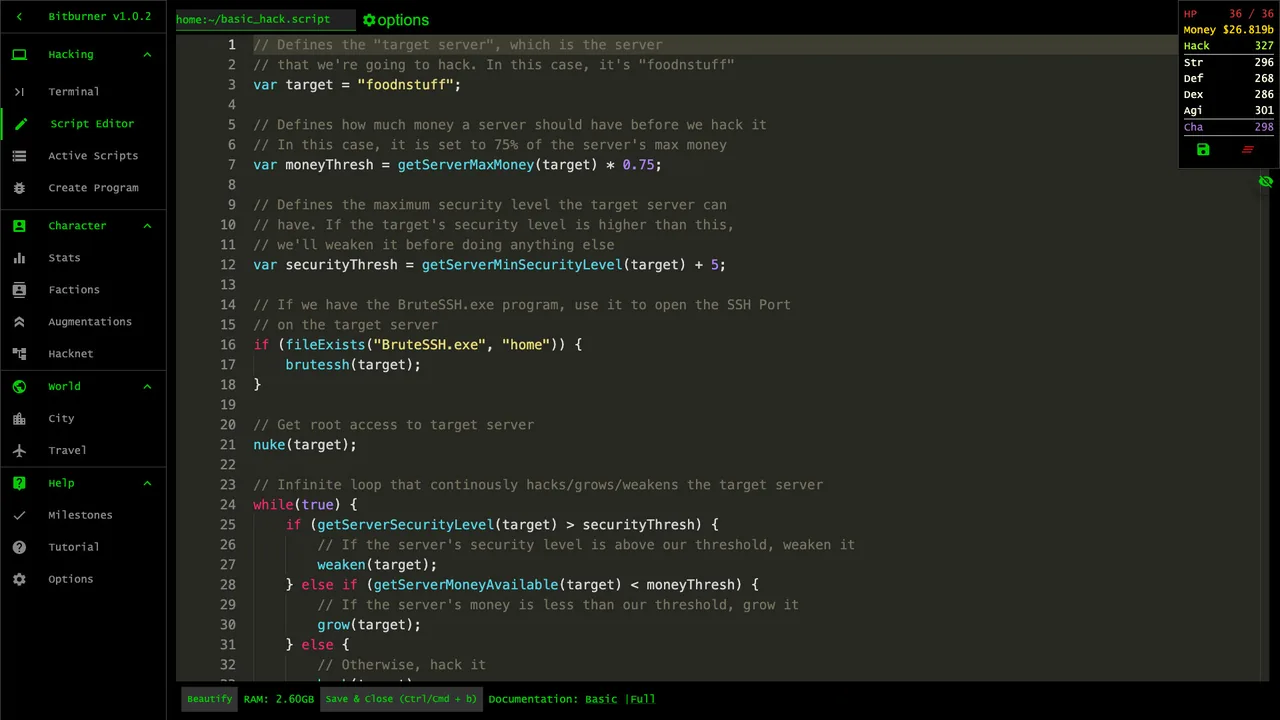
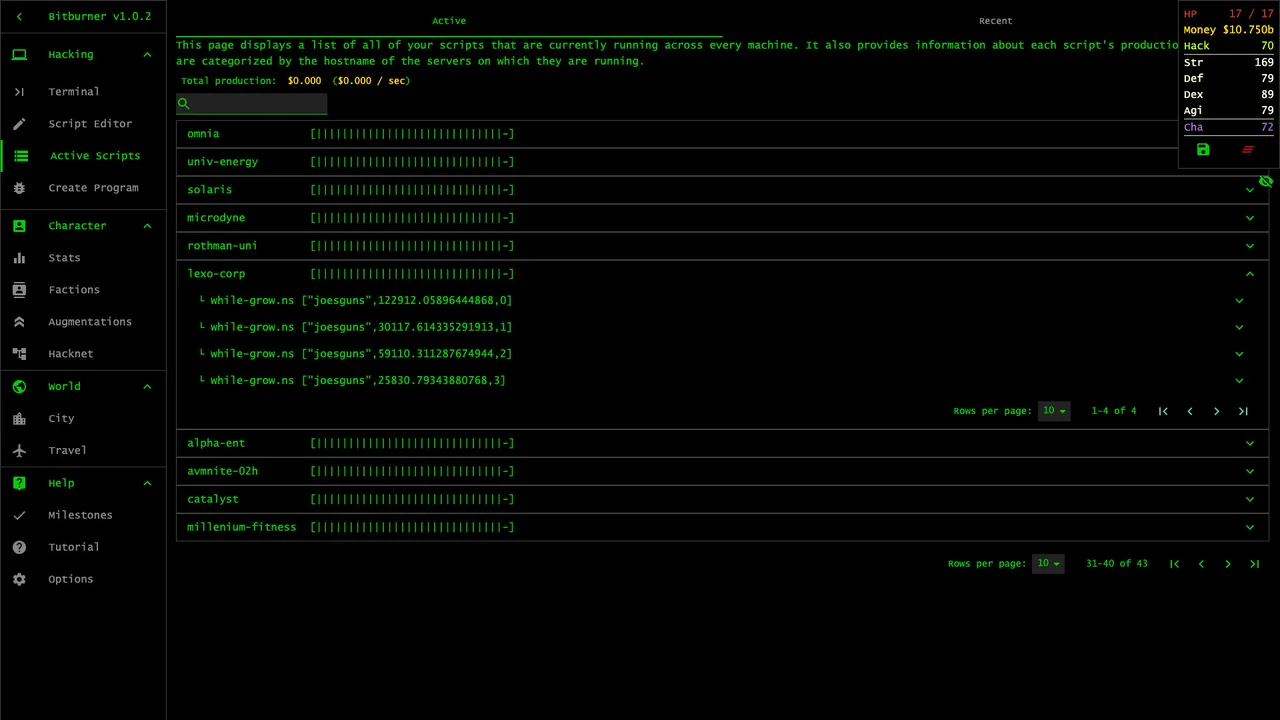
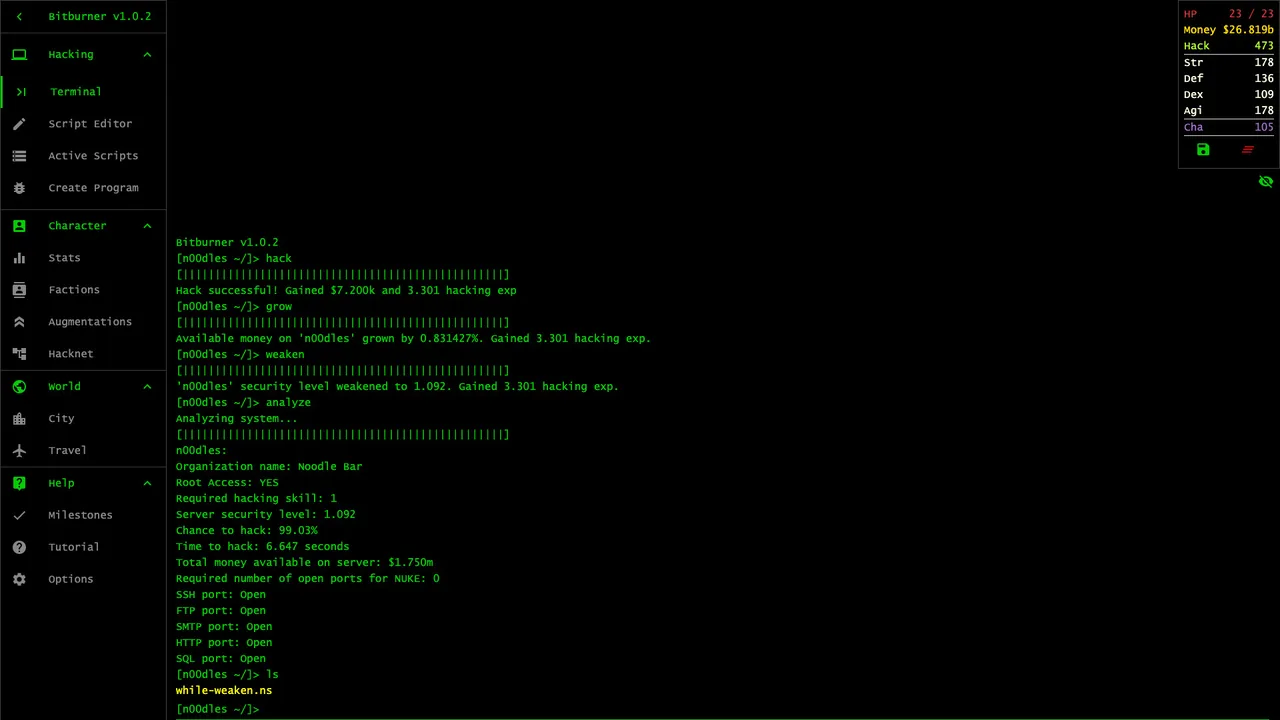
The opening hour is deliberately hands-on. You're in a terminal, you write a script that hacks a server called n00dles for money, and the game walks you through hack(), grow() and weaken() — the three verbs that everything else builds from. From there the scope opens fast: buy Hacknet Nodes for passive income, rent servers to run more scripts at once, join Factions by meeting their entry conditions, trade Augmentations for permanent stat bonuses, and eventually branch into Companies, Crimes, Infiltration, the stock market, gangs, a full corporation sim and Bladeburner operations — each one gated behind the last, each one exposed through the same scripting API rather than a separate minigame UI.
That structure makes Bitburner's real audience narrower than "incremental fans." It's built for people who either already write code for a living or a hobby, or who are willing to treat this as a programming tutorial with a game bolted on. The game's own FAQ insists it's "made with beginners in mind," and to its credit the starter script is short, commented and explained line by line. But the tutorial teaches you which button opens the terminal and which function calls do what — it doesn't teach you what a loop, a variable or an await actually is. Genuine beginners land in the reviews saying exactly that: the pasted example code works, but they can't see why, and the game has no patience for finding out. Experienced developers, meanwhile, describe the opposite problem — some find Bitburner's async model genuinely awkward, arguing you're boxed into sequential await calls where true concurrency would let more interesting scripts exist. Both complaints are really the same observation from opposite ends: this is a real programming environment with a real API's rough edges, not a simplified teaching sandbox, and it rewards people who already have a foothold in JavaScript far more generously than it rewards people starting from zero.
The reset that actually changes the rules
Where Bitburner separates itself from almost everything else in the genre is what happens once your scripts are good enough that you stop touching the keyboard. In most incrementals, that's the finish line — the game becomes a number ticking upward in a tab you've minimised. Here it's the midpoint.
The long game is BitNodes: distinct simulated realities, each with its own twist on the rules — one crushes your income sources, another opens up gang management, another hands you an entirely different scripting API for manipulating NPCs directly. Destroying a BitNode (the endgame requires manually hacking a server that needs a hacking stat in the thousands) wipes almost everything you built — your home RAM, your augmentations, your purchased servers — and hands you a Source-File instead: a permanent, stackable bonus that carries into every future BitNode and every future reset. Thirteen-plus BitNodes, each stacking differently, means the "prestige" layer isn't one lever you pull for a bigger multiplier — it's a structurally different game each time, and the Source-Files you're banking are what let your next set of scripts start from a stronger baseline instead of zero.
That's a genuinely well-built answer to the question every idle game eventually has to face: what do you do once the player has automated the whole loop? Bitburner's answer is to change the loop itself, repeatedly, and to make the player's accumulated scripting skill — not just their stat totals — the thing that carries forward. It's the strongest piece of design in the game, and it's also the part least likely to matter to anyone who bounced off the tutorial three hours earlier.
Built by whoever shows up, and it shows
Bitburner started as a free browser game in 2016 and didn't reach Steam until December 2021 — five years of open development before the storefront listing even existed. It's stayed that way since: the current codebase lives in a public repository with well over a thousand stars, community pull requests land constantly, and the credited developer line on Steam itself reads "Fulcrum Games, Hydroflame, and over 250 GitHub contributors." This is about as literally community-built as a game on Steam gets, down to an official policy of not accepting donations for it.
The upside of that model is a genuinely alive game. A major version released this May added a whole new late-game mechanic — a network-cracking system called Darknet — on top of dozens of interface fixes, and the project was still pushing commits days before this review was checked. Compare that cadence to almost anything else at this price, which is nothing, and it's hard to complain about the commitment.
The downside is the one the negative reviews keep circling back to: an open, contributor-driven codebase with a real scripting API doesn't get to quietly deprecate things. That May update shipped with an entire section of breaking changes — renamed functions, removed APIs, altered return values — and a note that the game will scan your saved scripts and generate a file explaining what it broke. That's honest, and better than silently corrupting a save. It's also a real cost for anyone who spent hours perfecting an automation script only to have a point release retire the function it was built on. Players who treat their scripts as a long-term project feel this more than anyone; more than one review describes coming back after a break to find their toolkit simply doesn't run anymore. A community-maintained tool used by hundreds of contributors is always going to evolve like a piece of software rather than settle like a finished game, and Bitburner wears that trade-off openly rather than hiding it.
What free actually buys you
There's no price to weigh here, which is unusual for a review this deep into a game's systems. Steam lists Bitburner as free, with no in-app purchases, no premium currency, no DLC and no advertising — and the same build has been free in a browser since before the Steam listing existed. Ninety-eight Steam achievements, cloud save support and a native desktop build are what the Steam version adds over the browser version; neither format asks for money at any point.
That completeness is worth stating plainly, because it removes the question that usually shadows a review like this one. There's no "is it worth the asking price" calculus, no held-back systems, no version of Bitburner that plays better because you paid for it. The only real cost is the one every free game with this much depth eventually asks for — your time, and in this case, a willingness to actually write code rather than just watch numbers move.
It's worth flagging one practical wrinkle that isn't about money: the Steam build's save lives in local browser-style storage rather than a normal save file, and the game's own documentation recommends manually exporting a backup rather than relying on it. Steam Cloud syncs that local save, but a corrupted local file is still a corrupted local file, and at least one widely visible negative review describes losing progress this way after a power outage. It's not common enough to define the game, but it's a real gap for a project otherwise this well cared for, and the fix — export your save occasionally — costs nothing and is worth doing.
Verdict
Bitburner is the rare incremental that earns the comparison to a real tool rather than a toy. The Netscript API is documented like software, the community has built genuine external-editor integrations for it, and the BitNode/Source-File structure gives the prestige layer something to say that most of the genre never bothers to attempt. Nothing else on Steam quite occupies this space, and that originality is the reason it scores as high as it does despite offering almost nothing in the way of art or sound design — this is a terminal window with a plot, and it knows it.
What keeps it from the very top of the scale is exactly the trade-off that makes it interesting in the first place. It doesn't onboard non-programmers with any real patience, its API has changed underneath its own players more than once, and the presentation makes zero effort to be anything other than text on a dark background. None of that is a flaw so much as a boundary the developers clearly chose on purpose — but a boundary is still a boundary, and it will lose plenty of players who would have loved everything past it.
If you already know your way around a for loop, or you've been meaning to learn and want a reason that isn't a tutorial site, there's nothing standing between you and hundreds of free hours. If you've tried to learn to code before and it didn't take, this particular door may stay shut — and that's a fair thing to know going in, for a game that will never once ask you for a cent to find out.
Readers who like automation without needing to write it themselves, and would rather that persistence carried on while they were off doing something else entirely, might also want to look at Wanderer.
Pros and cons
Pros
- The core loop is the rare case where the theme and the mechanic are the same thing, not a skin over a spreadsheet
- A genuine, documented Netscript API with autocomplete, TypeScript support and external-editor sync tools built by the community
- BitNodes and Source-Files turn prestige into a real reset with structurally different rules each time, not just a bigger multiplier
- Completely free with nothing held back, no currency to buy and nothing bought for you
- Still under active, ambitious development five years after its Steam launch, with major mechanics added as recently as this year
Cons
- The tutorial explains the buttons but not the programming concepts underneath them, so non-coders are handed a `while` loop and left to work it out
- Major versions have shipped breaking API changes that stop existing scripts from running, and the game says so bluntly rather than protecting the player from it
- Visual and audio presentation is close to nonexistent — this is a green-on-black terminal, on purpose, with no soundtrack to speak of
- Players who lean on the async scripting model report real friction with how Bitburner handles concurrent script calls
- Save data lives in local storage rather than a normal file, and the game's own FAQ tells you to manually export backups rather than trusting it
Screenshots
-
BitburnerImage: Fulcrum Games via Steam -
BitburnerImage: Fulcrum Games via Steam -
BitburnerImage: Fulcrum Games via Steam -
How the review scores each part of the gameWanderer Editorial -
The short versionWanderer Editorial