
Game review
Idle Grid
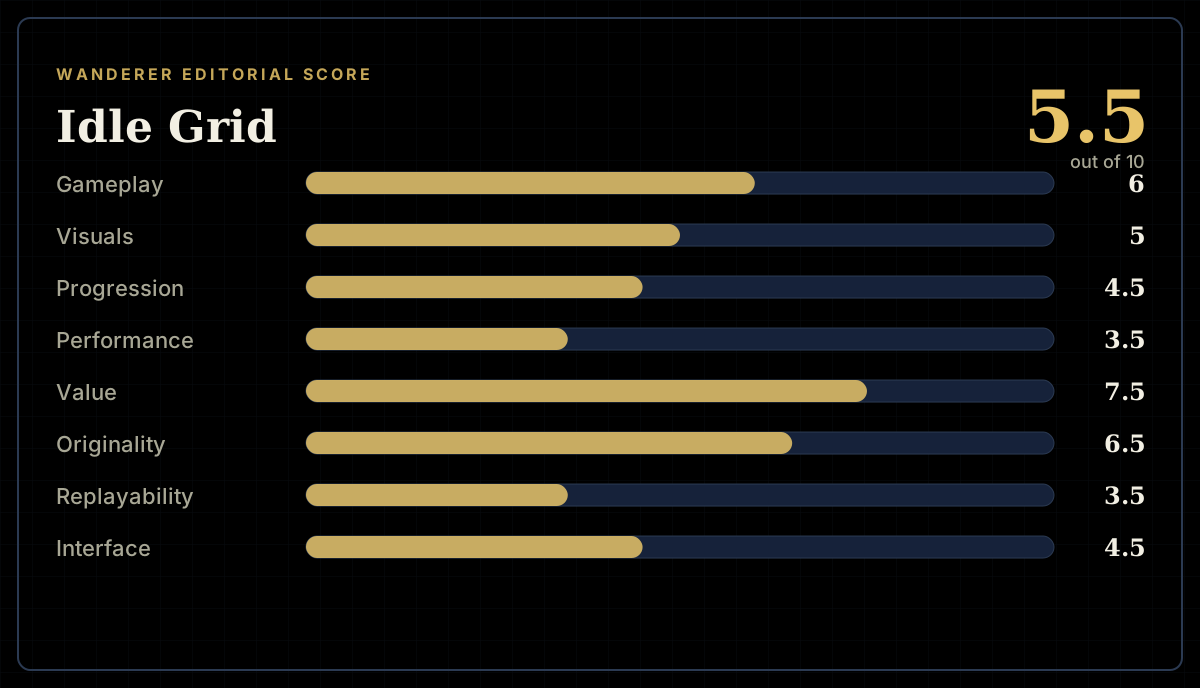
5.5 / 10
- Developer
- Lake Country Games
- Publisher
- Lake Country Games
- Released
- 5 February 2025
- Platforms
- Windows
- Genre
- Idle / Simulation
- Monetisation
- Free to play. No premium currency, subscriptions, advertising or in-app purchases appear on the Steam storefront listing
- Players
- Single-player
The short version
Idle Grid's whole pitch fits in one sentence: place factories, power plants and research labs on a grid, let adjacency bonuses do the heavy lifting, and watch a small industrial empire compound while you're away. That idea is sound, and for the first hour or so of a session it works — there's real pleasure in finding a layout that clicks. The trouble is what happens once that grid starts filling up.
Building animations that can't be turned off drag CPU usage upward as the board grows, the map has no scrolling — only zoom — so a busy grid becomes a wall of illegible icons, and a chunk of the community reports one of the four core building types simply not working. Add a prestige loop whose upgrade costs barely scale and a full 100% clear that most players finish in two to three hours, and what's left is a clever hour of factory-puzzle idling wrapped in a game that hasn't been finished.
Biggest strengths
- The adjacency system genuinely rewards deliberate layout planning — pairing factories with power plants and clustering research buildings changes outcomes, not just numbers
- Being completely free with no purchases, currency or ads visible on the storefront removes any monetisation anxiety before you've even installed it
- 27 Steam achievements give short-session players concrete goals beyond watching a counter climb, and most are reachable within a couple of hours
Biggest weaknesses
- CPU usage climbs sharply as the grid fills, and there's no setting to disable the building animations that multiple players tie directly to the slowdown
- The map can only be zoomed, never scrolled, so a filled grid forces you to zoom out until the buildings you're managing are too small to read clearly
- Several player reports describe the compactor — one of the game's core building types — as non-functional, with no clear indication whether or when it's been fixed
Who it's for: Idle-game completionists chasing a short achievement list and anyone curious about adjacency-bonus factory design who wants a free taste of it. Not for players who want dozens of hours of scaling incremental progression, or anyone on a laptop that can't shrug off a sustained CPU spike.
Our recommendation: It's free, so there's little to lose trying it for an evening — just don't expect it to hold your attention much longer than that, and expect your fan to spin up once the grid fills in.
5.5 / 10
Idle Grid asks a narrow question and answers it well for about an hour: what happens if the only thing that matters in an idle factory game is where you put things? There's no resource-hauling logistics puzzle here, no conveyor belts, no supply chains to route. You drop a factory, a power plant, a research lab or a compactor onto a grid, and the game rewards you for which tiles end up next to which other tiles. It's a smaller, sharper idea than most factory-incrementals attempt, and Lake Country Games — a solo-leaning studio making its first jump from itch.io prototypes to a Steam release — deserves credit for building a whole game around one clean mechanic rather than bolting adjacency bonuses onto something more sprawling. The problem is that everything outside that one mechanic feels like it shipped a few patches too early.
The adjacency loop is the whole game, and it mostly works
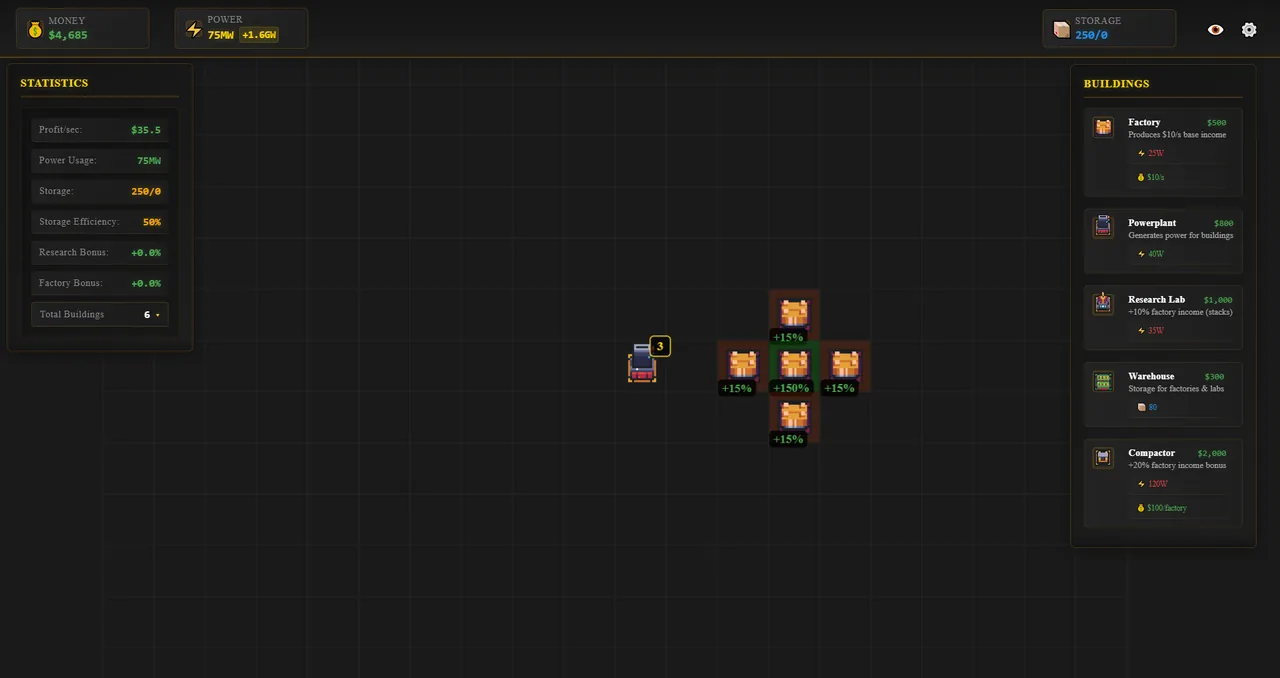
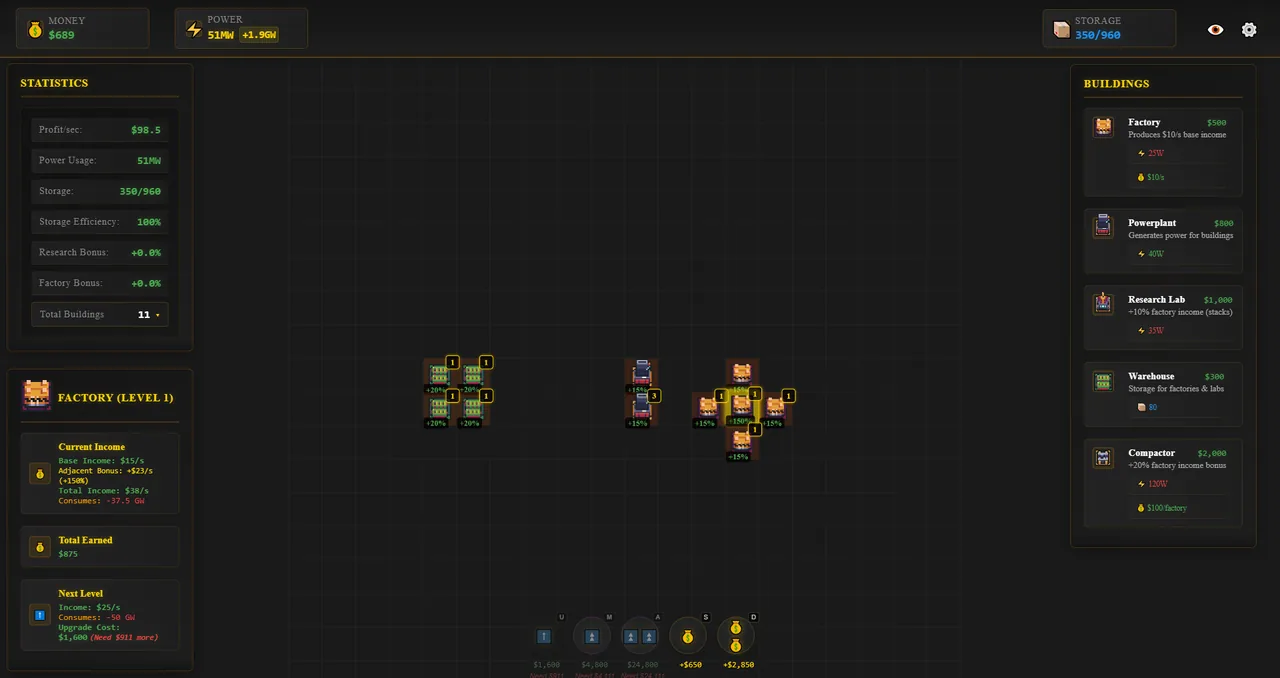
Every building on Idle Grid's grid does something different depending on its neighbours. Factories next to power plants run more efficiently. Research buildings clustered together boost each other's output. Compactors are meant to multiply whatever they're placed beside. None of this is explained when you start — there's no tutorial, and the game leaves you to click around and infer the system from outcomes, which more than one player has flagged as a rough first ten minutes. Once it clicks, though, the appeal is real: rearranging a cramped grid to squeeze a better multiplier out of three factories and a power plant has the same small, satisfying "aha" that makes adjacency-bonus design fun in genres far removed from idle games. It's the strongest idea in the build, and it's genuinely worth experiencing for free.
Where it comes apart is scale. Power management adds a second layer — balancing production against consumption, building backup storage against brownouts, upgrading plants as demand grows — and it's a reasonable complication early on. But the game doesn't give the adjacency system room to keep generating new decisions once the grid fills up. Several Steam reviewers who've cleared the full achievement list describe finishing everything the game currently offers in under three hours, and at least one notes that upgrading factories late in a run can actively work against you rather than for you, which suggests the balance hasn't been tuned much past the opening stretch.
Prestige exists, but it doesn't ask much of you
Idle Grid has a prestige system: sell off your grid, bank the profits as permanent upgrades, and start again with a head start. In principle that's the structure that gives idle games their long tail. In practice, player reports consistently describe prestige upgrade costs that barely increase between purchases — meaning there's little escalating challenge to chase, and repeated prestiging feels closer to a formality than a strategic choice. One review notes a further wrinkle where earlier prestige purchases don't apply their bonus until a second purchase goes through, which reads like an ordering bug rather than intentional design. None of this breaks the game, but it means the loop that's supposed to keep you coming back doesn't have much pull once the first playthrough ends.
Performance is the real problem
The single most consistent complaint across Idle Grid's Steam reviews isn't the pacing or the missing tutorial — it's CPU usage. Building animations play constantly and can't be switched off, and as the grid fills with structures, several players report CPU load climbing well past 60% and the game visibly lagging regardless of hardware. That's a serious issue for a genre whose entire premise is running quietly in the background while you do something else. Compounding it, the camera can only zoom, not pan or scroll, so once a grid is busy enough to need managing, the only way to see the whole board is to zoom out until individual buildings are too small to read — one reviewer put it bluntly: the scale is too small to make anything out. A factory-placement game that becomes illegible exactly when placement decisions matter most is a genuine design failure, not just a rough edge.
Layered on top of that, several players report that the compactor — one of only four core building types — simply doesn't function, going back several months of reviews without a confirmed fix mentioned in response. For a game this small, one dead building type out of four is a large hole in the systems the whole adjacency idea depends on.
Presentation and content are both thin, but it's free
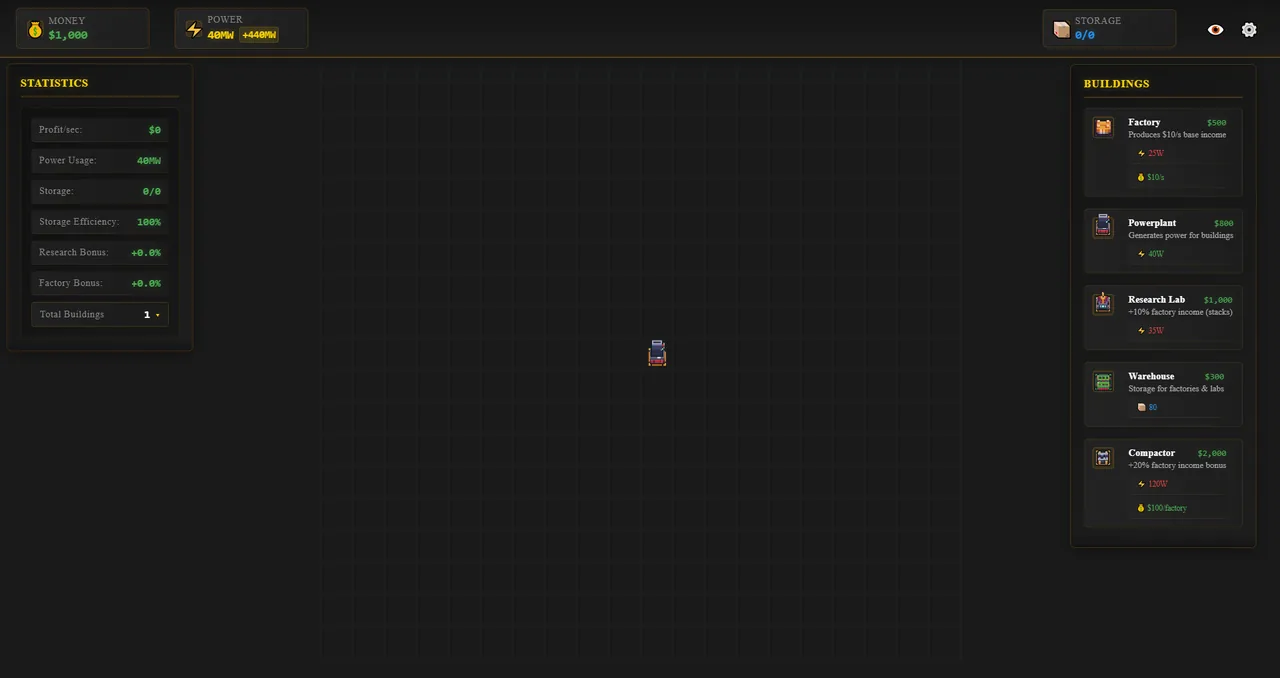
Visually, Idle Grid goes for a clean, minimalist grid look that suits its premise when the board is small — icons are readable, the palette is calm, and it doesn't try to be more than it is. That restraint stops paying off once the animation load and legibility problems above kick in, but at a glance, in early screenshots, it reads as a tidy little management toy rather than a budget product.
The bigger issue is simply how little there is to do. Between a two-to-three-hour full clear for most players, a small handful of building types, and a prestige loop that doesn't scale its own difficulty, Idle Grid runs out of new decisions well before most idle-game players are used to. Several reviewers explicitly ask for the game to carry an Early Access label rather than ship as a finished product, given how much still feels unfinished — the storefront listing doesn't currently carry that tag, which makes the gap between expectation and content more noticeable, not less. Because the whole thing costs nothing and carries no purchases, ads or currency of any kind, that thinness is easier to forgive than it would be in a paid release — but it does mean there's very little reason to open Idle Grid a second time once its achievement list is done.
Final verdict
Idle Grid has one good idea, executed well enough in its first hour to make you want more of it, and then doesn't give you more of it. The adjacency-bonus placement mechanic is a smarter, more focused take on factory-idling than most games in the genre attempt, and it's genuinely fun to puzzle out a better layout. But a prestige system that doesn't meaningfully escalate, a building type multiple players say doesn't work, a camera that can't scroll, and CPU usage that climbs into lag territory as soon as the grid gets interesting all point to a game that needed another few months before release rather than a launch button. It costs nothing to find out whether the core idea is for you — just don't expect it to hold your attention much past the achievement list, and keep an eye on your CPU usage once the grid starts filling in. Players who want that same "away from keyboard, still progressing" feeling with considerably more to chase over the long run may get more mileage out of something built specifically around persistent, ongoing progression, Wanderer included.
Pros and cons
Pros
- The adjacency system genuinely rewards deliberate layout planning — pairing factories with power plants and clustering research buildings changes outcomes, not just numbers
- Being completely free with no purchases, currency or ads visible on the storefront removes any monetisation anxiety before you've even installed it
- 27 Steam achievements give short-session players concrete goals beyond watching a counter climb, and most are reachable within a couple of hours
- The minimalist grid presentation stays legible and calm at small scale, before the building count climbs high enough to strain it
Cons
- CPU usage climbs sharply as the grid fills, and there's no setting to disable the building animations that multiple players tie directly to the slowdown
- The map can only be zoomed, never scrolled, so a filled grid forces you to zoom out until the buildings you're managing are too small to read clearly
- Several player reports describe the compactor — one of the game's core building types — as non-functional, with no clear indication whether or when it's been fixed
- The prestige system's upgrade costs barely increase with each purchase, so repeated prestiging adds very little strategic depth or difficulty curve
- There's no in-game tutorial explaining the adjacency mechanic, leaving new players to work out the entire premise through trial and error
Screenshots
-
Idle GridImage: Lake Country Games via Steam -
Idle GridImage: Lake Country Games via Steam -
Idle GridImage: Lake Country Games via Steam -
How the review scores each part of the gameWanderer Editorial -
The short versionWanderer Editorial