
Game review
NGU Idle
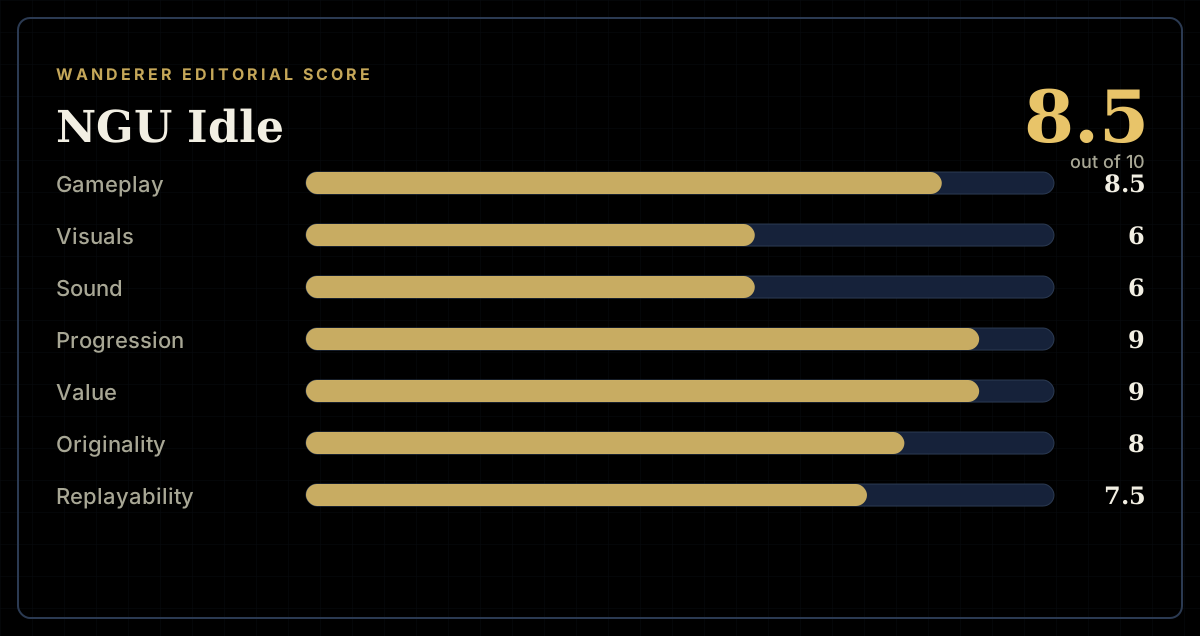
8.5 / 10
- Developer
- 4G
- Publisher
- 4G
- Released
- 1 October 2019
- Platforms
- Windows, Browser
- Genre
- Incremental RPG
- Monetisation
- Free to play everywhere it appears, with an optional premium currency (Arbitrary Points) that is also earnable through normal play
- Players
- Single-player
The short version
NGU Idle is what happens when "numbers go up" is taken as a design brief instead of a joke. Underneath the fart humour sits one of the most thoroughly interlocked rebirth structures the genre has produced — NUMBER, NGUs, Wandoos, Blood Magic and Advanced Training all feeding the same handful of stats from different directions, with almost nothing thrown away when you reset. Nearly a decade after it left Kongregate, that structure is still why players clock thousands of hours in it.
The cost is legibility. The game explains very little of what it hands you, the interface looks like it hasn't been redesigned since 2017 because it mostly hasn't, and there's a real wall in the mid-game where progress slows from daily to weekly. None of that is an accident — it's a game built for people who like discovering systems the hard way — but it means the official new-player experience and the actual new-player experience are two different things.
Biggest strengths
- Rebirthing resets almost nothing that matters — NGU levels, Wandoos, ITOPOD progress and Money Pit levels all carry forward permanently
- The entire game is free on every platform it ships on, and its premium currency is earnable through quests and towers rather than gated behind a price
- Adventure mode's 1,600-floor ITOPOD and recurring Titan fights give the idle loop an actual combat structure instead of pure number-watching
Biggest weaknesses
- The interface hands new players a dozen unexplained mechanics before it properly introduces any of them
- The "Mega Lands" wall around the mid-game can mean deliberately running a single rebirth for days just to clear it
- The comedic voice leans hard on toilet humour and self-aware cringe, and it won't land for everyone the way it's meant to
Who it's for: Spreadsheet-brained players who liked Adventure Capitalist's shape but wanted forty more systems bolted onto it, and don't mind a wiki tab open the whole time.
Our recommendation: Play it free in the browser first — Kongregate or Armor Games, no install required — and give it past the first rebirth before judging it. If the itch to open a wiki tab feels like fun rather than homework, move to the Steam build for cloud saves and achievements; nothing in it is locked behind money either way.
8.5 / 10
Most idle games hide their depth behind a single lever: click faster, wait longer, buy the next tier. NGU Idle hides its depth behind roughly a dozen levers, most of them unlabelled, several of them contradicting each other until you've played long enough to see why they don't. It has been doing this since it was a browser toy on Kongregate, and it is still doing it on Steam nearly seven years later with a 95% approval rating from almost eleven thousand reviews. That combination — genuinely obtuse design, genuinely adored by the people who stick with it — is the whole story here.
The pitch nobody explains to you
You start by training Strength, Toughness, Health Regen and a couple of other Basic Training stats, one bar filling at a time. You fight a boss when your Attack and Defense look strong enough. You lose eventually, because everything in NGU Idle is designed to be lost to, and you rebirth: your run-specific stats reset, you're handed a NUMBER that permanently multiplies your next Attack and Defense from Basic Training, and you start again slightly stronger. That's the entire pitch, and it's also almost nothing — everything interesting happens in what survives the reset.
What survives is a lot. NGUs — permanent training tracks split into eight Energy-powered and seven Magic-powered categories, unlocked after the first Titan falls — keep leveling for as long as you feed them, with a hard cap of a billion levels each that nobody is remotely close to reaching. Wandoos convert leftover Energy and Magic into more Attack and Defense mid-run. Blood Magic, Augments, Advanced Training and a currency called Money Pit each solve a different piece of the same problem: how to make the next rebirth start from a higher floor than the last one. None of these systems get a tutorial worth the name. You're expected to click into them, watch a number change, and work out the rest — or, more realistically, open the wiki that a decade of players have built specifically because the game won't.
Adventure mode does the heavy lifting
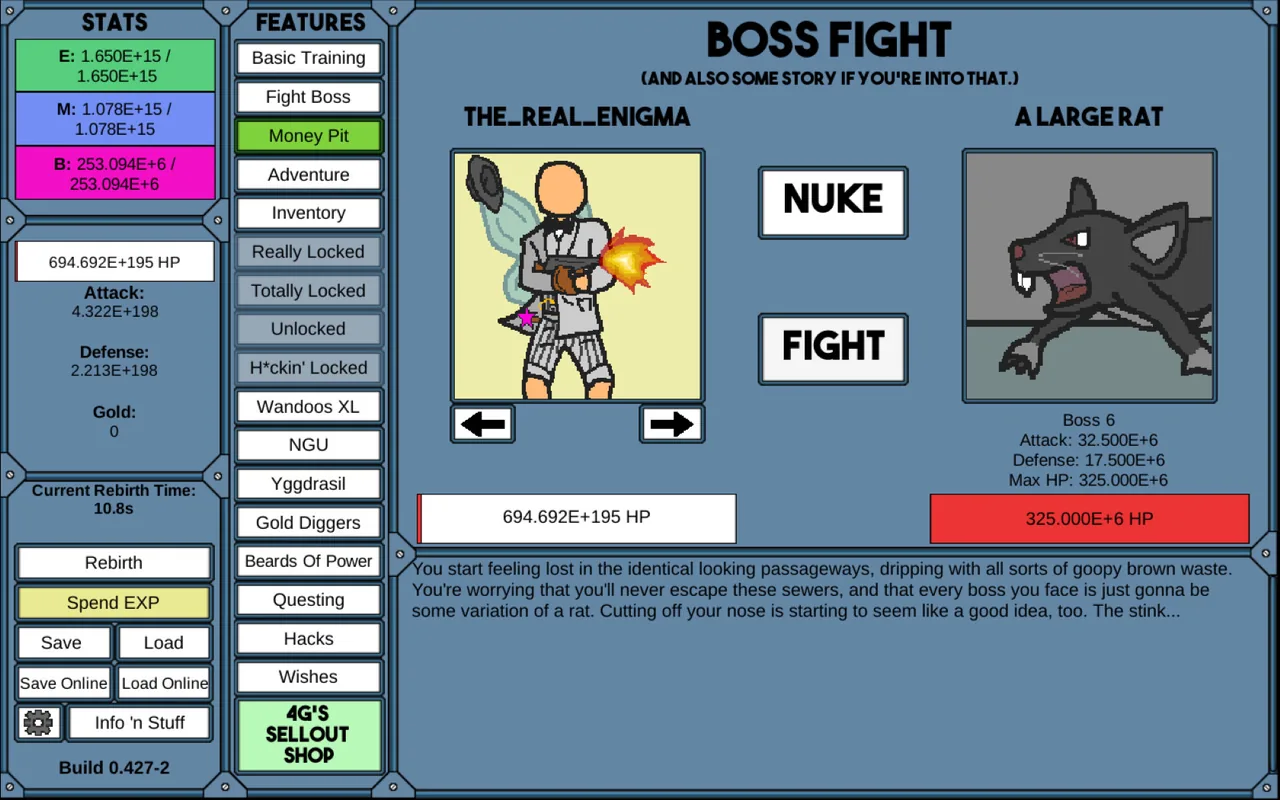
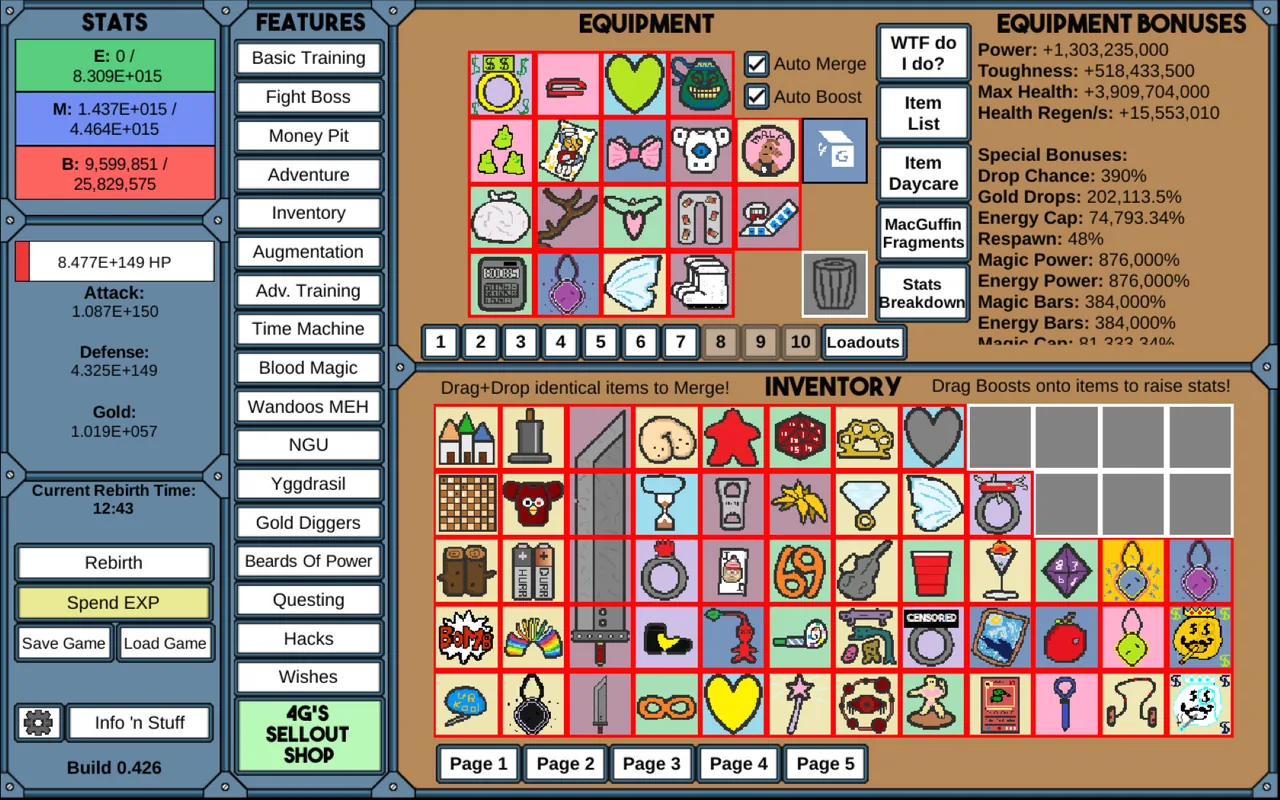
Where a lot of incrementals treat combat as a progress bar with a sword icon on it, NGU Idle's Adventure mode is closer to an actual dungeon crawl running in the background. Zones scale in difficulty, bosses marked with a yellow crown drop the equipment that defines your build, and regular mobs drop the boost items that buff specific stats for a limited time. Titans — the game's optional super-bosses — can be fought manually or auto-killed while you're away, and losing to one just bounces you back to a safe zone rather than punishing you.
The best-designed piece of it is the ITOPOD, the Infinite Tower of Pissed-Off Dudes: 1,600 floors of steadily harder enemies, unlocked by consuming a specific key dropped from an earlier boss. It's the game's clearest example of depth used well — a single, legible ladder that rewards climbing steadily rather than requiring you to understand six overlapping systems at once, and one of the few places NGU Idle lets a new player make obvious progress without outside help.
Where the depth turns into friction
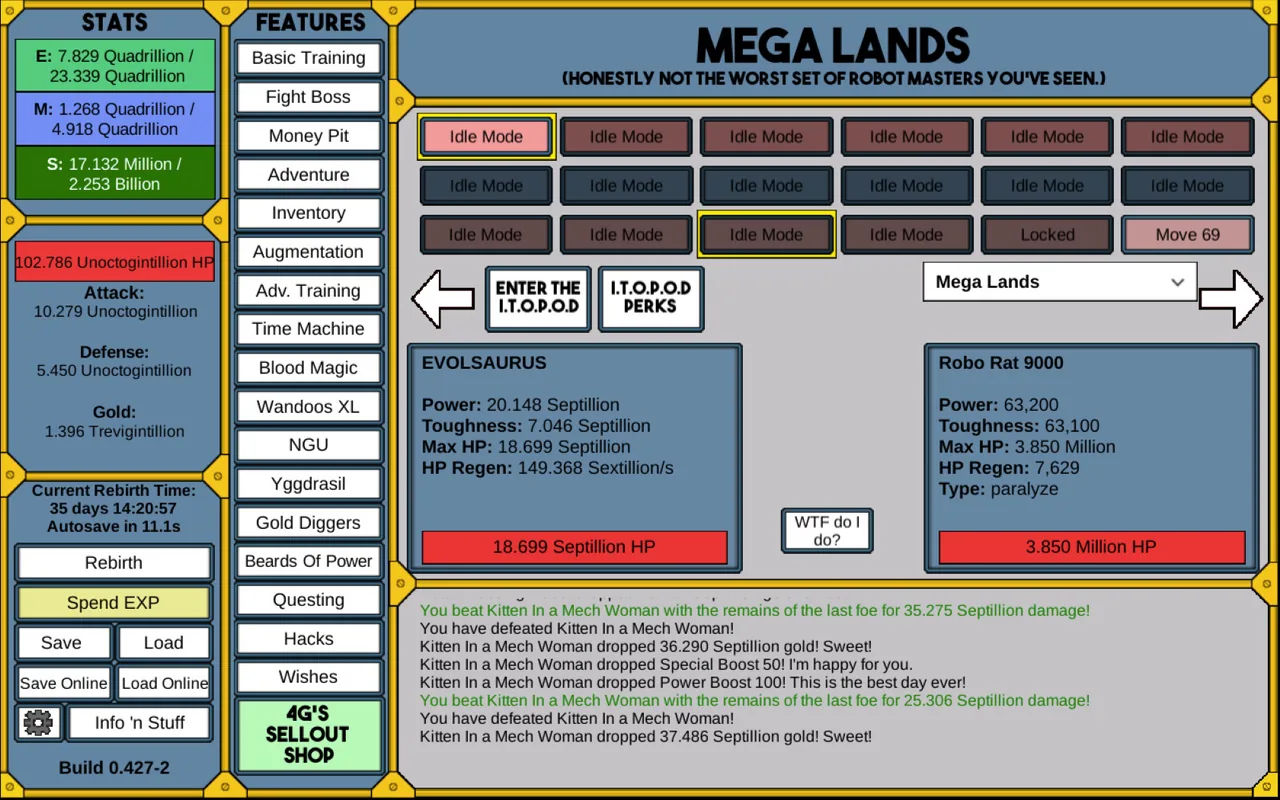
The trouble starts once those overlapping systems all matter at the same time, which happens sooner than the game's pacing suggests it should. Rebirths under an hour are penalised on the NUMBER they produce, which teaches an early lesson about patience — fine, and clearly deliberate. Less fine is what the community calls the "Mega Lands wall," a genuinely famous mid-game barrier that stops daily progress cold and typically takes a dedicated, multi-day rebirth just to punch through. Reaching that point without having read a guide first means hitting a wall you didn't see coming, built from systems the game never explained were connected.
That's the design tension the whole review keeps circling back to. Is the opacity a deliberate choice that rewards patient discovery, or is it friction the game leans on the community to patch? Honestly, both — and NGU Idle doesn't much care which answer you land on. The systems are consistent and fair once understood: nothing here is randomised nonsense, and the interlocking math rewards exactly the kind of obsessive spreadsheet thinking its audience shows up for. But "once understood" is doing a lot of work in that sentence, and the game itself does very little of the understanding for you. A long-running independent review of the game put it plainly after about a year of engagement: the drip-feed of new mechanics is genuinely well-paced early on, but most of what arrives later is "multiplicative bonuses to core stats" rather than new ideas, and the gap between zones widens until closing it takes weeks rather than days. That's a fair description of a game that trusts its own depth to carry the second half, and mostly succeeds, but stops innovating well before it stops demanding your time.
The free browser game and the also-free Steam game
Here's the part worth being precise about. NGU Idle isn't a free demo with a paid Steam upgrade — it's the same free game in both places. The browser version, still playable through Kongregate, Armor Games and Kartridge, is the complete game with nothing held back. Steam adds cloud saves, 61 achievements and the option to let the game run in the background without a browser tab open, which matters for a title built around long, uninterrupted rebirths, but it doesn't unlock content the browser build lacks.
What money actually buys is Arbitrary Points, spent in what the developer calls — with the kind of self-aware honesty that runs through the whole game — the Sellout Shop. AP buys convenience: EXP and PP conversions, quality-of-life shortcuts, and the odd cosmetic. It is also earnable for free through quests, ITOPOD floors and achievement bonuses, and the game's own store page is upfront that patient players can accumulate a decent amount without spending a cent. Nothing purchasable touches a competitive outcome, because there isn't one — this is a single-player save with no leaderboard worth chasing — and nothing purchasable substitutes for the core loop of training, fighting and rebirthing. It's about as clean a free-to-play model as the genre offers: no ads forced on you, no energy meter, no login streak nagging you back. The closest thing to a monetisation criticism is that the Sellout Shop exists at all in a game this transparently non-predatory, and even that reads more like the developer's sense of humour than a real complaint.
Presentation and tone
Visually, NGU Idle looks like what it is: a browser incremental that grew a much bigger game around it without ever budgeting for a UI pass. Menus are dense, numbers are everywhere, and nine years of accreted features share screen space that was never designed to hold them. It's functional rather than attractive, and a vocal minority of Steam reviews single out the interface as genuinely unpleasant to navigate rather than just old-fashioned. The comedic voice is similarly divisive — puns, toilet humour and a shop that calls itself a sellout — and it's not written to be subtle. Players who find that tone charming will find plenty more of it; players who don't will find it grating well before the hundredth joke lands.
Verdict
NGU Idle earns its reputation the hard way. There's no shortcut version of this review that skips past the fact that it asks more of a new player than almost any other free incremental on Steam, and that a fair amount of that difficulty comes from a UI and onboarding pass the game has simply never gotten around to. But the systems underneath are real, they're fair, they interlock in ways that reward long-term thinking rather than punishing it, and the monetisation asks for nothing it doesn't also let you earn. Ten years after it started as a Kongregate curiosity, it's still adding content, still free everywhere it lives, and still the game a huge slice of its audience points to when someone asks what "numbers go up" is supposed to feel like when it's done properly.
Play it in the browser first, expect the first few hours to be more confusing than they need to be, and don't be surprised if the wiki becomes a second tab you never close. That's not a bug in how NGU Idle was built. It's close to the point.
Prices and monetisation checked 30 July 2026.
Players who want a similar rebirth-and-permanence loop without needing a second monitor for a wiki might find Wanderer a gentler on-ramp — the progression keeps moving while you're away, but it stays on one road instead of a dozen interlocking systems.
Pros and cons
Pros
- Rebirthing resets almost nothing that matters — NGU levels, Wandoos, ITOPOD progress and Money Pit levels all carry forward permanently
- The entire game is free on every platform it ships on, and its premium currency is earnable through quests and towers rather than gated behind a price
- Adventure mode's 1,600-floor ITOPOD and recurring Titan fights give the idle loop an actual combat structure instead of pure number-watching
- New systems keep arriving for months rather than hours, with Advanced Training, Blood Magic and Augments landing well after most idle games have shown their whole hand
- Ten years of near-continuous updates from one developer, with the tone and the systems staying consistent the whole way
Cons
- The interface hands new players a dozen unexplained mechanics before it properly introduces any of them
- The "Mega Lands" wall around the mid-game can mean deliberately running a single rebirth for days just to clear it
- The comedic voice leans hard on toilet humour and self-aware cringe, and it won't land for everyone the way it's meant to
- No official mobile release, so away-from-desk players are stuck with a browser tab rather than an app icon
- A community wiki is close to mandatory for planning an efficient rebirth, and the base game does very little to acknowledge that
Screenshots
-
NGU IDLEImage: 4G via Steam -
NGU IDLEImage: 4G via Steam -
NGU IDLEImage: 4G via Steam -
How the review scores each part of the gameWanderer Editorial -
The short versionWanderer Editorial