Game review
Tap Tap Infinity
6.5 / 10
- Developer
- Scary Bee LLC
- Publisher
- Scary Bee LLC
- Released
- 17 July 2015
- Platforms
- Windows, macOS
- Genre
- Incremental RPG
- Monetisation
- Free-to-play with an optional "Soul Gems" premium currency, spent on Soul Links and upgrade speed-ups; no ads, no energy system, no required account
- Players
- Single-player
The short version
Tap Tap Infinity is a Clicker Heroes clone in the most literal sense — same zones, same hero roster, same reset-for-permanent-power loop — dressed in dated low-poly 3D and released two months after the game it's copying. Eleven years on, that origin story matters less than what the game actually does with its premium currency: Soul Gems can be earned entirely for free, several thousand-hour players vouch for the shop being genuinely optional, and there's no ad break or energy timer anywhere in it.
What holds it back isn't the free-to-play model, it's everything else standing still. Scary Bee LLC shipped its last patch note in September 2015 and never came back, so the interface, the 3D models and the unresolved cloud-save complaints are exactly as they were a decade ago — just older.
Biggest strengths
- Soul Gems, the premium currency, are earned steadily through free in-game gifts, and multiple reviewers with thousands of hours logged confirm the cash shop is skippable entirely
- No ads, no energy meter, no forced daily login, and nothing behind a paywall that blocks forward progress outright
- Boss Rush and the Rank-reset system give the mid-game a second gear that Clicker Heroes, the game it's copying, didn't have at the time
Biggest weaknesses
- The zone layout, hero roster shape and reset-for-power loop are close enough to Clicker Heroes that even that game's own developer had to publicly defend the differences in 2015
- Zero patches, balance changes or bug fixes since September 2015 — this is exactly the game it was at launch, for better and worse
- The interface still draws criticism as cluttered and dated, and the low-poly 3D monsters read as "grungy" even to reviewers who otherwise like the game
Who it's for: Idle-RPG fans who want a genuinely free Clicker Heroes with a fair currency, and who don't mind that the game hasn't been touched since Scary Bee LLC's last 2015 patch note.
Our recommendation: Install it if you want a free, no-pressure clicker to leave running in the background — just don't expect a reply if something breaks, and export your save early given the still-unresolved cloud-sync complaints in the review history.
6.5 / 10
Two months after Clicker Heroes turned idle clicking into a genre, a small studio called Scary Bee LLC released a game with the same zones, the same "hire your beaten bosses" hook and the same reset-for-permanent-power loop, wrapped in 3D models instead of 2D sprites. Clicker Heroes' own developer showed up on Reddit within weeks to say, in effect, it's derivative but not a straight rip — and Tap Tap Infinity has spent the eleven years since then getting exactly that argument, over and over, in its own Steam review section. What's changed in that time is everything except the game: no patch since September 2015, a slow trickle of new players still arriving in 2026, and a free-to-play currency that, unusually for the genre, seems to genuinely mean "free."
The Clicker Heroes shadow
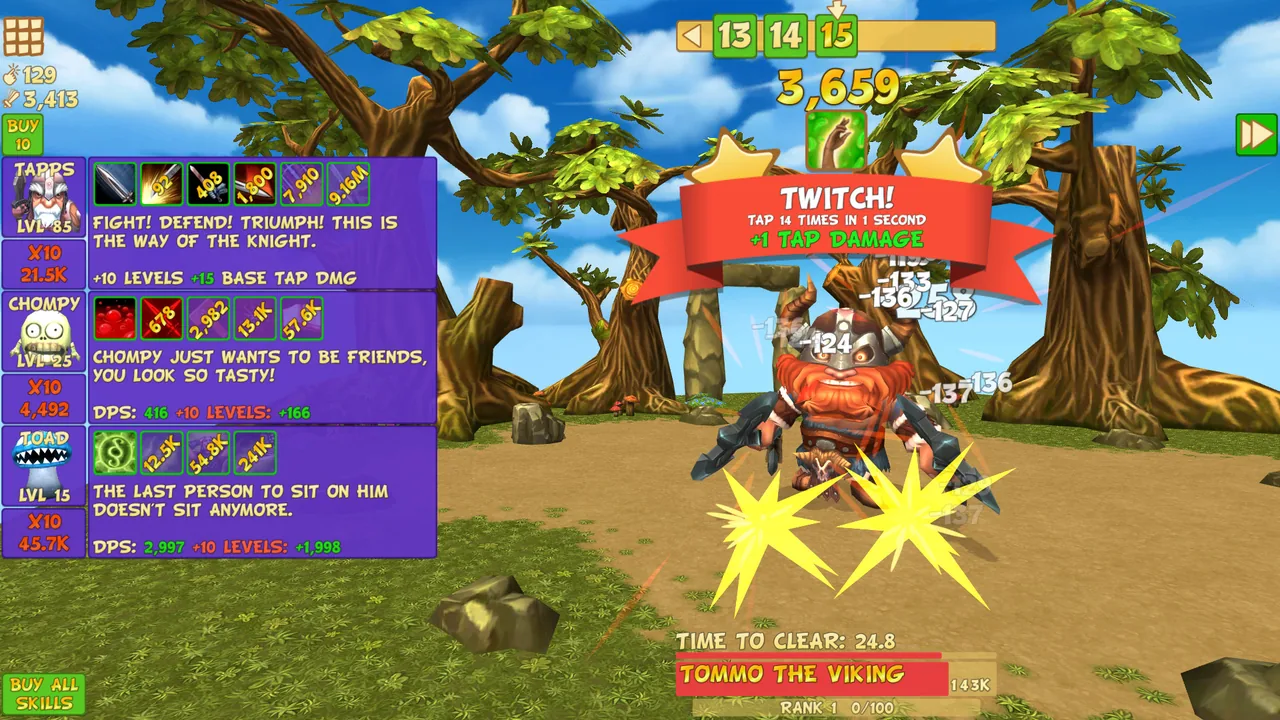
The comparison isn't subtle and the game doesn't pretend otherwise. Click monsters, watch gold drop, spend it hiring beaten heroes to auto-attack for you, push until your damage plateaus, then reset for a permanent multiplier and go again — that's Clicker Heroes' skeleton with a fresh coat of low-poly 3D paint over it. The most-upvoted negative review in the game's entire history (348 votes) makes exactly this point: "1 to 1 the same as Clicker Heroes, they didnt even bother changing the layout with the Level at the top." It's not an isolated complaint. Reading through the launch-week negatives, the overwhelming majority — 58 of the 100 most-upvoted negative reviews this game has ever received date to 2015 alone — are some version of "clone" or "rip-off," most from players who'd logged under two hours.
What makes this particular case unusual is that the developer got a public defense from the person best placed to object. Two weeks after launch, Scary Bee LLC's Steam announcement quoted Clicker Heroes' own developer, Fragsworth, from a Reddit thread: "the game progresses differently enough that I feel like they built it from scratch and used a lot of their own ideas to make it different without 100% mimicking everything in my game." That's a notably generous read from the one person with standing to be angry about it, and on the actual systems it's fair — Tap Tap Infinity's Rank-and-reset structure, its Boss Rush spell, and the way idle mode drops you out for only a few seconds on skill use rather than a full minute, are genuine departures once you're past the opening hour. But the opening hour is what most of those 2015 reviews were written from, and the shape underneath is close enough that "clone" is still the first word a fresh 2026 negative review reaches for — one recent one calls it, bluntly, "basically stolen."
A cash shop that keeps its promise
The part of Tap Tap Infinity that ages best is the part genre veterans usually distrust on sight. Soul Gems are the premium currency, spent on Soul Links (permanent account boosts) and on speeding up upgrades — the exact slot where most free-to-play idle games put their pressure. Here it doesn't. Free gems arrive steadily through in-game gifts, and the strongest evidence isn't a marketing line, it's the people who've actually tested it: a reviewer with 2,676 hours logged calls the shop "optional... even this 'premium currency' can be earned just by playing the game," one with 1,522 hours says it's "very fair and not required at all... outside of wanting to support the developer," and a third, at 2,552 hours, actively tells other players not to be afraid of the shopping cart button because the gems it sells are also just what free gifts hand out. None of that reads as astroturfing — it's the kind of specific, slightly technical endorsement that only shows up from players who've actually run the numbers over months of play. There's no ad break anywhere in the loop, no energy meter rationing how much you can do per session, and nothing behind a hard currency wall that blocks a free player from finishing the game outright.
It isn't flawless. One negative review flags a design trap worth taking seriously: a limited-time "Valentine Soul Link" that, if missed, makes a specific upgrade path to more free gems significantly harder to reach later. That's a real FOMO mechanic sitting inside an otherwise fair system, and it's the kind of thing a fresh 2026 install can't retroactively fix. But set against the genre's usual playbook — timers, energy caps, currency that quietly never quite covers what you need — Tap Tap Infinity's monetisation is closer to the honest end of the spectrum than the predatory one, and its most invested players are the ones saying so.
Progression that outlasts the clone label
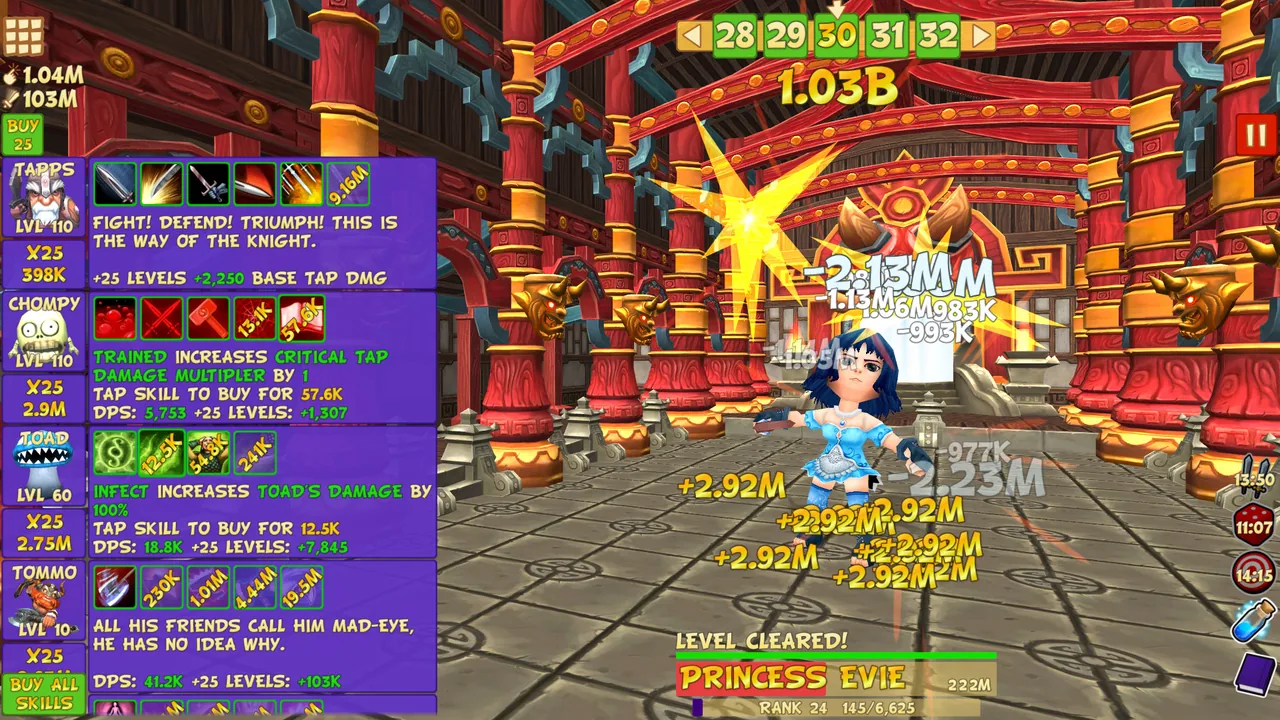
Underneath the launch-week noise, the systems that came after the opening hour hold up better than the "reskinned clone" reputation suggests. Ranks (a second reset layer stacked on top of zone progress), the Boss Rush spell, and a grid-mode hero display that several long-time Clicker Heroes players specifically call an improvement give the mid-game more texture than a pure copy would need. One 4,000-plus-hour reviewer, self-described as having cleared Clicker Heroes completely and gone looking for the next clicker to fill the gap, picked this one first among several alternatives launched the same night. Content runs deep enough to matter here too — one completionist review describes spending four to five months clearing the game's roughly 5,000 levels, helped along by regular free gifts and the Soul Link system rather than a purchase.
The tradeoff genre players will recognise immediately: this is still a long-haul idle game, and "free gifts every 30 minutes" plus offline earning means raw playtime figures in this review section measure something closer to how long a window sat open than how engaged anyone was — one review logs over 14,000 hours and describes it as something left running in the background between sessions of an unrelated game, not 1.6 years of continuous attention. Read the hour counts here as evidence the loop is worth leaving running, not literally worth watching.
A decade with the lights off
The single fact that should shape any 2026 recommendation is date-stamped and easy to verify: Scary Bee LLC's last announcement on this game's Steam page is from 25 September 2015, a routine "1.7.7 Live!" patch note. Nothing has followed it since — no bug fixes, no rebalance, no reply to the cloud-save complaints that surface periodically in the review history, one of which describes losing a save entirely after the developer "never got cloud save going before vanishing." That review is an outlier, not a pattern — most recent reviews don't mention save issues at all — but it's the kind of complaint that a supported game answers and an abandoned one just accumulates.
The game hasn't died in the sense of losing its audience entirely. It still draws a handful of concurrent players today, and its English review total has grown at a steady clip of roughly fifteen a year for the last several years rather than stopping dead after launch — sentiment in that recent trickle sits close to the lifetime average, not meaningfully better or worse. What has stopped is any development. The interface still draws "cluttered" and "terrible" complaints as recently as 2024, the low-poly monster models read as dated even to fans, and none of it is going to change. What you install today is precisely what existed in late 2015, running fine on modern hardware because it was never demanding to begin with, but permanently unfinished in whatever ways it was unfinished on the day Scary Bee LLC stopped answering.
Final verdict
Tap Tap Infinity earns real credit in one specific place: a free-to-play currency that its most dedicated players — the ones with the hours to have actually tested the alternative — say you genuinely don't need to touch. That's rarer than it should be in this genre, and it's worth something on its own. Everything else about the game is a decade-old snapshot of a Clicker Heroes tribute act, dated in its visuals, cluttered in its interface, and permanently stuck answering the same "is this a rip-off" argument its own inspiration's developer tried to settle back in 2015. Install it for a free, fair, background-running clicker. Just don't expect it to be anything other than what it already was.
Players who want a modern take on the same reset-for-power idea with active developer support might also want to check Wanderer's own progression systems, which keep advancing while you're away rather than sitting frozen at a single 2015 patch.
Pros and cons
Pros
- Soul Gems, the premium currency, are earned steadily through free in-game gifts, and multiple reviewers with thousands of hours logged confirm the cash shop is skippable entirely
- No ads, no energy meter, no forced daily login, and nothing behind a paywall that blocks forward progress outright
- Boss Rush and the Rank-reset system give the mid-game a second gear that Clicker Heroes, the game it's copying, didn't have at the time
- Runs comfortably on old hardware, and several reviewers specifically praise it for staying lag-free during heavy tapping
Cons
- The zone layout, hero roster shape and reset-for-power loop are close enough to Clicker Heroes that even that game's own developer had to publicly defend the differences in 2015
- Zero patches, balance changes or bug fixes since September 2015 — this is exactly the game it was at launch, for better and worse
- The interface still draws criticism as cluttered and dated, and the low-poly 3D monsters read as "grungy" even to reviewers who otherwise like the game
- A handful of long-time players report a broken or abandoned cloud-save promise, including one who says a save was lost outright waiting for it to be fixed
Screenshots
-
Tap Tap InfinityImage: Scary Bee LLC via Steam -
Tap Tap InfinityImage: Scary Bee LLC via Steam -
Tap Tap InfinityImage: Scary Bee LLC via Steam -
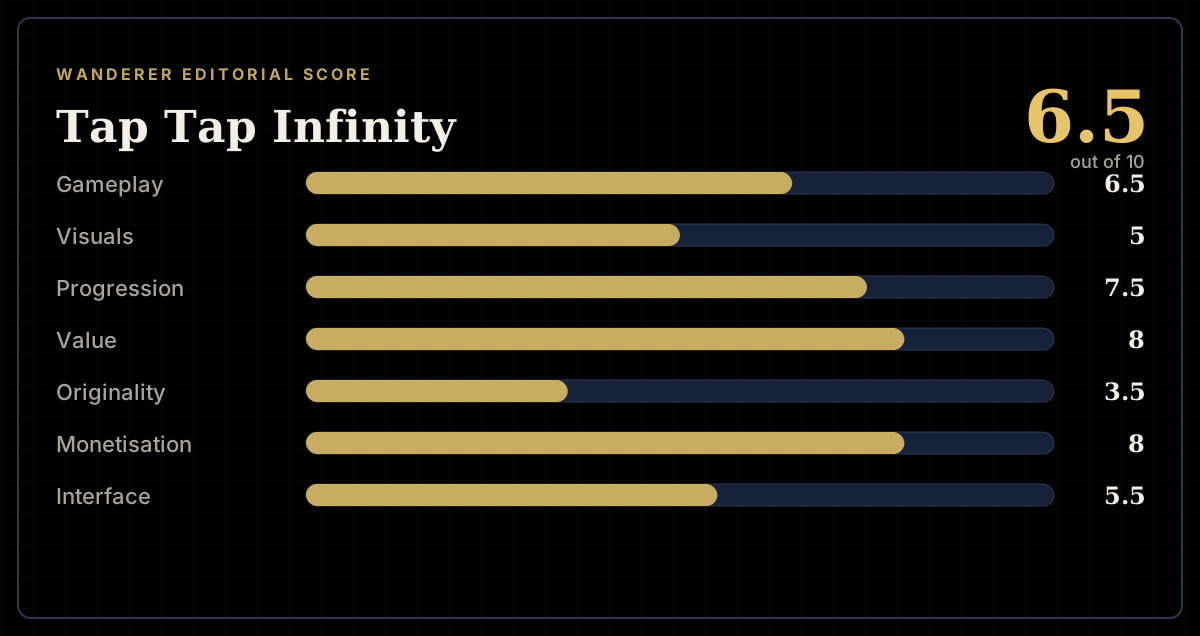
How the review scores each part of the gameWanderer Editorial -
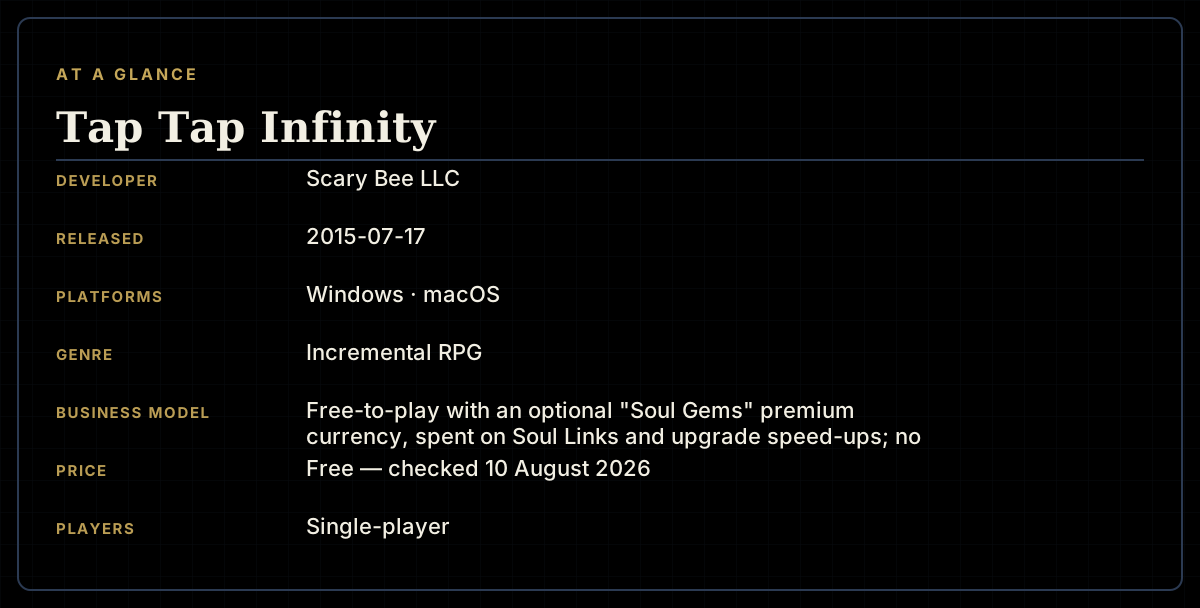
The short versionWanderer Editorial -
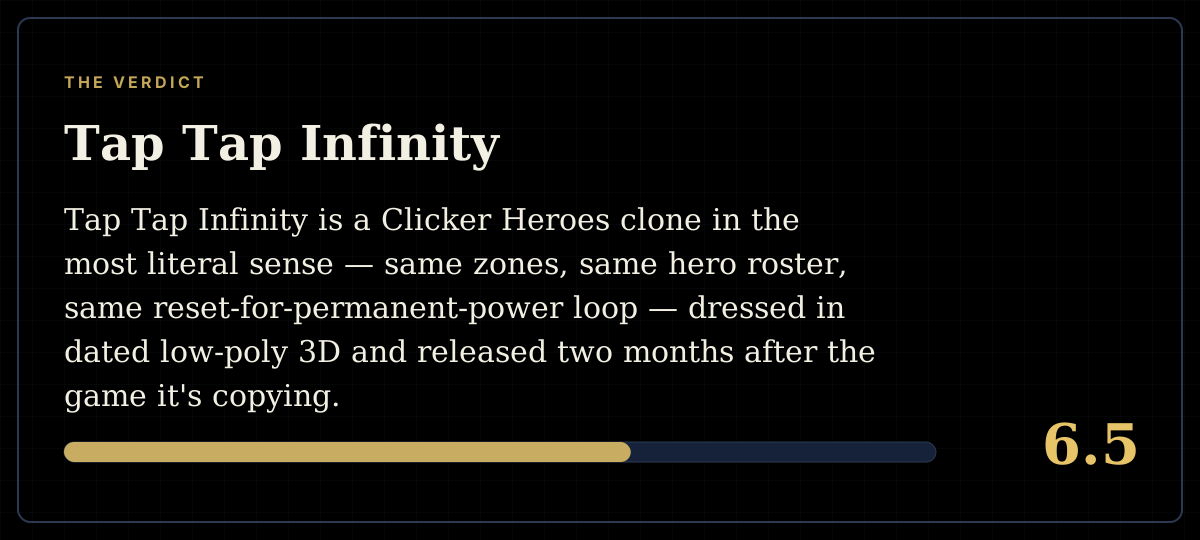
The final wordWanderer Editorial