Game review
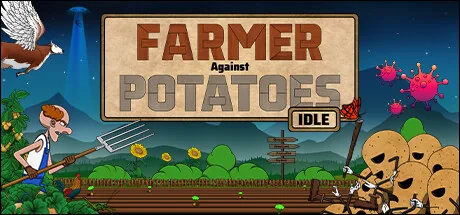
Farmer Against Potatoes Idle
7.5 / 10
- Developer
- Oni Gaming
- Publisher
- Oni Gaming
- Released
- 5 September 2024
- Platforms
- Windows, Android, iOS
- Genre
- Idle RPG
- Monetisation
- Free to play with an optional premium currency (Souls) earnable through play or bought in packs; Souls buy Soul Shop upgrades, potions and pet tokens, none of which are required to reach the game's late systems
- Players
- Mostly single-player, with optional asynchronous seasonal events where players deal damage to a shared community boss for leaderboard rewards
The short version
Farmer Against Potatoes Idle hides a genuinely deep prestige structure — Ascension, Reincarnation and six classes stacked on top of a talent tree and a two-million-combination item system — behind a title that sounds like a joke and an art style that plenty of players actively dislike. What earns it a 95% approval rating on Steam isn't the premise, it's the follow-through: the premium currency is genuinely optional, two years of Early Access turned into more than a year of steady post-launch patches, and the progression curve keeps handing out new decisions long after most free idle games have run out of ideas.
It's held back by an interface that even fans of the game complain about, and by a pacing problem in the deep hours where real-time walls get long enough that some players reach for third-party speed tools rather than wait them out.
Biggest strengths
- Ascension and Reincarnation build a real long-term prestige loop instead of a single flat reset, and six classes give each cycle a different shape
- The premium currency drops from daily quests and the Whack-a-Potato minigame, and nothing endgame-relevant is locked behind it
- Talent points can be freely reallocated, so experimenting with a build never costs a permanent mistake
Biggest weaknesses
- The interface is dense, under-explained and a frequent target of negative reviews even from players who otherwise recommend the game
- Some stretches of the mid-to-late game slow to real-time waits long enough that players openly discuss using cheat engines to skip them
- The early tutorial forces click-throughs before the systems make sense, which has cost the game reviews from players who never got past it
Who it's for: Idle RPG players who want real prestige-layer depth without a subscription or an aggressive shop, and anyone burned by pay-gated idle games who wants to see the free-and-fair end of the genre.
Our recommendation: Worth installing on the strength of the price alone — nothing meaningful is locked behind payment. Go in expecting a genuinely cluttered menu system and a mid-game slowdown, not a polished five-minute distraction.
7.5 / 10
There is a specific joke buried in the title, and Oni Gaming never lets you forget it: this is a game about a farmer, fighting potatoes, and it is idle. Nothing about that premise suggests a system worth analysing. And yet Farmer Against Potatoes Idle sits at roughly 95% positive across more than 8,000 Steam reviews, a number that would be respectable for a full-price game and is genuinely unusual for a free one — free games accumulate refund-proof one-star reviews from players who never intended to stay, and idle games in particular tend to collect complaints about monetisation the moment a currency wall shows up. FAPI mostly avoids both problems, and the reason is worth digging into, because it isn't the combat and it isn't the writing. It's the amount of honest, patient system design sitting underneath the silly title.
A wave-clear loop that exists to justify everything else
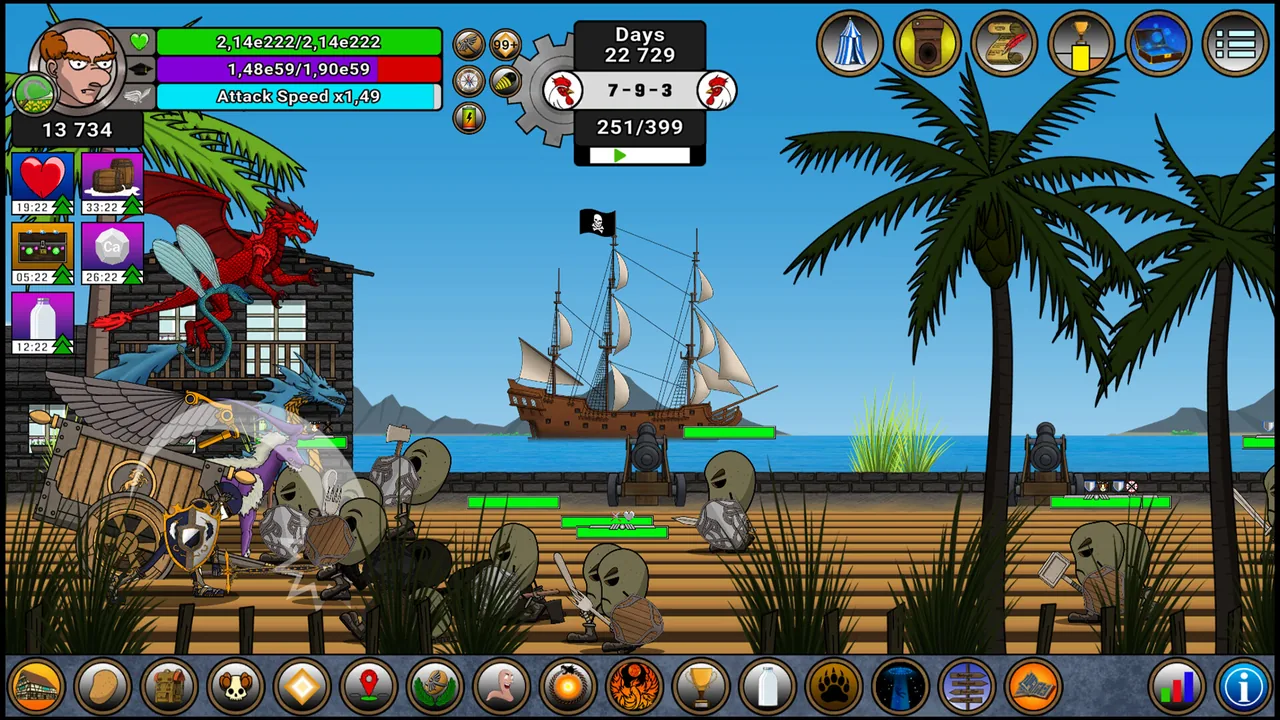
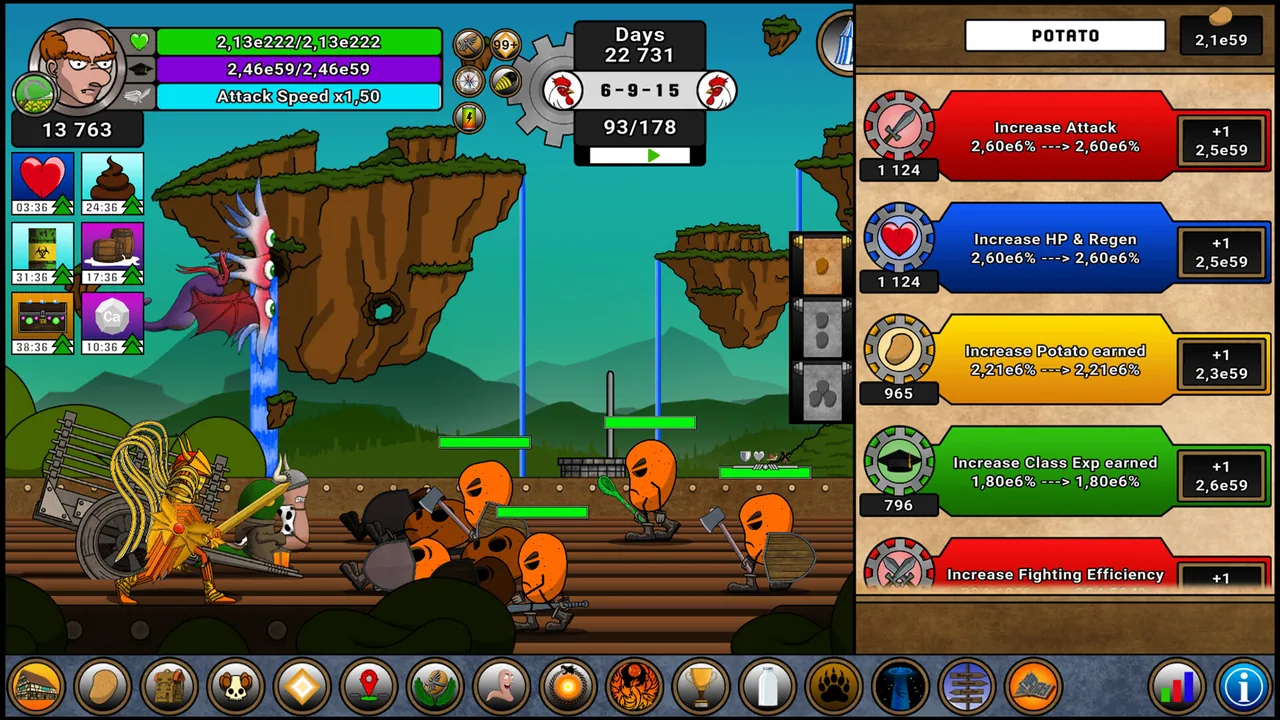
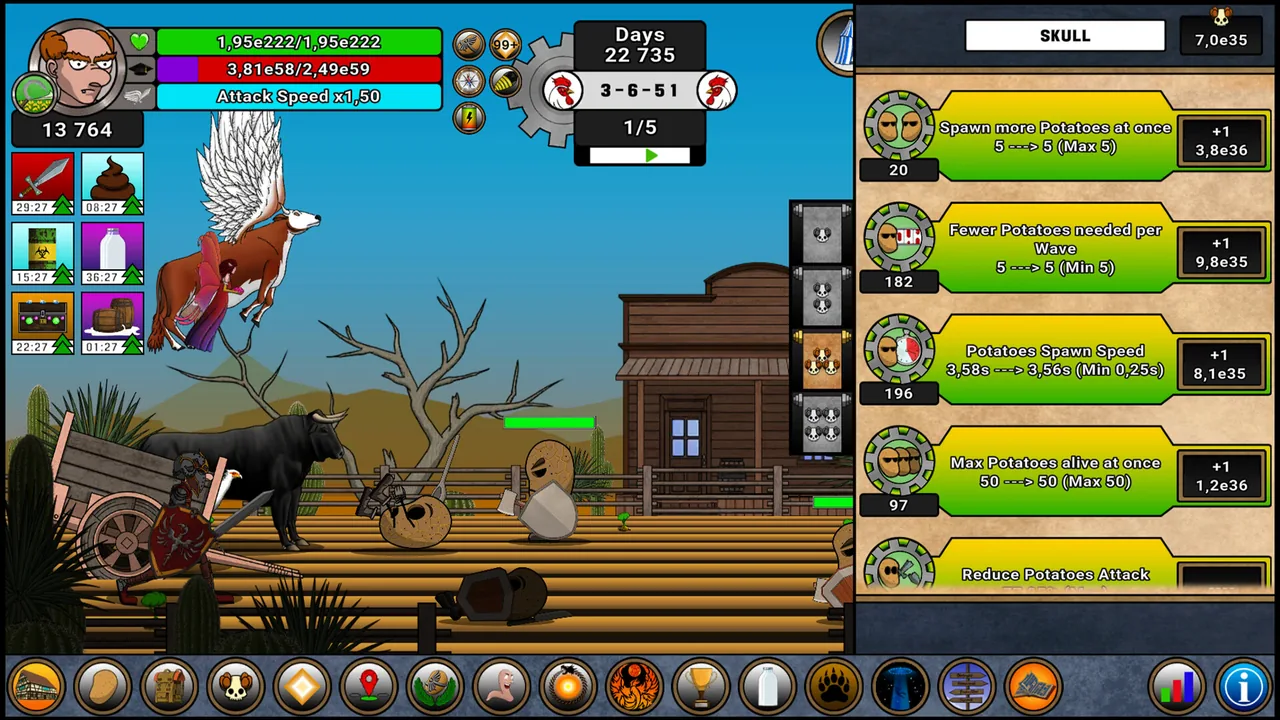
Strip away the meta-systems and the moment-to-moment game is simple by design: the farmer auto-attacks waves of potato enemies across five worlds broken into nine areas of 100 waves each, with two difficulty settings per area. Two early currencies, Potatoes and Skulls, fund more than thirty stat and debuff upgrades before the game's deeper systems open up. None of that is mechanically interesting on its own — there's no positioning, no timing window, no combat decision beyond "is my build strong enough for this wave yet." That's a deliberate trade familiar from the idle genre's biggest names: the combat is a resource check dressed up as a fight, and the real game is what you spend on it.
What keeps that from feeling thin is how much sits on top. A talent tree that's fully visible from the start and freely respecable lets players commit to a build without fear of wasting hours on a dead-end choice — a small design decision that removes most of the genre's classic early-game anxiety. A Whack-a-Potato minigame, structurally a straightforward whack-a-mole, hands out timed buffs and premium currency for a few minutes of active attention between idle stretches, giving the game something to do that isn't just watching numbers climb.
Ascension, Reincarnation, and six ways to start over
The system that actually earns FAPI its reputation is the prestige structure stacked two layers deep. Ascension resets active progress in exchange for permanent bonuses and unlocks, the standard idle-genre reset — but Reincarnation sits above it and lets players change between six classes, each built around a different talent focus and a different stat growth curve. That's a genuinely different design decision from most competitors' single flat prestige currency: instead of every reset just making the same build stronger, Reincarnation periodically hands players a reason to rebuild from a different angle entirely. Layer the item system on top — equipment with rating, enhancement levels and bonus-chance rolls that combine into millions of possible outcomes per slot — and the amount of decision space here comfortably exceeds what most free idle RPGs bother building, let alone give away for nothing.
The trade-off is that none of this explains itself well. Ascension and Reincarnation interact in ways the game expects players to work out from wikis and community guides rather than in-game text, and a new player dropped into the talent tree with no context has a rough first hour. That friction shows up directly in the review data — a specific and recurring complaint is that the early tutorial forces click-throughs on systems before there's any reason to understand them, costing the game reviews from players who bounced before the interesting decisions arrived.
An interface that undersells its own depth
This is the review's biggest asterisk, and it's a consistent one across player feedback rather than an isolated complaint. FAPI's menus are dense, numerous and short on explanation — stat screens, gem systems, loadouts and shop tabs all compete for space with minimal visual hierarchy, and even reviews that ultimately recommend the game frequently flag the UI as the thing they'd fix first. That's a real cost for a game whose actual value proposition is depth: a menu-heavy idle game lives or dies on whether players can quickly understand what a given upgrade does, and FAPI regularly asks players to guess, then check a wiki, then come back. It doesn't sink the experience — the systems underneath are worth the friction for players willing to push through — but it's a legitimate and repeated weakness, not a matter of taste the way the cartoon art style is.
The art itself is a smaller, more divisive issue. It's consistent and has its own identifiable look, but it's not to everyone's taste, and a meaningful slice of negative reviews cite it specifically as a reason they bounced off early. Unlike the interface, that one's genuinely subjective — some players find the exaggerated, cartoonish style part of the game's charm.
Souls, and the shop that doesn't lock the door
Free-to-play idle games earn their reputations from their shop as much as their systems, and this is where FAPI does its best work. The premium currency, Souls, buys upgrades, potions and pet tokens through the in-game Soul Shop, and it can be purchased in packs — a Starter Pack, tiered Potion Packs, Soul Bags running from a few dollars up toward the low twenties, a Power Pack and Pet Token bundles, priced modestly by mobile free-to-play standards. Critically, Souls also drop from playing: daily quests and the Whack-a-Potato minigame both hand them out for free, and nothing that gates access to the game's core Ascension, Reincarnation or item systems sits behind a paywall. Player sentiment backs this up consistently — "barely any microtransactions" and "no p2w" are recurring phrases in the review data, and it's an earned reputation rather than marketing language, since the systems that actually matter for long-term power are earnable through the same loops a non-paying player is already running.
The honest caveat, and one some free-to-play players raise themselves, is that the free rate of Soul accumulation is slow by design — reaching every Soul Shop upgrade without spending is a matter of months or years, not weeks. That's not pay-to-win in the meaningful sense the term implies: nothing sold provides a competitive edge in a game with no PvP, and nothing sold bypasses a wall that a patient free player can't eventually clear through the same systems everyone else uses. It is, more precisely, a patience tax rather than a progress gate, and that's a fair distinction that a lot of free idle games don't earn.
The walls, and why some players reach for a cheat engine
Where the design gets harder to defend is pacing in the deep hours. A recurring pattern in player feedback, distinct from the interface complaints, describes hitting stretches — particularly around specific Ascension tiers — where progress slows to real-time waits measured in days rather than active decisions, to the point that some long-tenured players openly discuss using third-party cheat-engine tools to compress that waiting rather than treat it as intended pacing. That's a meaningfully different problem from Melvor Idle's late-Mastery plateau or Idle Skilling's smaller-scope ceiling: those games run out of new decisions, while FAPI's complaint is closer to the opposite — the decisions are still there, but the clock between them stretches past what active or even generous offline progression comfortably covers. A wall that's long enough to send committed players looking for a workaround is a pacing problem the game hasn't fully solved, even if it only shows up deep into the systems most players never reach.
Save reliability is a smaller but real concern in the same category. A subset of long-time players have reported losing substantial progress to cloud-sync failures between devices, which is a serious complaint in any idle game where the entire value proposition is that time invested stays invested. It doesn't appear to be the dominant experience — the overall review sentiment stays comfortably in Very Positive territory — but it's present often enough in recent feedback to flag rather than dismiss as a one-off.
Still being built, three years in
FAPI spent two years in Steam Early Access before reaching 1.0 in September 2024, and the pace hasn't slowed since — balance and bug-fix patches were still landing in early 2026, addressing Ascension point refunds, gem drop-rate tuning and platform-specific save issues, alongside a larger "Transcendence" update reported to be testing new multiplayer systems on top of the existing seasonal community boss events, where players already deal damage to a shared target for leaderboard rewards rather than fighting in real time together. For a free game with no subscription and a genuinely optional shop, that level of sustained post-launch investment is the strongest possible argument for treating this as a long-haul commitment rather than a novelty worth a week of attention before it's abandoned.
Verdict
Farmer Against Potatoes Idle earns its unusually strong reception by doing the unglamorous half of free-to-play idle design correctly: the premium currency doesn't gate anything essential, the prestige structure is deep enough to keep handing out real decisions well past the point most competitors run dry, and the developer has kept supporting the game for years rather than launching it and moving on. Those are the things that actually decide whether a free idle game is worth a long-term investment, and FAPI clears that bar convincingly.
It doesn't clear the bar on presentation. The interface is a legitimate, widely-shared complaint rather than a nitpick, the tutorial's early friction costs it players before the good systems arrive, and the real-time walls in its deeper hours are long enough that some of its most committed players are reaching for tools the developer never intended them to need. None of that erases what's underneath, but it's enough to keep this out of the genre's very top tier.
Anyone curious whether a free idle game can be trusted not to nickel-and-dime its way through a prestige system should start here. Just go in ready to fight the menus for the first hour before the game starts explaining why it's worth the fight.
Pricing and monetisation checked 30 July 2026.
Players who'd rather have their progression carry across a persistent world with other people in it, rather than a solo Ascension counter, might find Wanderer scratches a similar number-goes-up itch without the shop screen.
Pros and cons
Pros
- Ascension and Reincarnation build a real long-term prestige loop instead of a single flat reset, and six classes give each cycle a different shape
- The premium currency drops from daily quests and the Whack-a-Potato minigame, and nothing endgame-relevant is locked behind it
- Talent points can be freely reallocated, so experimenting with a build never costs a permanent mistake
- Oni Gaming has kept shipping balance patches and bug fixes well into 2026, over three years after Early Access began
- The item system's rating, enhancement and bonus rolls create meaningful equipment decisions rather than a single upgrade path
Cons
- The interface is dense, under-explained and a frequent target of negative reviews even from players who otherwise recommend the game
- Some stretches of the mid-to-late game slow to real-time waits long enough that players openly discuss using cheat engines to skip them
- The early tutorial forces click-throughs before the systems make sense, which has cost the game reviews from players who never got past it
- Save syncing between devices has been unreliable enough that some long-time players have reported losing hundreds of hours of progress
- The cartoon art style is a specific, divisive look that a meaningful share of Steam reviewers say they can't get past
Screenshots
-
Farmer Against Potatoes IdleImage: Oni Gaming via Steam -
Farmer Against Potatoes IdleImage: Oni Gaming via Steam -
Farmer Against Potatoes IdleImage: Oni Gaming via Steam -
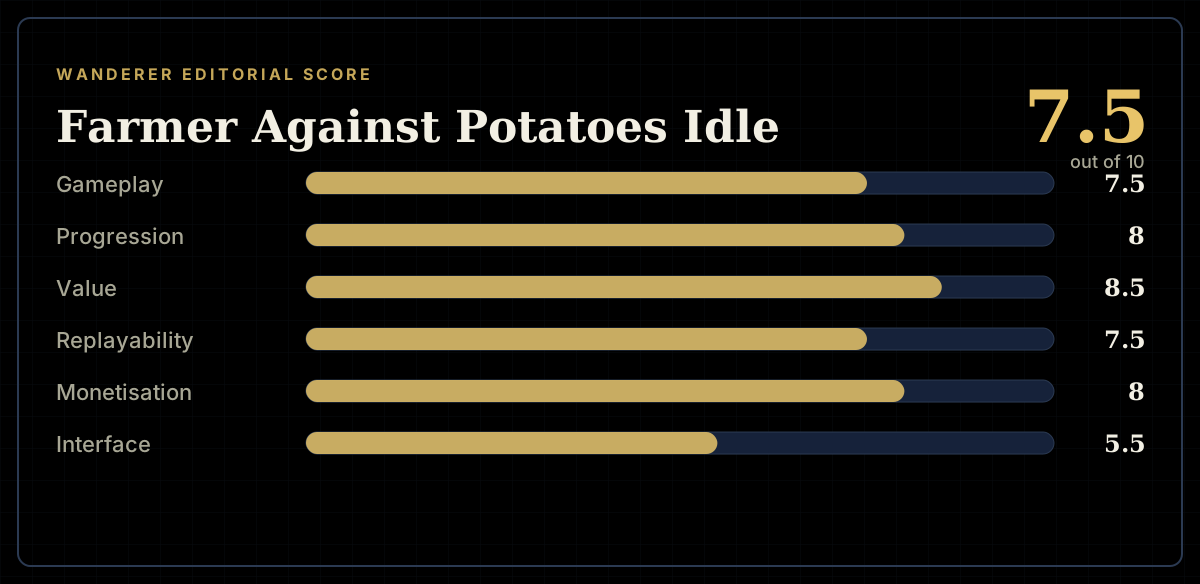
How the review scores each part of the gameWanderer Editorial -
The short versionWanderer Editorial