Game review
Clicker Heroes
7 / 10
- Developer
- Playsaurus
- Publisher
- Playsaurus
- Released
- 13 May 2015
- Platforms
- Browser, Windows, macOS, iOS, Android, PlayStation 4, Xbox One, Nintendo Switch
- Genre
- Incremental RPG
- Monetisation
- Free-to-play with an optional "rubies" premium currency and six cosmetic auto-clicker pet DLCs on Steam; no paywalled Ancients, heroes or zones
- Players
- Single-player
The short version
Clicker Heroes is the game that taught the idle genre to stop caring about the click. Its ascension loop, Hero Souls and the Ancients tree they buy are the direct ancestors of the reset-for-permanent-power systems every idle RPG now ships with, and the free-to-play model underneath them is still one of the fairer ones in the genre.
What it hasn't kept up with is everything built on top of that foundation since. The Ancients layer wants a spreadsheet before it wants a decision, the interface is a decade past its prime under a fresh coat of Unity paint, and years of dormancy while Flash quietly died around it left the game feeling more preserved than developed. It's a genuinely important piece of the genre's history and a perfectly playable free game today — just not the best version of the idea it invented anymore.
Biggest strengths
- Ascension into Hero Souls into the Ancients tree is the direct template nearly every later idle RPG's prestige system copied
- Free-to-play without a single Ancient, hero or zone locked behind rubies, unusually restrained for the genre
- Boss timers every few zones force an active decision point instead of letting the whole game passively scroll by
Biggest weaknesses
- Endgame Ancient leveling involves enough interacting multipliers that most serious players end up on a third-party calculator to plan a build
- Visual presentation has barely moved since the Flash era; the 2023 engine swap preserved the look rather than modernising it
- The midgame stretch between early ascensions and the Transcendence layer often reduces to holding down the mouse and waiting for a bigger number
Who it's for: Idle-game players who want to see where the "ascend, then optimise a permanent upgrade tree" template actually came from, and anyone who wants a free, low-pressure incremental to leave running in a background tab without a payment prompt ever forcing the issue.
Our recommendation: Play it free on Steam or in browser. Don't buy the rubies or the auto-clicker DLC pets until you know you're staying — none of it is required to see the game's best ideas, and the endgame Ancients math will eventually push you toward a community calculator whether you paid a cent or not.
7 / 10
Long before "idle RPG" was a Steam tag with its own storefront shelf, Clicker Heroes was already asking a question the rest of the genre spent the next decade answering: what happens once the player stops clicking? Cookie Clicker had shown that automation could carry a number-go-up game on its own. Clicker Heroes, arriving a year later, wrapped that idea in an RPG skin — heroes, zones, bosses, a permanent-upgrade tree bought with a currency you only earn by starting over — and in doing so wrote most of the rulebook the idle RPG genre still runs on. Its own developer mostly stopped adding to that rulebook years ago. The game just kept running.
Ascension, not just automation
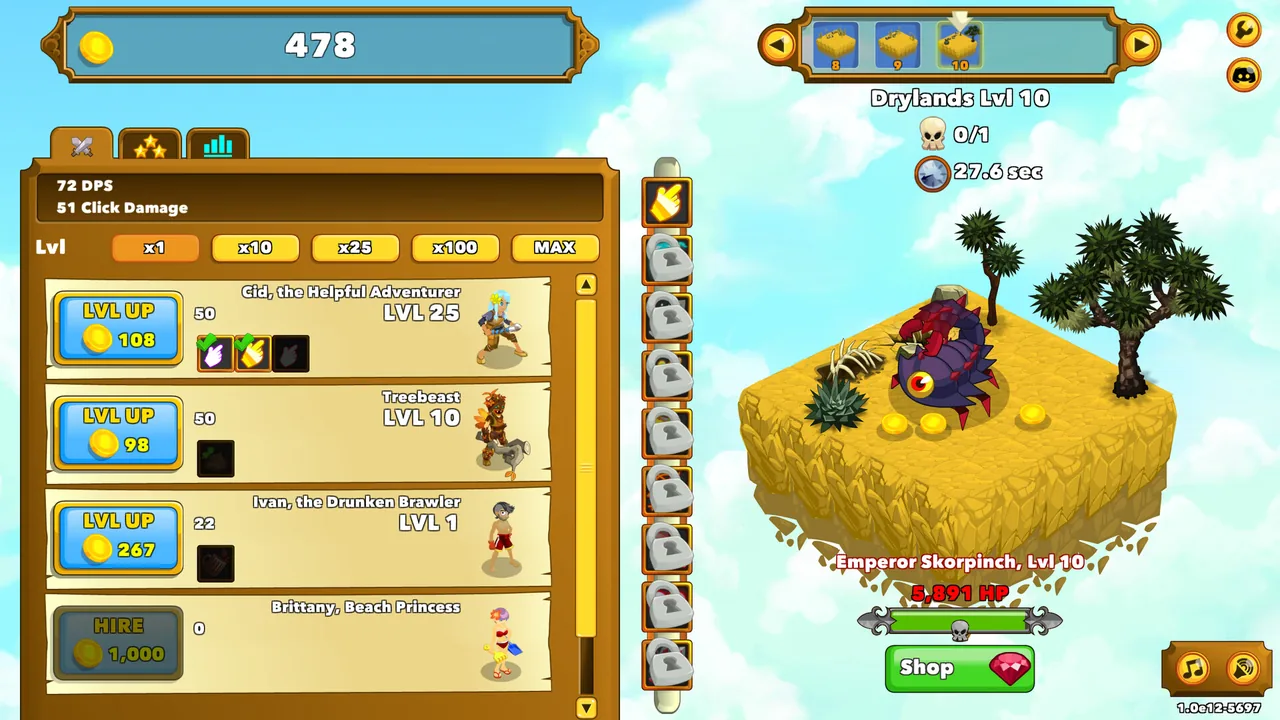
Clicker Heroes' core loop reads simply enough on the surface: click a monster, watch gold drop, spend gold hiring one of 35 heroes — Athena, King Midas and company — who then fight for you without another click required. Every fifth zone or so throws up a boss with a visible countdown; kill it in time and the run continues, let it flee too many times and it gets meaner, and either way that timer is the one moment in an otherwise idle stretch where the game asks you to actually pay attention rather than let numbers scroll.
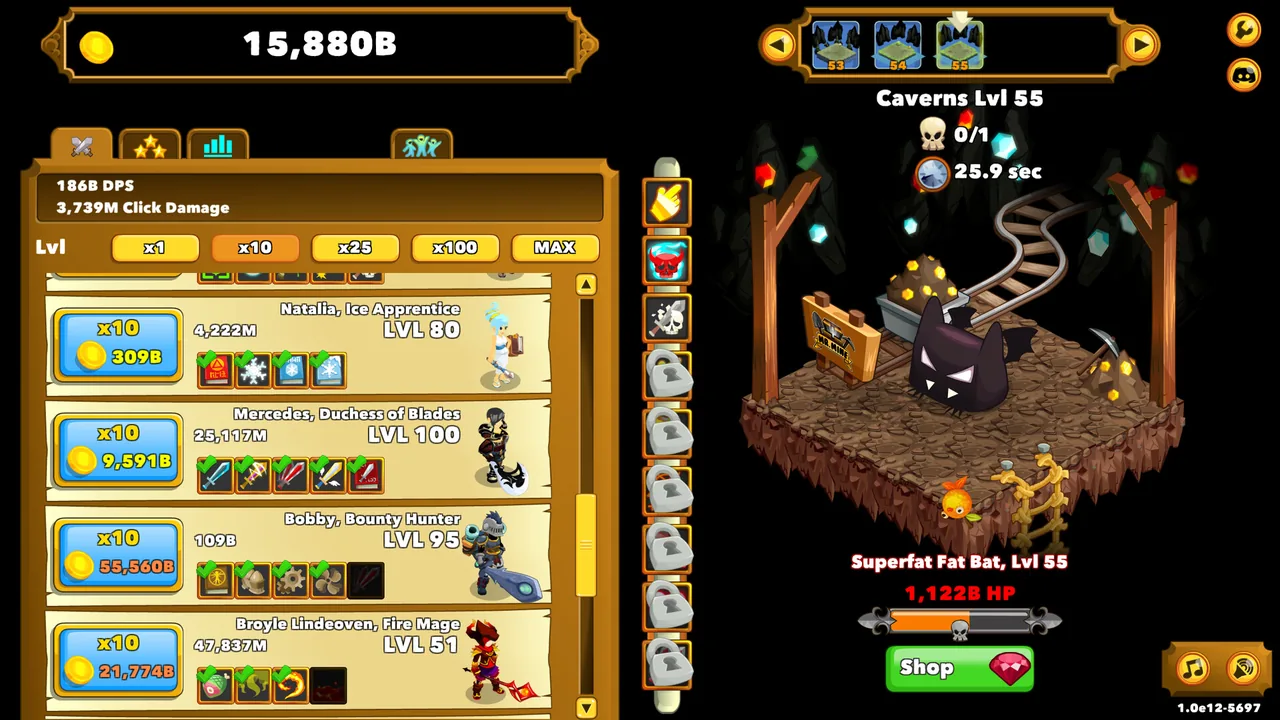
The part that mattered for the genre came after that loop stopped working. Push far enough and your heroes' damage output plateaus against the next zone's health pool, and the only way forward is to Ascend — reset every hero, every level, every zone gained — in exchange for Hero Souls, a currency that only exists because you gave up your run. Hero Souls buy Ancients: permanent, run-spanning multipliers to click damage, hero damage, gold find, hero-hiring cost and dozens of other levers, purchased with souls and never lost to a future ascension. That's the whole trick, and it's the one nearly every idle RPG built afterward has borrowed in some form: progress until you can't, reset on purpose, spend what the reset earned on something permanent, repeat with a higher ceiling each time. Melvor Idle's mastery pools, Idle Champions' ascension bonuses, even Wanderer's own persistent gathering skills owe something to a structure Clicker Heroes normalised before most of them existed. Layer a second reset on top — Transcendence, unlocked once a save is deep enough, which resets ascension progress itself for Ancient Souls that upgrade a separate tier of Outsiders — and you get the shape almost every "prestige within a prestige" idle game has since copied wholesale.
None of that is subtle design, and it isn't meant to be. What made it land in 2014 was how cleanly it separated "things I do because I want to" from "things the game does for me while I'm not looking," at a moment when most of the genre's ancestors — including Cookie Clicker itself — were still built primarily around the click. Clicker Heroes didn't invent idling. It made idling feel like the actual game, and clicking like the optional part.
The Ancients tree that needs its own spreadsheet
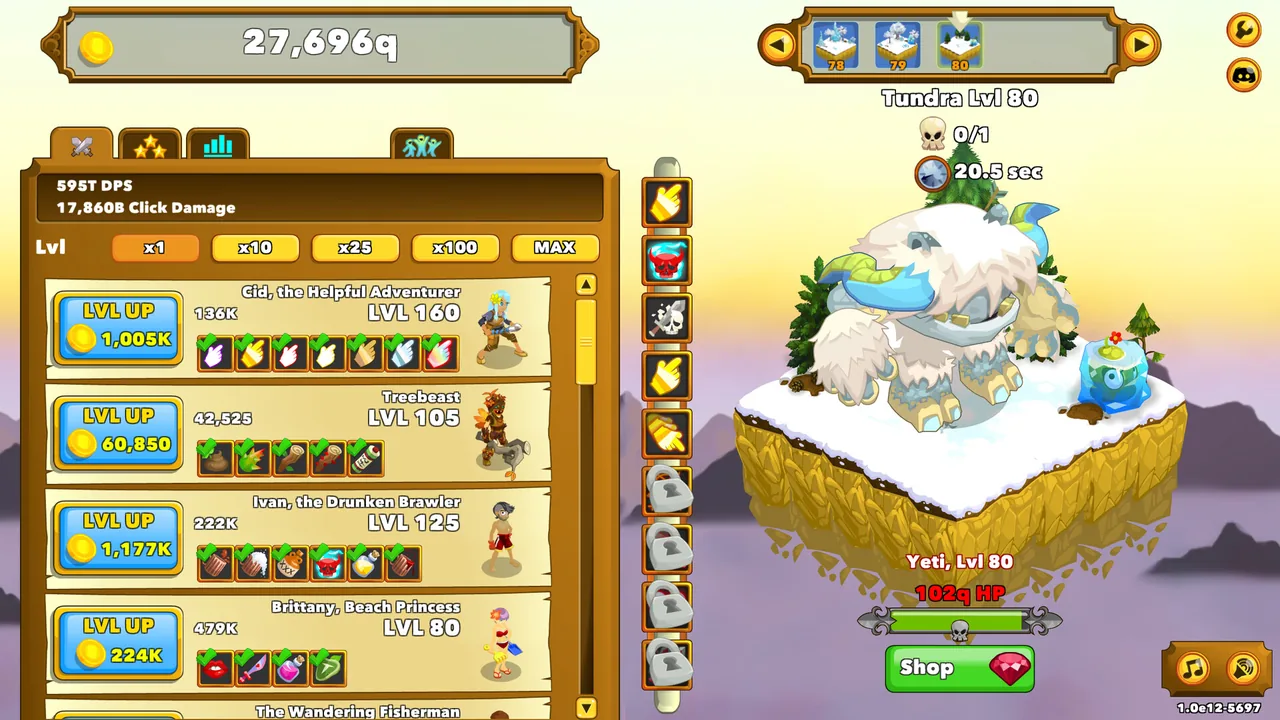
Where that design ages worse is in exactly the system it's remembered for. Buying an Ancient is a simple transaction — spend souls, raise a level, get a bigger multiplier — but the Ancients interact with each other in ways the game itself never fully explains. Some scale hero damage, some scale gold, some reduce the cost of leveling other Ancients, some reduce the cost of hiring heroes in a way that compounds with gold-generation Ancients in a completely different curve than either looks like in isolation. Getting the leveling order wrong doesn't ruin a run, but it does leave real progress on the table in ways that are invisible until a much later ascension shows the gap. The practical result, well known to anyone who's spent real time with the game, is that serious players stop guessing and start consulting a community-built calculator that tells them which Ancient to level next for a given soul budget. That's not necessarily a design failure — some players enjoy exactly that kind of optimisation puzzle, and the tools exist precisely because the community found the math worth solving. But it's a genuine barrier for anyone who wants to just play the game the way its opening hours suggest they can, and it's the clearest evidence that the Ancients tree was built by iterative addition over years rather than designed as a coherent whole from day one.
Nine years mostly frozen, then a scramble to survive
The honest history here matters more than usual, because it explains a lot about how the game feels today. Clicker Heroes launched as a Flash browser game on Kongregate in August 2014, reached Steam in May 2015, mobile that August, and PlayStation 4 and Xbox One in March 2017 — and then, for the better part of a decade, its core systems barely changed. When Adobe killed Flash at the end of 2020, Clicker Heroes' browser version simply stopped being playable, and even the Steam release — built on the same aging Flash-derived tooling under the hood — was running on borrowed time. The game spent roughly two years in that state before Playsaurus relaunched the browser version on CrazyGames in September 2022, and it wasn't until a public beta in late 2023, followed by a "beyond just an update" patch in December 2023, that the whole game was finally ported off Flash onto a modern engine. The patch notes for that port were explicit that the goal was compatibility and stability, not a redesign — "the game should be mostly the same experience," in Playsaurus's own words at the time.
That's the shape of Clicker Heroes' last decade: survival infrastructure work, not creative iteration. There's been a real uptick in attention since — a free Nintendo Switch release in October 2025, and a June 2026 update finally bringing proper controller remapping and Steam Deck support alongside cross-save between the Steam and web versions — but that's platform reach, not new Ancients, new zones or a reworked endgame. Meanwhile the sequel that might have replaced it, Clicker Heroes 2, entered Steam Early Access in 2018 as a paid, non-free departure from the original's model, never found its footing with players, and was discontinued, leaving the 2014 original as the only version of this idea Playsaurus still actively supports. If you're looking for a bigger, more modern Clicker Heroes to graduate into once you've mastered this one, it doesn't exist.
What the rubies actually buy
Clicker Heroes deserves real credit on the one front idle games most often fail: it was free before free-to-play idle games made a habit of gating basic progression, and it's stayed that way. Rubies, the premium currency, buy convenience and quality-of-life — things like accelerated progress items, cosmetic flourishes and inventory conveniences — not Ancients, not heroes, not access to zones, and not a shortcut past Transcendence. Every meaningful power source in the game is earned through play, and Playsaurus has been consistent about keeping it that way since rubies were added partway through the game's life rather than baked in from day one.
The Steam storefront layers six optional DLC packs on top — Zombie, Turkey, Red-Nosed Clickdeer, Boxy & Bloop, Unicorn and Whelpling "Auto Clickers," each around NZ$14.75 as of 30 July 2026. These are cosmetic pets that click on the player's behalf, which is a genuinely funny thing to sell in a game whose entire pitch is that you don't need to click — and a fair one, since idle output from heroes dwarfs manual clicking at any meaningful zone depth anyway. It's monetisation aimed at players who've already decided they like the game enough to decorate it, not a lever pulled on anyone trying to progress. Compared to the mobile idle RPG norm of energy timers, gacha pulls and pay-gated content tiers, Clicker Heroes' model is close to the fairest thing the genre offers.
Is it worth starting in 2026
That depends entirely on what you're looking for. As a piece of idle-genre history, Clicker Heroes is close to essential — it's the game that proved a full RPG skin could sit comfortably on top of an idle-automation loop, and everything from Melvor Idle's skill trees to Wanderer's own away-from-keyboard progression sits somewhere downstream of the reset-for-permanent-power idea it popularised. As a game judged purely against 2026's field, it's a harder recommendation: the visual presentation hasn't meaningfully moved since 2015, the interface groans under the weight of dozens of stacked multipliers the way genre veterans have since learned to avoid, and the years spent on survival maintenance rather than design work show in a midgame that leans on patience more than decisions. Set beside Cookie Clicker — the other free clicker still actively shipping content in 2026 — Clicker Heroes comes off as the more structurally important game and the less currently cared-for one; Cookie Clicker's studio kept building new minigames onto its foundation for over a decade, while Playsaurus mostly kept Clicker Heroes' lights on and moved its creative energy elsewhere.
None of that makes it a bad way to spend a free afternoon. It costs nothing, asks nothing of you financially to see its best ideas, and the ascension-into-Ancients loop that made it matter in 2014 still delivers the same basic satisfaction it always did. Just go in knowing you're visiting a landmark, not touring the genre's current state of the art.
Verdict
Seven out of ten. Clicker Heroes earns real credit for a contribution that's easy to take for granted now precisely because it worked: the ascension loop, Hero Souls and the Ancients tree it funds are load-bearing pieces of the modern idle RPG, and the free-to-play model built around them has aged into one of the more honest monetisation setups the genre has to offer. It loses ground on everything that isn't that core loop — a dated interface, an endgame that all but requires outside tools to plan properly, and a decade where the game survived rather than grew, culminating in a sequel that didn't make it and a scramble to keep the original alive once Flash died under it. Start here to understand where the genre's most common systems came from. Don't expect the sharpest version of them still being made.
Pricing, platform availability and Steam review data checked 30 July 2026.
Pros and cons
Pros
- Ascension into Hero Souls into the Ancients tree is the direct template nearly every later idle RPG's prestige system copied
- Free-to-play without a single Ancient, hero or zone locked behind rubies, unusually restrained for the genre
- Boss timers every few zones force an active decision point instead of letting the whole game passively scroll by
- Recent Unity engine port and Switch launch kept a nine-year-old Flash game genuinely playable rather than letting it rot
- Full controller and Steam Deck support added in 2026 makes the couch or handheld version a real option, not an afterthought
Cons
- Endgame Ancient leveling involves enough interacting multipliers that most serious players end up on a third-party calculator to plan a build
- Visual presentation has barely moved since the Flash era; the 2023 engine swap preserved the look rather than modernising it
- The midgame stretch between early ascensions and the Transcendence layer often reduces to holding down the mouse and waiting for a bigger number
- A near-decade of minimal updates, followed by an emergency port forced by Flash's death, left the design frozen well past the point competitors caught up
- Clicker Heroes 2's discontinuation means there's no bigger, better-supported version of this game to graduate into
Screenshots
-
Clicker HeroesImage: Playsaurus via Steam -
Clicker HeroesImage: Playsaurus via Steam -
Clicker HeroesImage: Playsaurus via Steam -
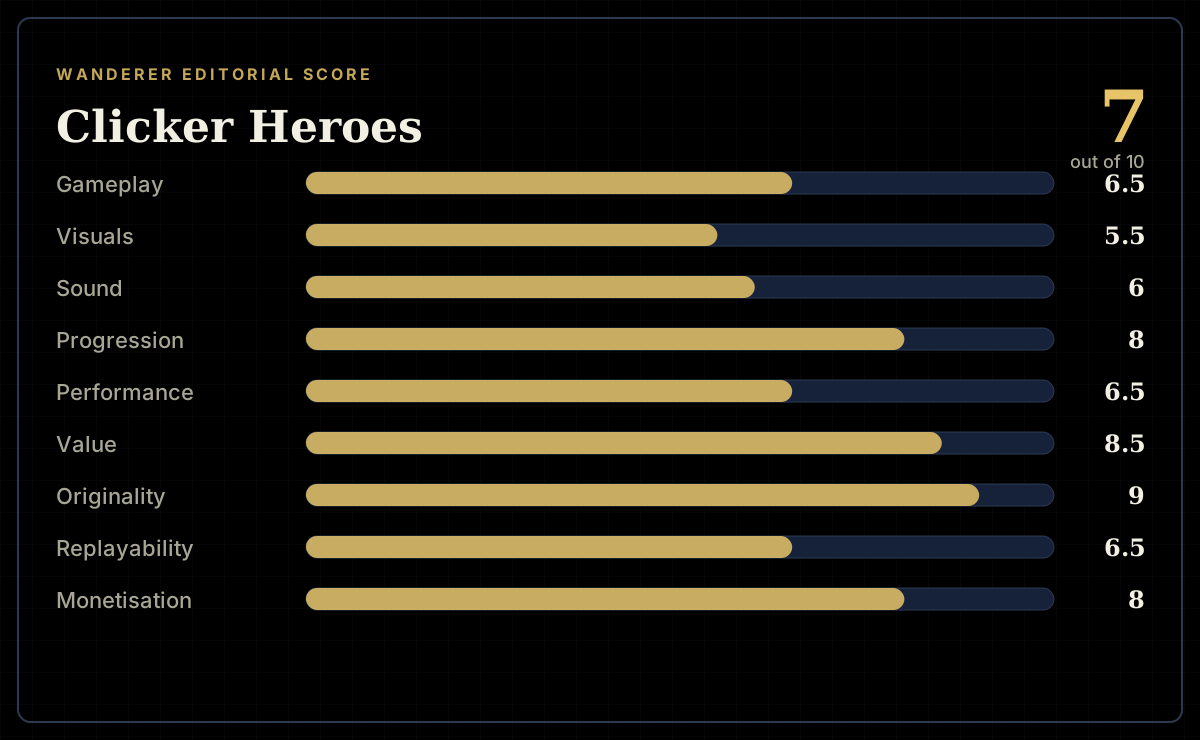
How the review scores each part of the gameWanderer Editorial -
The short versionWanderer Editorial