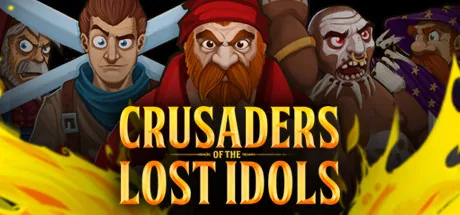
Game review
Crusaders of the Lost Idols
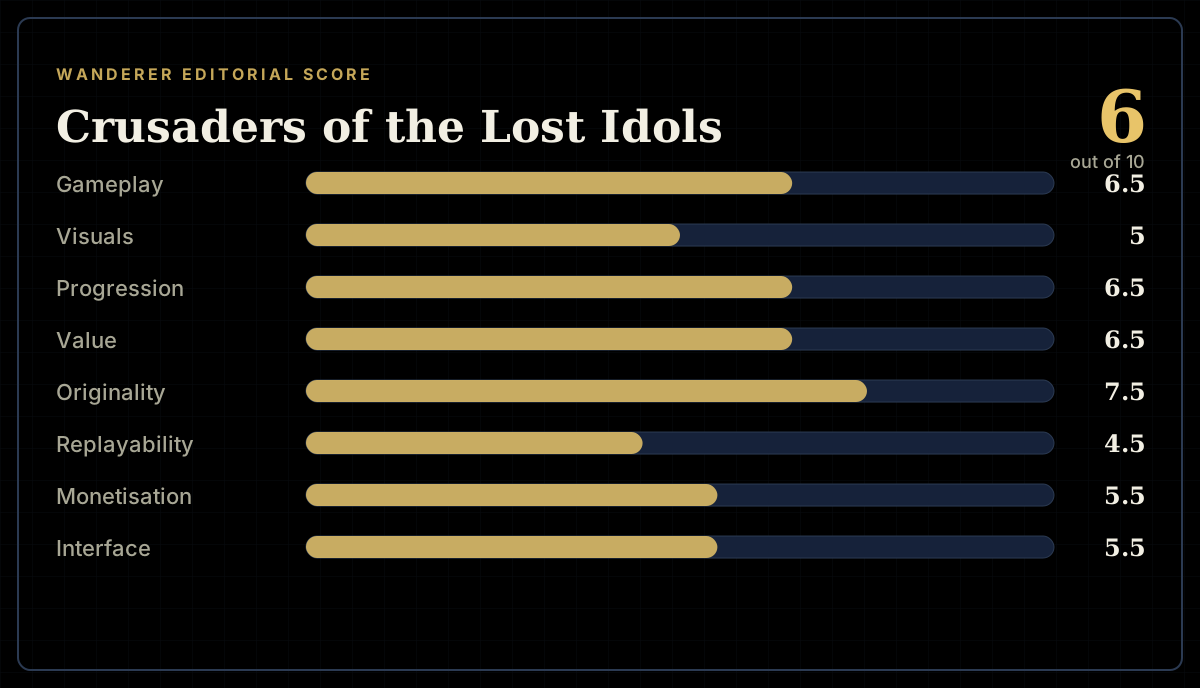
6 / 10
- Developer
- Codename Entertainment Inc.
- Publisher
- Codename Entertainment Inc.
- Released
- 13 October 2015
- Platforms
- Windows, macOS
- Genre
- Idle RPG
- Monetisation
- Free to play with 18 separate Steam DLC packs — 11 "Epic Starter Packs" that instantly unlock a specific crusader plus bonus gear, and 7 "Taskmaster Packs" that unlock helper characters who automate clicking and levelling; nothing behind the store gates a campaign, zone or core system
- Players
- Single-player
The short version
Crusaders of the Lost Idols solved a problem most idle games never bother to ask about — where you put a hero matters as much as which hero you own — years before its own developer reused the idea, with a Dungeons & Dragons coat of paint, in Idle Champions of the Forgotten Realms. The formation puzzle still holds up.
What doesn't hold up is everything around it. The last piece of new content shipped in April 2022, the official blog and Steam news feed have sat silent ever since, and the eighteen DLC packs on offer are selling access to a game whose creators have, in every practical sense, stopped making more of it.
Biggest strengths
- Formation positioning genuinely matters — crusader auras and buffs radiate by grid position, rewarding redesigning the lineup over just levelling it
- The entire base game, 120-plus crusaders and 10,000-plus levels across six-plus campaigns, is reachable for free without ever opening the store
- A dedicated Missions system lets patient players eventually earn crusaders and gear from past limited-time events rather than losing them forever
Biggest weaknesses
- No meaningful content update has shipped since April 2022, despite the store page and official blog still promising new crusaders and campaigns every month
- Taskmaster Packs sell automation for an idle game whose entire premise is that you don't need to click, a strange thing to put a price on
- A completionist buying all 18 DLC packs outright is looking at roughly NZ$223, for gear and crusaders a patient free player can substantially replicate by grinding
Who it's for: Idle-game players curious where Codename Entertainment's formation system came from before it got a licensed skin, and anyone who wants a free, no-pressure incremental that isn't actively trying to sell them anything new.
Our recommendation: Play it free — the entire base game, all six-plus campaigns and over 120 crusaders, is reachable without spending a cent, and nothing currently being withheld from you is going anywhere. Skip the DLC packs unless a specific crusader or Taskmaster genuinely appeals; there's no live event calendar creating urgency to buy now rather than grind later.
6 / 10
Idle Champions of the Forgotten Realms didn't invent the idea of lining heroes up so their auras chain down a formation. Crusaders of the Lost Idols did, three years earlier, for the same developer. Codename Entertainment's first idle game asks the same central question its later, more famous one would build a Dungeons & Dragons license on top of — does it matter where a hero stands, not just which hero you own — and answers it the same way: yes, decisively, and the puzzle is good enough to carry an entire genre entry on its own. The difference a decade makes is that Idle Champions is still receiving weekly content. Crusaders of the Lost Idols is not. Its last content patch shipped in April 2022, and the game has sat essentially frozen since.
The formation puzzle came first here
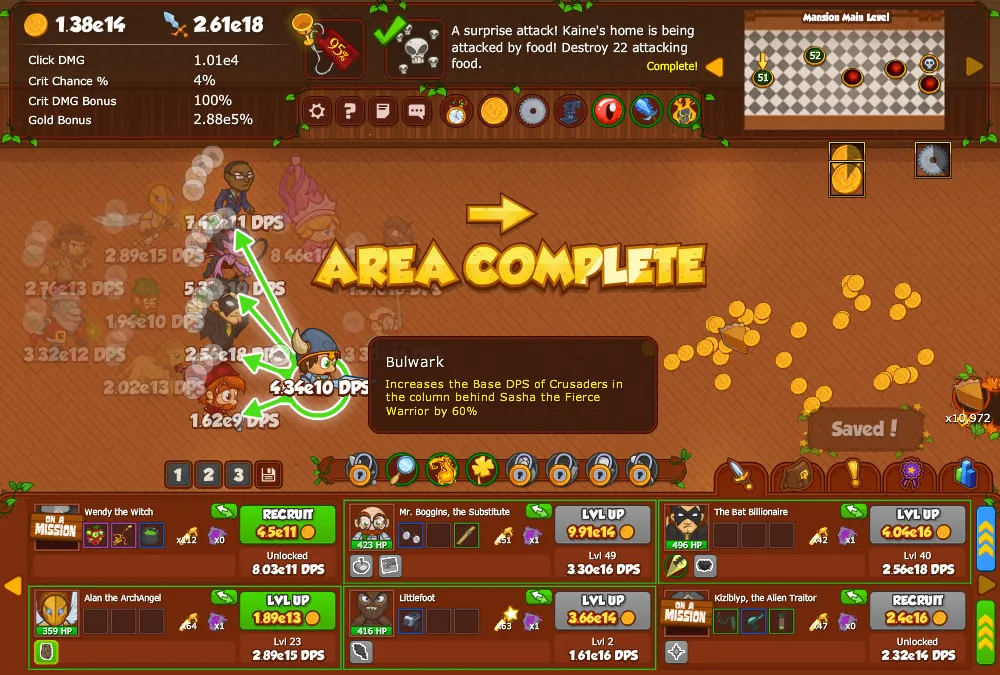
Crusaders stand in a formation, and most of what they contribute is passive: an aura that buffs, heals or debuffs within a fixed radius of wherever they're placed. A tank-type crusader needs to be up front to draw attention; a support crusader is wasted if she's not standing near whoever she's meant to be boosting. Levelling a crusader raises numbers, but the actual skill in the game — the thing that separates a formation that clears a stage cleanly from one that stalls out — is working out which twelve-or-so bodies belong next to each other for a given campaign or event. It's the same fundamental idea Idle Champions later wrapped in Forgotten Realms lore and scaled up to 140-plus champions, and it's worth saying plainly: this is where that idea started, and the earlier, plainer version still plays it straight rather than burying it under a licence.
Where the two games diverge is in what surrounds that puzzle. Crusaders leans hard into absurdist pop-culture humour — a roster that includes a Bat Billionaire, an Emo Werewolf and a RoboTurkey, achievements named things like "Your Mother's A Hamster" and "Holy Hand Grenade of Antioch" — in a way that reads as a scrappier, more irreverent take on the same mechanical spine. Combat itself is the genre standard: crusaders fight monsters automatically, gold and loot accumulate whether or not the window is open, and the formation choices you make are what decide how efficiently that idle time gets spent. None of that is a surprise nine years on. What's more surprising is how little of the surrounding game has changed to keep up with it.
Campaigns, idols, and a reset system worth the name
The scale on offer is genuinely large: over six campaigns spread across more than 10,000 levels, each with its own set of objectives layered on top of straightforward monster-killing. Progress far enough into any one and output plateaus against the next zone's health pool, at which point the game asks you to reset — sacrificing current progress for Idols, the currency the game is named after, which buy permanent talents that carry forward into every future run. It's a prestige structure that will feel immediately familiar to anyone who's played a Clicker Heroes descendant, and it does the job a reset system is supposed to do: it gives a stalled run a reason to end on purpose rather than just slowing down.
Daily quests hand out rubies for small objectives, and a Missions system sends idle crusaders on side jobs to earn gear, enchantment points and — notably — crusaders and items from past limited-time events. That last piece matters more than it might look. A lot of idle and gacha games treat a time-limited character as gone the moment its event window closes, which is exactly the kind of pressure that pushes players toward spending before they've had time to think about it. Crusaders of the Lost Idols instead built a permanent, grindable back door to almost everything it ever put behind a calendar. That's a genuinely player-friendly design choice, and one the review has to give real credit for, because it's not the industry norm.
What "monthly events" means when the calendar stopped
Here's the complication: that whole framework was built around a live event calendar that no longer exists. The Steam news feed for this game — and the developer's own blog, which still serves the same content as its front page — both stop at the same date: 7 April 2022, an update for "Nate's Candy Conundrum Tier 7." Nothing has followed it. The store page still advertises crusaders "added Every Month" and campaigns "released regularly," and that copy is simply no longer true; it's marketing language frozen in place from years before the updates actually stopped.
The practical effect on a player today is unusual for the genre, and worth separating from the usual FOMO story. There's no live event to feel pressured into buying into, because there hasn't been a new one in over four years. The Missions system that was designed to let patient players backfill past events now describes the entire achievable roster, not a rotating subset of it — everything the game will ever offer is already sitting there, earnable, with no fresh content being dangled to create urgency. That removes the sharpest edge idle games usually use to extract spending: there's no "this crusader vanishes Tuesday" pressure left to feel, because nothing new has arrived to vanish. It also means there's no reason to expect anything new arriving either. Long-time Steam reviewers describe support still answering tickets and the game remaining technically playable, which tracks — this reads like a title in maintenance mode rather than one that's been pulled, but it is not a game anyone should mistake for actively developed.
The DLC ladder: pay to unlock, pay to automate
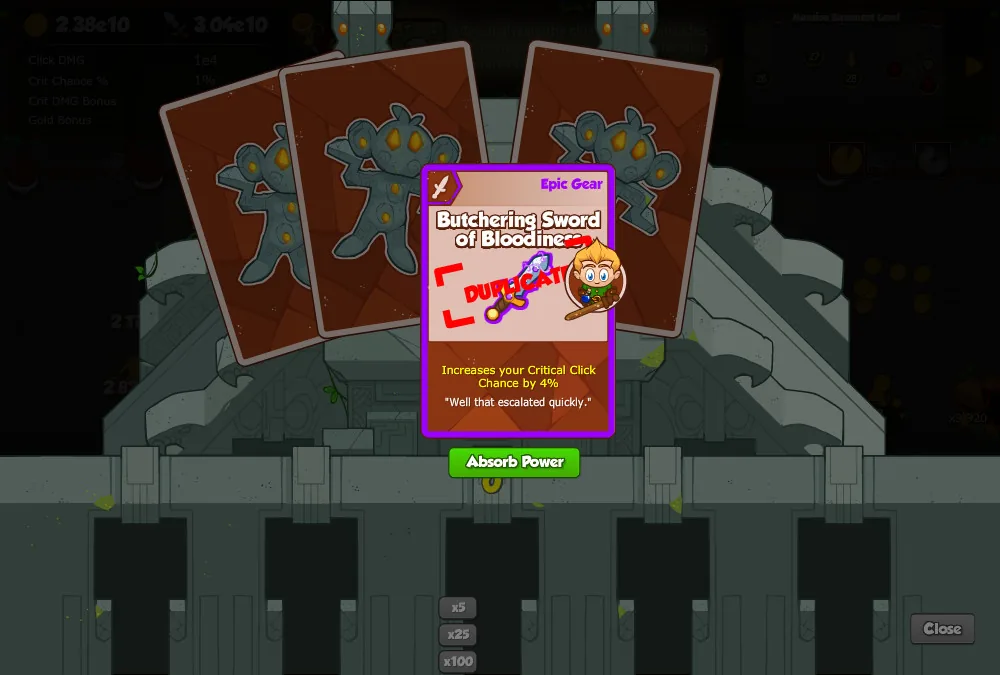
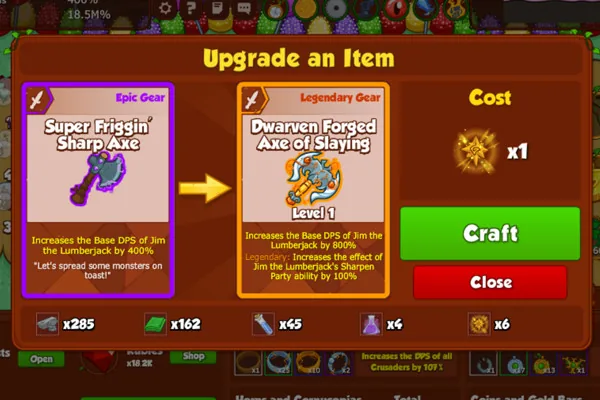
Steam lists 18 separate DLC entries for Crusaders of the Lost Idols, and they split cleanly into two families. Eleven are "Epic Starter Packs" — Milgrid, Langley, Imani, Baenarall, Billy, Mindy, Jiaolong, The Evanescent, Drosenthes, Tiernan and Ana — each priced at NZ$12.39 and each doing the same thing: unlock the named crusader if you don't already own her, hand over an exclusive "Golden Epic" item plus two rare gear pieces built specifically for her, and toss in a few thousand common crafting materials. Since the base game's own description confirms crusaders are collectible through ordinary play, what these packs are actually selling is a shortcut past the grind and an item tier — the Golden Epic — that isn't clearly available any other way.
The other seven are "Taskmaster Packs," ranging from NZ$6.29 (Azazel the Imp) up to NZ$18.49 (Silverwind), and this is the more interesting monetisation story here. Taskmasters are helper characters who click monsters for you, auto-level a crusader once per second, auto-use abilities, and auto-collect gold and quest items — assign enough of them and they even speed each other up. In other words: this is an idle game charging money for automation, on top of a genre whose entire premise is that the game plays itself so you don't have to. It's not predatory in the way a loot box or an energy timer is — nothing about progression is blocked without a Taskmaster, and the base game already idles along fine without one — but it's a genuinely strange thing to sell, and it says something about how this monetisation model was built: piece by piece, pack by pack, with no obvious ceiling.
Add every pack together and a completionist is looking at roughly NZ$223 for the full set, checked 30 July 2026. That's a real number, but it's worth putting next to Idle Champions of the Forgotten Realms, the same studio's later game — where completing the champion roster alone runs into the thousands once familiars and founder's bundles stack on top. Nothing here gates a campaign, a zone, or a core system; every pack is a specific crusader, a specific automation helper, or bonus materials layered on a game that's fully playable, and fully completable through the Missions system, without spending anything. That's a genuinely fairer arrangement than a lot of the genre offers — it's just also selling into a game where new things to want have stopped arriving.
Presentation, then and since
The tone is Crusaders' strongest asset outside the formation puzzle — a roster built from video-game and internet-culture references, delivered with achievement names that are jokes in their own right, gives it a personality a lot of po-faced idle RPGs never bother with. That personality is doing a lot of work, because the underlying visuals and interface are exactly what you'd expect from a 2015 browser game: functional, cluttered with currencies and buff icons, and untouched by the kind of UI modernisation pass Codename Entertainment's later game received. It runs on modest Windows and macOS hardware without difficulty and asks nothing of you technically. It's just visibly a decade old, in ways its sequel of sorts mostly isn't.
Verdict
Crusaders of the Lost Idols deserves recognition it rarely gets: the formation-positioning idea that makes Idle Champions of the Forgotten Realms interesting started here, and this version still plays that puzzle cleanly, without a licence's worth of extra systems layered on top of it. The free game is genuinely complete, its Missions system means nothing is permanently lost to a closed event window, and its DLC — while adding up to a real number across all 18 packs — never gates anything a patient player can't eventually reach on their own.
It doesn't score higher because there's no getting around what four-plus years of silence does to an idle game built on the promise of monthly events and a growing roster. The store still advertises a living game; the news feed says otherwise. Play it for the formation puzzle, treat the Missions grind as the actual free-to-play path through its content, and don't go in expecting anyone to add to it.
Players who'd rather their idle progression stay attached to a world that keeps moving, with regular updates rather than a calendar that stopped in 2022, may prefer that in Wanderer.
Pricing, DLC contents and update history checked 30 July 2026.
Pros and cons
Pros
- Formation positioning genuinely matters — crusader auras and buffs radiate by grid position, rewarding redesigning the lineup over just levelling it
- The entire base game, 120-plus crusaders and 10,000-plus levels across six-plus campaigns, is reachable for free without ever opening the store
- A dedicated Missions system lets patient players eventually earn crusaders and gear from past limited-time events rather than losing them forever
- None of the 18 DLC packs gate a campaign, zone or core system — every one sells a specific crusader, gear bundle or automation convenience
- Achievement and event names carry a self-aware, pop-culture-literate sense of humour that's rare in the genre
Cons
- No meaningful content update has shipped since April 2022, despite the store page and official blog still promising new crusaders and campaigns every month
- Taskmaster Packs sell automation for an idle game whose entire premise is that you don't need to click, a strange thing to put a price on
- A completionist buying all 18 DLC packs outright is looking at roughly NZ$223, for gear and crusaders a patient free player can substantially replicate by grinding
- Multiple long-time reviewers single out the core loop as repetitive once the formation puzzle is solved, with little added since to disguise it
- Visual style and interface have not been meaningfully modernised since the game's mid-2010s browser-game roots
Screenshots
-
Crusaders of the Lost IdolsImage: Codename Entertainment Inc. via Steam -
Crusaders of the Lost IdolsImage: Codename Entertainment Inc. via Steam -
Crusaders of the Lost IdolsImage: Codename Entertainment Inc. via Steam -
How the review scores each part of the gameWanderer Editorial -
The short versionWanderer Editorial