Game review
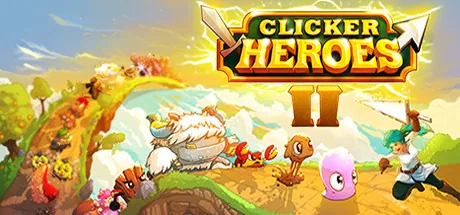
Clicker Heroes 2
4 / 10
- Developer
- Playsaurus
- Publisher
- Playsaurus
- Released
- 16 July 2018
- Platforms
- Windows, macOS
- Genre
- Incremental Action RPG
- Monetisation
- One-time Early Access purchase with no premium currency, loot boxes, subscriptions or DLC; monetisation stopped entirely when the store listing was pulled
- Players
- Single-player
The short version
Clicker Heroes 2 spent nearly six years in Early Access trying to turn a clicking game into a genuine build-crafting RPG, tore its own skill tree and item systems out and rebuilt them at least twice along the way, and was formally pulled from sale in March 2024 without ever reaching a finished release. Some of what it built — the Automator's condition-and-action scripting above all — is a genuinely interesting idea that nothing else in the genre quite copied. None of that changes what the product actually is: a paid sequel to a free game, permanently unfinished, no longer being sold, and abandoned by the studio that made it.
Biggest strengths
- The Automator's priority-ordered condition-and-action stones let players script entire play sessions, a depth of manual automation the rest of the idle genre never quite matched
- Two structurally different classes, Cid's linear click-and-buff kit and the Wizard's elemental Runecorder spellcasting, gave the sequel a build-crafting layer the original Clicker Heroes never had
- The Ascension-into-Transcension double-reset loop preserved permanent power gains even through repeated skill tree rebalances
Biggest weaknesses
- Playsaurus charged a one-time Early Access price for a sequel to a game the entire genre expects to play free, and said publicly afterward that the pricing was a mistake
- The game never left Early Access in nearly six years and was formally retired from sale in March 2024 without reaching a 1.0 release
- Major systems were torn out and rebuilt more than once — Gilding replaced by Ascending, Ethereal items replaced by Artifacts, Empyrean Motes added and later removed — leaving years of patch notes that read like course corrections rather than content
Who it's for: Existing owners deciding whether an old key or purchase is worth booting up again, and idle-genre completists curious how a sequel to one of the format's founding games managed to talk itself out of existing. Not a game anyone can currently buy, so there is no audience for a first-time purchase recommendation.
Our recommendation: If you already own it, there's a real, half-finished RPG in there worth an afternoon out of curiosity. If you don't, you can't buy it, and even if a key turns up secondhand, the original Clicker Heroes gives you the ascension loop this game was built around for nothing.
4 / 10
Some sequels fail loudly, with a bad launch trailer and a week of ridicule. Clicker Heroes 2 failed quietly, over six years, one patch note at a time, until the studio that made it posted a short announcement removing it from sale and admitting there was no version 1.0 coming. That announcement is the most important fact about this game. Everything else — the Automator, the skill trees, the two very different playable classes — is worth discussing on its own terms, but none of it changes what Clicker Heroes 2 ultimately is: a paid, unfinished product that its own developer gave up on.
What it was trying to become
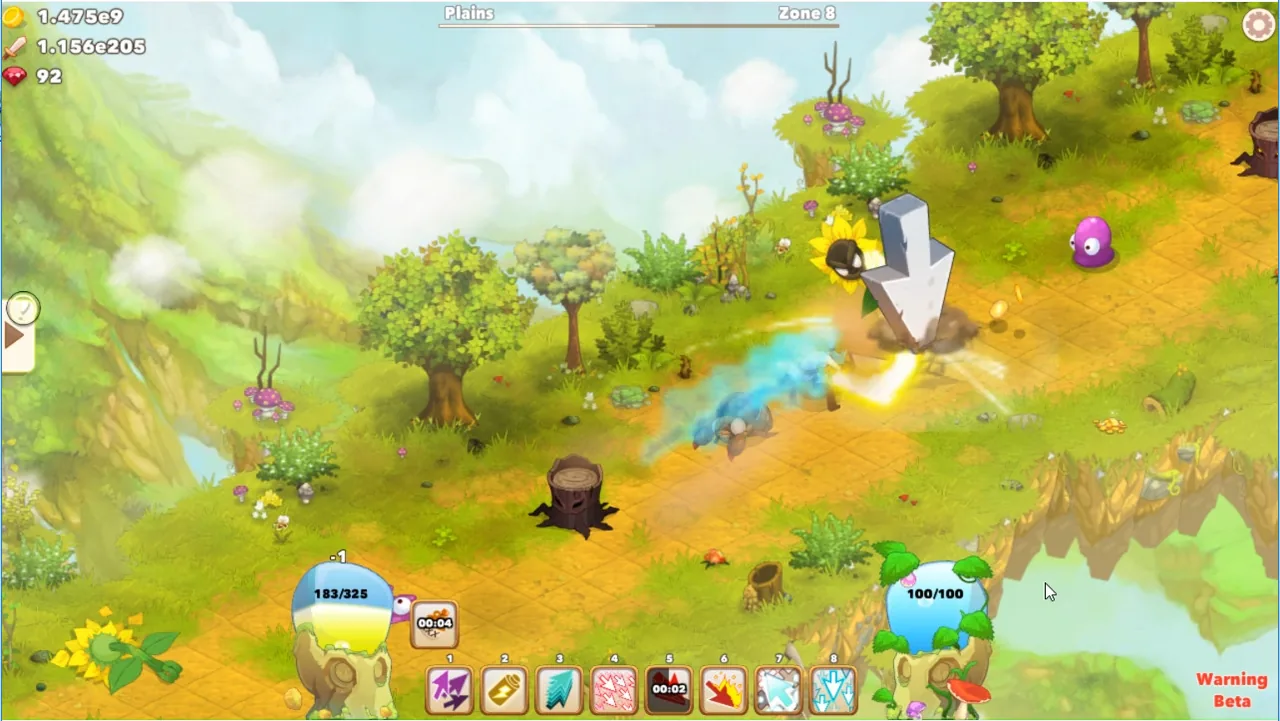
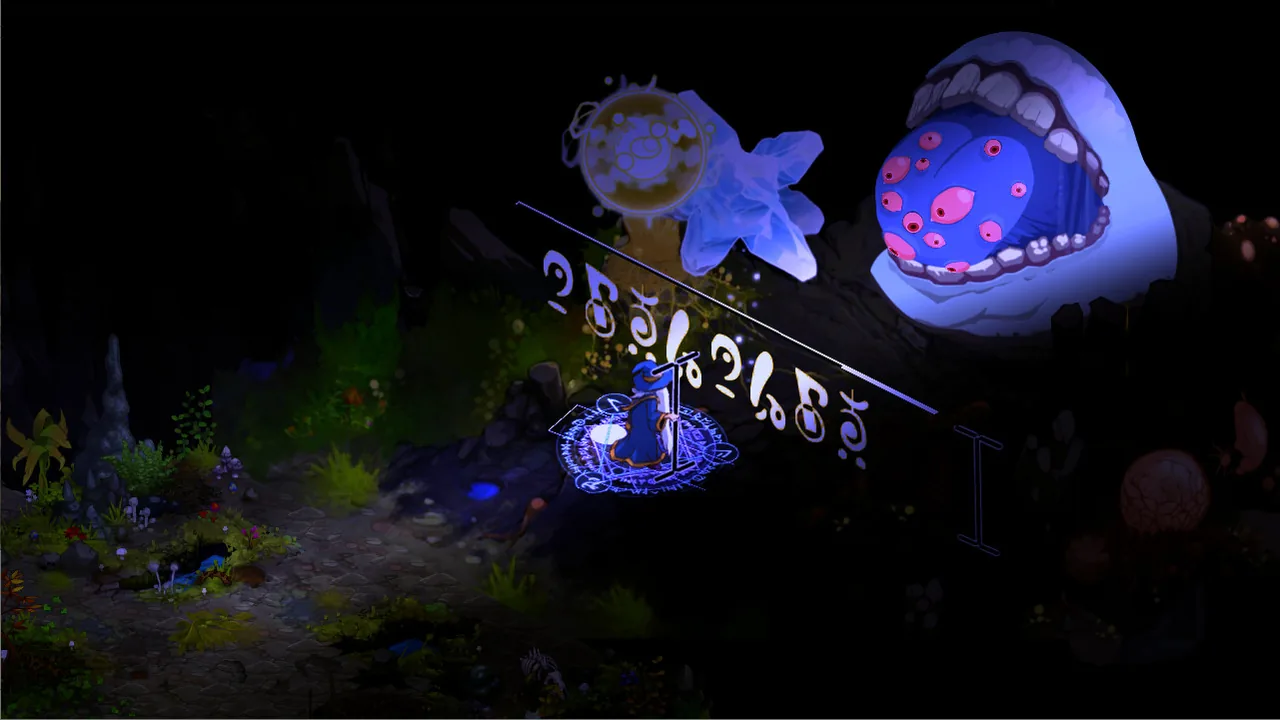
The original Clicker Heroes built an entire genre template out of one idea: ascend, spend what the reset earned on permanent upgrades, repeat with a higher ceiling. Clicker Heroes 2 opened in Steam Early Access on 16 July 2018 trying to build a proper RPG on top of that template rather than a bigger version of the same loop. Instead of thirty-five interchangeable heroes hired with gold, it gave players one controllable character at a time — first Cid, a melee-focused clicker with buff stacking and eventually a specialization-locked skill tree, then the Wizard, added over a year later, who casts elemental spells through a sequencer called the Runecorder rather than swinging a weapon. Items stopped being flat stat sticks and became Ethereal gear with rolled traits, later replaced entirely by crafted Artifacts. Ascension got a second reset layered on top of it, Transcension, which converts a completed ascension into permanent perks the way the original's Ancients convert Hero Souls.
On paper, that's a defensible pitch: keep the reset-for-permanent-power spine that made the original matter, and build actual character building around it instead of a hero-hiring spreadsheet. The problem is that "on paper" describes the game at almost every point across its development, because the specific shape of that pitch kept changing.
The Automator, and why it's the one idea worth keeping
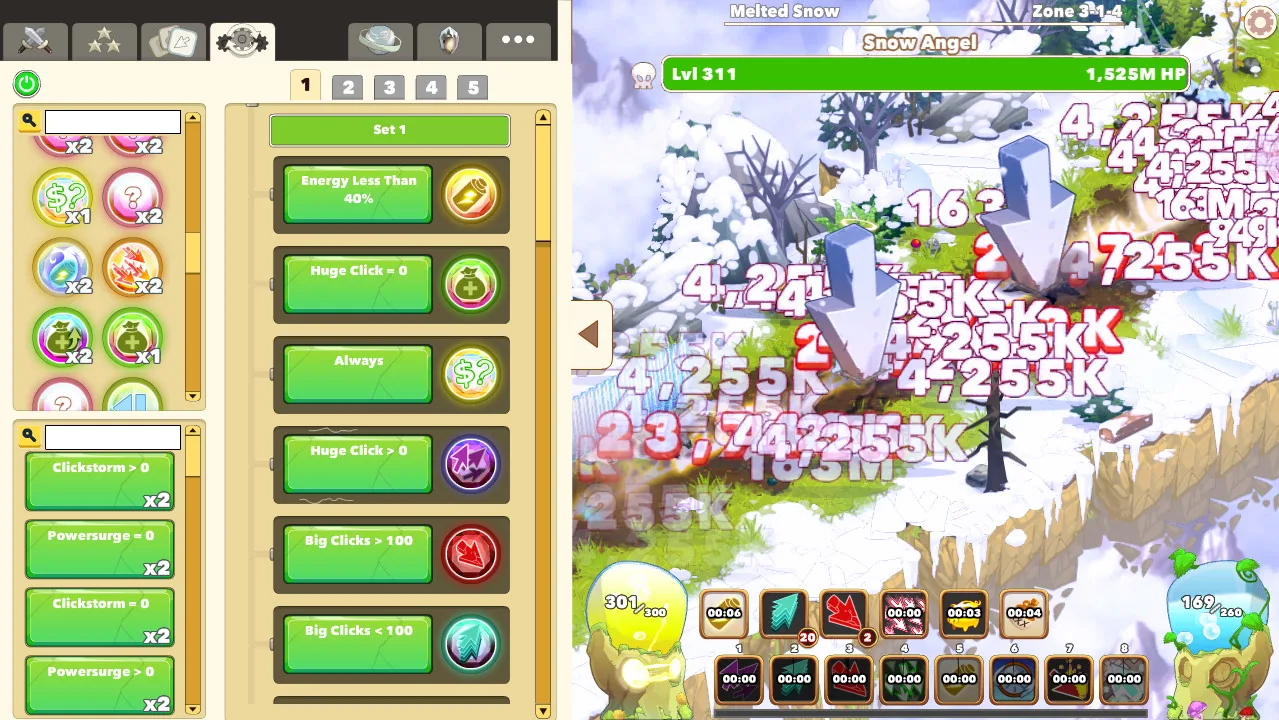
Buried inside all that churn is a genuinely good idea. The Automator is a priority-ordered list of condition-and-action "stones" — if energy is above a threshold, cast this; if a boss timer drops below a set point, use that — that the player builds by hand and the game then executes automatically, checking the list top to bottom every tick. It's closer to a lightweight scripting language than a toggle, and getting it wrong is a real, well-documented trap: place an unconditional "always" action first with no cooldown and every rule behind it never fires. Players who learned to order theirs correctly could effectively author their own play style rather than choosing from a menu of presets. Nothing else in the mainstream idle genre committed to that level of player-authored automation, and it's the one system in Clicker Heroes 2 that reads as a real design contribution rather than an iteration on the original.
It doesn't rescue the whole game, because a scripting tool is only as good as the systems it's scripting, and those systems spent six years being rebuilt out from under it. The Automator itself had to be partially reset more than once when the skill tree it depended on changed shape, which tells you a lot about how development actually went here.
Six years of rebuilding the same house
The patch history is the clearest evidence of what went wrong, because it isn't a history of new content — it's a history of undoing and redoing core systems. Gilding, the original reset mechanic, was scrapped in 2020 and replaced with Ascension, which kept skill tree progress instead of wiping it. Ethereal items were removed, brought back reworked, and eventually replaced by Artifacts crafted from boss drops. Empyrean Motes and Ancient Shards, mechanics the developers had kept around specifically to bridge the power gap between casual and optimizing players, were eventually deleted outright when a June 2021 update introduced separate difficulty modes to solve the same problem a different way. That update, patch 0.18, was the last substantial content the game ever received. A couple of hotfixes followed within days. Then nothing.
Playsaurus addressed the situation directly in a June 2021 blog post, and it's worth reading in its own words because it's unusually candid for a developer statement. They named four specific mistakes: continuing large-scale development on the aging Flash platform long after its tools and community had thinned out; letting the sequel's mechanics drift too far from what made the original work, calling several of those changes "wrong choices" in hindsight; launching Early Access with what they described as only "a few days worth of content," which set expectations the game never caught up to; and charging money for a sequel to a game the entire audience knew as free. On that last point they were blunt: "Had we made the game free to play, it would have been more acceptable." The post ends by acknowledging staff layoffs and stating plainly that the studio had spent far more on development than the game had earned back, with no promise of a path out. Nothing meaningful shipped after that admission. Nearly three years later, on 13 March 2024, Playsaurus posted a short retirement notice removing Clicker Heroes 2 from sale, noting that Adobe Flash's near-total disappearance had made it impossible to even obtain the tools needed for further builds, and that "the original team is no longer with us." Existing owners keep access. Nobody else gets in.
What the price actually bought
This is where the review has to be blunt about value, because there isn't much room for nuance. Clicker Heroes 2 charged a one-time Early Access price for content that, per the developers' own account, amounted to a few days' worth of material at launch and never expanded into the finished RPG it was pitched as. There was no premium currency, no loot box, no subscription and no DLC layered on top — whatever else went wrong here, Playsaurus never tried to extract more money out of an incomplete game once the initial sale was made, which is at least consistent with how restrained they kept the original's ruby economy. But restraint on additional monetisation doesn't offset the core issue: buyers paid up front for a product that stopped being developed, was never finished, and is no longer available to anyone who doesn't already own it. Judged purely as a transaction, that's close to the worst outcome a paid Early Access game can produce short of outright fraud, and the developers have effectively said as much themselves.
The user-review record backs up how divisive the result was rather than how bad it was outright. Steam's aggregate sits at "Mixed," roughly 52% positive across 2,825 reviews — not a pile-on, but not a redemption either. Recent negative reviews tend to focus on exactly what you'd expect from a game whose developer publicly confirmed the same complaint: no updates, a purchase that stopped being supported, a store listing that eventually vanished. The positive half generally comes from players who engaged with the build-crafting and Automator systems on their own terms and got real enjoyment out of them before the updates stopped — which lines up with this review's read that the ideas underneath Clicker Heroes 2 weren't the failure. The execution, the pacing of content, and above all the decision to charge for an Early Access sequel to a beloved free game were.
Where this leaves the original
The contrast with Clicker Heroes is unavoidable and the developers invited it themselves by building a sequel in the first place. The original stayed free, survived a forced engine migration off Flash, and picked up a Switch release and controller support as recently as this year. The sequel tried to be more ambitious, charged for that ambition, and lost the studio's attention within three years of launch. If you're new to either game in 2026, there's no real decision to make: the original is free, actively maintained, and still delivers the ascension loop the sequel was trying to expand on. The sequel isn't for sale. Idle-RPG players who like permanent, no-reset progression that keeps advancing while they're away from the screen may find that pull familiar — it's a large part of what Wanderer itself is built around — but that's a different kind of game solving a different part of the same appetite.
Verdict
Four out of ten. Clicker Heroes 2 is not a scam and it isn't broken — the Automator in particular is a real design contribution the rest of the idle genre never matched, and the Cid-versus-Wizard split gave it a build-crafting layer its predecessor never attempted. But a review has to grade the product that exists, and the product that exists is a paid game that never finished being made, whose own studio has publicly called the pricing a mistake, and which was pulled from sale in 2024 with no path back. Nearly six years of Early Access produced repeated do-overs of its own core systems rather than a stable foundation to build content on top of. There's a decent, half built RPG buried in here for the people who already own it. There is no case for anyone else to go looking for it.
Development history, pricing status and Steam review data checked 1 August 2026.
Pros and cons
Pros
- The Automator's priority-ordered condition-and-action stones let players script entire play sessions, a depth of manual automation the rest of the idle genre never quite matched
- Two structurally different classes, Cid's linear click-and-buff kit and the Wizard's elemental Runecorder spellcasting, gave the sequel a build-crafting layer the original Clicker Heroes never had
- The Ascension-into-Transcension double-reset loop preserved permanent power gains even through repeated skill tree rebalances
- Existing owners can still launch and play the full extent of what shipped, since Playsaurus left the client functional after pulling it from sale
- Difficulty modes added late in development at least tried to separate casual pacing from the min-max builds serious players were chasing
Cons
- Playsaurus charged a one-time Early Access price for a sequel to a game the entire genre expects to play free, and said publicly afterward that the pricing was a mistake
- The game never left Early Access in nearly six years and was formally retired from sale in March 2024 without reaching a 1.0 release
- Major systems were torn out and rebuilt more than once — Gilding replaced by Ascending, Ethereal items replaced by Artifacts, Empyrean Motes added and later removed — leaving years of patch notes that read like course corrections rather than content
- No meaningful update has shipped since June 2021, and the developers have been explicit that they cannot promise more
- New players cannot buy it at all anymore, so the only people this review can actually advise are the ones who already own it
Screenshots
-
Clicker Heroes 2Image: Playsaurus via Steam -
Clicker Heroes 2Image: Playsaurus via Steam -
Clicker Heroes 2Image: Playsaurus via Steam -
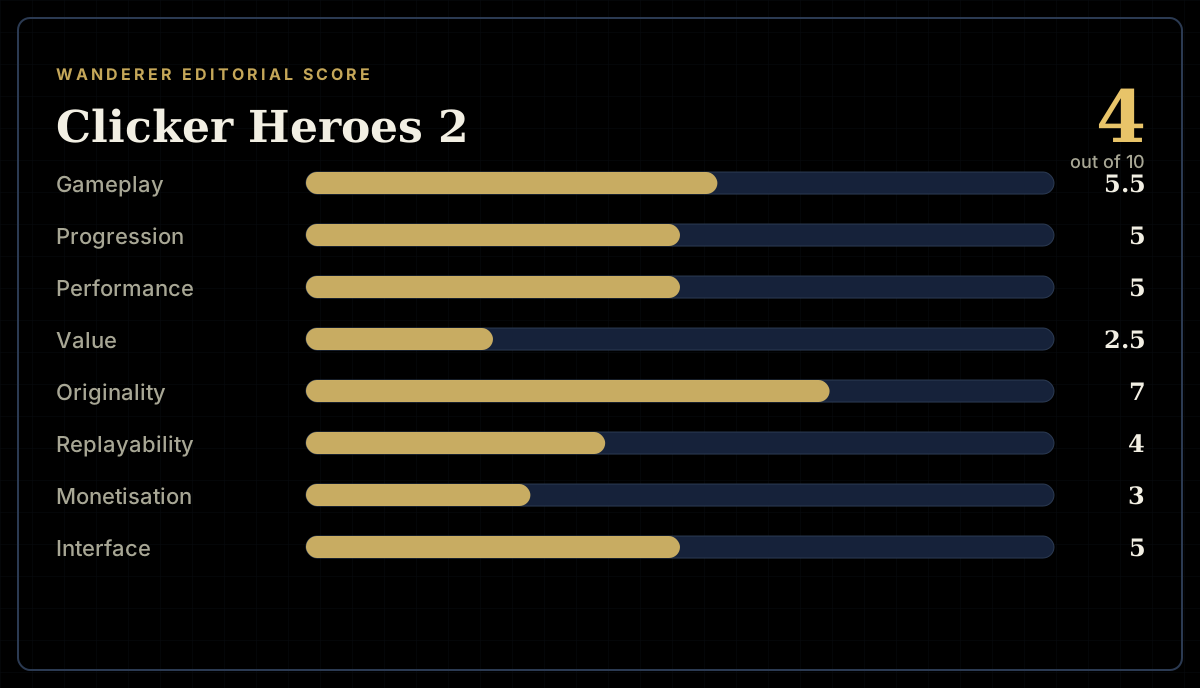
How the review scores each part of the gameWanderer Editorial -
The short versionWanderer Editorial