Game review
Grim Clicker
6 / 10
- Developer
- EvilCharm Games
- Publisher
- EvilCharm Games, Aleksandr Golovkin
- Released
- 30 January 2024
- Platforms
- Windows
- Genre
- Idle/Clicker Action RPG
- Monetisation
- Free-to-play with optional in-app purchases (Shards and Black Wax premium currencies); no ads, no subscription, no traditional DLC
- Players
- Single-player
The short version
Grim Clicker's skill tree is the real product here — years of Early Access growth produced a genuinely branching set of builds, from shield-tanking Generals to elemental multiplier combos, and that's rare in a genre that usually offers one obvious upgrade path. But the shell around it works against the tree constantly: clicking is capped by an energy meter, the best gear sits behind RNG chests or a shard shop with a very slow free drip, and undiscovered skill nodes hide their own descriptions until you've already committed points nearby.
Biggest strengths
- The skill tree carries years of Early Access growth into genuinely distinct builds — shield-tanking Generals, crit specialists, elemental combo stacking — rather than one obvious power path
- Nothing is hard-walled behind payment; daily quests and free currency drips do eventually buy into the shard shop, just slowly
- No PvP and no leaderboard means the premium shop only competes with your own patience, not another player's wallet
Biggest weaknesses
- Skill nodes hide their own effect descriptions until enough points are already invested nearby, turning build planning into guesswork rather than an informed choice
- Best-in-slot gear and cosmetics sit behind Chests that are either rare drops or a shard purchase, and players who ran the numbers put the pure free-quest route at well over a month per chest
- Active clicking is capped by an energy meter, undercutting the basic idle-genre promise that paying attention should beat leaving the hero to fight alone
Who it's for: Patient idle-RPG players who enjoy planning a build more than watching a number increase, and who won't mind a shop nagging at the edges of a genuinely free game.
Our recommendation: Worth installing for free if skill-tree depth is what you're after. Anyone expecting a true offline idler, or a clicker that respects an active session more than a passive one, will bounce off it inside an hour.
6 / 10
Grim Clicker didn't arrive fully formed. It spent something like four years in Early Access, quietly accumulating skill branches, currencies and reset systems under version numbers that read like a diary — "Wisdom Branch," "Singularity Points," "End of the Universe" — before finally hitting 1.0 at the end of January 2024. That history matters, because it explains both what the game gets right and what it never quite cleans up. The skill tree at the centre of Grim Clicker is genuinely large and genuinely branching, the product of years of a solo-ish studio adding ideas one patch at a time. The shell wrapped around that tree — an energy-gated click system, RNG loot chests, a shard shop with a famously slow free drip — reads like a game that never stopped to ask whether its monetisation was still doing the tree justice once it left Early Access behind.
An immortal hero, and a click that costs you something
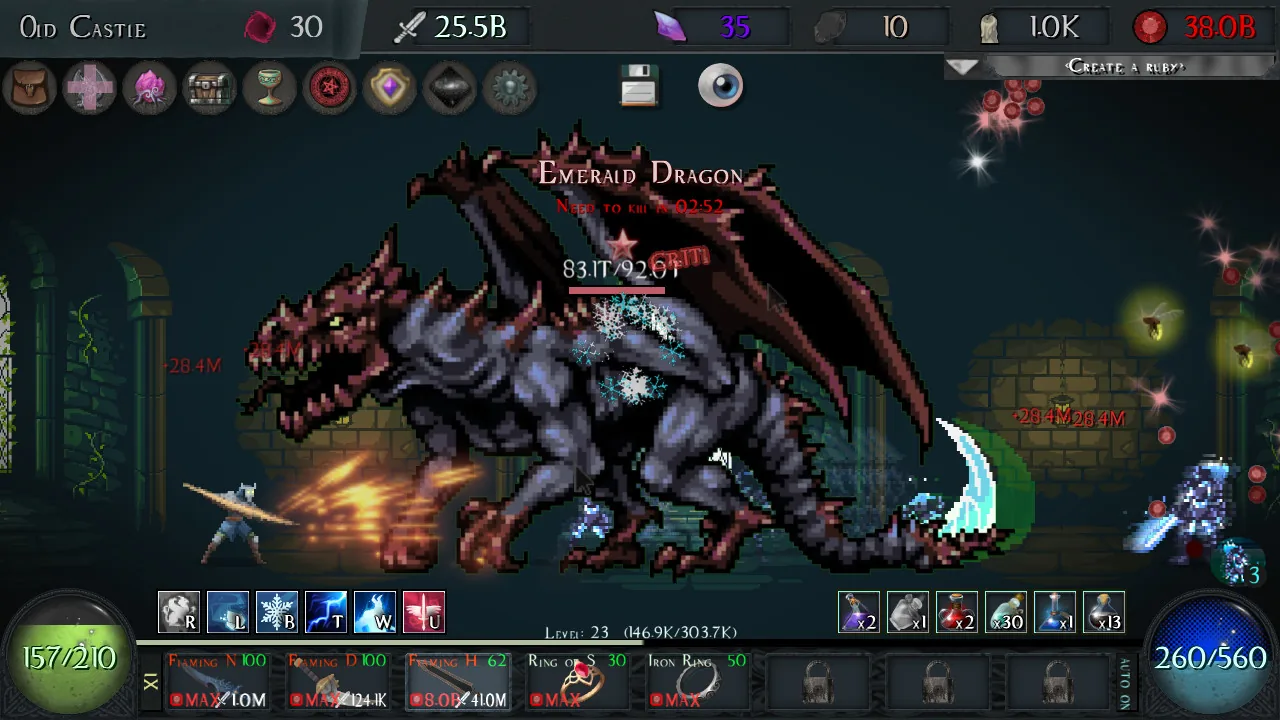
The premise is simple by design: your character cannot die. EvilCharm Games states this outright — "the character is immortal, so you can safely let him fight on his own" — and the game is built around that promise. There's no health bar, no failure state, no combat risk in the way an action RPG usually means it. Your hero walks right through a side-scrolling world, fighting automatically, while you decide how much to intervene.
That's where the genre's oldest design question shows up: does choosing to play actively beat leaving the hero alone? Grim Clicker answers it strangely. Manual clicking does help, particularly early, but it draws from an energy meter that runs out well before a session does, which is exactly the detail both Steam reviewers and an independent Xbox review of the same game (rebranded Grim Idle on that platform) single out as undercutting the point of clicking in a game called Grim Clicker. You can't out-click the wall; you can only chip at it until the meter empties, then wait.
The skill tree is the actual game
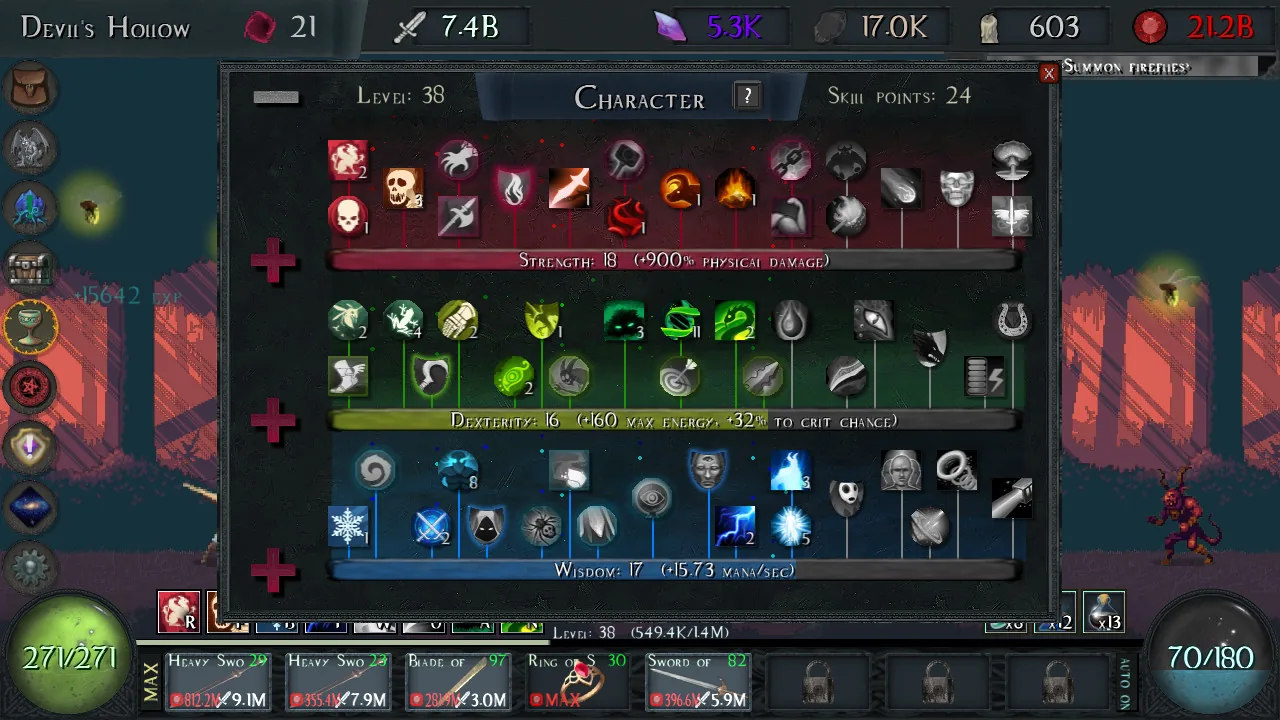
Strip away the click gimmick and the loot chests, and what's left is a legitimately deep build planner. Multiple branches support real playstyles — a shield-focused General build, crit-stacking glass cannons, elemental multiplier combinations that longtime players discuss in specific terms because certain node pairings compound far harder than others. That's the part of Grim Clicker that earns its organic praise: players who stick around consistently cite the tree, not the combat or the art, as the reason they're still logging in months later.
The tree undercuts itself in one specific, avoidable way. Nodes you haven't invested in yet don't show their own descriptions — you can't preview what a branch does until you've already committed points near it. That's not a minor UI oversight in a game whose entire pitch is "find your own strategy." It converts planning into blind guessing for exactly the systems a thoughtful player would most want to evaluate before spending a scarce resource on them, and it's a criticism that shows up independently from players on both Steam and Xbox rather than as an isolated complaint.
Ritual resets and the galaxy climb
Progression is structured around planets and galaxies, each one raising the ceiling on what your build needs to survive, with a "Ritual" system letting you reset accumulated progress for permanent strength gains — a fairly standard incremental-game prestige loop. Where it gets interesting is the endgame twist added well after 1.0: completing all nine planets unlocks the option to continue into an alternate, "lifeless" universe while keeping prior progress, essentially a soft new-game-plus layered onto the existing reset structure.
The problem is less the shape of the system than how it feels moment to moment. A frequent complaint, recurring across reviews written a year or more apart, is that each new galaxy feels like starting over rather than compounding what came before — the exact opposite of what a good prestige system should deliver. When a reset genuinely rewards the player, it manifests as a faster, stronger second lap. When players describe repeatedly feeling like they're back at zero, that's the system failing at its one job, not merely a matter of pacing taste.
What "idle" actually means here
Here's the detail worth being precise about, because the genre label promises something specific: Grim Clicker is not built around a calculated "you were away for six hours, here's a lump sum" formula the way most mobile-style idlers are. The simulation appears to keep running as long as the client process is alive — foreground or backgrounded — which is consistent with player reports of the game logging far more hours than they remember actively spending, and also consistent with a separate, recurring complaint that the game isn't really an idler at all once you've fully closed it. There's no publicly documented offline-progress formula to point to here, and the practical upshot for a prospective player is straightforward: don't expect Grim Clicker to catch you up after a week away the way a phone idler would. Expect it to keep simulating only while it's actually running somewhere.
Monetisation: what's actually for sale
To be specific, since this is where a meaningful share of the negative feedback concentrates: Grim Clicker sells Shards and Black Wax, spent in a shop and on Ritual-adjacent upgrades, and used to buy or accelerate Chests — the loot containers that hold the game's best weapons, crafting materials, potions and pets. None of this is pay-to-win in the competitive sense, because there's no PvP and no leaderboard for a purchase to distort; nobody's outcome is affected by what anyone else spends. What it is, more precisely, is pay-to-skip: money buys faster access to a gear tier that free play also reaches, eventually, through daily quests and a small currency trickle for backing up your save. The rub is in that word "eventually" — several players who did the actual arithmetic on quest rewards versus chest costs arrived independently at figures in the range of one to two months of daily play for a single chest through free means alone. That's not a wall a free player can't climb. It's a slope steep enough that the shop is clearly designed to look tempting well before the free route pays out, and it's the single most consistent complaint in critical reviews spanning the game's entire post-launch life, not a one-off from a single vocal player.
Presentation, performance and reliability
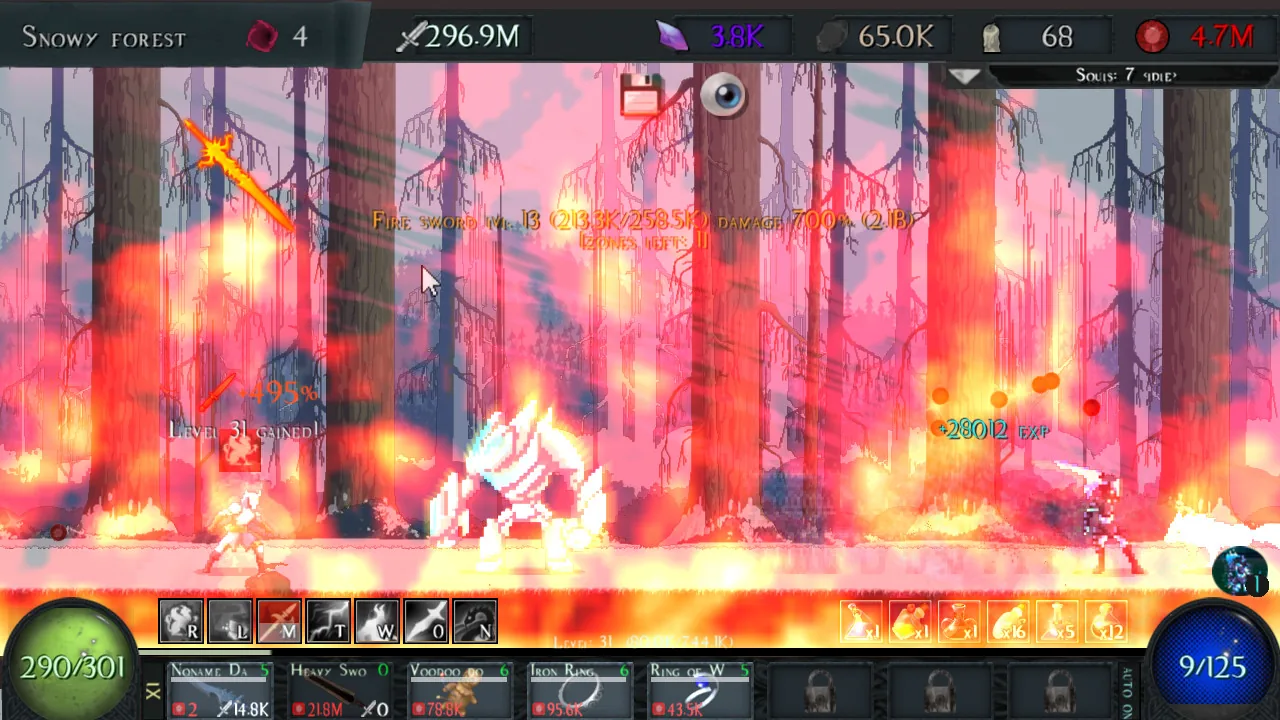
The pixel art is serviceable dark fantasy rather than distinctive dark fantasy — functional enough to read at a glance, though a recurring criticism calls the sprite work "fuzzy" in a way that makes enchantments and skill icons harder to distinguish than they should be at this genre's information density. Performance is inconsistent rather than broadly broken: most players report nothing unusual, but a minority describe freezes and low frame rates severe enough to be notable on strong hardware, which is a strange complaint for a game this visually modest.
More concerning is a pattern of save and progress loss that resurfaces across periods more than a year apart rather than clustering in a single launch-week bug wave — power outages wiping saved progress, at least one update that reset accumulated currency outright, and an isolated but alarming report of a Ritual reset failing to clear upgrade costs and softlocking a fresh run. None of this is universal, and most reviews don't mention it at all, but it shows up often enough, spread widely enough across the game's history, that it reads as a genuine reliability weak point rather than bad luck.
Verdict
Grim Clicker earns its "Mostly Positive" tag honestly: the skill tree is the real deal, built over years rather than assembled for a trailer, and players who enjoy planning a build over watching a number tick up have a legitimate reason to stick with it. What keeps this from scoring higher is everything wrapped around that tree — an energy meter that punishes the exact clicking the title promises, skill nodes that hide their own information until you've already spent on them, a chest economy whose free path several players have independently clocked at a month or more per reward, and a save-reliability track record that keeps resurfacing rather than staying in the past. Free does mean free here; nothing is locked away permanently. It just isn't a fast or especially comfortable free, and the game rarely goes out of its way to make the slow route feel worthwhile rather than merely available.
Players who want their idle time to genuinely respect time away from the screen, rather than requiring the client to keep running somewhere, may prefer to look at Wanderer — its offline progression is calculated on return rather than simulated live.
Pros and cons
Pros
- The skill tree carries years of Early Access growth into genuinely distinct builds — shield-tanking Generals, crit specialists, elemental combo stacking — rather than one obvious power path
- Nothing is hard-walled behind payment; daily quests and free currency drips do eventually buy into the shard shop, just slowly
- No PvP and no leaderboard means the premium shop only competes with your own patience, not another player's wallet
- The Xbox port under the Grim Idle name gives console players an easy, low-friction achievement hunt built on the same systems
- Still receiving patches years after leaving Early Access, most recently in October 2025, rather than sitting abandoned
Cons
- Skill nodes hide their own effect descriptions until enough points are already invested nearby, turning build planning into guesswork rather than an informed choice
- Best-in-slot gear and cosmetics sit behind Chests that are either rare drops or a shard purchase, and players who ran the numbers put the pure free-quest route at well over a month per chest
- Active clicking is capped by an energy meter, undercutting the basic idle-genre promise that paying attention should beat leaving the hero to fight alone
- Progress resets with every new galaxy tier, and a recurring complaint across two years of reviews is that each new area feels like starting over rather than compounding earlier power
- Save and progress loss is reported across multiple periods rather than as a single launch-week bug, including crashes, power-cut saves and at least one patch that reset currency outright
Screenshots
-
Grim ClickerImage: EvilCharm Games via Steam -
Grim ClickerImage: EvilCharm Games via Steam -
Grim ClickerImage: EvilCharm Games via Steam -
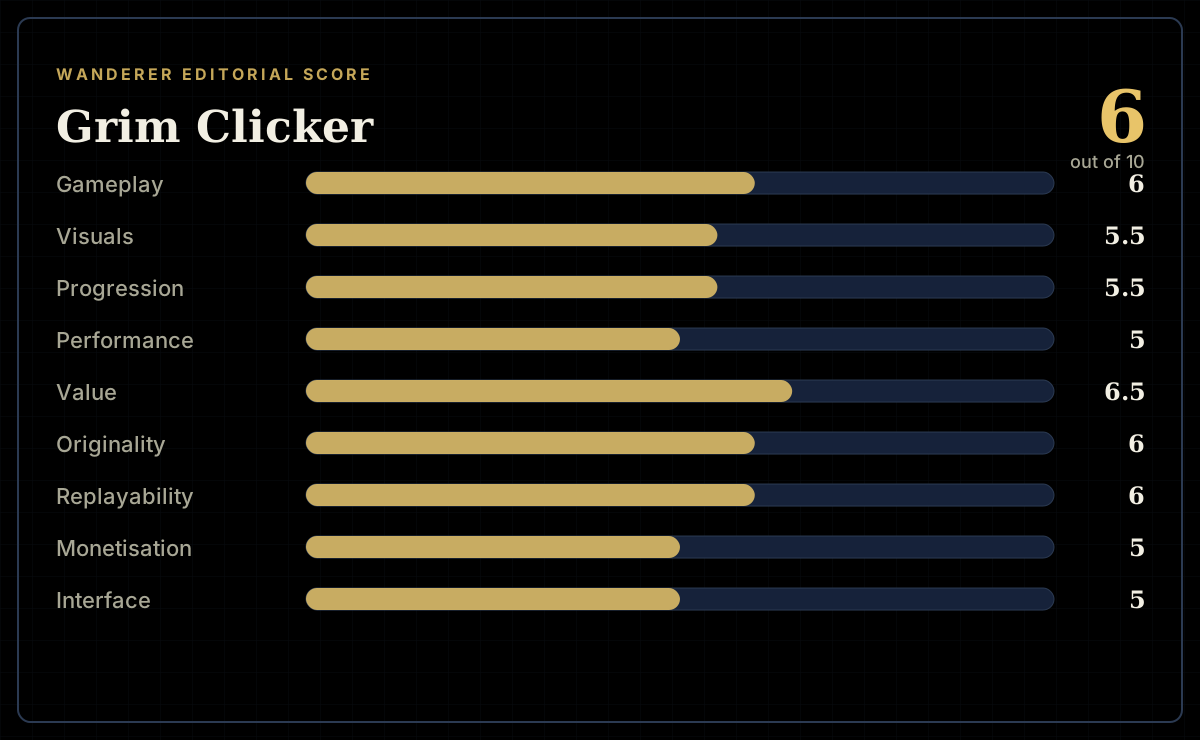
How the review scores each part of the gameWanderer Editorial -
The short versionWanderer Editorial