
Game review
Idle Slayer
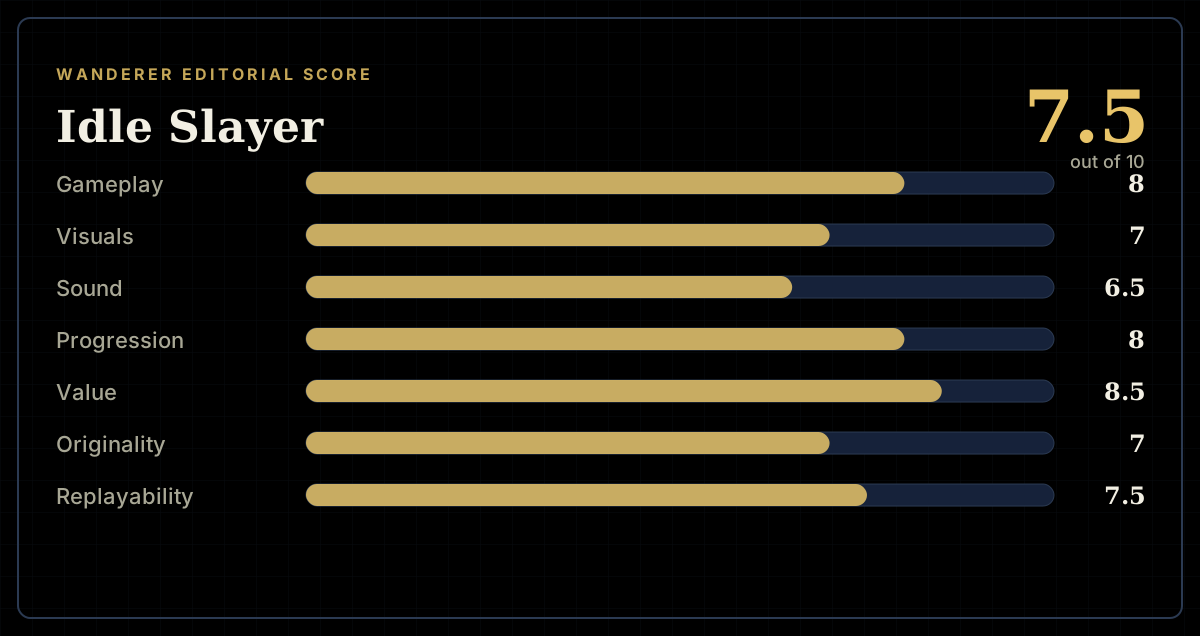
7.5 / 10
- Developer
- Pablo Leban
- Publisher
- Pablo Leban
- Released
- 21 December 2020
- Platforms
- Windows, Android, iOS
- Genre
- Idle RPG
- Monetisation
- Free-to-play on Steam, iOS and Android, with optional in-app purchases and, on mobile only, optional rewarded ads
- Players
- Single-player
The short version
Idle Slayer's coin-trail jumping is the rare idle-game "skill" that actually changes the session's payout, not just its pacing, and the Ascension and Ultra Ascension layers give the prestige loop real depth. But the systems around that core — crafting, pets, the Jewels of Soul shop — sprawl faster than they get explained, and RNG-gated materials turn late progression into waiting rather than playing.
Biggest strengths
- Timing a jump run through a full coin trail pays out meaningfully more than letting it idle past, so the active layer earns its place instead of decorating one
- Ascension and Ultra Ascension stack two full prestige resets on top of each other instead of one flat "start over" button
- No forced ads on any platform, and the community consensus is that free currency alone clears the premium shop over a long enough session
Biggest weaknesses
- Late Ascension tiers lean on RNG-gated material drops that regular players flag as the point where grinding starts to feel like waiting rather than playing
- The active jump layer stops mattering the moment a session is left running, which undercuts the game's own headline mechanic during the hours most idle players are actually away
- The Jewels of Soul bundle range tops out at a steep $99.99, a premium-currency ladder idle games are usually built to avoid needing at all
Who it's for: Players who liked the idea of Cookie Clicker but wanted a reason to keep a thumb on the screen, and anyone who wants their idle game's active minigame to actually be worth playing.
Our recommendation: Install it free on whichever platform is already in your pocket. If a single ascension run holds your attention, the second and third will too — the shop is easy to ignore either way.
7.5 / 10
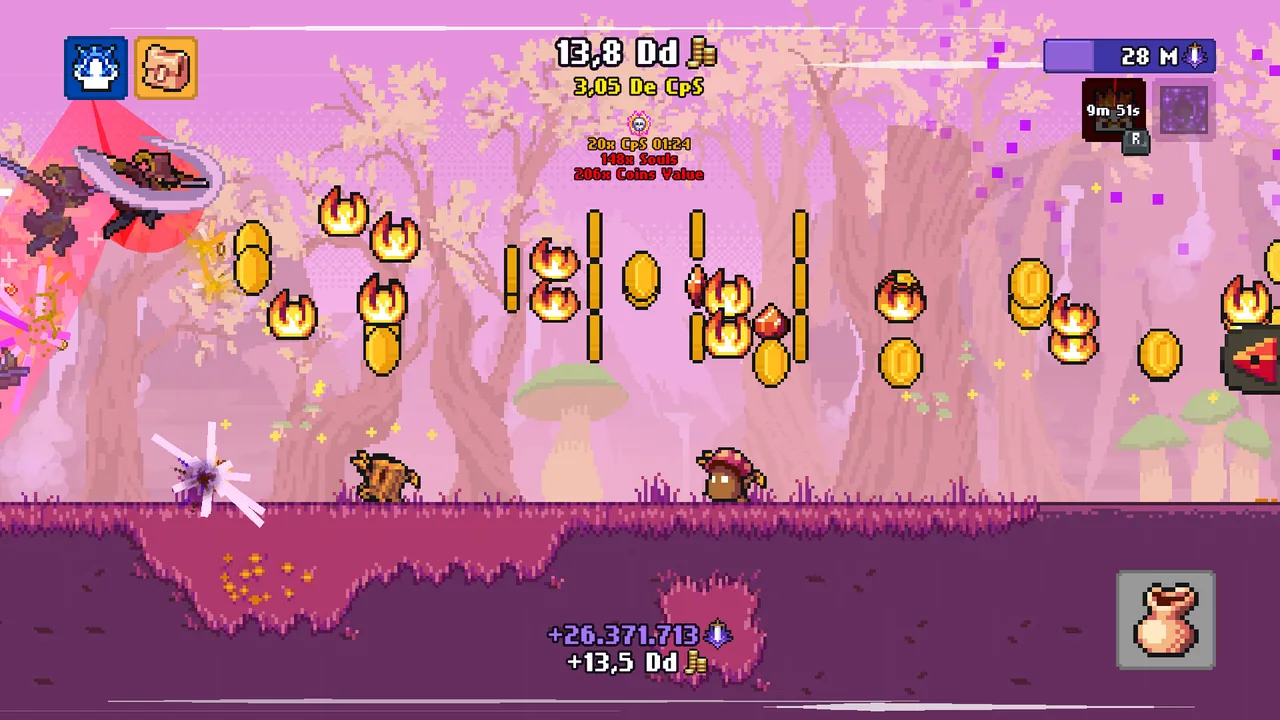
Most idle games treat their "active" minigame as a courtesy — something to tap while you wait for the numbers to do the real work. Idle Slayer built its entire pitch around inverting that. Your Slayer walks and fights on their own, the way every idle hero does, but every so often a trail of coins arcs across the screen in a jumping pattern only a human can catch cleanly. Miss the timing and the run still earns something. Nail it and the run earns a lot more. That's a small mechanical decision with a large consequence: it makes the choice to actually hold the controller matter in a genre that mostly asks you not to.
The jump is the point
The loop underneath the jumping is standard idle-RPG furniture — walk right, fight automatically, collect coins and souls, spend souls on a growing tree of permanent upgrades, unlock new dimensions with tougher enemies and better drops. What isn't standard is how much of the game's identity sits on top of that furniture rather than inside it. Coin trails appear on a timer, arc through jumps of increasing difficulty, and reward a clean run with a payout multiplier that dwarfs what passive collection earns over the same stretch. Bonus stages built around dodging and timing do the same thing for souls.
That's a genuinely well-judged answer to the spine question every idle game with an active layer has to answer: does playing actively beat leaving it alone? Here, yes, clearly, for as long as someone is looking at the screen. The problem is the second half of that sentence. Idle Slayer's name is a promise about what happens when nobody's looking, and the entire coin-trail system goes dormant the instant the session isn't active — Steam players have reported progressing noticeably faster than mobile players simply because the desktop client can be left open and unattended for unlimited stretches, farming baseline income, while the phone app is subject to the usual background restrictions. The active layer is the best idea in the game and also the one thing it can't sell you on doing nothing.
Souls, Ascension, and the second prestige layer
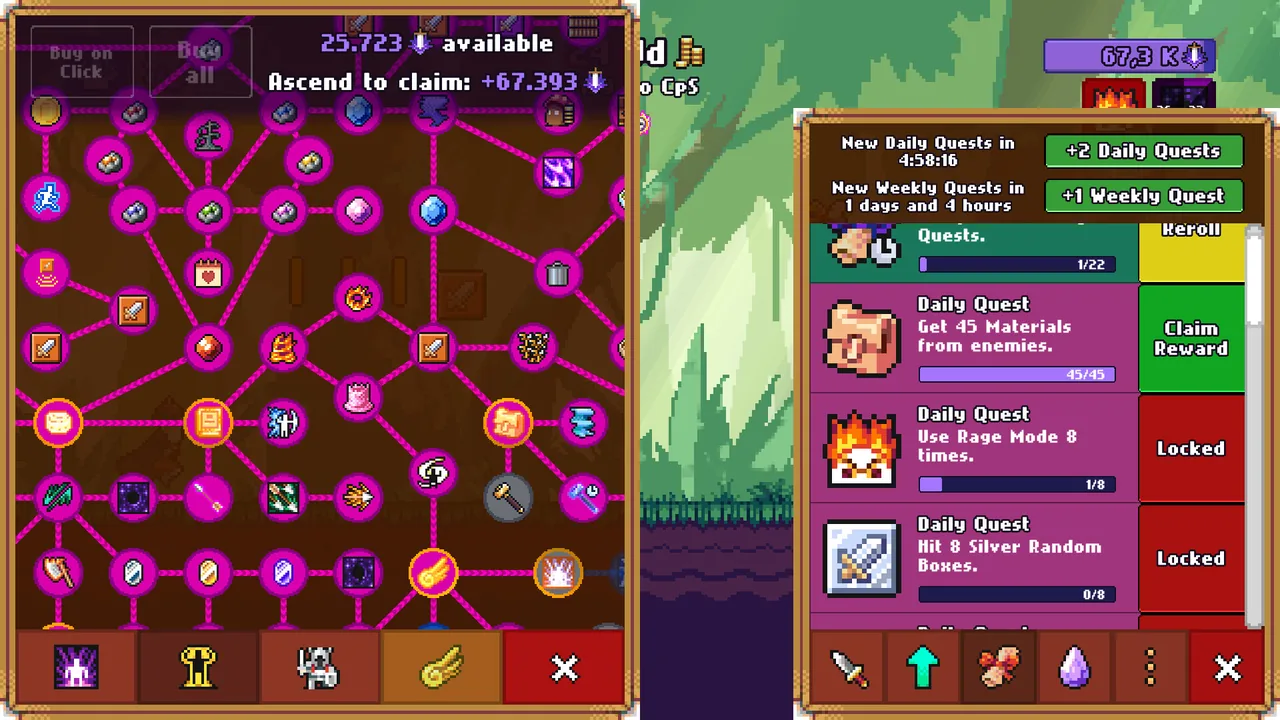
Where Idle Slayer earns its progression score is the shape of the reset. Ascension is the first prestige tier: cash in accumulated progress for Ascension Points, spend those on a branching tree of permanent multipliers, and start the run again meaningfully stronger. That's a familiar shape for anyone who's played an incremental game before. What isn't familiar is Ultra Ascension sitting above it — a second-order reset that clears the entire Ascension tree in exchange for Ultra Slayer Points, a rarer currency that buys upgrades powerful enough to make the next trip through Ascension faster than the last. Two nested prestige loops, each one restructuring how the loop below it plays out, is more structural ambition than most idle games bother with, and it gives long-term players an actual reason to keep resetting rather than treating prestige as a chore between real progress.
The cost of that ambition is legibility. New systems keep arriving well past the point most idle games have shown their whole hand — new divinities, new astral upgrades, new quest lines layered onto quest lines — and the game leans on its community wiki more than its own tutorialisation to explain how they interlock. That's not fatal in a genre built for players who enjoy optimising a system on a spreadsheet in a second tab, but it's a real onboarding cost for anyone who wants the game to explain itself.
Pets, gear, and the upgrade sprawl
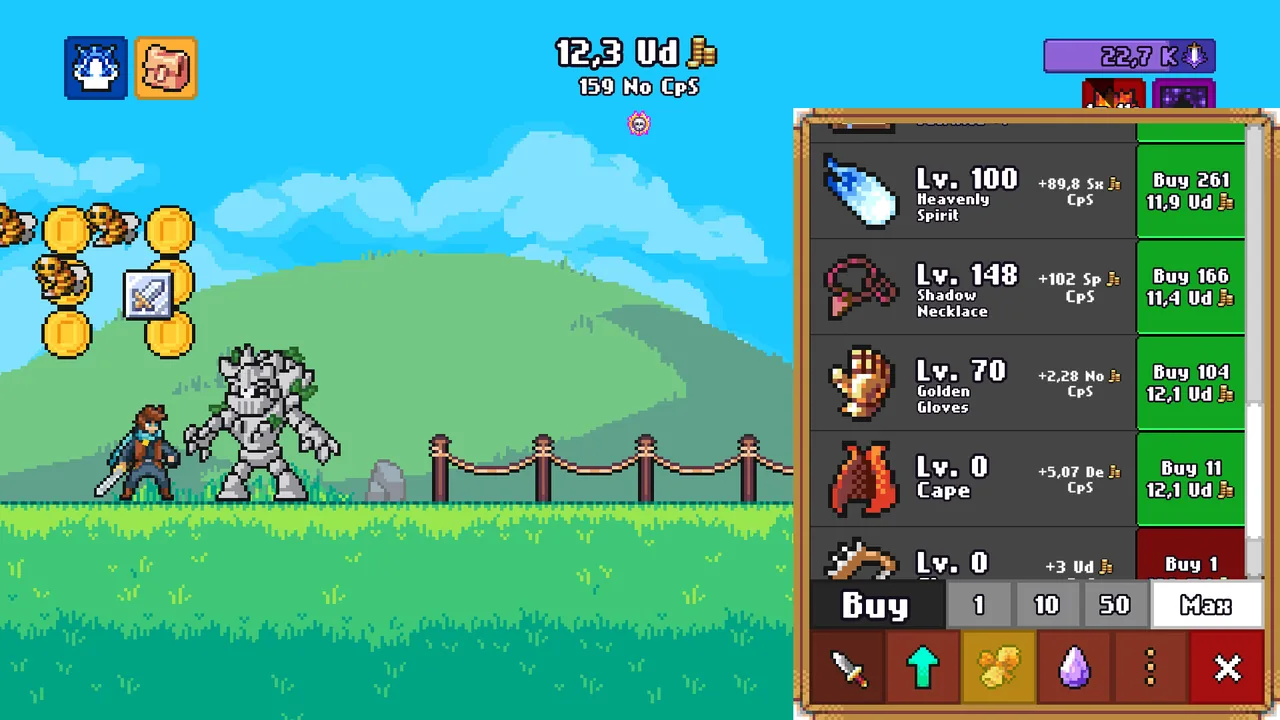
Beneath the two prestige layers sits a wide horizontal spread of secondary systems: craftable gear built from dimension-specific materials, a rotating cast of unlockable skins, companion pets that sit alongside the Slayer and contribute their own passive bonuses, and a Jewels of Soul shop that converts a premium currency into permanent economy boosts. Individually, none of these systems is complicated. Collectively, they're a lot to track, and the game's own player base is consistent about where the friction shows up: material drops for the later crafting tiers are RNG-gated heavily enough that progress can stall on bad luck rather than effort, turning what should be active grinding into passive waiting for the right roll. That's the genre's oldest complaint wearing a new dimension's coat of paint, and Idle Slayer doesn't dodge it any better than its peers do.
The pet system is a good example of the pattern. It's a legitimate passive-bonus layer — hatch, feed and level companions for their own multipliers — and it's popular enough that players regularly bring it up unprompted in Steam discussions. It's also one more system competing for the same currency and the same attention as gear, skins and the two ascension trees, and the game rarely tells you which one deserves priority this week.
Two storefronts, one shop
For most of its life, Idle Slayer ran an unusual split: free on mobile with rewarded ads and the Jewels of Soul shop, but a flat $4.99 to own on Steam, pitched to PC players on the strength of an ad-free, always-open desktop client. That arrangement has since been retired — Steam now carries the same free-to-play model as mobile, with existing purchasers grandfathered a currency bonus for their earlier support. It's the right call. Charging one platform for content the other gives away never made much sense for a game whose core loop is designed to run in the background regardless of what device it's on.
What's left is a single, consistent monetisation shape across all three storefronts. The Jewels of Soul shop takes real money and converts it into currency, gear boosts and time-savers, priced from $1.99 up to a steep $99.99 at the top of the bundle ladder — but the currency is also earnable for free through daily quests and in-run drops, and the pattern reported by long-term players is that patient free income eventually buys out most of what the shop sells. Mobile carries one purchase Steam doesn't need: ad removal, $9.99 outright or $3.99 a month, on top of ads that were never forced to begin with — watching one only doubles offline earnings or grants a bonus-stage retry. Nothing here gates content behind a wall a free player can't eventually climb; the complaint isn't predation, it's a shop with a very tall top rung and a lot of moving parts to compare against each other. Steam's own client is Windows-only, so the ad-free, always-on desktop experience that used to be the whole justification for paying isn't available to Mac or Linux players even now that it's free.
Presentation and endgame
Idle Slayer looks and sounds exactly like what it is: a solo developer's pixel-art project that prioritised systems over spectacle. The sprite work is clean and readable rather than showy, the 8-bit soundtrack does its job without asking for attention, and neither ever gets in the way of the numbers, which is the correct priority for a game this system-dense. It won't win anyone over on looks alone, and it isn't trying to.
The long tail is where the game earns its keep. 651 Steam achievements, cloud saves shared between phone and PC, a steady stream of seasonal events and new dimensions, and two stacked prestige layers combine into a game built to be returned to for months rather than finished in a weekend. Whether that tail stays interesting depends entirely on tolerance for the RNG-heavy stretches between ascensions — the players still active after a year are the ones who made peace with that rhythm early.
Verdict
Idle Slayer's best idea is also its most honest one: it built an idle game where choosing to pay attention actually pays better than not, and it never pretends otherwise. The two-tier Ascension structure gives that attention somewhere real to go, and the move to free-to-play everywhere fixed the one decision that never made sense. What holds it at a very good score rather than an excellent one is everything stacked around that core — a pet-and-crafting layer that grows faster than it explains itself, RNG gates that turn grinding into waiting, and a premium shop with more rungs than it needs.
Anyone curious what an idle game looks like when its active minigame is actually worth playing should install it free on whichever screen is closest. Players who want a genre entry that explains its systems as it goes, rather than trusting the wiki to do it, should expect a rougher first few hours than the coin trails suggest.
Players drawn to progression that keeps ticking over whether or not a screen is open may also want to look at Wanderer — it runs the same offline-respecting idea through a persistent world instead of a single restartable run.
Pros and cons
Pros
- Timing a jump run through a full coin trail pays out meaningfully more than letting it idle past, so the active layer earns its place instead of decorating one
- Ascension and Ultra Ascension stack two full prestige resets on top of each other instead of one flat "start over" button
- No forced ads on any platform, and the community consensus is that free currency alone clears the premium shop over a long enough session
- Steam finally matches the free mobile version instead of charging PC players for the same content, closing the game's oddest historical wrinkle
- 651 Steam achievements and shared cloud saves between phone and PC give long-term players plenty to chase without losing progress switching screens
Cons
- Late Ascension tiers lean on RNG-gated material drops that regular players flag as the point where grinding starts to feel like waiting rather than playing
- The active jump layer stops mattering the moment a session is left running, which undercuts the game's own headline mechanic during the hours most idle players are actually away
- The Jewels of Soul bundle range tops out at a steep $99.99, a premium-currency ladder idle games are usually built to avoid needing at all
- Steam is Windows-only, so the ad-free always-on desktop version isn't an option for Mac or Linux players
- The retro pixel art and 8-bit soundtrack are pleasant but unambitious next to how much system depth sits underneath them
Screenshots
-
Idle SlayerImage: Pablo Leban via Steam -
Idle SlayerImage: Pablo Leban via Steam -
Idle SlayerImage: Pablo Leban via Steam -
How the review scores each part of the gameWanderer Editorial -
The short versionWanderer Editorial