Game review
Idle Skilling
6.5 / 10
- Developer
- Lavaflame2
- Publisher
- Lavaflame2
- Released
- 23 September 2019
- Platforms
- Windows, iOS, Android
- Genre
- Idle RPG
- Monetisation
- Free to play with in-app purchases. The Steam listing doesn't itemise the shop, but Lavaflame2 runs the same gem-currency model as its later game — cosmetics and convenience sold alongside content that stays reachable through play.
- Players
- None. Single-player only, no guilds, no trading, no shared systems of any kind
The short version
Idle Skilling is where Lavaflame2 worked out the skill-web idea that Legends of Idleon later built an entire multi-character MMO around, and running it as a single character makes several of that formula's problems disappear. There's no roster to manage, no eleven inventories to empty, and the whole thing was built to be checked in five-minute bursts rather than owned as a second job.
What it loses next to its own sequel is scale and polish — fewer skills, a flatter interface, and a game that was quietly stopped being the studio's main focus once the bigger project took over.
Biggest strengths
- A single character removes the roster-management busywork that becomes a chore in Legends of Idleon
- Skills feed each other in the same way IdleOn's later web does, just with far fewer moving parts to track
- Sessions are genuinely built around checking in for a few minutes, not planning an AFK schedule
Biggest weaknesses
- The interface has not been meaningfully redesigned since its mobile-first 2019 debut and looks it on a monitor
- Fewer skills and a single character mean the interlocking-systems idea plateaus much sooner than in IdleOn
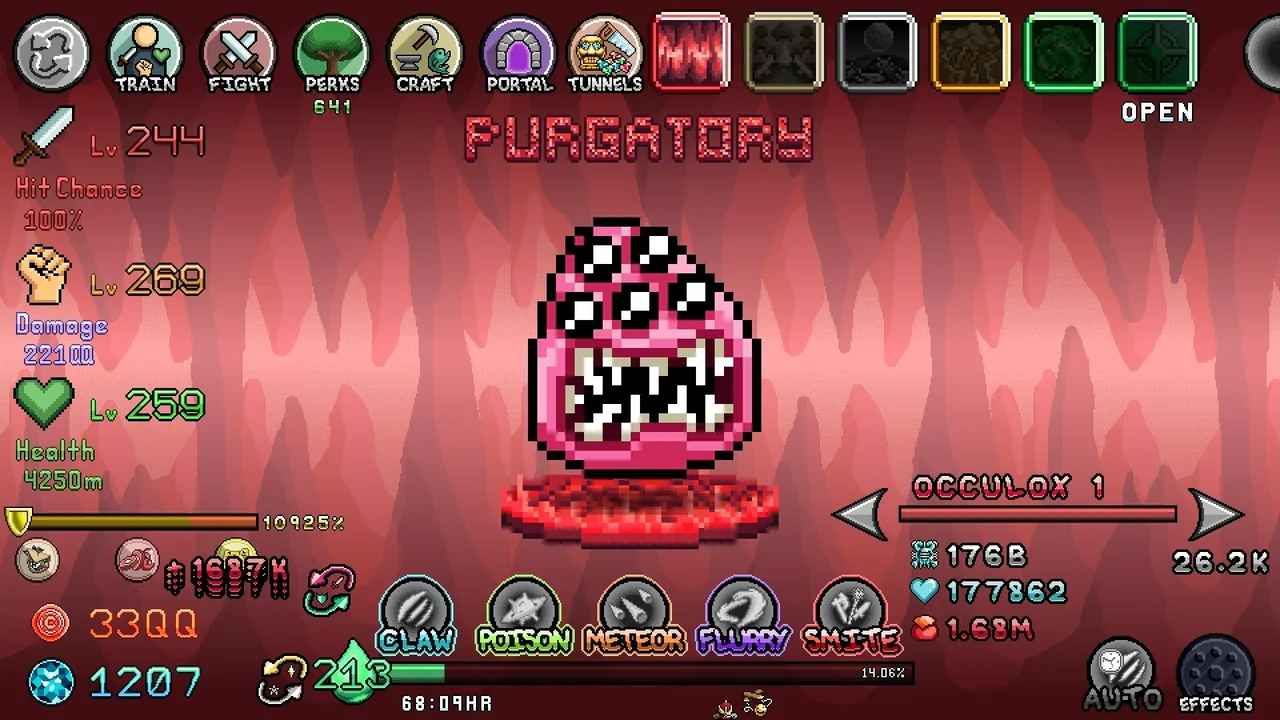
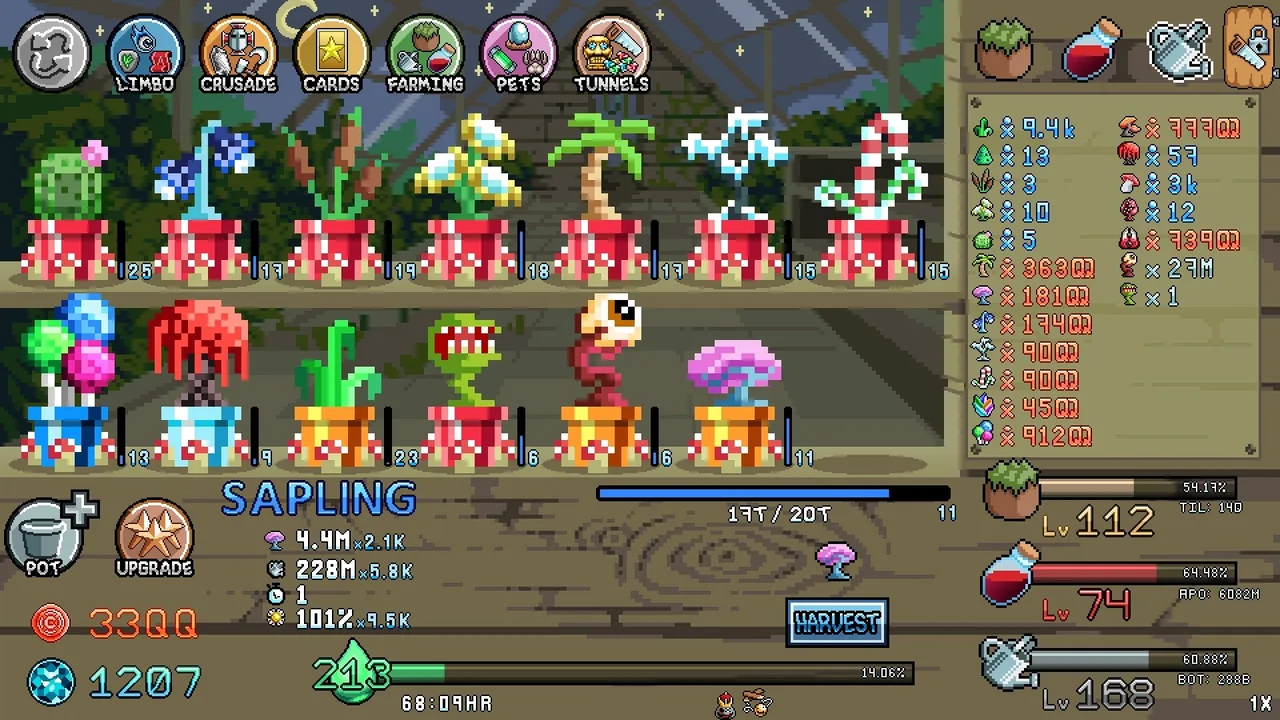
- Visual variety is thin — pixel-art icons and flat menus carry the entire presentation
Who it's for: Idle fans who want the Lavaflame2 skill-interlock formula without eleven characters to babysit, and anyone curious about Legends of Idleon who wants to see where its ideas started.
Our recommendation: Worth an install if short, low-commitment sessions suit you better than IdleOn's hours-long AFK planning. Don't expect it to keep receiving the sequel's level of attention.
6.5 / 10
Legends of Idleon didn't invent the idea of skills that feed each other — better mining making better smithing making better tools making better mining. Idle Skilling did, three years earlier, on a phone screen, with one character instead of eleven. Playing the two side by side, even just on paper, is the closest thing the idle genre has to a director's commentary track: you can watch Lavaflame2 work out which parts of the formula were worth scaling up, and which parts got left behind for good reason.
Idle Skilling first appeared on iOS in September 2019, roughly a year before Legends of Idleon reached Android and more than a year and a half before IdleOn's Steam debut. It didn't reach Valve's storefront itself until 15 September 2022, arriving as a smaller, quieter release next to a sequel that was already deep into Early Access and pulling most of the studio's attention. That timeline matters more than it might first seem — this isn't a spin-off or a mobile port trimmed down from the bigger game. It's the prototype, released after the sequel it inspired, in a genre where sequels usually bury their predecessors rather than sit next to them on the same platform.
One character changes everything
The single biggest structural difference between the two games is also the one that does the most work. Idle Skilling gives you exactly one character. There's no roster to build, no deciding which of eleven slots trains Alchemy versus Construction, no eleven separate inventories filling up while you're away. Every skill point, every piece of gear, every prestige currency belongs to the same character, all the time.
That sounds like less game, and in a strict feature-count sense it is. But it also removes the single biggest source of friction Legends of Idleon never solved: the bookkeeping tax of managing a crowd. IdleOn's roster planning is a genuinely interesting puzzle the first time you build it, and a repetitive chore every time after that, once you're emptying eleven bags and re-checking eleven card loadouts on every session. Idle Skilling never asks you to do any of that. You open the game, check on one character, adjust one queue, and close it again. If IdleOn's biggest structural regret is that it never automated its own scale, Idle Skilling's advantage is that it never had the scale to need automating in the first place.
The skill web, in miniature
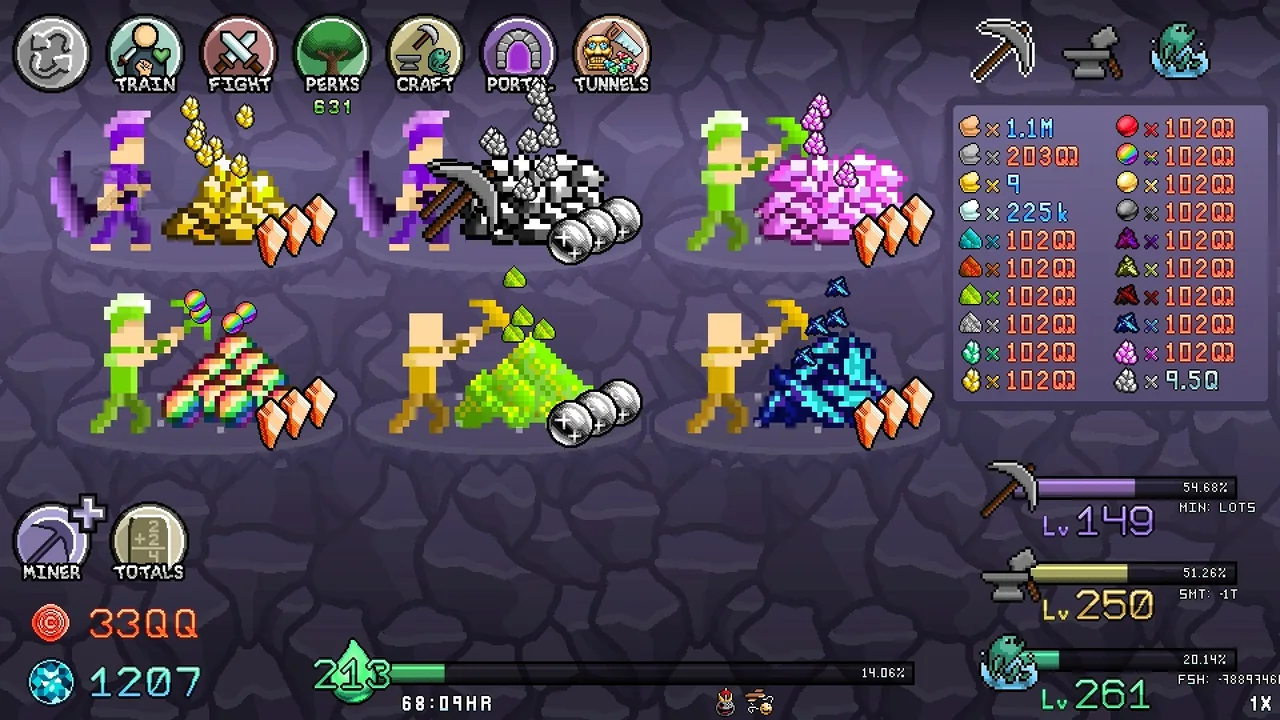
The interlocking-systems idea that makes Legends of Idleon's best moments work is present here in recognisable form: skills aren't separate minigames sitting next to each other, they feed into one another. Progress in a gathering skill unlocks better materials for a crafting skill, crafting produces the equipment that makes combat and further gathering faster, and prestige layers reset some of that progress in exchange for permanent multipliers that make the next run faster than the last. It's the same idea IdleOn would later stretch across twenty skills and dozens of classes, just running on a noticeably smaller engine.
That smaller scale is a genuine trade-off rather than a straightforward downgrade. With fewer systems in play, the web plateaus sooner — there's a point, well before Idle Skilling runs out of content, where you can see the whole shape of how its skills connect, in a way IdleOn's much larger web resists for a very long time. Whether that's a weakness depends entirely on what you want from an idle game. Players who found IdleOn's endless expansion exhausting rather than exciting will likely find Idle Skilling's tighter scope a relief. Players who came to Legends of Idleon specifically for the feeling of a system that never stops growing will find the smaller game runs out of that feeling much faster.
The prestige structure carries real weight here too, in the way well-built idle games use resets to make the next hour feel different from the last rather than just faster. Losing progress in exchange for a permanent multiplier is standard idle-genre currency, but Idle Skilling's single- character structure means every reset decision is legible in a way IdleOn's rarely is — there's only one character's progress to weigh against the bonus, not eleven characters' worth of compounding trade-offs.
An interface that never left 2019
Where the smaller scope stops being an advantage is presentation. Idle Skilling's interface reads exactly like what it is: a game designed for a phone screen in 2019 that has picked up new systems over the years without a corresponding redesign. Menus are flat, dense grids of small icons with minimal visual hierarchy, and the pixel-art skill icons that work fine at mobile thumbnail size feel sparse spread across a desktop monitor. Legends of Idleon inherited a version of this same problem — a MapleStory-indebted wall of numbers and icons that never got rebuilt for the game it grew into — and it's worth noting the flaw didn't start with the sequel. It started here, and IdleOn mostly just added more of it rather than fixing it.
The Windows build asks for almost nothing in return: a processor and memory specification that would have been modest a decade ago, no dedicated sound card requirement, a gigabyte of storage. That's consistent with a game built mobile-first and never re-engineered for anything more demanding, which cuts both ways — nobody's hardware will struggle with it, but nobody should expect it to look like a game built for 2026 either. There's no Mac or Linux build listed on Steam, which is a smaller omission than it would be for a heavier game, but still an odd gap for something this undemanding.
The shop, and what it inherited
Idle Skilling is free, with in-app purchases confirmed on its Steam listing but not itemised there the way some storefronts break down their shops in detail. What is verifiable is the studio's own throughline: the game's official support page routes directly to Legends of Idleon's website and a Lavaflame2 support inbox, which is as clear a signal as a developer can give that these two games share a business model as well as a design lineage. Judged against what Legends of Idleon's shop became — genuinely earnable content sitting next to convenience purchases (storage, card slots, crafting bonuses) that edge closer to progression than pure cosmetics usually do — Idle Skilling reads as the earlier, lower-stakes version of the same idea. There's no evidence on the storefront of anything IdleOn-style gated behind extreme luck or grinding, the way its sequel's 2025 companion system drew criticism for. That may simply be a function of a smaller game with a smaller live-ops budget rather than a deliberately gentler philosophy, but the practical result for a player checking it out today is the same: nothing here currently pressures a wallet the way the sequel occasionally does.
Steam's user-review numbers back up a "solid, not spectacular" read. The game sits at Mostly Positive, with roughly 70% of its 2,380 all-time reviews favourable — a level below Legends of Idleon's own all-time score, and one that tracks with a smaller, less actively maintained project rather than a broken one. A sample pulled from the most recent reviews on the store page runs noticeably cooler than the all-time figure, which is consistent with a game that receives far less day-to-day developer attention now that its sequel is the studio's flagship release.
Is it still worth starting in 2026?
This is the question that actually decides the score, and the honest answer is: it depends on what you're looking for, more than it depends on which game is "better." Legends of Idleon is objectively the larger achievement — more skills, more classes, more worlds, four and a half years of continuous updates, and a multiplayer layer Idle Skilling never attempts. If what you want is the deepest version of this studio's ideas, there's no contest, and Idle Skilling was clearly superseded by its own sequel in every dimension that scales.
But "superseded" isn't the same as "obsolete." IdleOn's scale is also its biggest cost: eleven characters' worth of maintenance, an interface that has never caught up with everything it now has to display, and sessions that reward players willing to treat AFK planning as a genuine hobby. Idle Skilling asks for none of that. It's a smaller, calmer, faster-to-understand version of the same core idea, and for a player who wants five minutes of meaningful decision-making rather than a second job, that's a real and specific advantage, not just a consolation prize for having missed the bigger game.
Final verdict
Idle Skilling is a well-made first draft that happens to still be playable, still free, and still structurally sound years after its own sequel eclipsed it. It won't hold anyone's attention the way Legends of Idleon does, and its interface shows its age in a way the sequel's does too, only earlier and more plainly. But the single-character structure fixes a real problem IdleOn never solved, and the skill-web idea that made the studio's reputation is present here in a genuinely enjoyable, much lower-commitment form.
Play it if short sessions and a single character sound more appealing than an eleven-person roster. Skip straight to Legends of Idleon if scale is what you're actually after — just know you're skipping the game that worked the idea out first.
Price and monetisation checked 30 July 2026.
Players who'd rather commit to one character on one continuous road than compare two versions of the same studio's idle formula might find Wanderer scratches a similar itch without asking you to pick between them.
Pros and cons
Pros
- A single character removes the roster-management busywork that becomes a chore in Legends of Idleon
- Skills feed each other in the same way IdleOn's later web does, just with far fewer moving parts to track
- Sessions are genuinely built around checking in for a few minutes, not planning an AFK schedule
- Free content is not gated behind the shop — nothing in the Steam listing suggests a paywall on systems
- Runs on almost nothing; the Windows minimum spec asks for hardware from two decades ago
Cons
- The interface has not been meaningfully redesigned since its mobile-first 2019 debut and looks it on a monitor
- Fewer skills and a single character mean the interlocking-systems idea plateaus much sooner than in IdleOn
- Visual variety is thin — pixel-art icons and flat menus carry the entire presentation
- Steam lists no Mac or Linux build despite the game's mobile-first, lightweight nature
- Update pace has clearly slowed since Legends of Idleon became the studio's flagship
Screenshots
-
Idle SkillingImage: Lavaflame2 via Steam -
Idle SkillingImage: Lavaflame2 via Steam -
Idle SkillingImage: Lavaflame2 via Steam -
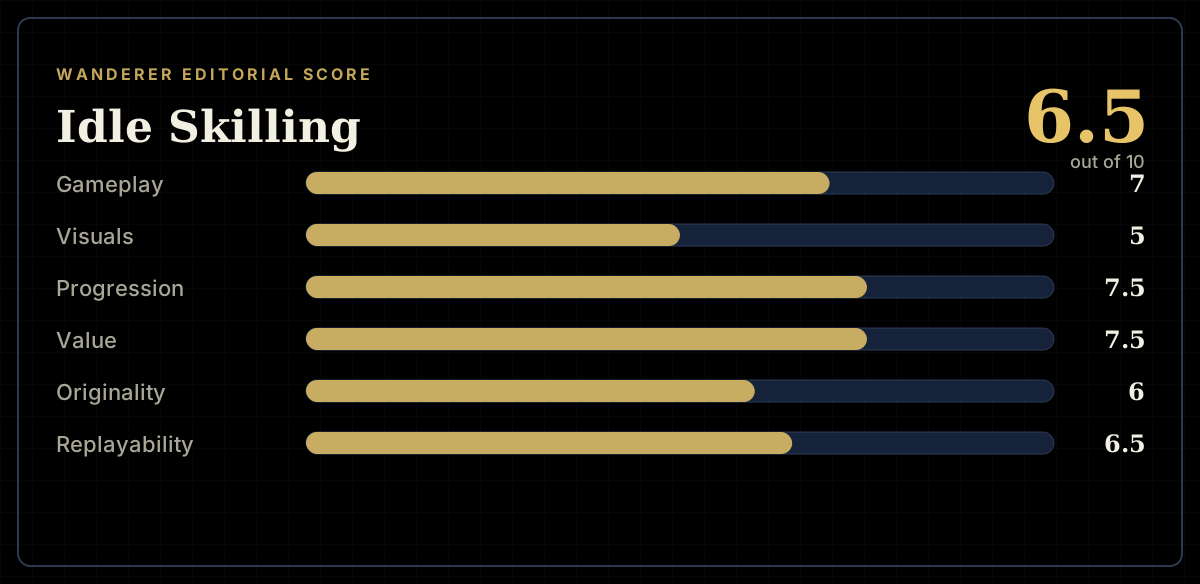
How the review scores each part of the gameWanderer Editorial -
The short versionWanderer Editorial