Game review
Tower Wizard
8 / 10
- Developer
- Barribob
- Released
- 19 June 2025
- Platforms
- Windows
- Genre
- Incremental RPG
- Monetisation
- One-time purchase; no ads, no in-app purchases, no DLC
- Players
- Single-player
The short version
Tower Wizard asks you to gather magic, summon spirits and construct rooms until a single tower grows into a small, self-sustaining kingdom, and it does that with a level of custom pixel art and musical charm that most five-dollar incrementals never bother chasing. The upgrade web is genuinely well tuned — new purchases keep unlocking small synergies with older ones rather than just inflating a number — and the game respects your time by actually ending instead of stretching itself out with endless prestige loops.
Where it loses ground is the prestige system itself, which a meaningful share of players found skippable and, at the very end, actively punishing, plus an interface that gets fiddly at higher scaling and offers no controller support. It's a short, confident, well-made incremental rather than a genre-redefining one.
Biggest strengths
- Fully custom pixel art and a calming, well-composed soundtrack give the genre an atmosphere it usually skips
- The upgrade tree keeps surfacing small synergies between buildings and spirits rather than just scaling one number upward
- Steam's review tally sits at roughly 97% positive across nearly nine thousand reviews, an unusually consistent verdict for a niche genre
Biggest weaknesses
- Prestige is easy to ignore entirely, and several players who did so found it added little beyond an optional detour
- Pressing the game's final "finish" button strips any banked prestige currency along with the run, an ending several reviewers found deflating rather than triumphant
- The interface gets fiddly at the upscaled resolution setting, with stray misclicks on upgrade buttons a recurring complaint
Who it's for: Incremental fans who want a few focused evenings rather than a hundred-hour commitment, and anyone burned out on clicker games that never let them stop playing.
Our recommendation: Buy it. At under five dollars it's one of the cheaper ways into a well-polished, self-contained incremental, though players chasing a long endgame should temper their expectations around length.
8 / 10
Most incrementals treat an ending as a design failure to be delayed with ever-steeper prestige curves. Tower Wizard treats it as the point. Barribob's follow-up to 2024's Magic Archery hands you a single wizard and a single tower, and everything you do — gathering magic, summoning spirits, constructing rooms, researching new spells — is aimed at finishing that tower rather than perpetually re-optimising it. It's a small, confident game that knows exactly how long it wants to last, and it spends that time well.
The loop: a tower that grows room by room
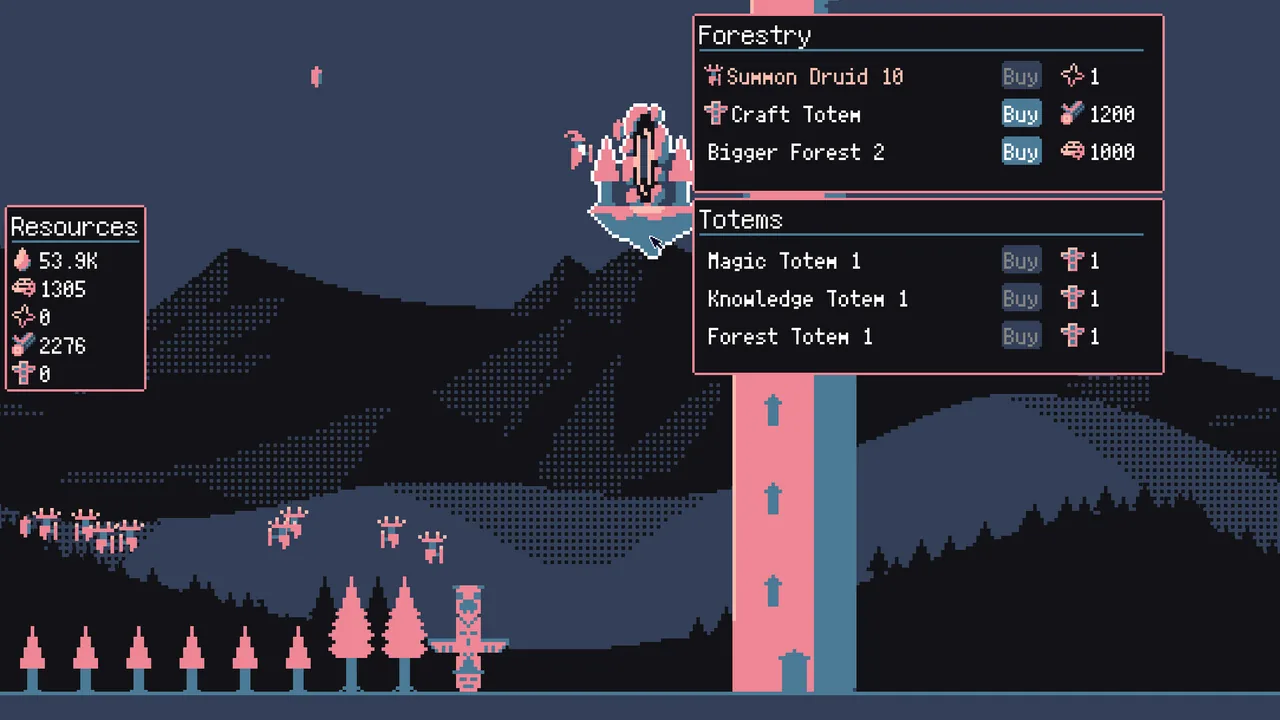
The premise is simple enough to explain in one sentence: gather magic, spend it on upgrades and buildings, watch the tower get taller and busier. What keeps that loop from feeling generic is how tightly its pieces lean on each other. Spirits summoned early on gather raw resources faster; those resources fund buildings that unlock new spells; those spells, in turn, change what the spirits are capable of doing next. None of this is presented as a formal skill tree with branching paths — it's closer to a steady accumulation of small, complementary systems that keep suggesting new combinations rather than a straight line of bigger numbers replacing smaller ones. Steam reviewers describe the appeal in almost identical terms: the satisfaction comes from noticing a synergy between two upgrades that don't look related on paper, not from watching one meter climb.
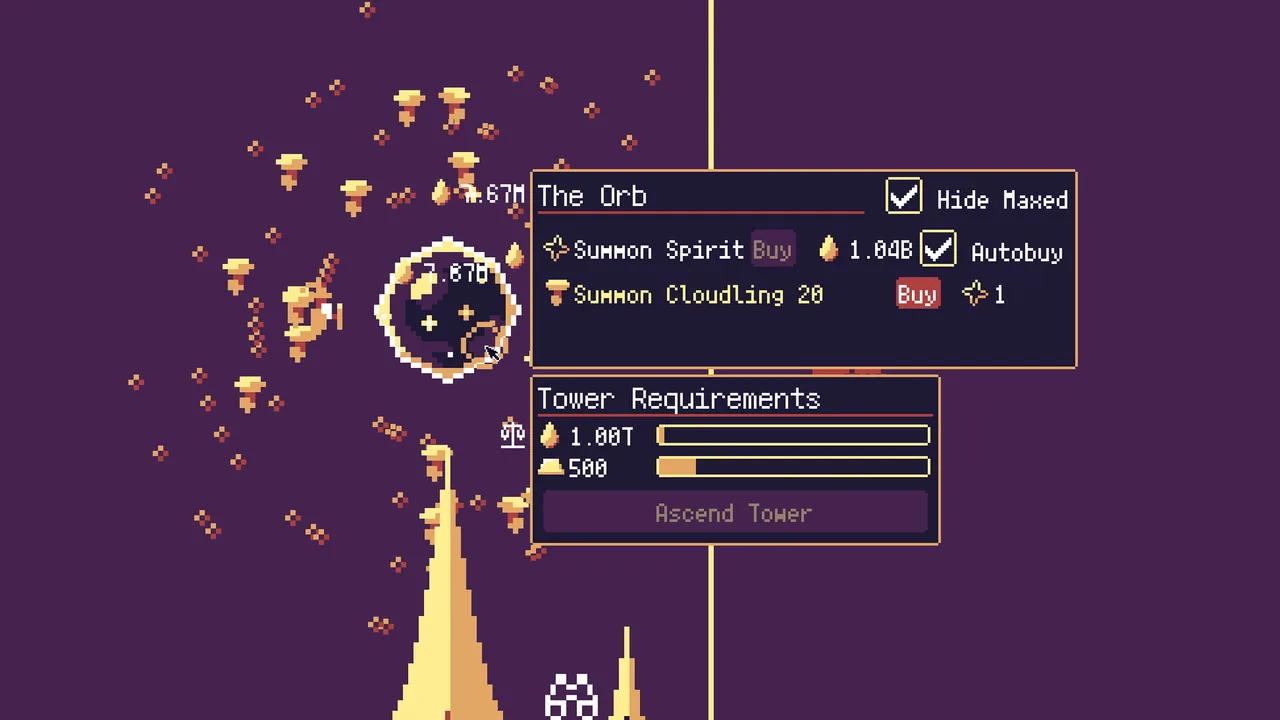
Twelve Steam achievements sketch the shape of the back half of the game — elemental "walls" (Solar, Cloud, Cosmic), a Holy Grail, totems, an "Inverted" state and, tellingly, one simply called The End. That last one matters more than it looks. Tower Wizard is built to be completed, and the fact that finishing is a named, celebrated achievement rather than an afterthought sets the tone for how the whole game is paced.
Prestige is where opinion splits
The one system that divides the game's audience is prestige. Structurally it's familiar: reset your progress, keep a portion of it as a permanent bonus, come back stronger. Tower Wizard implements it gently — one widely echoed player report notes needing only a handful of resets across an entire playthrough, nothing like the dozens of cycles some incrementals demand. That restraint is a deliberate strength for players who dislike the genre's more grindy resets.
It's also the game's most contested design decision. A meaningful slice of Steam reviews argue that Tower Wizard can be finished without ever prestiging at all, which makes the system feel optional to the point of irrelevance for players who don't go looking for it. More pointed still, several reviewers describe the game's final "finish" button as actively punishing: triggering the ending wipes the current run clean, including any prestige currency banked along the way, so the moment meant to feel like a victory lap instead reads to some players as losing progress for no clear reward. It's not a bug — the game behaves exactly as designed — but it's a rough edge in an otherwise well-thought-through structure, and it's worth knowing about before you hit that button expecting a clean send-off.
Presentation carries more weight than the price suggests
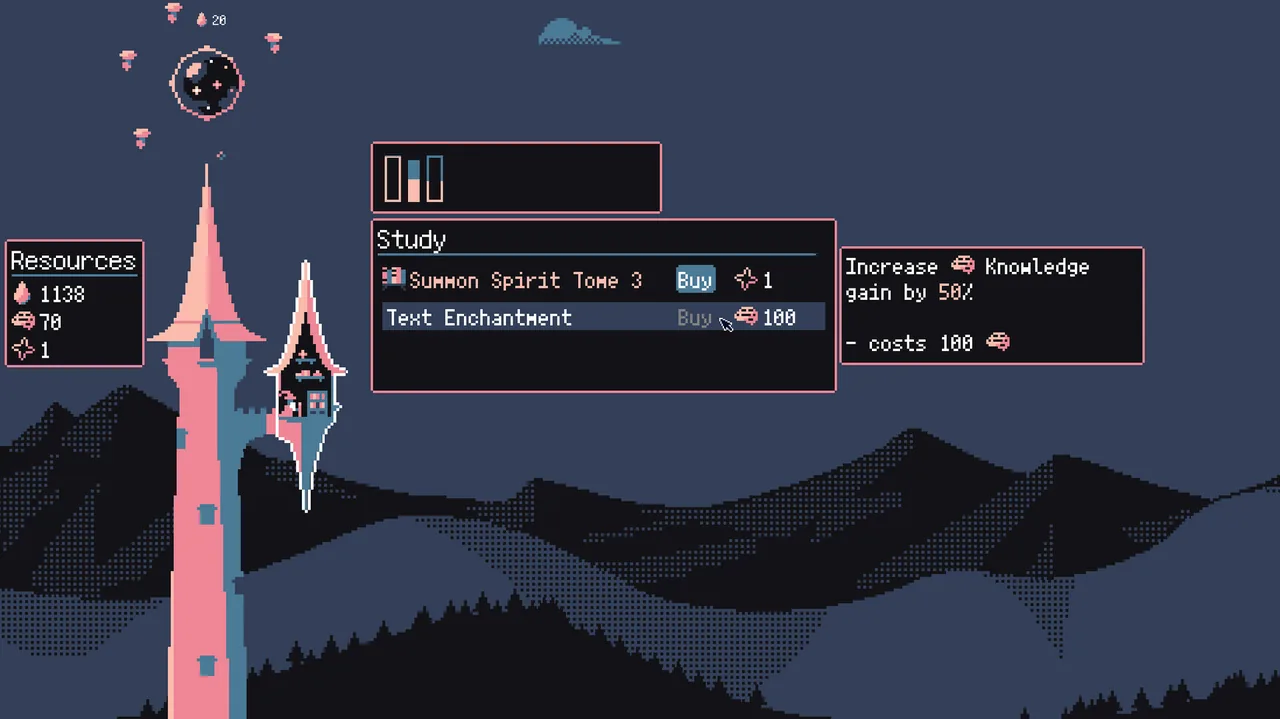
For a NZ$4.49 game, Tower Wizard's presentation punches well above its price bracket. Every sprite in the tower, from the building exteriors to the spirits flitting around gathering resources, is custom pixel art rather than the stock-asset patchwork that fills out a lot of the budget incremental space, and the soundtrack is consistently singled out by players as calming rather than merely inoffensive background noise. It's the kind of atmosphere that makes leaving the game running in a background window genuinely pleasant instead of purely functional, and it's a large part of why the reception has been as warm as it has.
Performance isn't really a question worth dwelling on — this is a lightweight 2D incremental with no reported stability complaints, and it runs comfortably on essentially any Windows machine capable of running a Steam client at all. The interface is the one place presentation gets shakier: more than one player specifically flags an upscaled display option as the point where things get fiddly, with misclicks on upgrade buttons a recurring minor annoyance. Add in the complete absence of controller support — odd, given the game otherwise ships with adjustable text size, colour alternatives and a mouse-only play option — and the interface ends up the weakest link in an otherwise tidy package.
Value and how long it actually lasts
Length is the other recurring theme in player feedback, and it cuts both ways depending on what a reader wants from an incremental. Reported playtimes cluster heavily in the two-to-nine-hour range, with most players describing the game as comfortably finishable across one to three sittings. For anyone who's grown tired of incrementals that manufacture artificial length through repeated resets and inflating grind walls, that's presented as a selling point — several reviews explicitly praise Tower Wizard for not overstaying its welcome or padding itself out with busywork. For anyone shopping for a long-haul incremental to sink weeks into, the same trait reads as a limitation: a handful of reviews describe the game as too short or too thin once the core loop has been seen once, with the back half in particular accused of dragging without adding meaningfully new mechanics.
At under five dollars, though, the arithmetic is hard to argue with. Even a conservative two-hour playthrough puts the cost per hour well below almost anything else on the incremental shelf, and the near-universal praise for the art and music means that time is spent somewhere genuinely pleasant to look at and listen to, rather than merely tolerated on the way to the next number.
Verdict
Tower Wizard earns an 8.0 by doing a small number of things very well rather than chasing genre breadth. The upgrade web rewards attention without demanding a spreadsheet, the presentation is several notches above what the price implies, and the willingness to actually end the game — rather than stretch it into an indefinite prestige loop — is a genuinely rare virtue in this genre. It loses ground on the prestige system's diminishing relevance and its oddly deflating final button, on an interface that gets fussy at higher scaling with no controller fallback, and on a runtime that some players will find satisfyingly tight and others will find simply thin.
Anyone looking for a short, well-made incremental to fill an evening or two — something that respects a definite ending instead of asking for an open-ended subscription of attention — should buy this without much hesitation. Players who measure an incremental's worth in hundreds of hours of late-game optimisation will want to adjust expectations accordingly. Wanderer players who like watching a base grow passively while they're away from the keyboard will recognise the appeal of a tower that keeps building itself even when nobody's watching the number tick over.
Pros and cons
Pros
- Fully custom pixel art and a calming, well-composed soundtrack give the genre an atmosphere it usually skips
- The upgrade tree keeps surfacing small synergies between buildings and spirits rather than just scaling one number upward
- Steam's review tally sits at roughly 97% positive across nearly nine thousand reviews, an unusually consistent verdict for a niche genre
- The game has an actual, definite ending instead of an infinite prestige treadmill, so a single purchase gets fully used up
- NZ$4.49 undercuts most of the incremental genre for the amount of finished, polished content delivered
Cons
- Prestige is easy to ignore entirely, and several players who did so found it added little beyond an optional detour
- Pressing the game's final "finish" button strips any banked prestige currency along with the run, an ending several reviewers found deflating rather than triumphant
- The interface gets fiddly at the upscaled resolution setting, with stray misclicks on upgrade buttons a recurring complaint
- No controller support, despite a decent spread of other accessibility options
- Most players clear the whole game in under ten hours, which will read as too short for anyone wanting a long-haul incremental
Screenshots
-
Tower WizardImage: Barribob via Steam -
Tower WizardImage: Barribob via Steam -
Tower WizardImage: Barribob via Steam -
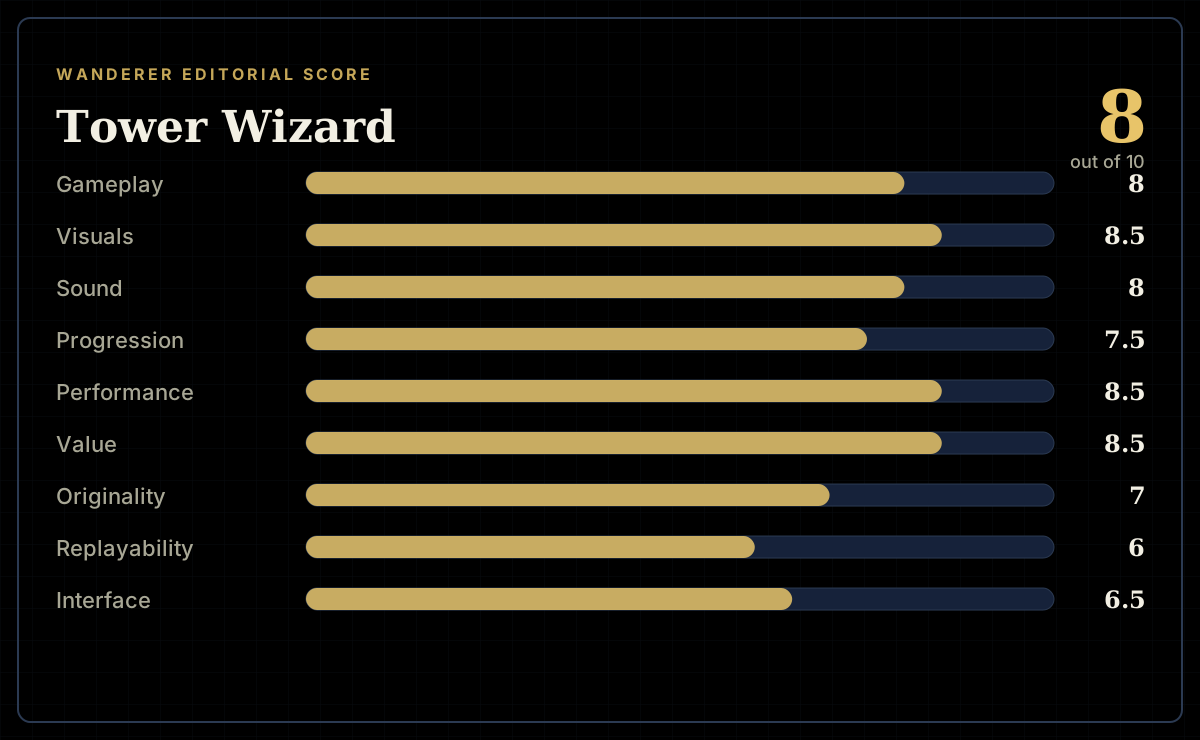
How the review scores each part of the gameWanderer Editorial -
The short versionWanderer Editorial