
Game review
10-Man Idle
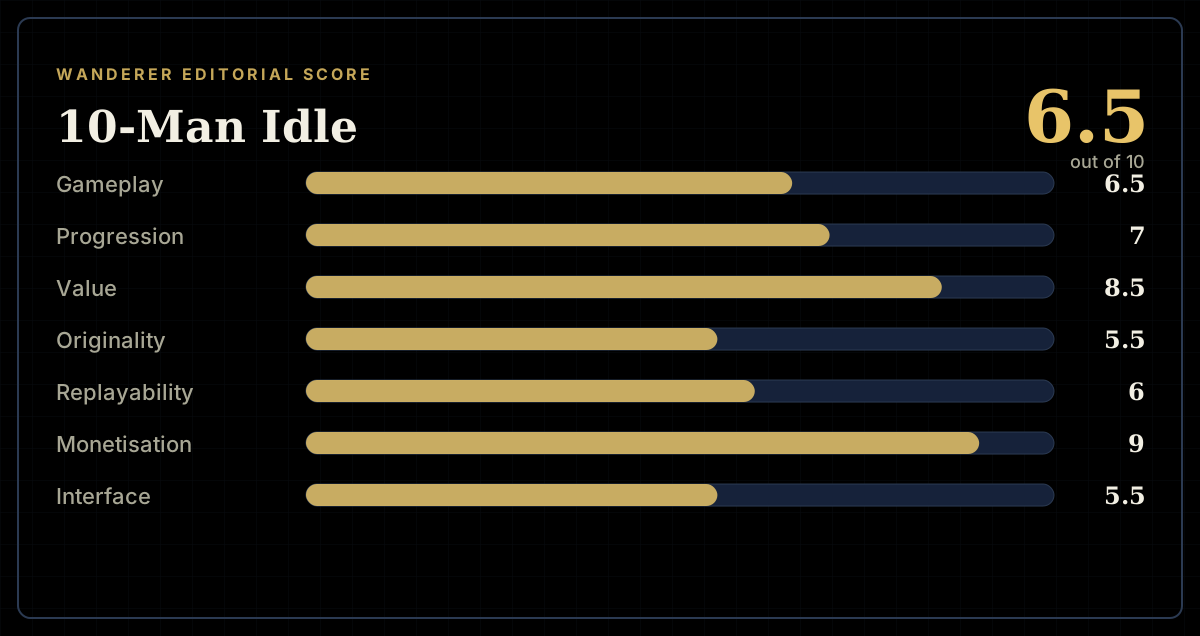
6.5 / 10
- Developer
- JLGames
- Publisher
- JLGames
- Released
- 1 August 2026
- Platforms
- Windows, macOS
- Genre
- Guild Management Idle RPG
- Monetisation
- One-time purchase. No microtransactions, no advertising, no DLC on the store page
- Players
- Single-player only
The short version
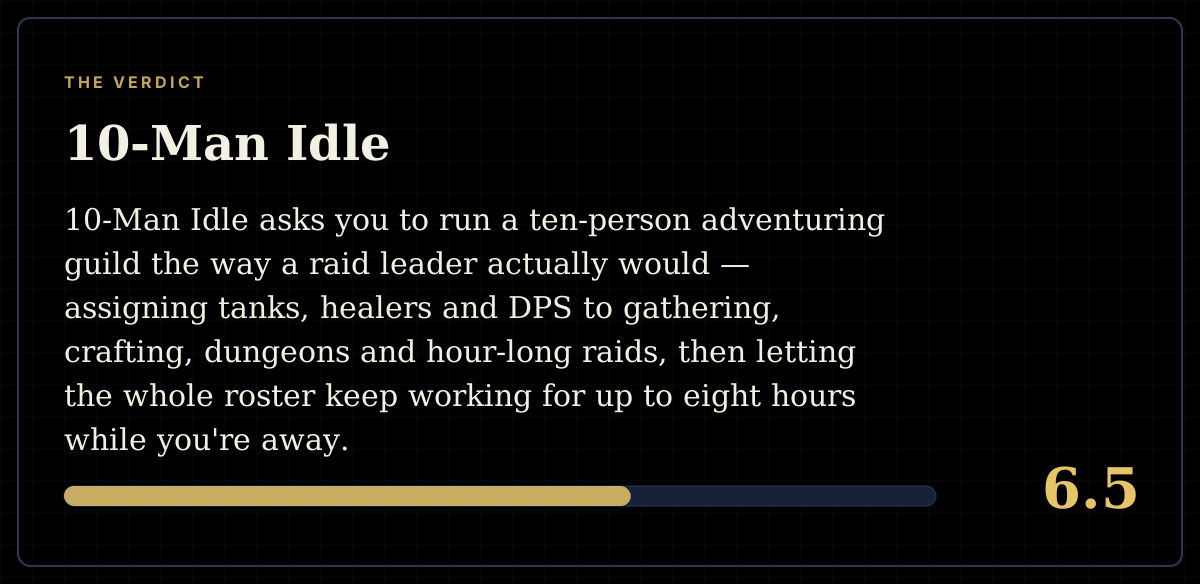
10-Man Idle asks you to run a ten-person adventuring guild the way a raid leader actually would — assigning tanks, healers and DPS to gathering, crafting, dungeons and hour-long raids, then letting the whole roster keep working for up to eight hours while you're away. Eleven classes and eleven professions running eight to ten tiers deep is a genuinely large amount of system for a solo developer to have built, and the complete absence of any purchase beyond the NZ$7.39 asking price is close to unheard of in this genre. What keeps it from landing higher is that its dungeons and raids don't auto-repeat, which turns the game's most idle-friendly content into the one part of the loop that still needs a player parked at the keyboard.
Biggest strengths
- Eleven classes covering tank, healer and DPS roles give party composition an actual decision to make, rather than treating every hero as an interchangeable stat stick
- Eleven professions running eight to ten tiers each give the crafting side of the game a long, legible ladder instead of a shallow gathering minigame bolted onto the RPG
- A single NZ$7.39 purchase with no in-app purchases, ads or DLC — genuinely nothing else on the store page to buy
Biggest weaknesses
- Dungeons and raids do not repeat automatically, so the content that should anchor an idle game's late game currently requires a player to manually re-launch every run
- Equipment doesn't show which classes or weapon types can use it until after it's been crafted, turning gearing into a trial-and-error guess rather than an informed choice
- A scripting bug in the recipe generator has produced near-duplicate item variants across rarity tiers, a launch-week rough edge one early reviewer flagged in blunt terms
Who it's for: Idle RPG players who want genuine class and profession depth rather than a single skilling ladder, and anyone burned by free-to-play guild games who wants to pay once and be done with it.
Our recommendation: Worth the price of a coffee if you're willing to treat it as a young 1.0 release rather than a finished product — the professions and gear systems are already substantial, but go in expecting to babysit dungeon and raid queues manually until the developer ships the auto-repeat feature that's reportedly already in testing.
6.5 / 10
Most idle RPGs sell you a single hero and let a stat sheet do the rest of the work. 10-Man Idle hands you an entire raid roster instead — ten adventurers split across eleven classes, each one needing a role, a profession and somewhere useful to be sent while you're not looking — and it's the shape of that ambition, more than any single system inside it, that makes the game worth paying attention to barely a day after its 1.0 launch. It's also, six months out from an Early Access start most of its current audience never saw finished, a game that still asks you to babysit the exact content it should be running without you.
Running a guild instead of a hero
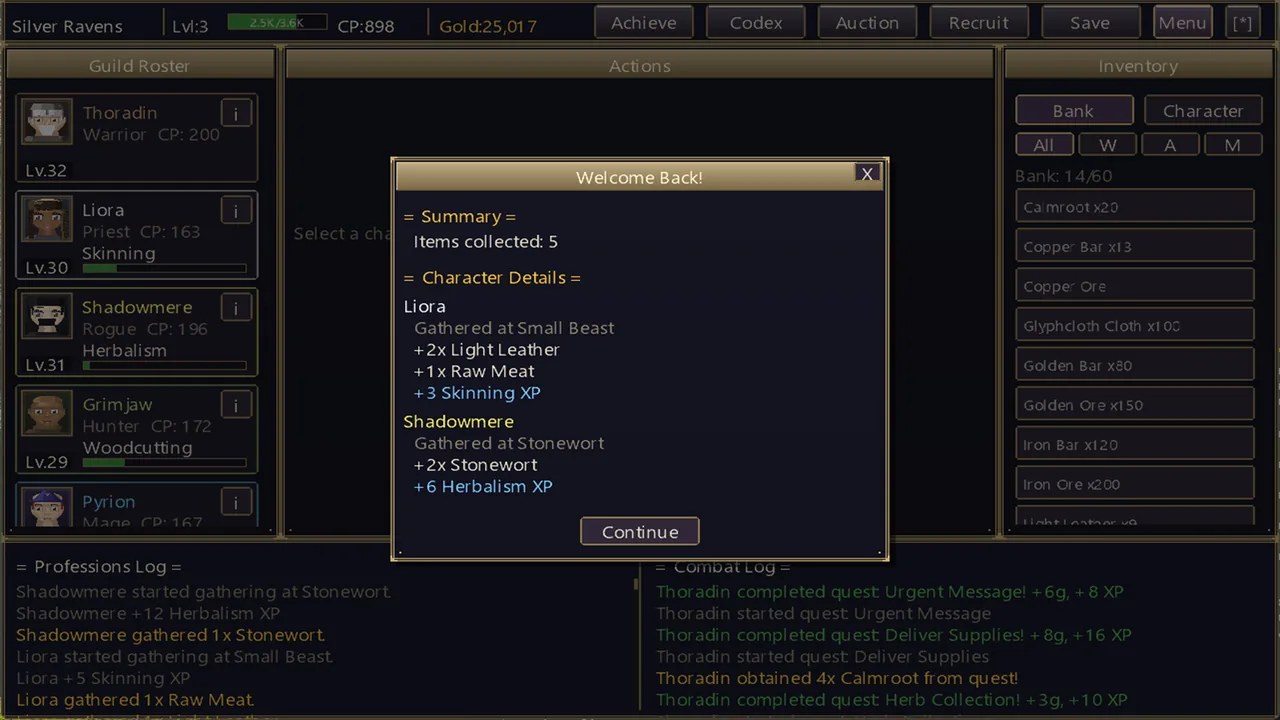
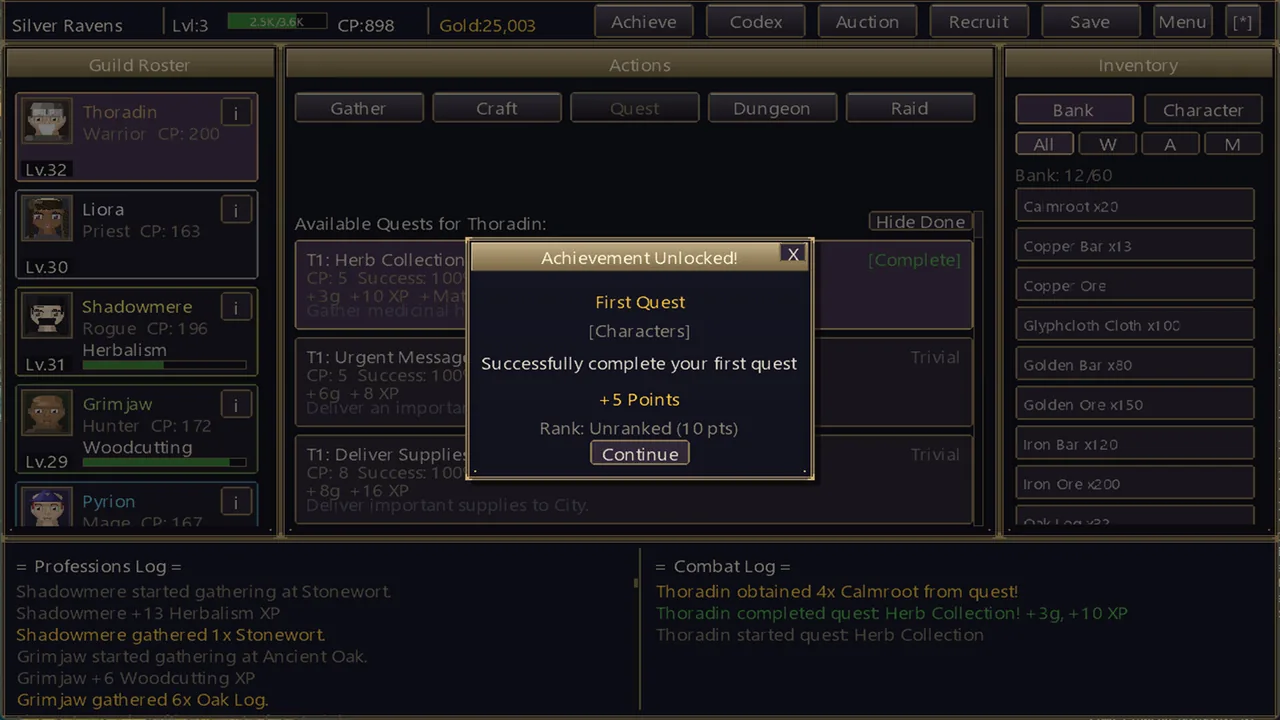
The pitch is guild management rather than a single climbing number. You recruit adventurers into Warrior, Paladin, Mage, Rogue, Priest and six other classes, each filling a Tank, Healer or DPS role, and the roster only works if the composition does — sending an all-DPS party into a dungeon built around a tank soaking hits is the kind of mistake the game actually punishes, rather than one it politely papers over with bigger numbers. That's a real point of difference from the genre's more common "eleven heroes, one job each" structure, where role only matters cosmetically. Here it determines whether a run succeeds.
Alongside combat sits an equally serious crafting side: eleven professions spanning gathering (mining, harvesting, fishing) and crafting (smelting, brewing, cooking, enchanting), each running eight to ten tiers deep. That's a legitimate amount of content for a solo developer to have built and balanced, and it gives 10-Man Idle something a lot of idle RPGs skip entirely — a reason to keep half your roster on profession duty even once combat has somewhere to send the rest. Gear comes in five rarity tiers, and the loop of gathering feeding crafting feeding the party's combat effectiveness is coherent enough that it doesn't feel like two separate games stapled together.
The part that should run itself, doesn't
The trouble starts exactly where an idle game's trouble shouldn't: the content meant to define the mid-and-late game. Dungeons exist to raise guild level, guild level gates access to more dungeons and eventually raids, and none of the three currently repeat on their own. In a game whose entire premise is that the guild keeps working while you're elsewhere, having to manually relaunch the one activity that actually advances your account is a genuine structural contradiction, not a minor inconvenience. One of the earliest and most detailed Steam reviews called this out specifically, and the developer's own reply confirmed auto-repeating dungeons and raids were already written and being tested for an upcoming patch — which suggests the gap was a launch sequencing issue rather than a design choice, but it's still the thing sitting at the center of the loop for anyone playing 10-Man Idle in its current form.
It compounds with a second friction point: gear doesn't tell you which class or weapon type can actually equip it until after you've spent professions' worth of materials crafting it. For a game this deliberate about class identity mattering, discovering compatibility after the fact rather than before committing resources is an odd inconsistency, and it's exactly the kind of thing that should be a quick interface fix rather than a systemic one.
A young 1.0, not a finished product
It's worth being precise about what "released 1 August 2026" actually means here, because the Steam review page doesn't reflect it yet. 10-Man Idle spent roughly six months in Early Access before this week's 1.0 launch, and every review currently attached to the store page — all seven of them — was written in the first two weeks of that Early Access period, back in early February. None of that feedback has caught up with whatever the 1.0 build actually ships with, which means the "too few reviews for a score" state Steam shows right now is honestly the correct read: there simply isn't a current-version sentiment to report yet, positive or otherwise.
What that early batch does show is a pattern worth noting anyway, because several of the specific complaints line up with what's still true post-launch: one player described a loot-generation bug that produced repeated near-identical item variants across rarity tiers in blunt, dismissive terms, and the developer's reply traced it to a nested loop in the recipe-generation script rather than disputing that the bug existed. Another flagged a UI click bug that made buttons unresponsive entirely, which the developer says has since been fixed. That back-and-forth is a genuinely good sign for a solo project — every single review with a complaint got a specific, technical, dated response from the developer, not a form-letter acknowledgment — but it also means 10-Man Idle is still very much a game being built in public, six months of Early Access notwithstanding.
Value and monetisation
There's almost nothing to criticise here, which is rare enough in this genre to be worth highlighting on its own. 10-Man Idle costs NZ$7.39, once, with no in-app purchases, no advertising and no DLC anywhere on its store page — a solo developer explicitly committing, in the store description itself, to never adding microtransactions. For a genre where the more common shape is free-to-play with a VIP ladder or a gem shop creeping toward the core loop, a flat one-time price with genuinely nothing else to buy is close to the cleanest monetisation model this category offers. Whatever else needs patching, nobody buying 10-Man Idle needs to wonder what they're being sold next.
Final verdict
10-Man Idle has the bones of a very good guild management idle RPG: real class roles, a crafting economy with actual depth, meaningful offline progress and a pricing model that asks for one honest payment and stops there. What keeps it in solidly middling territory rather than a clear recommendation is that its central idle-game promise — content that keeps advancing without you — currently breaks down at the exact point that should prove it, because dungeons and raids need a player to keep relaunching them. Add an equipment system that doesn't tell you what a hero can wear until you've already crafted it, and a launch-week item-generation bug, and you have a game whose foundations are more convincing than its current execution.
None of that is necessarily permanent. A developer who answers bug reports with specific, technical fixes within days, and who was already testing auto-repeat dungeons before this review went up, is a good bet to have closed the gap between "ambitious systems" and "systems that actually run themselves" within a few patches. Right now, though, judge it on what shipped: a promising, honestly priced idle RPG that still needs you to do some of the idling yourself.
Players who'd rather see this kind of class-and-profession depth wrapped around a persistent, already-idle-friendly world might compare it with genre regulars like Melvor Idle or the long-running solo-developer project Legends of Idleon, both of which solved the auto-repeat problem years ago. Readers who liked the multiplicative-economy angle of Archmage Idle will recognise the same "genuinely deep systems, rough execution" trade-off here. And anyone who wants that guild-keeps-grinding-while-you're-away feeling tied to a persistent world instead of a closed save file might also want to look at Wanderer.
Pros and cons
Pros
- Eleven classes covering tank, healer and DPS roles give party composition an actual decision to make, rather than treating every hero as an interchangeable stat stick
- Eleven professions running eight to ten tiers each give the crafting side of the game a long, legible ladder instead of a shallow gathering minigame bolted onto the RPG
- A single NZ$7.39 purchase with no in-app purchases, ads or DLC — genuinely nothing else on the store page to buy
- The developer has replied individually to early bug reports with specific technical explanations and shipped fixes within days rather than leaving reports unanswered
- Up to eight hours of offline progress means a guild kept working overnight or during a workday, not just a token catch-up bonus
Cons
- Dungeons and raids do not repeat automatically, so the content that should anchor an idle game's late game currently requires a player to manually re-launch every run
- Equipment doesn't show which classes or weapon types can use it until after it's been crafted, turning gearing into a trial-and-error guess rather than an informed choice
- A scripting bug in the recipe generator has produced near-duplicate item variants across rarity tiers, a launch-week rough edge one early reviewer flagged in blunt terms
- Every review currently on Steam was written during the six-month Early Access build, months before the 1.0 release this review covers, so the public review score reflects an older version of the game
- No Linux build, in a genre whose audience skews toward players who like to leave a game running in the background on whatever machine is free
Screenshots
-
10-Man IdleImage: JLGames via Steam -
10-Man IdleImage: JLGames via Steam -
10-Man IdleImage: JLGames via Steam -
How the review scores each part of the gameWanderer Editorial -
The short versionWanderer Editorial