Game review
Legends of Idleon
7 / 10
- Developer
- Lavaflame2
- Publisher
- Lavaflame2
- Released
- 9 November 2020
- Platforms
- Windows, iOS, Android, Browser
- Genre
- Idle MMORPG
- Monetisation
- Free to play. A gem currency buys cosmetics and collectible companions, plus convenience items — storage space, card slots, crafting-bonus unlocks, an auto-loot pickup — that sit closer to the core loop than pure cosmetics do.
- Players
- Shared-world MMO systems — guilds, trading, party dungeons, world bosses, friend bonuses — layered on top of a single-player idle core; no PvP
The short version
Legends of Idleon is the idle genre's most ambitious class-and-skill web — eleven starting characters, dozens of classes branching off three archetypes, twenty interlocking skills and a world map that keeps unfolding years after most idle games would have run out of ideas. The scale is real and mostly free to reach.
What holds it back from the top tier is friction on two fronts: an interface that has never been redesigned for the game it grew into, and a gem shop that has drifted from convenience toward outcomes that matter, most visibly in the companion system introduced in late 2025.
Biggest strengths
- Twenty skills and dozens of classes genuinely interact — a warrior's mining stat feeds a mage's smithing queue
- Eleven character slots turn the roster into a real specialisation puzzle rather than eleven copies of the same build
- Guilds, a player marketplace, party dungeons and world bosses give the "MMO" label real substance despite no PvP
Biggest weaknesses
- The interface is a dense, MapleStory-indebted wall of icons and numbers that has not been redesigned to match the game's growth
- Storage space, card slots and crafting-bonus unlocks are gem-shop items that sit closer to progression than cosmetics usually do
- A companion system added in late 2025 drew sustained criticism for gating its strongest pets behind extreme luck, long grinds, or direct purchase
Who it's for: Spreadsheet-brained idle fans who want more knobs than the genre usually offers, and RuneScape-adjacent skillers who don't mind a screen full of numbers to get them.
Our recommendation: Free to try, and worth a serious look if multi-character idle management appeals to you at all. Stick to the first two or three worlds before deciding whether the gem shop bothers you — that's where the convenience purchases start pressing harder.
7 / 10
Most idle games give you one character and dare you to stop watching it. Legends of Idleon gives you eleven, hands each one a different job, and then asks whether you can actually run a roster instead of just multiplying your clicking by eleven. That question — is managing this many characters a strategic puzzle or just the same chore times eleven — sits underneath everything else the game does, and the answer changes depending on which system you're looking at.
It is also, quietly, one of the longest-running Early Access success stories on Steam: a single developer, working under the name Lavaflame2, shipped it on Android in late 2020, brought it to Steam in April 2021, added iOS in 2022, and kept adding worlds, classes and skills for four and a half years before the storefront finally listed a full release on 6 November 2025. Very few idle games get that much runway. Fewer still spend it as productively as this one has.
Eleven heroes, one attention span
The core loop is standard idle-genre shape at first glance: pick a character, send it to chop wood or punch slimes, watch a number climb, spend the number on upgrades. What's different is the scale Idleon applies to that loop. You can eventually run up to eleven characters in parallel, each queued into a different skill or hunting ground, each contributing to a shared account-wide stash, and each one you level is a permanent investment rather than a disposable alt.
That structure genuinely rewards planning. A common early build sends a Warrior to mine, a Mage to chop wood, and an Archer to fish, because each class carries passive bonuses to skills outside combat — Idleon's real trick is making "who does what" a puzzle with actual wrong answers, not just a flavour choice. Deciding which of your eleven slots trains Alchemy versus Construction versus straight combat is the kind of decision that pays off or costs you weeks later, and that's a rarer thing in this genre than the marketing copy of most idle games would have you believe.
Where it stops being strategy and starts being bookkeeping is in the maintenance. Eleven characters means eleven inventories to empty, eleven card loadouts to check, eleven storage runs to make when a bag fills up mid-AFK. None of that is hard. All of it is repetitive in a way the genre's better-designed games have found ways to automate or abstract away, and Idleon mostly hasn't — you feel every one of those eleven slots as a small tax on your attention every time you sit down with the game.
A skill web disguised as a class tree
Twenty skills exist across combat and non-combat categories — Mining, Smithing, Choppin, Fishing, Catching, Trapping, Worship, Alchemy, Construction, Cooking, Sailing, Farming and more — and the class system sits directly on top of them rather than beside them. Three starting archetypes, Warrior, Archer and Mage, branch twice more into named specialisations, and specialisations branch again into secret advanced classes discovered rather than simply unlocked. By the time every branch and hidden tier is counted, the storefront advertises 38 classes in total, and each one carries its own passive skill affinities that ripple back into the roster-planning problem above.
The payoff is that almost nothing in Idleon sits in isolation. Better Mining feeds Smithing materials. Better Smithing produces the tools that make Mining faster. Better Cooking keeps your active fighters standing in encounters long enough to farm the drops the whole chain depends on. It's the same "pull one thread, three others move" idea that the best skill-based idle games lean on, just applied across a wider cast of characters instead of one. Few idle RPGs commit this hard to making every system a dependency of every other system, and it's the single best reason to spend real time here.
The cost of that ambition is legibility. New players are handed most of this complexity within the first couple of hours, well before they have any framework for judging which of it matters yet. The community-guide culture around Idleon exists for a reason — this is a game that expects you to consult a wiki, and that expectation starts early.
Seven-plus worlds, and what "gating" really means here
Idleon's map expands in discrete worlds, each one gating the next behind a mix of character level, key story quests and specific skill thresholds rather than a simple number. That's a healthier gate than pure combat level — it means a character who's neglected fishing can't bluff their way past a fishing check by grinding kills somewhere else, which keeps the skill web from earlier mattering all the way through. By the time a roster reaches the later worlds, the difficulty curve stops being purely additive: a review written independently of this one flagged the third world specifically as the point where balance noticeably tightens, and that pattern lines up with how the gating is built — each world assumes the previous one's skill investment, not just its combat stats.
The downside of building a genre-topping number of interlocking systems is that new worlds keep arriving on top of old ones rather than replacing them, and the game has never really trimmed anything. Early systems stay relevant just enough that you can't ignore them, which is good for depth and bad for anyone hoping the interface would eventually simplify.
Is it actually an MMO?
The store page calls it an MMO, and the label is doing real work but not the work "MMO" usually implies. There's no shared overworld where you see other players moving around in real time, and no PvP of any kind. What's actually shared is a set of asynchronous systems layered over an otherwise single-player idle core: guilds of up to 210 members pooling points into shared stat bonuses, a player-to-player trading and marketplace layer, party dungeons you can run alongside friends, and world bosses that reward coordinated timing rather than coordinated combat.
That's a fair, honestly-built version of "social idle game," and it's more substantial than most genre peers manage. It just isn't the kind of MMO the term evokes for anyone expecting a persistent shared world. Judged as what it is — a single-player skill sim with real multiplayer scaffolding bolted on top — it earns the label. Judged against the word's older meaning, it's a stretch, and the store page leans on that ambiguity more than it probably should.
The shop, precisely
Idleon is free, and the developer's own framing is that nothing meaningful is locked behind payment — every class, map, skill and boss is reachable without spending. That claim holds up better than most free-to-play games' equivalent promise, mostly because the raw content really is open from the start.
Where it gets more complicated is convenience. The gem shop sells cosmetics, which are the uncontroversial part, but it also sells storage expansions, extra card slots, crafting-bonus unlocks and an auto-loot feature that a widely used community shop guide singles out as the one purchase most players end up treating as close to mandatory rather than optional. None of those are pay-to-win in the sense of buying stronger gear directly, but storage space and card slots are not cosmetic either — they're capacity, and capacity is the resource an idle game with eleven characters and hundreds of items runs on. An independent review of the game's early progression flagged the same pattern from the other direction, pointing specifically at bag space and smithy upgrades as places where the free game visibly slows down and the shop visibly speeds it back up.
The sharper edge is more recent. A companion system added in late 2025 drew a sustained wave of player criticism for gating its strongest pets behind a combination of very low luck odds, months of grinding, or straightforward purchase — the kind of design that shifts the conversation from "is this a convenience fee" to "is this power for sale." It's a genuine departure from the shop's earlier, more defensible convenience-only reputation, and it shows up in the Steam numbers: recent reviews sit several points below the game's all-time average, a gap worth watching rather than dismissing as noise.
None of this makes Idleon predatory in the way energy-timer mobile games are predatory — there's no countdown forcing you back, no ad interruptions, no subscription. But an idle game's implicit promise is that patience is always a valid substitute for money, and the companion system is the first place in Idleon's history where that promise gets genuinely shaky.
Presentation and the weight of its own history
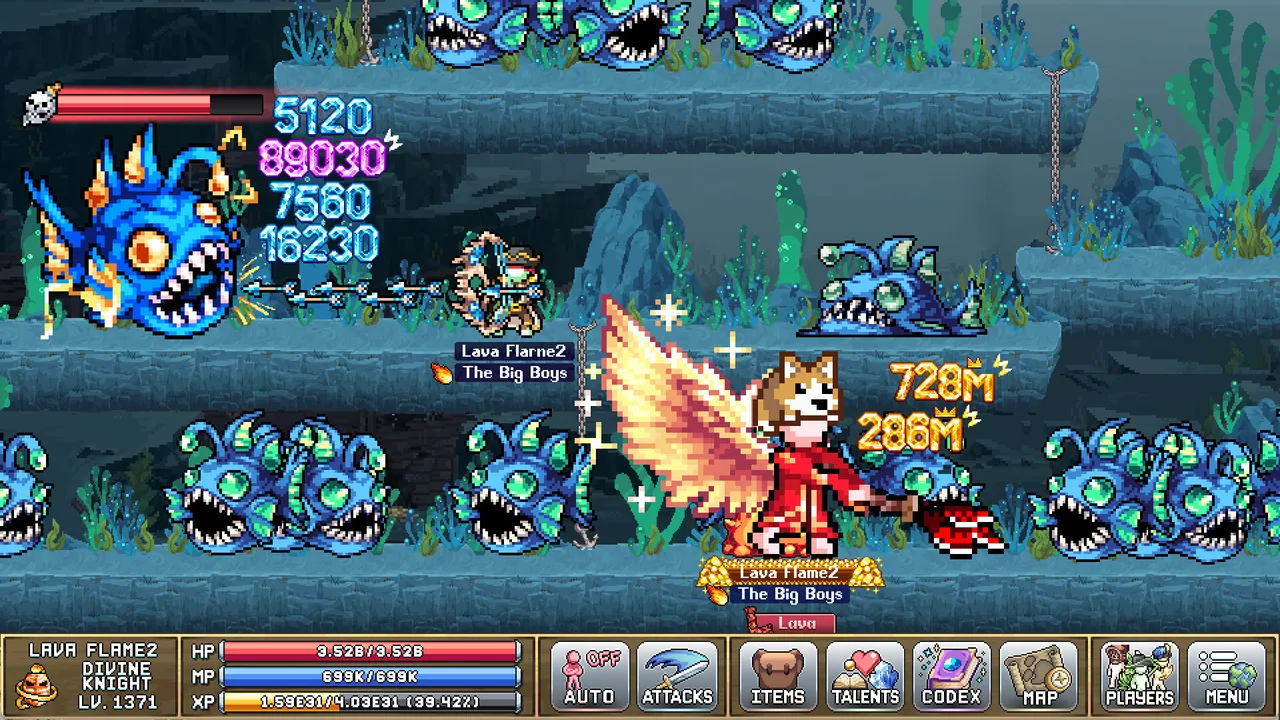
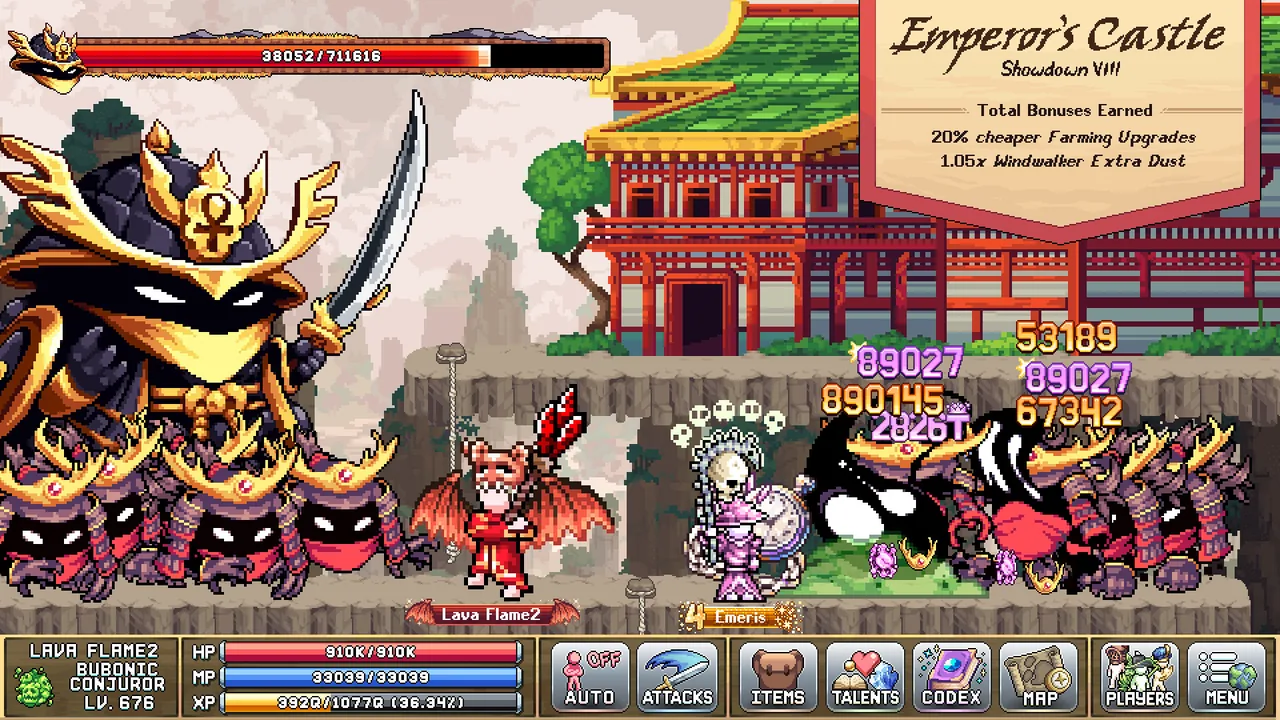
The art is bright, cartoonish and self-aware, full of fourth-wall jokes that suit a game willing to poke fun at its own grind. It's also visibly indebted to MapleStory's UI language — menu layout, inventory grid, skill-tree presentation — closely enough that the resemblance is one of the more common comparisons players make. That's not automatically a flaw in a genre built on functional screens over pretty ones, but four and a half years of continuous feature addition have left the interface looking like what it is: a UI designed for a much smaller game that never got rebuilt for the one it became.
Technically it's light enough to run on almost anything — the game began life as a browser title and that heritage shows in the low system requirements on Steam — and it's genuinely present everywhere that matters, Windows, iOS, Android and browser, with an account system that carries progress between them. Mac and Linux remain unsupported on the Steam client specifically, which is a narrower gap than it would have been five years ago but still an odd omission for a game this platform-flexible everywhere else.
Final verdict
Legends of Idleon earns its reputation as the idle genre's most systemically ambitious game. Twenty skills, dozens of classes, a roster you can genuinely misbuild, and a world that keeps expanding years after most competitors would have called it finished — that's a rare combination, and almost all of it is available without spending a cent.
It doesn't reach the top of the genre because the two things standing between a new player and that depth are real: an interface that has never caught up with the size of what it's presenting, and a monetisation model that spent years earning trust as convenience-only before the 2025 companion system spent some of that trust back down. Neither is fatal. Both are the difference between a very good idle game and an exceptional one.
Play it free, build a small roster before you build a large one, and decide for yourself around world three whether the shop is asking for money or just offering it. That's roughly the point where the game reveals which kind of idle player it wants you to be.
Price and monetisation checked 29 July 2026.
Players who like the idea of a roster pulling in different directions but would rather manage one character on one continuous road than eleven characters across eleven menus might find Wanderer the calmer version of the same idea.
Pros and cons
Pros
- Twenty skills and dozens of classes genuinely interact — a warrior's mining stat feeds a mage's smithing queue
- Eleven character slots turn the roster into a real specialisation puzzle rather than eleven copies of the same build
- Guilds, a player marketplace, party dungeons and world bosses give the "MMO" label real substance despite no PvP
- Content gating rarely locks a system behind payment — everything sellable in the gem shop is also earnable through play
- Four-plus years of continuous free updates have kept the world genuinely growing, worlds deep into double digits of content
Cons
- The interface is a dense, MapleStory-indebted wall of icons and numbers that has not been redesigned to match the game's growth
- Storage space, card slots and crafting-bonus unlocks are gem-shop items that sit closer to progression than cosmetics usually do
- A companion system added in late 2025 drew sustained criticism for gating its strongest pets behind extreme luck, long grinds, or direct purchase
- Managing eleven characters' skill queues, storage runs and card farms becomes repetitive bookkeeping well before it becomes strategy
- Windows-only on Steam, with Mac and Linux unsupported even though the mobile and browser versions exist
Screenshots
-
IdleOnImage: Lavaflame2 via Steam -
IdleOnImage: Lavaflame2 via Steam -
IdleOnImage: Lavaflame2 via Steam -
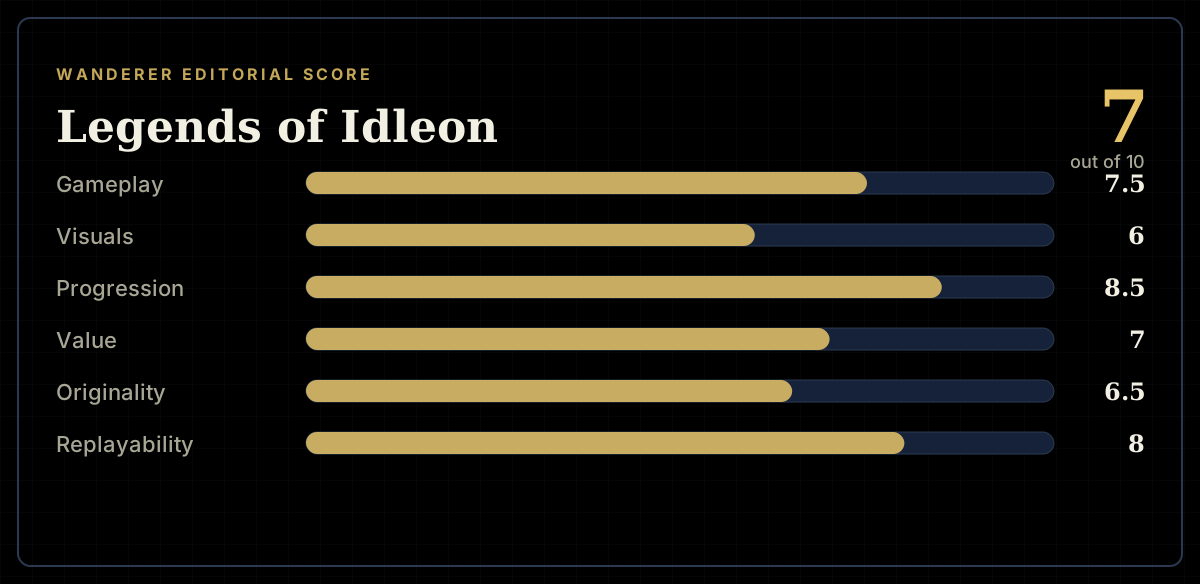
How the review scores each part of the gameWanderer Editorial -
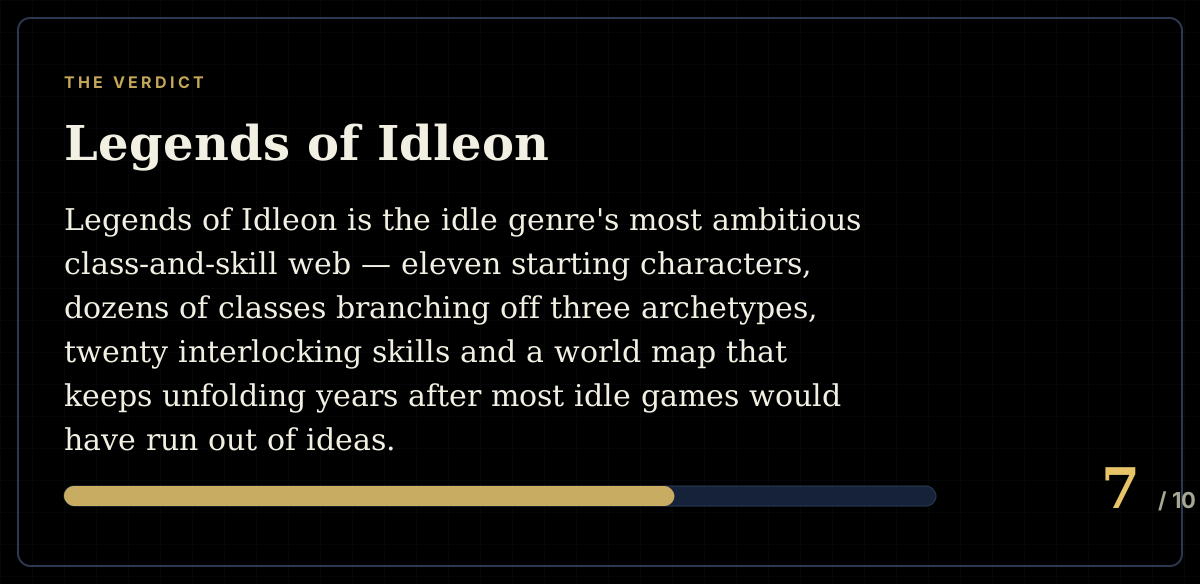
The short versionWanderer Editorial