Game review
Among Us
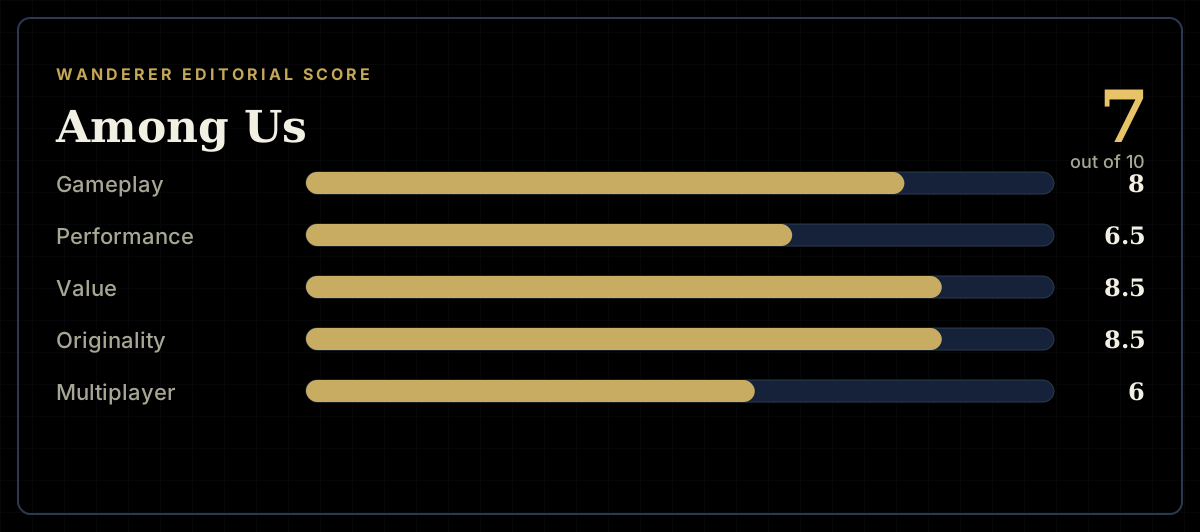
7 / 10
- Developer
- Innersloth
- Publisher
- Innersloth
- Released
- 16 November 2018
- Platforms
- Windows
- Genre
- Social Deduction
- Monetisation
- One-time purchase, NZ$7.49. Optional in-app cosmetic purchases (pets, hats, skins) on top of the base price.
- Players
- Online and LAN multiplayer for up to 15 players, cross-platform with mobile and console
The short version
Among Us is Very Positive at 92% across 430,697 reviews, a remarkable figure for a game whose cultural moment technically passed years ago — recent English sentiment sits at 91%, essentially matching the lifetime score, evidence of a stable, ongoing playerbase rather than a game coasting on 2020 nostalgia alone.
Its history includes a genuine accessibility redemption arc worth telling directly: the single most-upvoted negative review in the game's entire history, with 6,163 votes, is a 2020 complaint that colorblind and color-deficient players couldn't reliably distinguish crewmate colors. Innersloth's June 2022 patch added colorblind text labels and wire symbols directly addressing it, and that exact complaint essentially disappears from negative reviews written afterward. What hasn't gone away is a different, more persistent issue: reviewers across every year, including recent ones, describe public lobbies as dominated by young players, quick-chat-only restrictions, and players who quit the instant they aren't assigned impostor.
Biggest strengths
- A simple, clever, endlessly replayable social deduction formula that made an obscure 2018 release into a defining cultural phenomenon
- A genuine accessibility fix: colorblind text labels and wire-connection symbols were added in June 2022, directly resolving what had been the single most-upvoted complaint in the game's history
- Exceptional value at NZ$7.49 for a game that's sustained an active, cross-platform playerbase for six years past its viral peak
Biggest weaknesses
- A real, persistent, multi-year complaint: public lobbies are widely described as dominated by very young players, with disruptive or low-effort behavior recurring across reviews from 2020 through 2026
- Players quitting mid-match the moment they aren't assigned impostor is a frequently cited, long-standing frustration that undermines public games specifically
- A 2022-2023 age-verification requirement drew sharp, specific complaints from reviewers who described being locked out of accounts after an input error, though this issue is largely absent from more recent reviews
Who it's for: Groups of friends looking for a fast, social party game that rewards clever lying and sharp deduction, and who plan to play mostly in private lobbies rather than public matchmaking. Less suited to solo players hoping to jump into public games with strangers.
Our recommendation: Buy it for game night with people you already know — that's overwhelmingly where the positive reviews describe the game shining. Go in with tempered expectations for public matchmaking specifically; a genuinely persistent, multi-year pattern of reviews describes public lobbies as young, chaotic, and prone to players leaving the moment they aren't impostor.
7 / 10
Among Us spent nearly two years as an obscure 2018 release before a 2020 streaming wave turned it into one of the defining cultural moments of that year. Six years on from that peak, the more interesting question isn't whether it was good then — it's whether it's still good now, and reading widely through its review history, spanning every year since launch, gives a clearer and more specific answer than the "it was a 2020 thing" dismissal it sometimes gets.
The formula that still works
The core loop hasn't changed and doesn't need to: crewmates run tasks around a map while one or more impostors sabotage and kill among them, with the entire group periodically stopping to argue, accuse and vote someone off based on circumstantial evidence and social reads. It's a formula reviewers across every year of this game's history credit as genuinely clever rather than just well-marketed — simple enough to teach in a minute, deep enough to sustain arguments that go on far longer than the matches themselves. At NZ$7.49 for up to 15-player games with friends, reviewers consistently frame it as exceptional value regardless of when they discovered it.
A real accessibility fix worth crediting directly
Here's a specific story worth telling in detail rather than glossing over: the single most-upvoted negative review in this game's entire history, sitting at 6,163 votes, is a 2020 complaint that crewmate colors were nearly indistinguishable for colorblind and color-deficient players — lime versus yellow, blue versus purple, described as making basic gameplay genuinely difficult. That's not a fringe complaint; it's the most-upvoted piece of criticism the game has ever received on Steam. Innersloth's June 2022 patch directly addressed it, adding a colorblind text option that labels crewmate colors by name during gameplay and meetings, plus symbols on wire-connection tasks so players don't have to distinguish colors to complete them. The result shows up clearly in the data: that specific complaint is essentially absent from negative reviews written after the fix shipped. It's a genuinely good example of a widely-flagged accessibility gap getting addressed rather than ignored, and it deserves to be credited as directly as the original complaint was.
The complaint that never went away
What hasn't resolved is different, and it recurs with real consistency from 2020 through the most recent reviews in this sample: public lobbies are widely and repeatedly described as chaotic, dominated by very young players, and prone to a specific frustrating pattern — players quitting the instant they discover they're a crewmate rather than the impostor. "This game desperately needs a ban system to counter act that behaviour," reads one review from the game's early peak, and reviewers in 2025 and 2026 are still describing essentially the same public-lobby experience. A separate, specific complaint concerns quick-chat restrictions applied to some accounts, which several reviewers say flattens meeting discussions into a rotation of pre-set phrases rather than the free, clever back-and-forth that makes accusations land. A 2022-2023 wave of reviews also describes a genuinely serious account-lockout bug tied to a new age-verification requirement — entering a birth year could permanently lock an account behind a "Guardian" email flow — though this specific complaint is largely absent from the 2024-2026 sample, suggesting it was substantially resolved even though it isn't documented here as thoroughly as the colorblind fix.
Reading the completion data
With 33 achievements, the completion curve reflects broad, casual engagement. Core survival and early-task milestones sit around 40-48%, showing most buyers who launch the game experience its basic loop. The rarer achievements, tied to specific hide-and-seek mode wins on harder difficulty, fall under 1%, reflecting how much smaller the audience is for the game's newer, more demanding modes compared to its classic format.
7 out of 10. Among Us earns real, lasting credit for a design that still works six years past its viral peak, and for a specific, well-documented example of Innersloth fixing a widely-flagged accessibility gap rather than letting it sit. It's held below the top tier by a genuinely persistent public-lobby problem that reviewers have described consistently since 2020 and continue to describe today — this is a game best played with people you already know, not one to expect a great experience from in open matchmaking with strangers.
Pros and cons
Pros
- A simple, clever, endlessly replayable social deduction formula that made an obscure 2018 release into a defining cultural phenomenon
- A genuine accessibility fix: colorblind text labels and wire-connection symbols were added in June 2022, directly resolving what had been the single most-upvoted complaint in the game's history
- Exceptional value at NZ$7.49 for a game that's sustained an active, cross-platform playerbase for six years past its viral peak
- Cross-platform play and LAN support make it easy to get a full group together regardless of what device everyone owns
Cons
- A real, persistent, multi-year complaint: public lobbies are widely described as dominated by very young players, with disruptive or low-effort behavior recurring across reviews from 2020 through 2026
- Players quitting mid-match the moment they aren't assigned impostor is a frequently cited, long-standing frustration that undermines public games specifically
- A 2022-2023 age-verification requirement drew sharp, specific complaints from reviewers who described being locked out of accounts after an input error, though this issue is largely absent from more recent reviews
- Quick-chat-only restrictions applied to some accounts limit free typing in meetings, which several reviewers say flattens the game's social deduction back-and-forth into repetitive pre-set phrases
Screenshots
-
Among UsImage: Innersloth via Steam -
Among UsImage: Innersloth via Steam -
Among UsImage: Innersloth via Steam -
How the review scores each part of the gameWanderer Editorial -
The short versionWanderer Editorial