
Game review
Archmage Idle
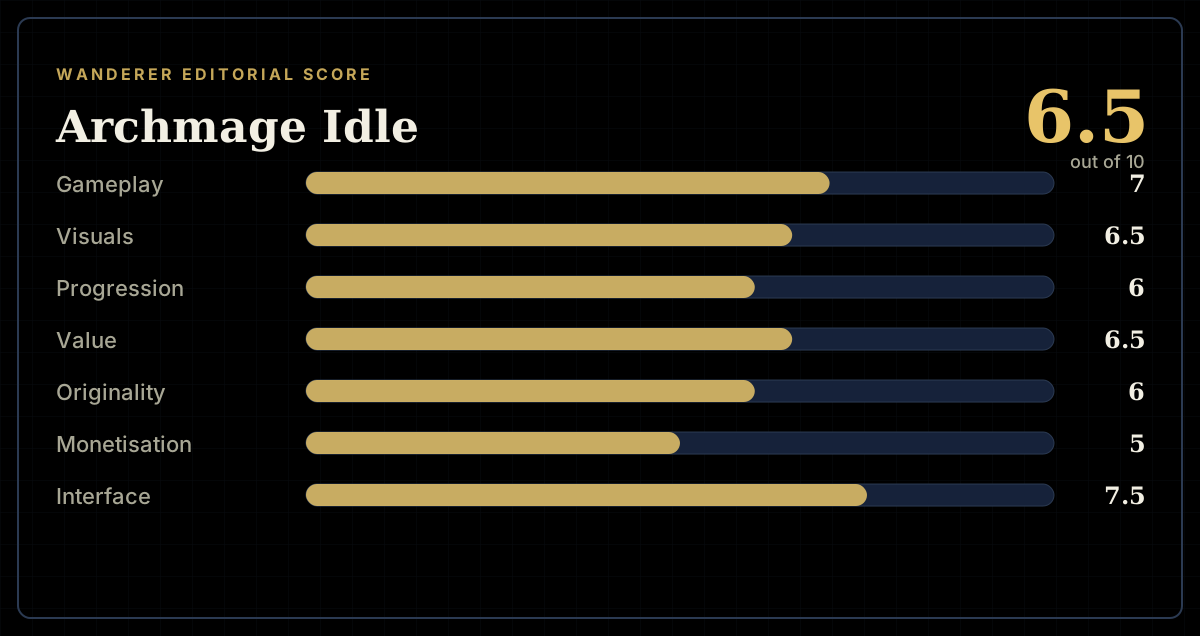
6.5 / 10
- Developer
- TopCog
- Publisher
- TopCog
- Released
- 2 July 2026
- Platforms
- Windows, macOS, Linux, iOS, Android
- Genre
- Idle RPG
- Monetisation
- Free-to-play with in-app purchases — five cumulative VIP tiers, a separate XP boost purchase, and optional rewarded ads on the mobile builds
- Players
- Single-player only
The short version
Archmage Idle takes the Melvor Idle formula — parallel skills, a shared economy, offline progress that keeps running whether you're watching or not — and reskins it as a wizard guild where every skill multiplies every other skill instead of sitting in its own tab. That synergy idea is the game's best feature and the reason a chunk of its player base openly prefers it to the game it's most obviously answering. It's held back by a single-worker system that turns a dozen-plus available activities into a queue of one, and by a VIP purchase ladder that asks players to buy their way up through five tiers rather than choosing the level of support that suits them.
Biggest strengths
- Every skill multiplies every other skill instead of levelling in isolation, giving the economy a genuine sense of interconnection that most single-track idle skill trees don't attempt
- The interface shows exactly where an item comes from without sending players to a wiki, and lets combat and skilling run at the same time rather than forcing a choice between them
- Content is consistently reported as completable without spending, with VIP purchases functioning as acceleration rather than a gate in front of systems
Biggest weaknesses
- Only one worker can be assigned to an idle task at a time even though academies, cauldrons, bazaars and combat are all separately available, turning what should be parallel automation into a single queue that bottlenecks every other system
- The VIP ladder is cumulative rather than a menu — reaching the $20 top tier means having already bought the $3, $5, $10 and $15 tiers beneath it, a structure several players single out as needlessly punitive even though no individual tier is expensive
- Skill and upgrade unlocks arrive as blind gambles with no description of what's being unlocked, so hours of farming can pass before a player learns whether the payoff was worth it
Who it's for: Idle-RPG regulars who already know Melvor Idle's shape and want to see a genuinely different take on its skill-economy formula, and free-to-play players who don't mind a cosmetic-and-convenience shop as long as nothing behind it is required to finish the content.
Our recommendation: Worth installing since it costs nothing to try, and the skill-synergy hook is strong enough to justify the first several hours on its own. Go in expecting the single-worker limit to slow you down hard once your task list grows, and treat the VIP ladder as something to ignore rather than climb — every account report of a free completion backs that approach up.
6.5 / 10
Idle RPGs have spent the last few years quietly converging on the same shape: a hub of parallel skills, a shared item economy feeding all of them, and a promise that the numbers keep climbing whether you're at the keyboard or not. Archmage Idle doesn't try to escape that shape. It commits to it and asks a more interesting question inside it — what if the skills weren't parallel at all, but multiplicative? You're an Archmage running a wizard guild, training mages at academies, brewing runes in cauldrons and trading goods at bazaars, and the game's central conceit is that none of those systems level up in isolation. Every skill you raise makes the others produce more, which turns what could have been another Melvor Idle clone into something with a genuinely different economic backbone.
A guild where everything feeds everything else
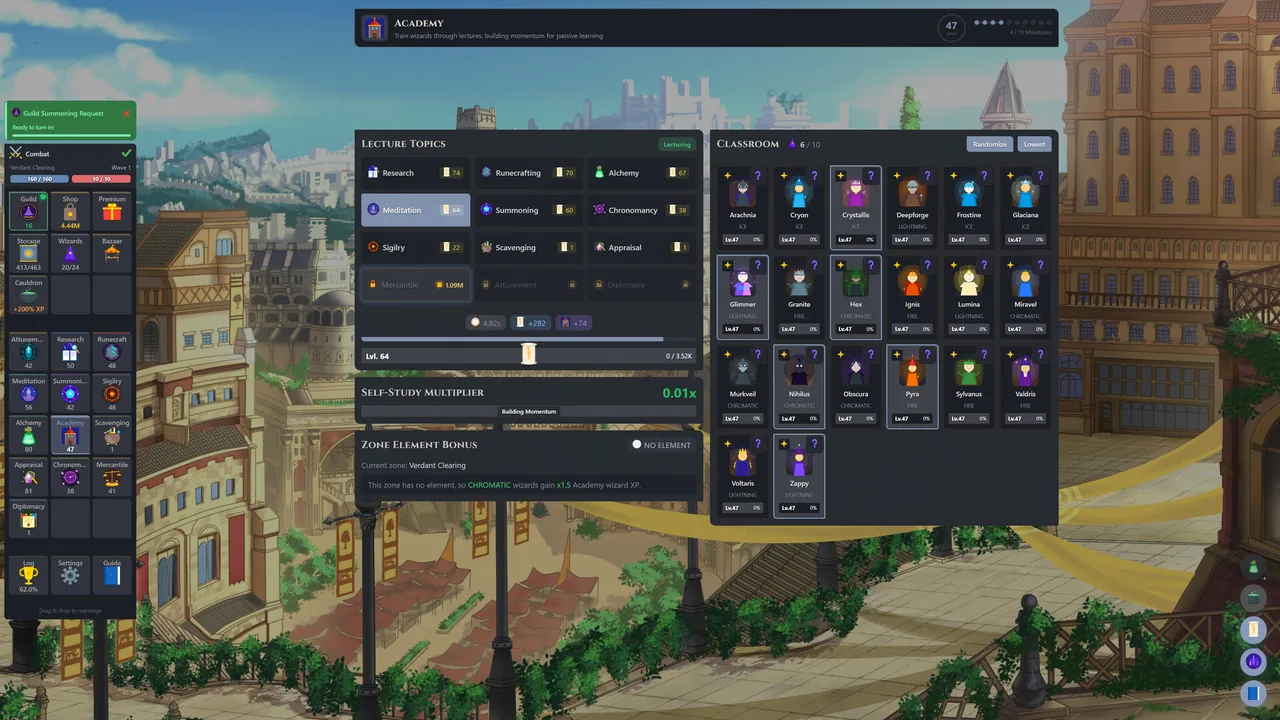
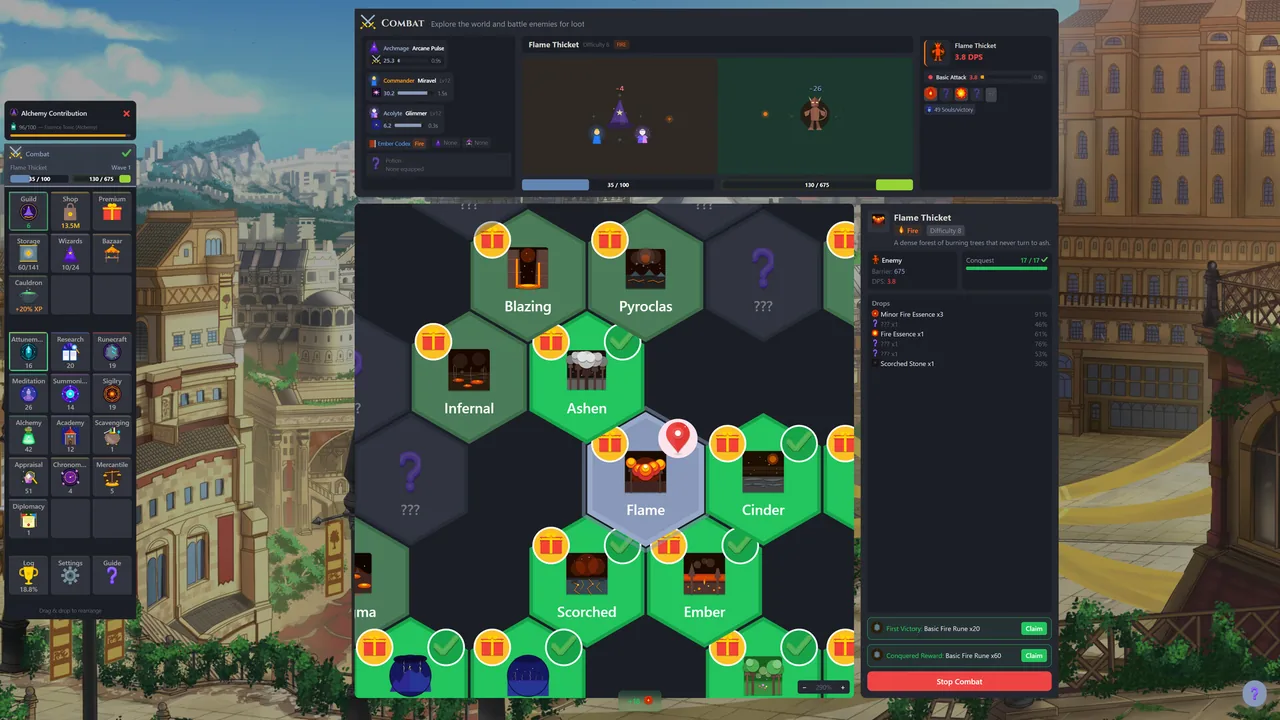
The comparison to Melvor Idle isn't incidental — it's the frame a large share of Archmage Idle's own player base uses to talk about it, and the game earns the comparison rather than dodging it. Where Melvor's skills mostly sit in their own lane and interact through a shared bank, Archmage Idle builds interlock directly into its numbers: training wizards at the academy strengthens combat output, combat feeds materials back into the supply chain, and the bazaar turns surplus goods into the resources that speed everything else up again. Players who've put serious hours in describe the pacing and skill synergy as a real improvement on the genre's reigning template, and it's easy to see why — a system where raising one number quietly raises several others rewards the kind of long-view planning idle players actually enjoy, rather than just handing out bigger numbers for the same repeated action.
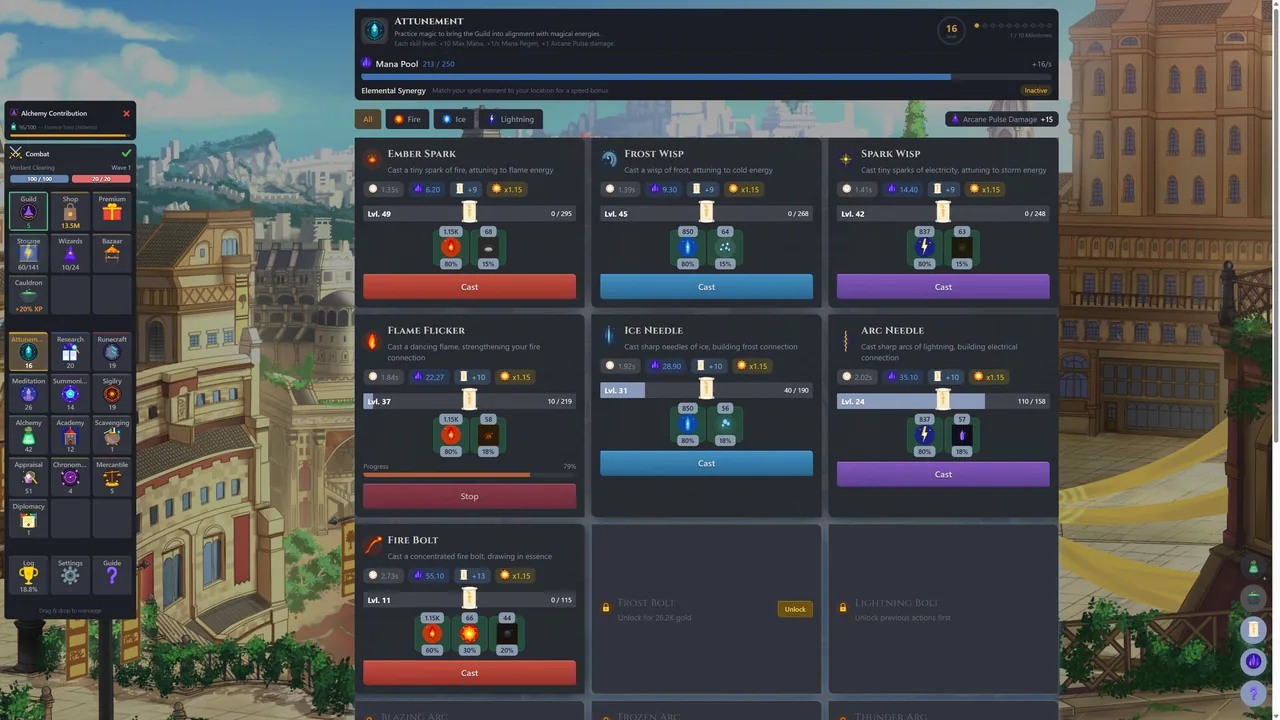
The interface does a lot of work in making that interconnection legible. Item sourcing is shown directly in the UI rather than requiring a trip to a community wiki, which matters enormously in a genre where half the friction usually comes from not understanding where a material drops. The game also lets combat and skilling run concurrently instead of forcing a choice between them, which several long-time genre players call out as the single clearest way it improves on its most obvious rival. For a solo-developed idle RPG going up against a genre benchmark, that's a confident, well-aimed pitch.
The one-worker wall
The design decision that undercuts all of that ambition is a strict limit of one active worker at a time. Academies, cauldrons, bazaars and combat are all separately available activities, but only one of them can actually be running at once — everything else sits idle waiting its turn. That's a strange choice for a game whose whole identity is built on systems multiplying each other, because it means the interconnected economy Archmage Idle is proud of can only ever advance on one front at a time. Players who came in expecting the genre's usual promise of genuinely parallel automation describe the bottleneck as the thing that turns an addictive loop into a queue, and it's hard to disagree once the task list grows past a handful of activities and the single worker can't come close to keeping up with all of them.
That queue problem compounds with a second complaint that shows up across current reviews: skill and upgrade unlocks are gated behind blind gambles that don't tell you what you're unlocking before you commit hours of farming to them. In a game this transparent about item sourcing, the opacity around its own progression tree stands out as an inconsistency rather than a deliberate design choice, and it's a fair target for criticism.
Inventory, stability and the rough edges
Item management is the other recurring friction point. Archmage Idle's economy spans hundreds of crafting materials, and a meaningful share of them look and read similarly enough that sorting through the pack becomes its own chore rather than a byproduct of playing well. That's a familiar failure mode for idle RPGs that lean on wide item pools instead of curated ones, and Archmage Idle hasn't solved it any better than its peers have.
On the technical side, the Steam release has shipped with a Linux build that multiple players report as non-functional, which matters more than it might for a smaller title because Linux is one of only three PC platforms Steam actually lists for the game. Missing Steam achievements are a smaller but persistent complaint, oddly conspicuous for a game that otherwise leans on completionist systems like item collection and skill trees to hold attention. None of this looks like neglect — TopCog is a solo studio that has kept shipping balance and bug fixes since launch — but a month-old release still carrying a broken platform build is a real mark against it.
Monetisation: five tiers, in order
Archmage Idle is free on every platform it ships on, and the good news for anyone worried about pay-to-win pressure is that the actual content is consistently reported as completable without spending a cent — VIP purchases read as acceleration, not a gate blocking systems behind a paywall. That's the most important thing a free-to-play idle RPG can get right, and by most accounts Archmage Idle does get it right at the level of individual features.
Where the model earns real criticism is its shape. The VIP system is built as five tiers priced from $3 up to $20, and they're cumulative rather than a menu you pick from — reaching the top tier means having already bought every tier below it, which adds up to roughly $53 for a player who wants full access. No single purchase in that ladder is unreasonable on its own, but forcing players to climb through cheaper tiers to reach the one they actually want is a structure that reads as designed to maximise total spend rather than to let a generous player simply choose their level of support. It's the kind of monetisation decision that turns "the shop is fair" into "the shop is fair, but annoyingly structured," and it's a distinct enough complaint across current reviews that it's clearly costing the game goodwill it would otherwise have earned. The mobile builds add optional rewarded ads for small boosts, removable with a one-time purchase — a more conventional and less contentious piece of the model than the VIP ladder sitting next to it.
Final verdict
Archmage Idle's best idea — an economy where every skill genuinely multiplies every other skill — is strong enough that it deserves to be judged as more than a Melvor Idle reskin, and a real slice of its player base already treats it that way. What keeps it at a Mixed standing on Steam isn't one single flaw but an accumulation of smaller ones sitting on top of good bones: a one-worker limit that fights the game's own interconnected design, blind progression gambles in an otherwise transparent interface, item clutter the genre still hasn't solved, a broken Linux build a month after launch, and a VIP ladder that makes generosity feel more complicated than it needs to.
None of that stops the free content from being genuinely worth your time if the synergy hook appeals to you — it's free to find out, and there's no purchase required to see the systems that make the game interesting. Just don't go in expecting the parallel-automation feel the genre usually promises, and treat the VIP tiers as something to skip rather than a ladder worth climbing.
Players who want an interconnected economy that keeps advancing while they're away, without the tier-by-tier purchase structure sitting on top of it, might also want to look at Wanderer.
Pros and cons
Pros
- Every skill multiplies every other skill instead of levelling in isolation, giving the economy a genuine sense of interconnection that most single-track idle skill trees don't attempt
- The interface shows exactly where an item comes from without sending players to a wiki, and lets combat and skilling run at the same time rather than forcing a choice between them
- Content is consistently reported as completable without spending, with VIP purchases functioning as acceleration rather than a gate in front of systems
- True offline progression keeps academies, cauldrons and bazaars running at the same rates whether the game is open or not
- A responsive solo developer has kept patching the game since launch, addressing balance and bug reports raised in early reviews
Cons
- Only one worker can be assigned to an idle task at a time even though academies, cauldrons, bazaars and combat are all separately available, turning what should be parallel automation into a single queue that bottlenecks every other system
- The VIP ladder is cumulative rather than a menu — reaching the $20 top tier means having already bought the $3, $5, $10 and $15 tiers beneath it, a structure several players single out as needlessly punitive even though no individual tier is expensive
- Skill and upgrade unlocks arrive as blind gambles with no description of what's being unlocked, so hours of farming can pass before a player learns whether the payoff was worth it
- Inventory fills with dozens of similarly named crafting materials that carry little visual distinction, and item clutter is one of the most consistent complaints in current player feedback
- The Linux build has been reported non-functional at launch, and missing Steam achievements are a recurring sore point for a game that otherwise leans on completionist systems
Screenshots
-
Archmage IdleImage: TopCog via Steam -
Archmage IdleImage: TopCog via Steam -
Archmage IdleImage: TopCog via Steam -
How the review scores each part of the gameWanderer Editorial -
The short versionWanderer Editorial