
Game review
Cycle Idle RPG
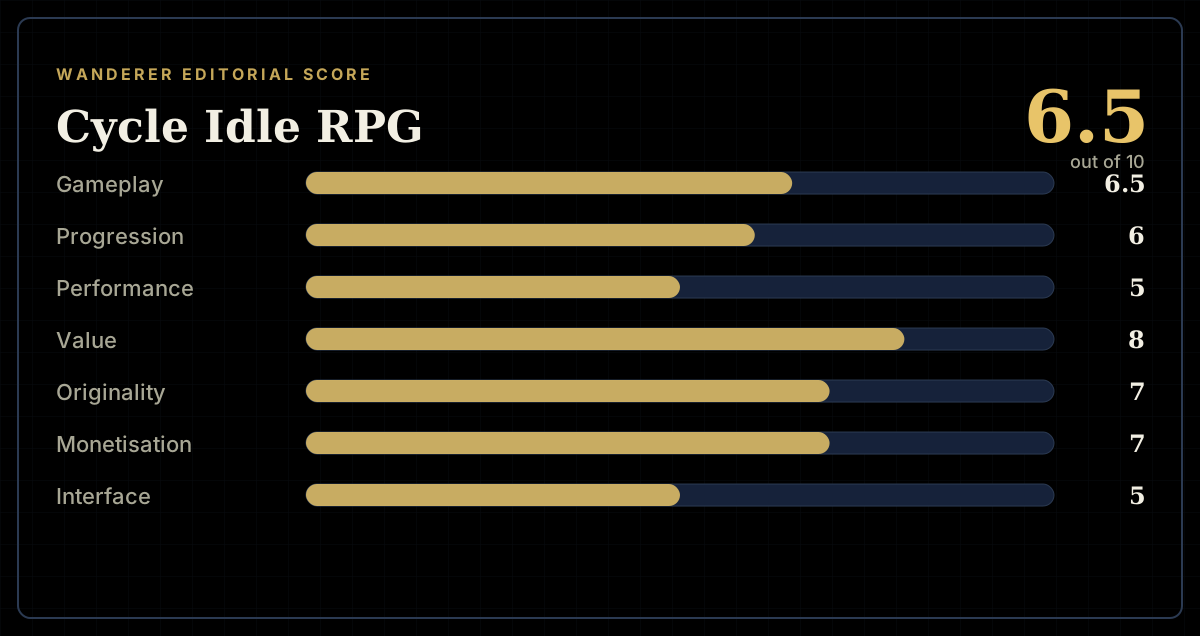
6.5 / 10
- Developer
- Leafcutter
- Publisher
- Leafcutter Studios
- Released
- 22 November 2025
- Platforms
- Windows
- Genre
- Idle RPG
- Monetisation
- Free to play with in-app purchases. Premium currency is also earnable in game; purchases are quality-of-life rather than power, with no paid speed or damage multipliers.
- Players
- Single-player only
The short version
Cycle Idle RPG does the hardest thing in its genre properly: your character fights while the game is closed, at the same rate it fights while you're watching, with no energy meter and no timer asking for money. Players who have been burned by "idle" games that quietly stop idling notice immediately, and the reviews that praise it are unusually specific about why.
Then it spends its second half undoing that. Progress gates behind minigames you must play actively — an arena to reach the third island, a daily puzzle-optimisation exercise worth 50% movement speed — and premium currency will remove some of those chores for you. An idle game that becomes a daily chore is a contradiction, and enough long-playtime reviewers describe hitting that wall to make it the defining problem rather than a quibble.
Biggest strengths
- Genuine 1:1 offline progression with no energy bar, which the genre promises far more often than it delivers
- Restrained monetisation by idle-game standards — no paid speed or damage multipliers, and the premium currency can be earned through normal play
- Real depth in the class, subclass, pet and equipment combinations for players who like optimising a build against specific enemies
Biggest weaknesses
- Progression gates behind active minigames, including an arena that blocks access to the third island and a daily optimisation puzzle attached to a large speed bonus
- Premium currency shortcuts some of those daily chores, which makes the chores look like they exist to be sold
- Reviewers repeatedly report very high CPU use with no frame-rate cap — a serious flaw in a game designed to be left running
Who it's for: Idle-game players who specifically want offline progression that works, and who enjoy min-maxing gear and skill combinations against a bestiary. Anyone who wants to set a game running and genuinely forget it will resent the daily obligations that appear later.
Our recommendation: Free, so it costs nothing but disk space to find out — and the first island or two are a good time. Expect the appeal to turn on whether mandatory minigames inside an idle game strike you as variety or as homework.
6.5 / 10
"Finally, an idle game that actually is idle." That's a real player's opening line, and it's the most useful sentence anyone has written about Cycle Idle RPG. The genre has spent a decade attaching the word "idle" to games that stop dead the moment you close them, or that meter your absence with an energy bar and sell you the difference. This one doesn't. Your character fights offline at the same rate it fights while you watch, and for a free game made by a very small studio, that alone earns it a look.
What complicates the recommendation is everything the game builds on top of that foundation, much of which requires you to sit there and play by hand.
First, a correction to the store page
Steam lists this as a 22 November 2025 release. It isn't, quite — the page's own Early Access date is 7 March 2024, and the great majority of its reviews were written during that twenty-month Early Access run. If you're weighing the score, you're mostly reading opinions of builds from 2024 and 2025 rather than reactions to a fresh launch. That matters here more than usual, because several of the loudest early complaints, including a genuinely alarming absence of autosave, were fixed long before 1.0.
The loop, and what it gets right
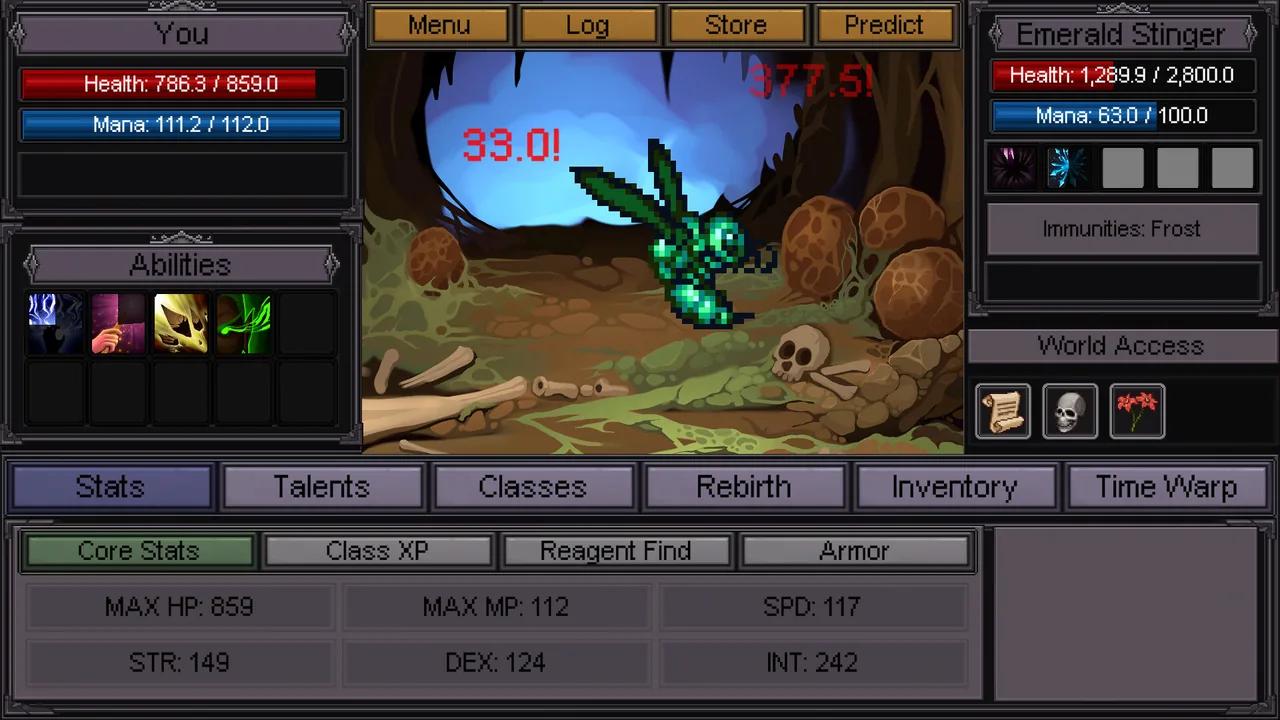
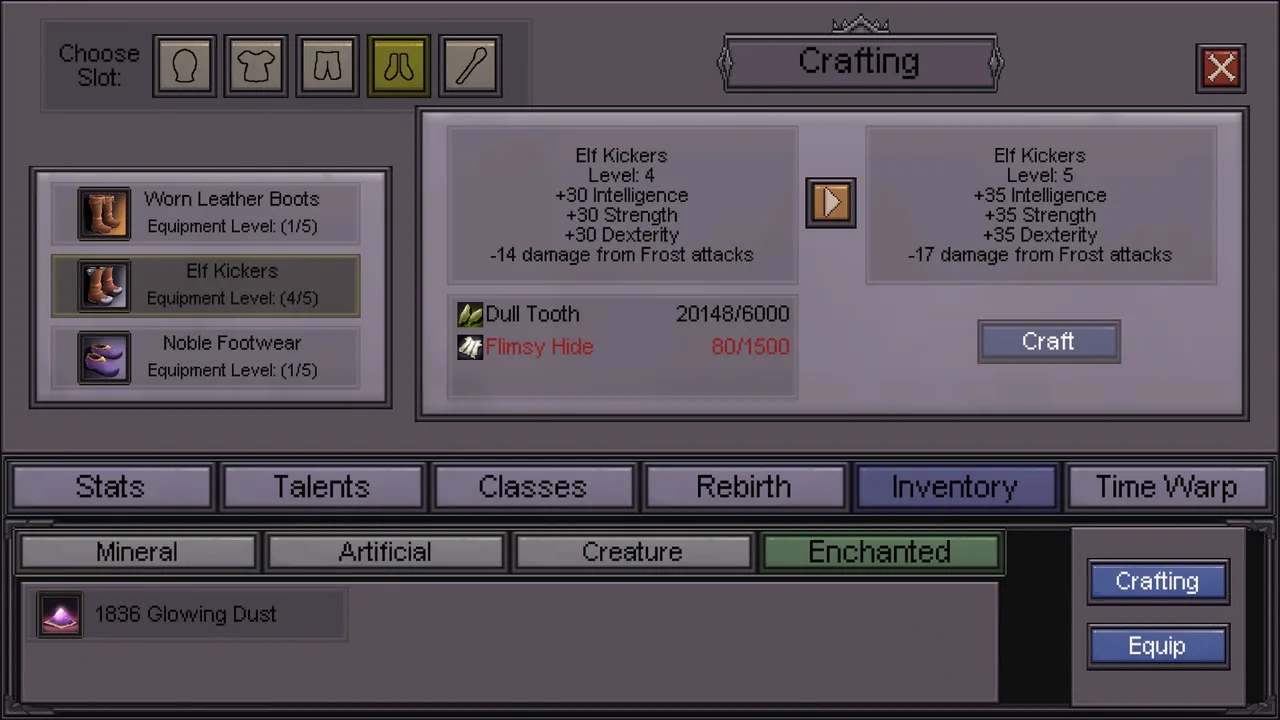
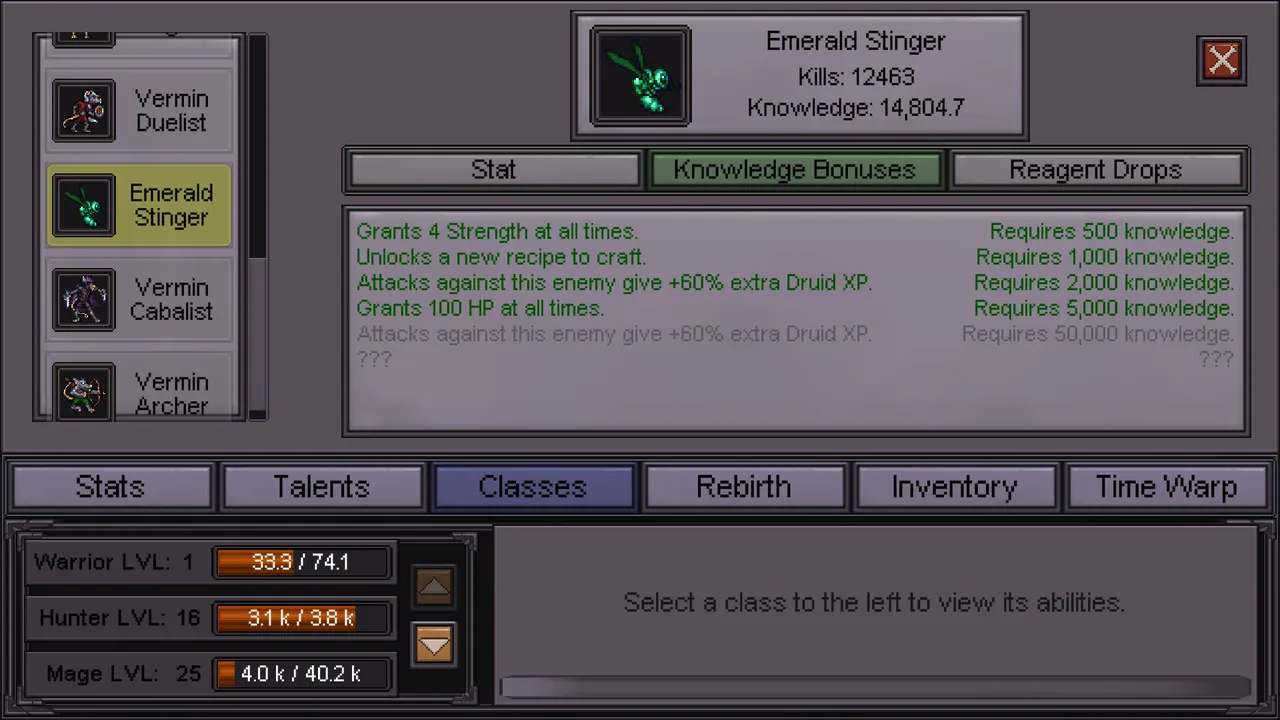
You pick a class, you fight monsters automatically, and you get stronger. Around that sits a bestiary that rewards grinding knowledge of each enemy, a crafting system for equipment, a garden of beneficial plants, pets, subclasses, and roughly a dozen subsystems that unlock as you go.
The build layer is the part that holds up. Classes have real stat identities — a mage gets nothing from strength, a hunter nothing from intelligence — and the game expects you to assemble gear and skills against the specific enemy you're farming. Reviewers with hundreds of hours describe it as a min-max game rather than a number-go-up game, which is a meaningful distinction: the interesting decision isn't when to prestige, it's what loadout to leave running overnight. One player at 86 hours calls it "an example of what all idle games should strive for," on the grounds that the genre is about planning and playing in bursts, and this respects that.
Monetisation deserves credit too, and I say that as someone who has scored plenty of idle games harshly for it. There are no paid speed multipliers and no paid damage multipliers — the two levers that usually make an idle cash shop indefensible. The premium currency is earnable through normal play. The store isn't shoved in your face. Several reviewers arrived expecting a pay-to-win mess after reading early reviews and wrote follow-ups saying it isn't one; one goes to the trouble of explaining that the +20% drop-rate purchase is multiplicative on your base rate rather than a flat addition, which is the sort of detail only an annoyed optimiser checks. Set against Shakes and Fidget, whose whole business is selling you a faster ladder climb, this is a much more honest arrangement.
Then it asks you to stop idling
Here's where it comes apart, and the criticism is consistent across the players who stayed longest.
The game gates progression behind minigames you have to play actively. A card-based minigame appears early. An arena blocks access to the third world — a reviewer with 2,849 hours logged, who otherwise describes a solid experience, says that single gate is what flipped their review negative. Later, a daily puzzle-piece optimisation exercise is attached to a 50% progression-speed bonus, meaning you either do it every day or run at two-thirds pace forever. A reviewer at 1,374 hours gave up there.
The sharpest summary comes from a player at 127 hours: "There is no vertical depth for the main game but it's scattered around mini games horizontally. To make it worse you are forced to play those half-baked mini games on a daily basis. In simple terms this is a daily chore more than an idle game."
That's the review's central problem in one line. An idle game's implicit contract is that it respects your absence. Building mandatory daily active tasks into it doesn't add variety so much as revoke the contract — and it lands hardest on exactly the players the offline progression attracted. Melvor Idle is the useful comparison: it also has enormous system sprawl, but its systems are things you set running, not appointments you keep.
The monetisation, so defensible elsewhere, gets caught in this too. Premium currency can remove some of the daily chores. Once a game sells relief from an obligation, the obligation starts to look load-bearing for the wrong reasons — as one long-term reviewer puts it, the purpose of the mechanics starts to seem like annoying the player so the annoyance can be monetised. I don't think that's the whole story here, given how restrained the rest of the shop is, but it's a fair inference and the design invites it.
A performance problem worth knowing about
Multiple reviewers report the game consuming enormous CPU — one measured about 70%, another found it maxing their processor with no way to cap the frame rate. For most games that's an annoyance. For a game whose entire pitch is "leave me running in the background," it undercuts the product: the players most likely to love the offline progression are the ones most likely to keep it open all day next to everything else. It's the single most fixable thing on this list and the one I'd want addressed first.
What the completion data says
The achievement curve is legible and slightly brutal. 92% of players record the bestiary achievement and 73% the equipment one, so nearly everyone engages with the core systems. The garden sits at 48%. Reaching the second island drops to 29%. The rarest achievements bottom out around 1%.
Read alongside the reviews, that shape tells a coherent story: the opening is compelling and broadly accessible, and attrition sets in around the point the subsystems start stacking and the first hard gates appear. Roughly seven in ten players never reach the second island of a game whose content is organised by island.
Support
The developer has kept patching well past 1.0 — arena exploits in November 2025, a run of integer-overflow fixes through the first half of 2026 as long-running saves hit numbers the code didn't expect, talent-allocation bugs in May 2026. That last category is a good sign in an idle game, because overflow bugs are what you get when players actually leave a game running for months. The public patch cadence has been quiet since May 2026, which is worth noting without reading too much into it for a project this size.
The verdict
Cycle Idle RPG earns a 6.5, and it's a frustrating 6.5 rather than a mediocre one, because the thing it does best is the thing its genre most often fakes. True offline progression, an honest shop, and a build system with genuine optimisation depth is a strong hand. Free, it's an easy thing to try.
What stops it going higher is that it doesn't trust its own best idea. The minigame gates, the daily speed-bonus puzzle, the arena standing between you and a third of the content — these turn a game you could leave alone into one that expects a check-in, and the players who invested hundreds of hours are the ones saying so loudest. Add a CPU appetite that punishes leaving it open, and the offline promise gets undercut from two directions at once.
Try it if the pitch of "set a loadout, close the game, come back stronger" is what you want from the genre, and accept that the back half will ask more of you than the front half promised. Look elsewhere if daily obligations are precisely the thing you came to idle games to escape.
If that last sentence describes you, Wanderer is built on the opposite instinct — the world keeps working while you're gone, and there's nothing you have to log in to claim.
Pros and cons
Pros
- Genuine 1:1 offline progression with no energy bar, which the genre promises far more often than it delivers
- Restrained monetisation by idle-game standards — no paid speed or damage multipliers, and the premium currency can be earned through normal play
- Real depth in the class, subclass, pet and equipment combinations for players who like optimising a build against specific enemies
- A dozen unlockable subsystems keep the early and middle game changing shape
- Still receiving fixes well past its 1.0, including a run of integer-overflow patches through early 2026
Cons
- Progression gates behind active minigames, including an arena that blocks access to the third island and a daily optimisation puzzle attached to a large speed bonus
- Premium currency shortcuts some of those daily chores, which makes the chores look like they exist to be sold
- Reviewers repeatedly report very high CPU use with no frame-rate cap — a serious flaw in a game designed to be left running
- Content sprawls sideways into minigames rather than deepening the core loop
- Late progression slows to multi-week waits for small percentage upgrades
Screenshots
-
Cycle Idle RPGImage: Leafcutter Studios via Steam -
Cycle Idle RPGImage: Leafcutter Studios via Steam -
Cycle Idle RPGImage: Leafcutter Studios via Steam -
How the review scores each part of the gameWanderer Editorial -
The short versionWanderer Editorial