
Game review
Idle Cultivation
6.5 / 10
- Developer
- Linmios
- Publisher
- Linmios
- Released
- 17 May 2025
- Platforms
- Windows
- Genre
- Idle RPG
- Monetisation
- One-time purchase. A single optional cosmetic DLC exists; no ads, no premium currency, no energy timers
- Players
- None; fully single-player
The short version
Idle Cultivation gives its xianxia premise a real spine: four cultivation realms, each split into three named stages, each gated by a Tribulation fight, with a reincarnation system that spends a new Soul Power currency on a permanent perk grid once you're ready to start again. Steam's achievement data backs up that the climb is a genuine taper rather than a single wall — Mortal Realm's boss sits at 76.8% completion, Earthly's at 34.8%, Heavenly's at 19.4%, Immortal's at 11.1%.
Two things hold it back from recommending without caveats. Save corruption and lost progress are recurring complaints stretching from launch week to last month, including players who lost 170 hours and 40 hours respectively with no way to recover them — a serious problem for a genre whose entire pitch is trusting the game while you're not looking. And the game's own heaviest players, several logging 400 to over 3,000 hours, describe advancement flattening out after the second or third reincarnation. The developer has since confirmed as much: as of May 2026, Idle Cultivation's last major content update has already shipped, and development effort has moved to a sequel.
Biggest strengths
- The four-realm, twelve-stage cultivation ladder with Tribulation gates between each realm gives the number-go-up loop real structure, and achievement-completion data shows a believable, gradual taper rather than a single dead wall
- Nine interlocking skills — cultivation, mind, body, dao, array, alchemy, forging, talismans and gardening — plus sect recruitment and building give a NZ$5.99 game an unusual amount of scope
- Monetisation is limited to one optional NZ$2.99 cosmetic pack for sect character appearances, with nothing that touches progression, and its three user reviews are unanimously positive
Biggest weaknesses
- Save corruption and lost-progress reports recur across the game's whole lifespan, including a 170-hour save wiped in March 2026 and an offline-progress calculation that froze the game for a 647-hour player as recently as July 2026
- Several of the game's most committed reviewers, with hundreds to thousands of hours logged, report that meaningful advancement stalls after the second or third reincarnation and that later prestige runs don't noticeably speed up the early game
- Item icons are reused with only a colour and tier-number change across dozens of pills, talismans and manuals, and in-game explanations are thin enough that several reviewers say they needed outside guidance just to understand core systems
Who it's for: Idle RPG players who specifically want the cultivation/xianxia fantasy and don't mind reading through unexplained systems to find it — particularly anyone who bounced off Melvor Idle wanting more numbers and less RuneScape.
Our recommendation: Worth the asking price for the genre fantasy and the sheer amount of interlocking systems on offer, but back up your save file manually and go in knowing the developer has already said the big updates are behind it.
6.5 / 10
Trusting the number to keep going up
Idle Cultivation asks for the specific kind of trust every idle game asks for: leave it running, walk away, come back later, and the number should be bigger. For most of its buyers that trust has been repaid — the game sits at 79% positive across 140 Steam reviews, and its most enthusiastic reviewers count their time in the hundreds and thousands of hours. But scattered across that same period, at intervals from launch week to last month, other players have logged on to find the number gone entirely: a wiped save, a corrupted sect, an offline-progress calculation that simply stops. That tension — a genuinely deep xianxia cultivation ladder built by one developer, sitting on top of a save system that periodically fails the people who trusted it longest — is the whole story of this NZ$5.99 release.
Idle Cultivation is a solo-developed idle RPG built entirely around the Chinese cultivation (xianxia) fantasy: you meditate to absorb Qi, break through cultivation realms, fight tribulation bosses sent to test your ambition, and eventually reincarnate to start again with permanent bonuses. Developer Linmios shipped it out of nowhere in May 2025 and has patched it close to weekly since, all the way up through a "Dao Companion" update in May 2026 that the developer has since confirmed is the last big content addition the game will get.
The realm ladder actually holds together
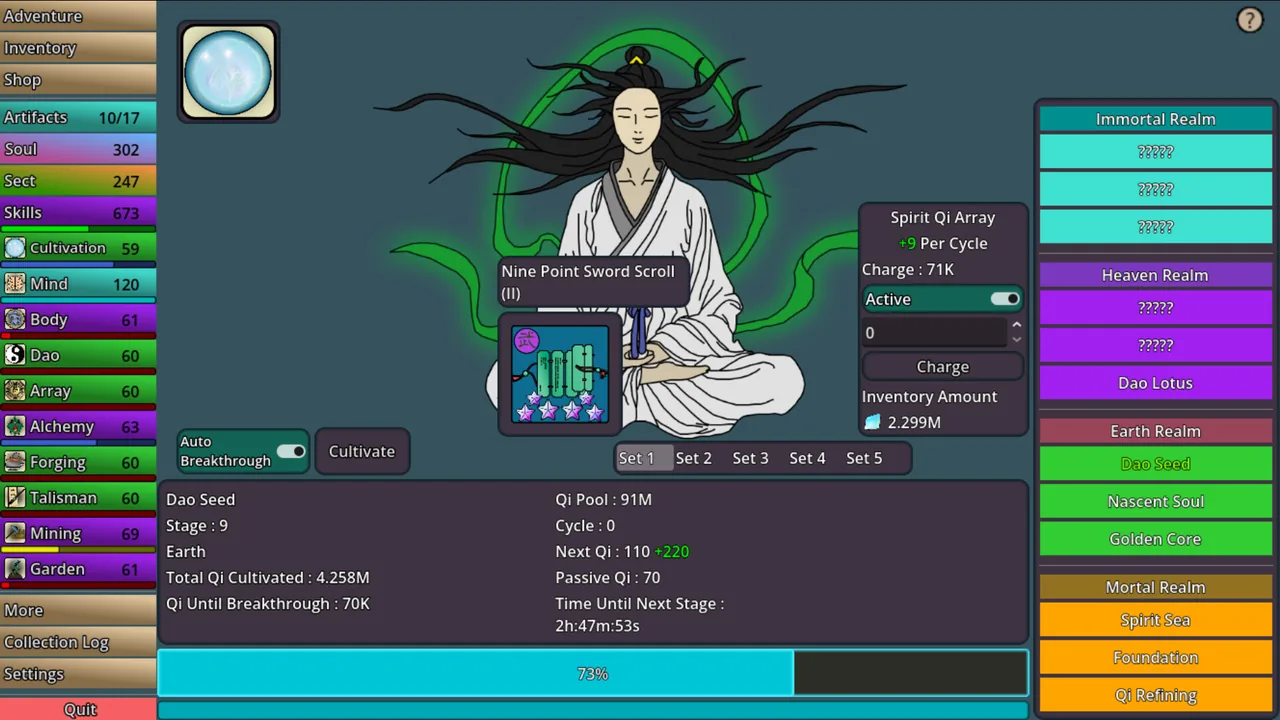
The spine of Idle Cultivation is a four-realm cultivation path — Mortal, Earthly, Heavenly, and Immortal — each split into three named stages (Mortal alone runs Qi Refining, Foundation, and Spirit Sea) and each gated behind a Tribulation: a scripted boss fight you can't out-idle your way past. This is the structural backbone every cultivation-fiction idle game reaches for, and it's the part Idle Cultivation gets convincingly right. Global Steam achievement data shows the ladder behaving exactly the way a well-paced gate should: the Mortal Realm's boss achievement sits at 76.8% completion, the Earthly Realm's at 34.8%, the Heavenly Realm's at 19.4%, and the Immortal Realm's at just 11.1% — a steady taper rather than one brutal wall, which matches the shape of a game built to be climbed over dozens of hours rather than one that punishes players for not memorising a build.
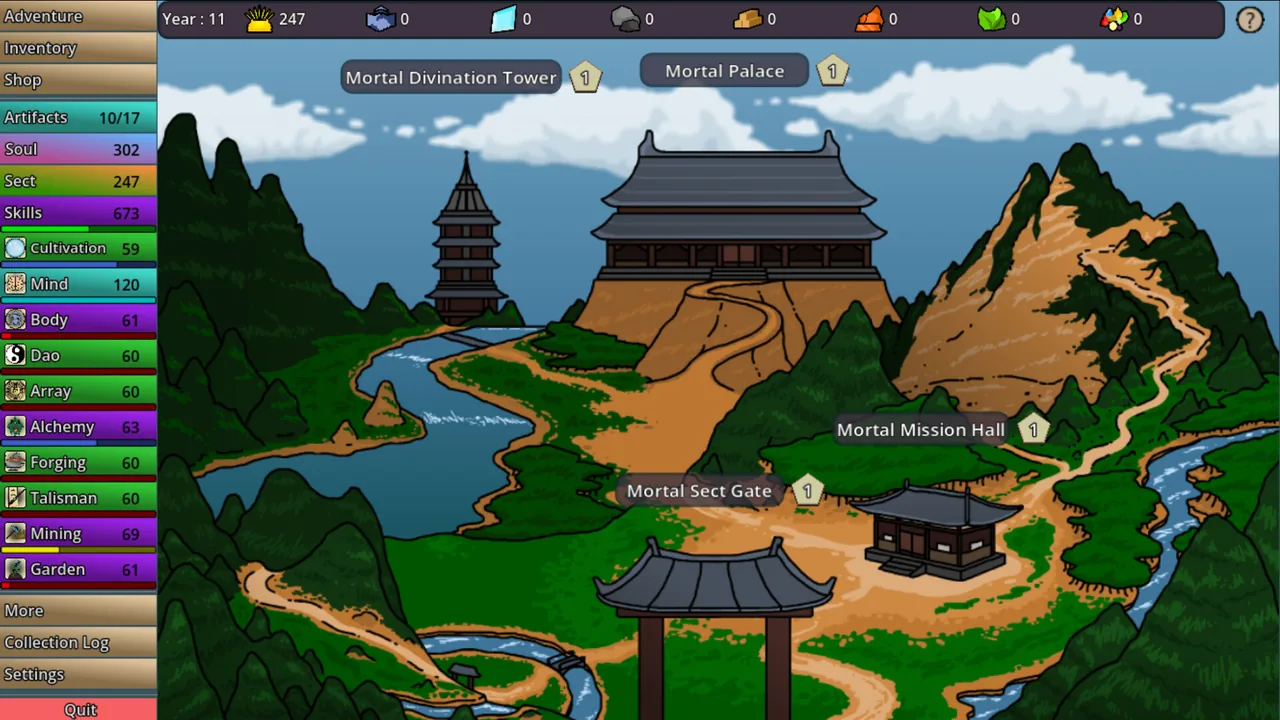
Underneath that ladder sits an unusually wide set of interlocking skills for the price: Cultivation, Mind, and Body train the character directly; Dao and Array unlock passive combat bonuses in twelve-tier trees; Alchemy, Forging, and Talisman crafting turn mined and gathered materials into gear, pills, and buffs; Mining and Gardening supply the raw materials. Layered on top of all of it is a sect-building game — recruiting disciples with their own stats, elemental affinities, and skill potentials, then constructing and upgrading buildings like a Crafting Tower or Training Grounds to put them to work — plus a "Physiques" collection system that rewards discovering rare elemental bloodline traits with their own star ratings and combat bonuses. It's a genuinely large amount of interconnected systems for six dollars, and reviewers repeatedly describe being drawn in by exactly that scale: "It's missing some mechanics, but for being relatively new, it's perfect," reads one; a Chinese-language reviewer who logged over 32,000 minutes called it "brave" for building reincarnation into a long-form loop this way, awarding it a literal "7/10."
Where the climb flattens
The same players putting in the hours to reach that verdict are also the ones most qualified to say where the climb stops working. Idle Cultivation's reincarnation system — called Reincarnate in-game — resets your character in exchange for Soul Power, a currency spent on a permanent perk grid organised by realm and by skill. It's the genre's standard prestige structure, and on paper it should be what keeps a cultivation idle game interesting past the first realm. In practice, several of the game's highest- playtime critics say it stops delivering. One 978-hour reviewer, thumbs down, put it plainly: "The peak of engagement lies around the 2nd or 3rd reincarnation and everything past that lacks depth." Another, at 479 hours: "After the first couple of reincarnations there's no real advancement. Or, if there is, there's no clear way to find it. There are no mechanics that increase the speed of new lives." A 3,067-hour reviewer — the single highest logged playtime in the entire review sample — described still needing an hour and a half to advance a single cultivation level while working toward the very first realm boss, and said the grind was pushing them toward giving up despite genuinely liking the game underneath it. A Chinese-language review with over 2,000 hours logged made the same point from the opposite angle: reincarnation shortens the early game to the point of feeling pointless, while the late game still demands long idle stretches regardless.
None of this reads as players who bounced off the game early — the median playtime among Idle Cultivation's English-language negative reviews is 56.6 hours, and several of the most detailed negatives are attached to accounts with hundreds or thousands of hours logged, well above the 249.9-hour median for its positive reviews. These are the game's own veterans, describing a ceiling they hit after investing seriously in the climb. That complaint now has a confirmed cause: a May 2026 developer post titled "New Achievements and Future Plan" states outright that the just-finished Dao Companion update "will be the last big update for Idle Cultivation," citing an unstable early codebase built while the developer was still learning Godot, with future work limited to "smaller updates, QoL and fixes." A follow-up post in July 2026 confirmed active development has shifted to a sequel, Idle Cultivation 2, still in the concept-and- Patreon stage with no release date. Idle Cultivation isn't abandoned — the patch notes keep coming — but its era of new systems has already ended, which matters directly for anyone buying in hoping the ceiling its veterans describe will eventually get pushed back.
The save file is the actual risk
The more serious problem is narrower but sharper. Scattered through the review history, dated across the game's entire lifespan rather than clustered at launch, are reports of outright data loss. In May 2025, launch week: "The game keeps deleting my save." In February 2026: "The game data wiped after 40 hrs. Waste of money and time." In March 2026, from a 497-hour player who'd logged 170 hours of that specific character: "I logged on and found that everything I had got wiped... My sect is still there, but everything else is gone... What's the point of making a manual save backup if you can't retrieve it?" And in July 2026 — the most recent report in the sample, a month before this review — a 647-hour player wrote that "the game freezes while calculating offline progress," specifically while working toward the game's grindiest late-game achievements. That last one lands hardest of all: offline calculation isn't a side feature of an idle game, it's the feature, and a freeze there means the exact promise the genre makes to its players is the part that's breaking.
Four reports across fifteen months, out of 140 total reviews, isn't an epidemic. But it's not a fossil either — it isn't clustered in a single patch window the way most technical complaints in this library turn out to be, and the most recent instance is current. For a game that asks you to invest hundreds of hours accumulating gear, disciples, and Soul Power with no cloud-independent export beyond Steam Cloud, that risk deserves to be weighed against the depth on offer, not buried under it.
An interface built to look like a spreadsheet, on purpose
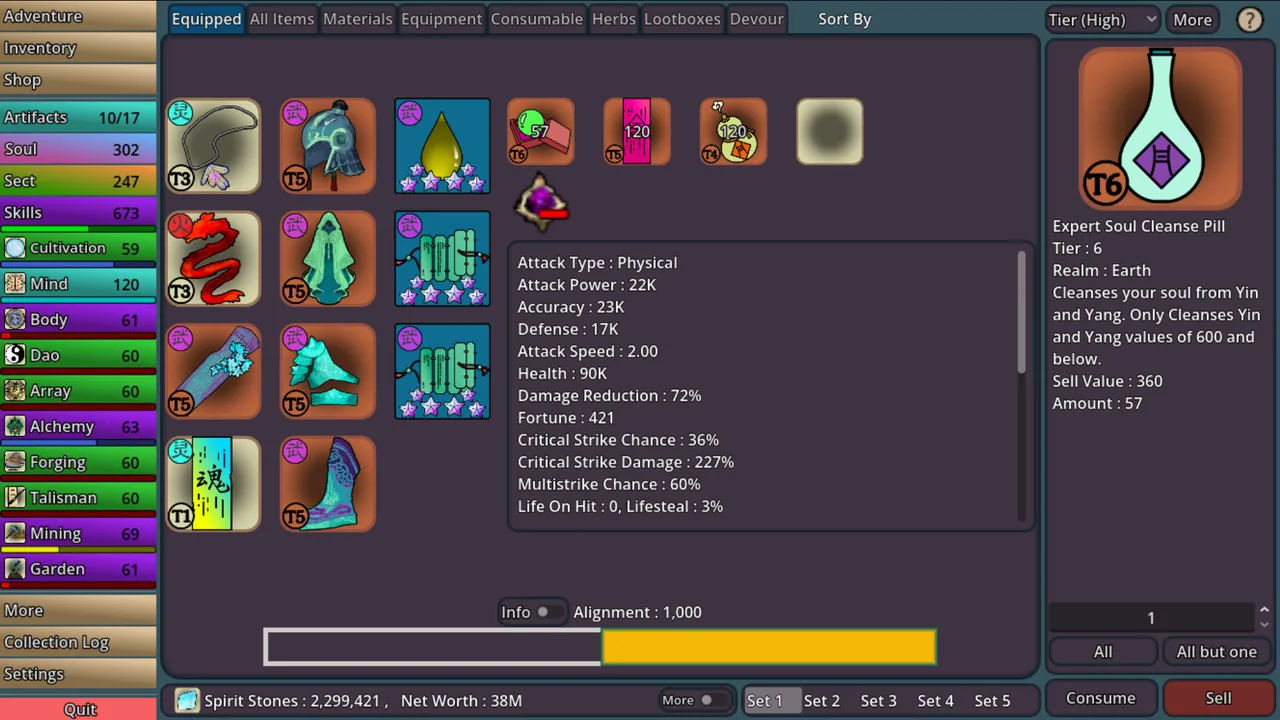
Idle Cultivation's UI is unmistakably modelled on the Melvor Idle school of idle-game design — a permanent left-hand skill sidebar, a central action panel with a progress bar and a "Start" button, dense tooltips packed with raw numbers. Several reviewers say so directly, and not always as a compliment: one calls it "a bad reskin of Melvor Idle with way less content," while another, more generously, recommends playing Melvor first "unless something about this appeals to you in particular." The comparison holds up in the screenshots — right down to reused icon art. Pills, talismans, and cultivation manuals share nearly identical base artwork across dozens of items, distinguished only by a colour shift and a small tier number, which makes browsing the shop or crafting menu visually repetitive even when the underlying items are meaningfully different. In-game guidance is thin: several reviewers describe the game "throwing everything at you" with no tutorial explaining how the nine skills interact, and one specifically wishes for "a nice wiki" that doesn't yet exist. None of it is broken — menus load, numbers update, tooltips explain individual stats clearly enough — but it asks a lot of patience from anyone not already fluent in this exact genre's conventions.
A cultivation game still waiting on its own language
Idle Cultivation ships with English as its only complete language, which is a strange position for a game built entirely from Chinese wuxia and xianxia source material — realms named Golden Core and Nascent Soul, tribulation lightning, sect disciples with elemental affinities lifted wholesale from the genre's web-novel roots. Steam's Simplified Chinese reviews notice the gap immediately: "Testing and art both involved Chinese people, and yet somehow there's no Chinese," reads one, "This kind of cultivation idle game would definitely be a hit in China if localised!!!!" The developer has been visibly working on it — a May 2026 patch note reads "Fixes and expanded Chinese Localization" — but the Chinese-language reviews posted since then still describe the translation as incomplete, several saying they're waiting for it to finish before returning. It's a solvable gap, and clearly one the developer is aware of, but as of this review it still leaves a meaningful part of Idle Cultivation's natural audience reading English tooltips for a fantasy that was never really written in English to begin with.
Monetisation, for once, isn't the problem
Whatever else is worth debating about Idle Cultivation, its business model isn't. It's a single NZ$5.99 purchase with no ads, no premium currency, and no energy system standing between the player and the next breakthrough. A single optional DLC exists — the "Idle Cultivation - Support Pack" at NZ$2.99 — and it buys nothing but additional character appearances for the sect system; all three of its Steam reviews are positive, and none mention feeling pressured to buy it. For a genre this library has repeatedly found riddled with pay-to-skip timers and premium currencies, a flat price with a purely cosmetic add-on is worth stating plainly rather than taking for granted.
Final verdict
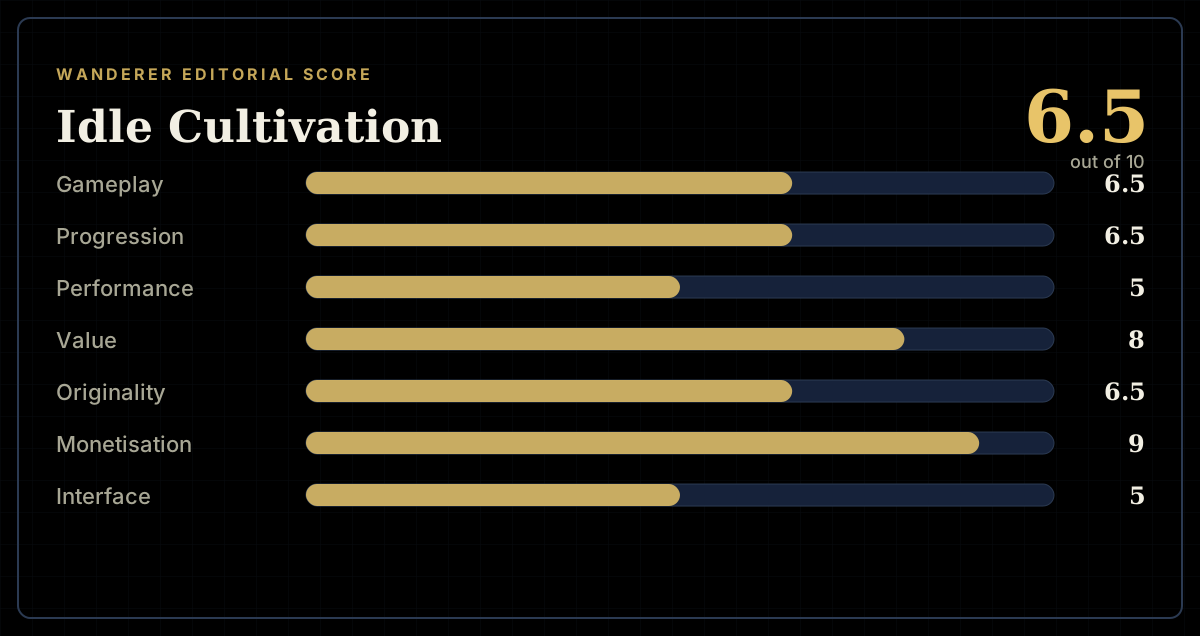
Idle Cultivation succeeds at the hardest part of building a cultivation-themed idle game: it gives the fantasy a real ladder, with realms, tribulations, and a reincarnation loop that at least gestures at genre-appropriate structure, wrapped around nine interlocking crafting and gathering skills that add up to real scope for six dollars. What keeps it from a stronger recommendation is that its own most dedicated players — not casual bouncers, but people with hundreds or thousands of hours logged — describe hitting a depth ceiling a few reincarnations in, and the developer has since confirmed that ceiling isn't getting pushed any higher, because Idle Cultivation's era of major updates ended in May 2026. Layer a recurring, still-current save-corruption problem on top of that, in a genre built entirely on trusting a game to keep a promise while you're not watching, and 6.5 is the honest number: worth playing for the specific audience that wants this exact fantasy and this exact amount of systems, difficult to recommend without real caveats to anyone else. If you buy in, back up your save file yourself, and don't expect the late game to fundamentally change from where it stands today.
Players who want the same skill-sidebar structure with a decade of ongoing content behind it should look at Melvor Idle instead; those who specifically want more cultivation-fiction idle games to compare against should read Wanderer's review of Cultivation Idle, a smaller, cheaper, still-in-Early-Access entry in the same niche.
Pros and cons
Pros
- The four-realm, twelve-stage cultivation ladder with Tribulation gates between each realm gives the number-go-up loop real structure, and achievement-completion data shows a believable, gradual taper rather than a single dead wall
- Nine interlocking skills — cultivation, mind, body, dao, array, alchemy, forging, talismans and gardening — plus sect recruitment and building give a NZ$5.99 game an unusual amount of scope
- Monetisation is limited to one optional NZ$2.99 cosmetic pack for sect character appearances, with nothing that touches progression, and its three user reviews are unanimously positive
- The developer ships fixes on close to a weekly cadence and is personally active on the game's Discord, which shows in a changelog running to dozens of patch notes since launch
Cons
- Save corruption and lost-progress reports recur across the game's whole lifespan, including a 170-hour save wiped in March 2026 and an offline-progress calculation that froze the game for a 647-hour player as recently as July 2026
- Several of the game's most committed reviewers, with hundreds to thousands of hours logged, report that meaningful advancement stalls after the second or third reincarnation and that later prestige runs don't noticeably speed up the early game
- Item icons are reused with only a colour and tier-number change across dozens of pills, talismans and manuals, and in-game explanations are thin enough that several reviewers say they needed outside guidance just to understand core systems
- English is the only complete language on a game built entirely around Chinese cultivation fiction; a Chinese localisation patch has been in visible progress since at least May 2026 and Chinese-speaking reviewers still describe it as unfinished
Screenshots
-
Idle CultivationImage: Linmios via Steam -
Idle CultivationImage: Linmios via Steam -
Idle CultivationImage: Linmios via Steam -
How the review scores each part of the gameWanderer Editorial -
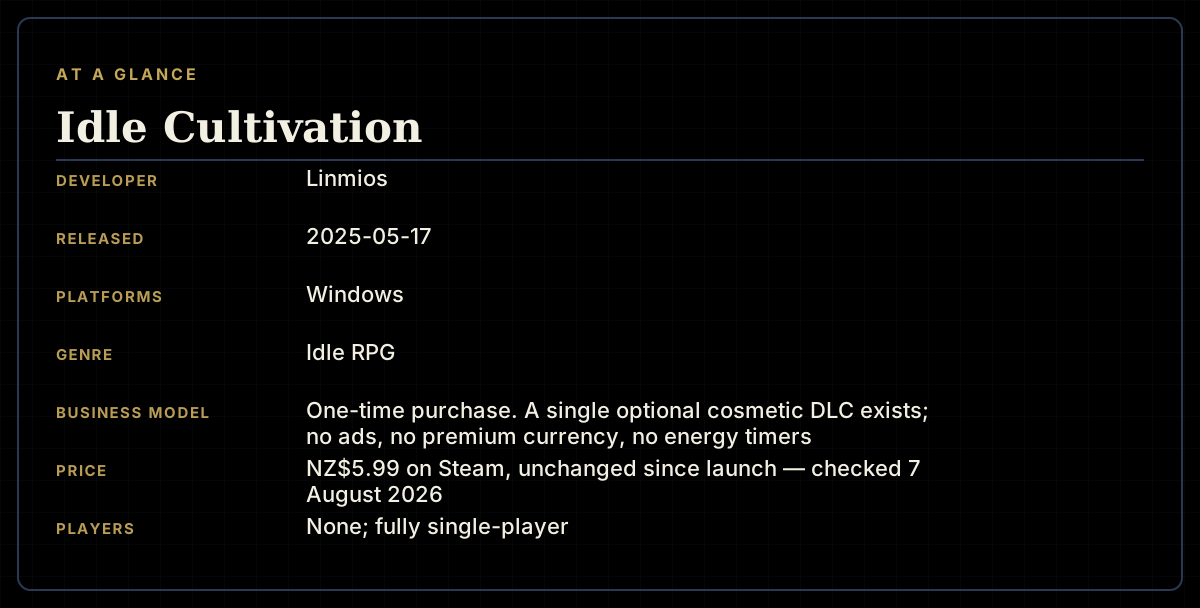
Idle Cultivation at a glanceWanderer Editorial -
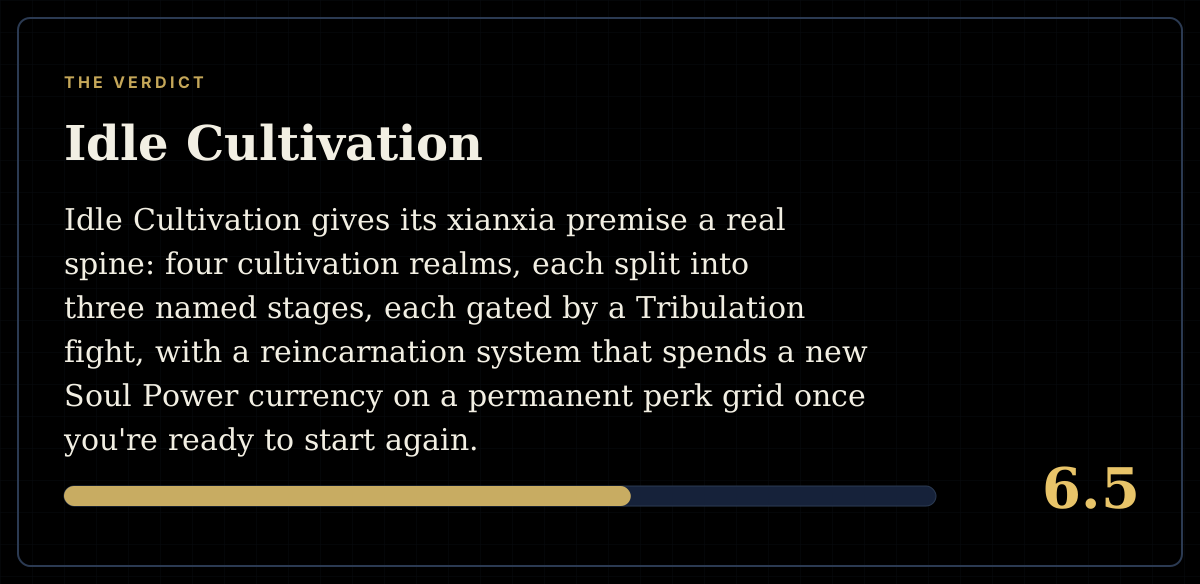
The short versionWanderer Editorial