Game review
Aditore Review
6 / 10
- Developer
- Gadget Node Games LLC
- Publisher
- Gadget Node Games LLC
- Released
- 15 September 2026
- Platforms
- ["Windows"]
- Genre
- RPG
A Sixth Consecutive Launch With Nothing to Cite
Aditore released on Steam on 15 September 2026 and, like every other title covered in this stretch of the schedule, currently has zero Steam user reviews. This review is built entirely from the developer's own store page description, not from verified play, so every claim about how the mining and combat loop actually feels in practice should be read as the developer's pitch rather than a confirmed result. That caveat matters more than usual here, since the whole design hinges on a specific pressure mechanic that's easy to describe on paper but hard to judge without seeing how it actually plays out over repeated runs.
Golems, a Foundry, and a Mining Company's Quota
The premise is unusually utilitarian for a fantasy-adjacent RPG: the player works for "a mining company that hands you quotas," building and deploying golems from a home base called the Foundry to dig into assigned zones and extract ore. There's no grand narrative pitched here — no ancient evil, no chosen one — just a job with a deadline, which the store page leans into directly: "runs are short and sharp. The pressure is the point." That's a distinctive framing choice for the genre, trading epic stakes for a much more mundane, almost logistical premise built entirely around the tension of a shrinking clock.
A Three-Day Clock Over Turn-Based Tactics
The central mechanic is a hard three-day limit on every expedition, with "each deploy costs a day," meaning a squad only gets three chances to dig deep enough into a zone to hit its ore quota before the run ends. Within each deployment, the game plays as grid-based tactics: golems fight "rival constructs" and must "cut routes to veins" to reach the ore itself, meaning combat and excavation are treated as the same spatial problem rather than as separate systems bolted together. Turn order is handled through what the store page calls "timeline turns," where unit speed determines sequencing, so players are asked to "plan digs around enemies" rather than simply alternating turns in a fixed pattern — a system that, if it works as described, would reward reading the timeline as carefully as reading the map itself.
That fusion of excavation and combat into one spatial puzzle is the part of the pitch most worth watching once player feedback eventually arrives. Plenty of tactics games ask players to manage positioning against enemies alone; asking players to also treat the terrain itself as a resource to be dug through — routes to ore veins presumably need to be cleared turn by turn, the same turns that could otherwise be spent attacking or repositioning — adds a scheduling problem on top of the usual combat one. Every turn spent cutting a path is a turn not spent fighting, and with only three total deployments before the quota deadline, that trade-off between digging speed and combat safety looks like it's meant to be the main strategic tension the game is built around, rather than a secondary wrinkle.
Golems That Level Mid-Fight but Reset Every Run
One detail sets Aditore apart from typical tactics-RPG progression: golems can level up "in-battle" during a single dig, gaining strength from level 1 to level 3 as the expedition proceeds, but the store page is explicit that these gains "reset next fight." That means all lasting progression has to run through the Foundry instead, where copper, iron, and gold mined during runs get spent to build and upgrade a squad of up to four golems for the next expedition. It's a structure that separates short-term tactical growth (which resets) from long-term strategic growth (which persists), putting the emphasis on squad composition and Foundry investment between runs rather than on any individual golem becoming permanently more powerful.
Resetting in-battle levels every run is a deliberate design choice with a clear trade-off. On one hand, it keeps every expedition self-contained and prevents a snowball effect where an already-strong squad simply gets stronger indefinitely, which should in theory keep the three-day quota meaningfully tense on every single run rather than only during the first few. On the other hand, it also means the only progression that carries over between runs is whatever gets banked at the Foundry, so the three named ore types — copper, iron, and gold — presumably need to be tuned carefully against golem costs to make each run's haul feel like it's building toward something, rather than just resetting the player to the same starting position with a marginally better roster. That balance between per-run tension and cross-run growth is exactly the kind of thing that's usually easiest to judge from actual playtime, which isn't available here yet.
A Discounted Launch Price for a Short-Run Structure
At NZ$6.31 with a 20% launch discount off NZ$7.89 at the time of writing — the store page notes the discount runs for "the first 14 days" — Aditore is priced at the budget end of the tactics-RPG space, which fits a game built around short, repeatable runs rather than a single long campaign. There's no mention of any monetisation beyond the base purchase. The store page also flags that controller support is coming "when it's actually finished," an unusually blunt admission from a developer about an incomplete feature, which is worth factoring in for anyone specifically planning to play with a controller rather than mouse and keyboard.
Verdict
Aditore pitches a tightly focused turn-based tactics loop built around a three-day expedition clock, golems that level temporarily in battle but grow permanently only through Foundry investment between runs, and a deliberately mundane mining-company premise in place of typical fantasy RPG stakes. Like every other title covered in this stretch, it remains completely unreviewed by Steam's user base at the time of writing, so its central pressure mechanic and squad-building loop are unverified claims rather than confirmed strengths. Its low, discounted launch price keeps the risk of trying it modest, making it a reasonable pick for tactics fans specifically curious about its quota-and-clock structure — with the standing caveat that this assessment rests entirely on the developer's own description rather than anyone's actual playthrough.
Screenshots
-
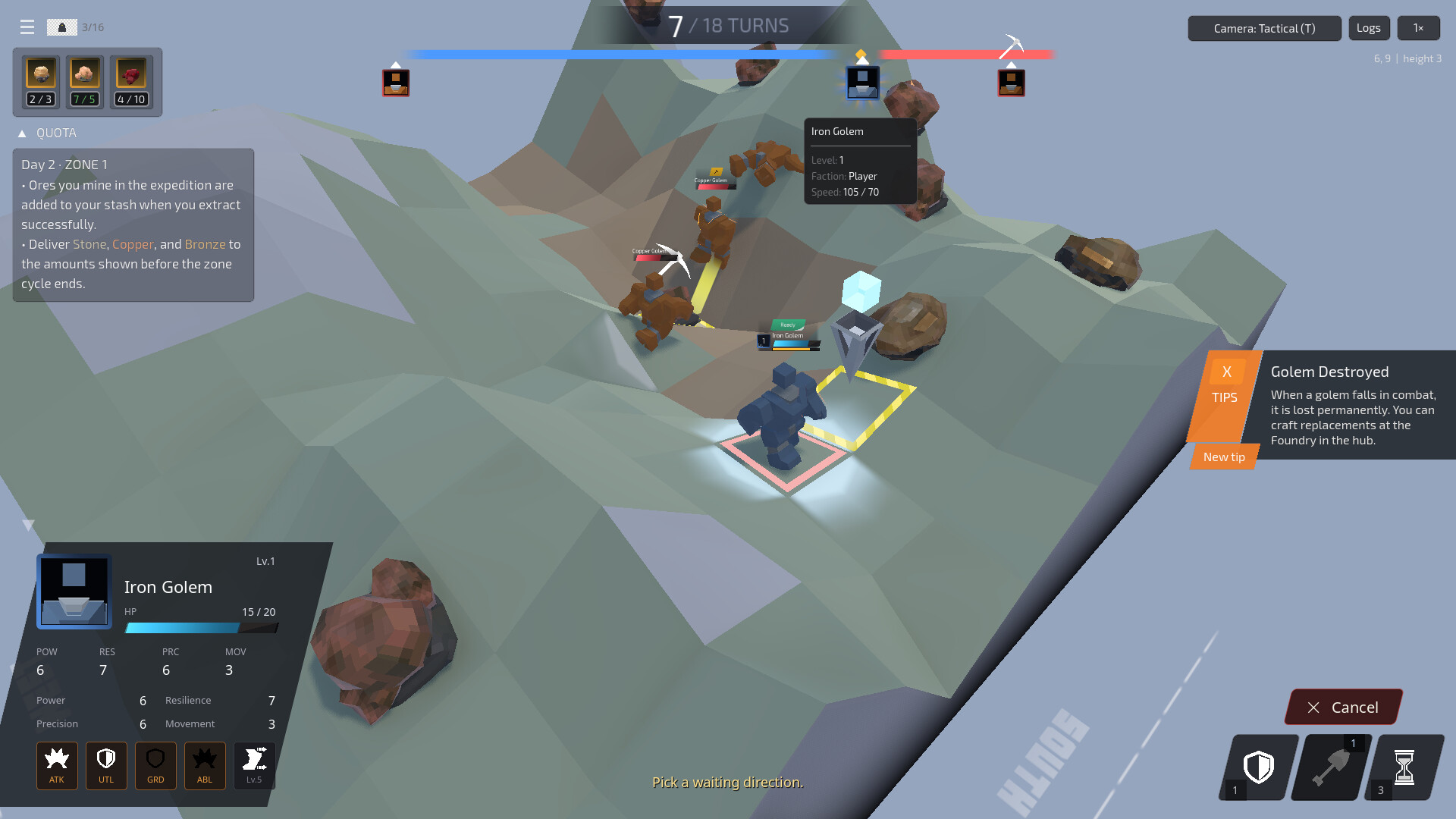
A quota panel tracks delivery targets for the current zone while a turn counter and stat readout manage the tactical fight underneathImage: Gadget Node Games LLC via Steam -
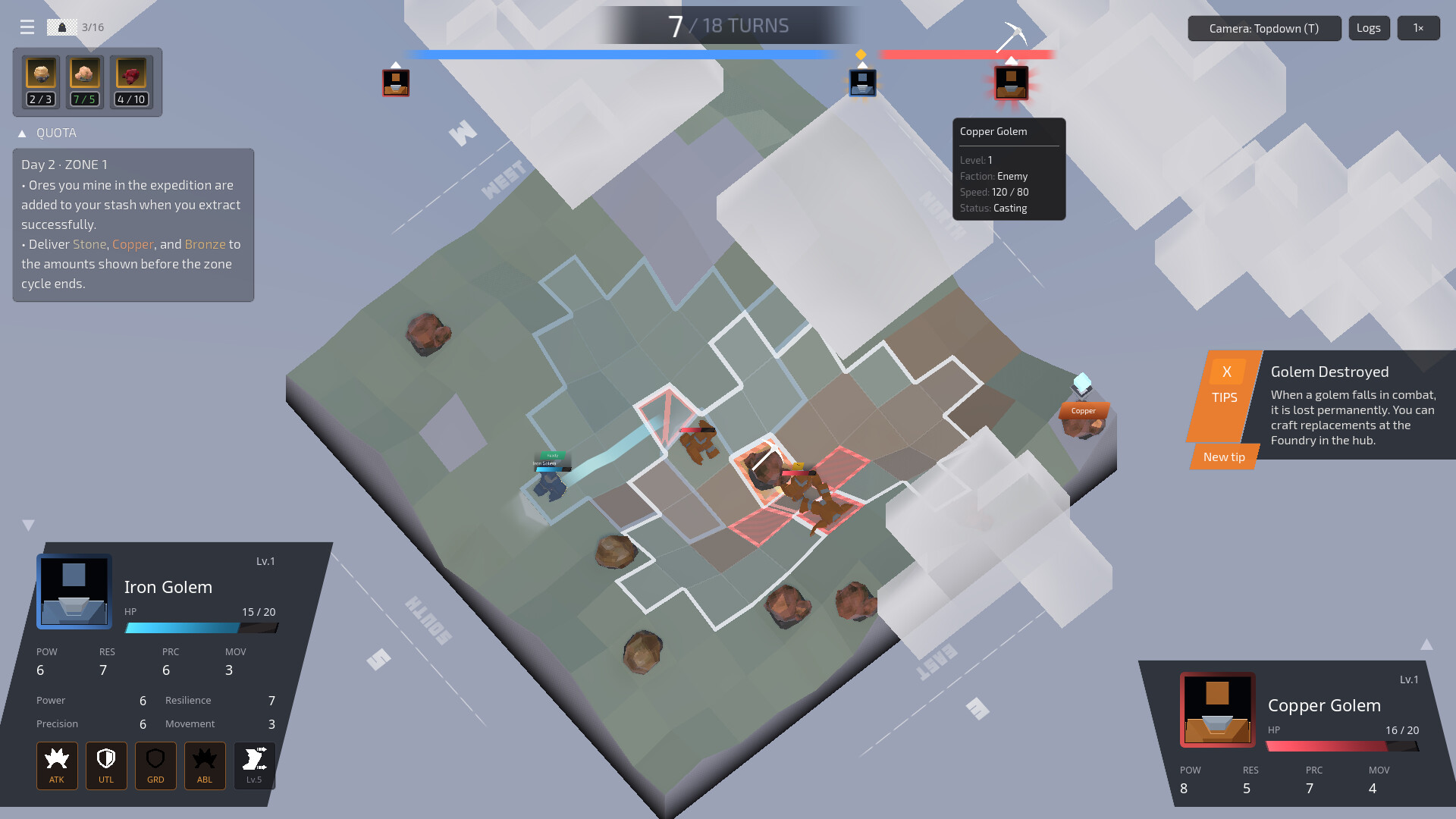
A top-down camera option lays out golem positioning and status effects like the Copper Golem's "Casting" state more clearlyImage: Gadget Node Games LLC via Steam -
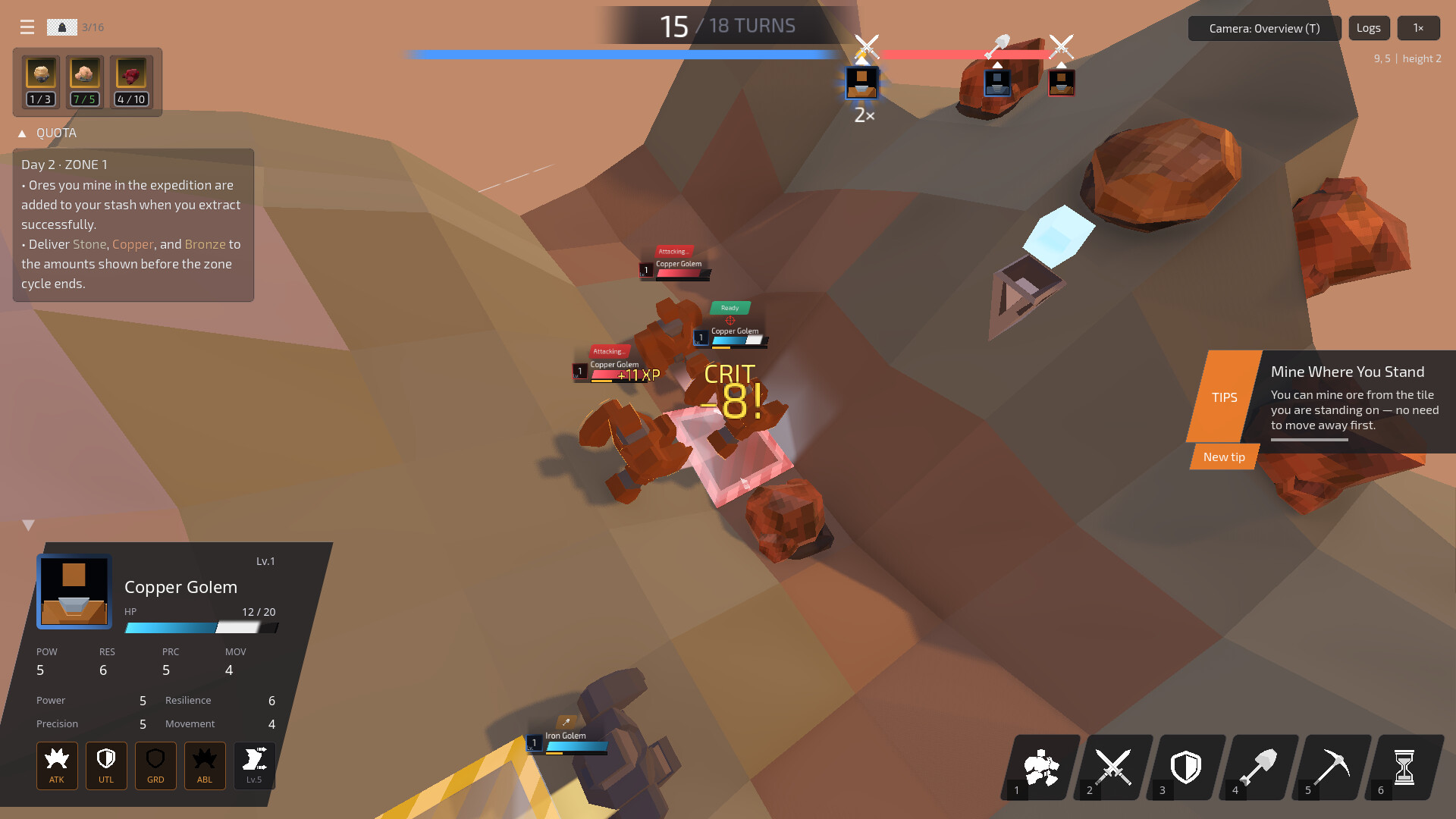
A critical hit lands for 8 damage while a tip reminds players they can mine ore from the tile they're standing on without moving firstImage: Gadget Node Games LLC via Steam