Game review
AETHER CROWN Review
6 / 10
- Developer
- DEVPHAN
- Publisher
- DEVPHAN
- Released
- 10 September 2026
- Platforms
- ["Windows"]
- Genre
- RPG
An Eighth Consecutive Launch Without a Single Review
AETHER CROWN released on Steam on 10 September 2026 and currently has zero Steam user reviews, continuing an unbroken run of unreviewed launches covered in this stretch of the schedule. This review draws entirely on the developer's own store page description, not on verified play, which matters more than usual for a visual novel: the actual quality of the writing, the pacing of Carl's story, and how satisfying its multiple endings feel are exactly the kind of things a store page description can gesture at but never actually demonstrate.
A Guild Story Told Through Schedule Management
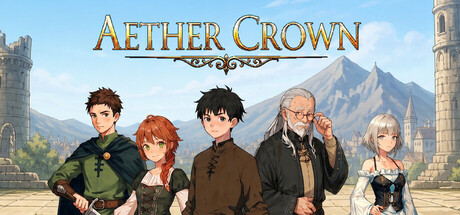
The setup follows Carl, "a young boy who dreams of becoming an adventurer," who travels to a royal capital and joins Dandelion, "a legendary guild he has always admired" — only to discover that "the guild, the city, and the life of an adventurer are very different from what he imagined." That's a fairly conventional coming-of-age framing for a fantasy visual novel, but the store page is explicit that the player's main tool for shaping the story is scheduling: deciding "when to train, when to work, when to build relationships, and when to prepare for danger," with those choices determining which "story events," "dangerous incidents," or romantic subplots actually trigger. Rather than a linear visual novel with occasional branch points, AETHER CROWN pitches its narrative as something closer to an emergent outcome of how the player allocates Carl's limited time.
RPG Systems Layered Under Visual Novel Choices
Underneath the schedule-management and relationship-building layers, the store page describes genuine RPG mechanics: "character stats, equipment, gold, reputation, personal traits, and turn-based battles." Combining a dating-sim-adjacent schedule system with turn-based combat and stat growth is a fairly ambitious hybrid, since it asks players to think about time management, relationship-building, and combat preparation as three interlocking systems rather than treating any one of them as the main draw. Whether that combination feels cohesive rather than like three separate games stitched together is difficult to judge from a feature list alone — a schedule-and-relationship sim can succeed or fail almost entirely on how well it paces its systems against each other, and that's the kind of balance question a store page description simply can't answer.
The specific risk with this kind of hybrid is that the turn-based combat ends up feeling like a secondary system bolted onto the real game, rather than a fully realised one in its own right — a common failure mode when visual novels add RPG mechanics mainly to give player choices some numerical weight. The store page's own framing leans toward story-first ("AETHER CROWN is primarily a story-driven visual novel, but it also includes simulation and RPG systems"), which is an honest way to set expectations but also suggests combat depth may be modest by the standards of a dedicated turn-based RPG. That's not necessarily a flaw for the genre it's aiming at, but it does mean players drawn in specifically for the RPG side of the pitch should calibrate their expectations toward the visual novel's needs rather than a full tactical combat system.
Multiple Endings, Including Failure and Early Death
The store page is candid about the stakes attached to those scheduling decisions: alongside its main endings, it lists "early endings, including failure or death depending on the player's choices," meaning a poorly managed schedule or a risky decision can cut Carl's story short well before any of the intended conclusions. That's a meaningfully harsher structure than the "pick your favourite ending" model common to gentler visual novels, since it puts real weight behind the resource-management side of the game rather than treating stats and preparation as flavour dressing on top of a story that unfolds the same way regardless. The full experience is pitched at "approximately 4 hours to reach an ending," a short runtime that fits the genre and suggests replaying to see different endings, rather than one long playthrough, is the intended way to experience everything on offer.
A Mid-Range Price for an Untested Hybrid
At NZ$14.17 with a 10% discount off NZ$15.75 at the time of writing, AETHER CROWN sits at a reasonable mid-range price for a roughly 4-hour visual novel with RPG and simulation systems layered in, especially given the genre's tendency to reward multiple playthroughs to see different endings. There's no mention on the store page of any monetisation beyond the base purchase. The game's unusually broad language support — fourteen languages including English, French, German, Japanese, Korean, and both Chinese variants — suggests a wider international release than many small indie visual novels attempt, though it's worth noting the store page's own screenshots at the time of writing show the game running with Korean-language UI text rather than English, so they may not be representative of how the interface looks with English selected.
Verdict
AETHER CROWN pitches an ambitious hybrid of schedule-management visual novel and turn-based RPG, built around Carl's guild-adventurer story in a royal capital, with real failure states and early endings giving weight to how the player manages his limited time. Like every other title covered in this stretch, it remains completely unreviewed by Steam's user base at the time of writing, so the crucial question of whether its three interlocking systems — scheduling, relationships, and combat — actually mesh well in practice is entirely unverified. Its broad language support and reasonable mid-range price make it a low-risk pick for visual novel fans specifically curious about a heavier RPG hybrid, with the standing caveat that this assessment rests entirely on the developer's own description rather than anyone's actual playthrough.
Screenshots
-
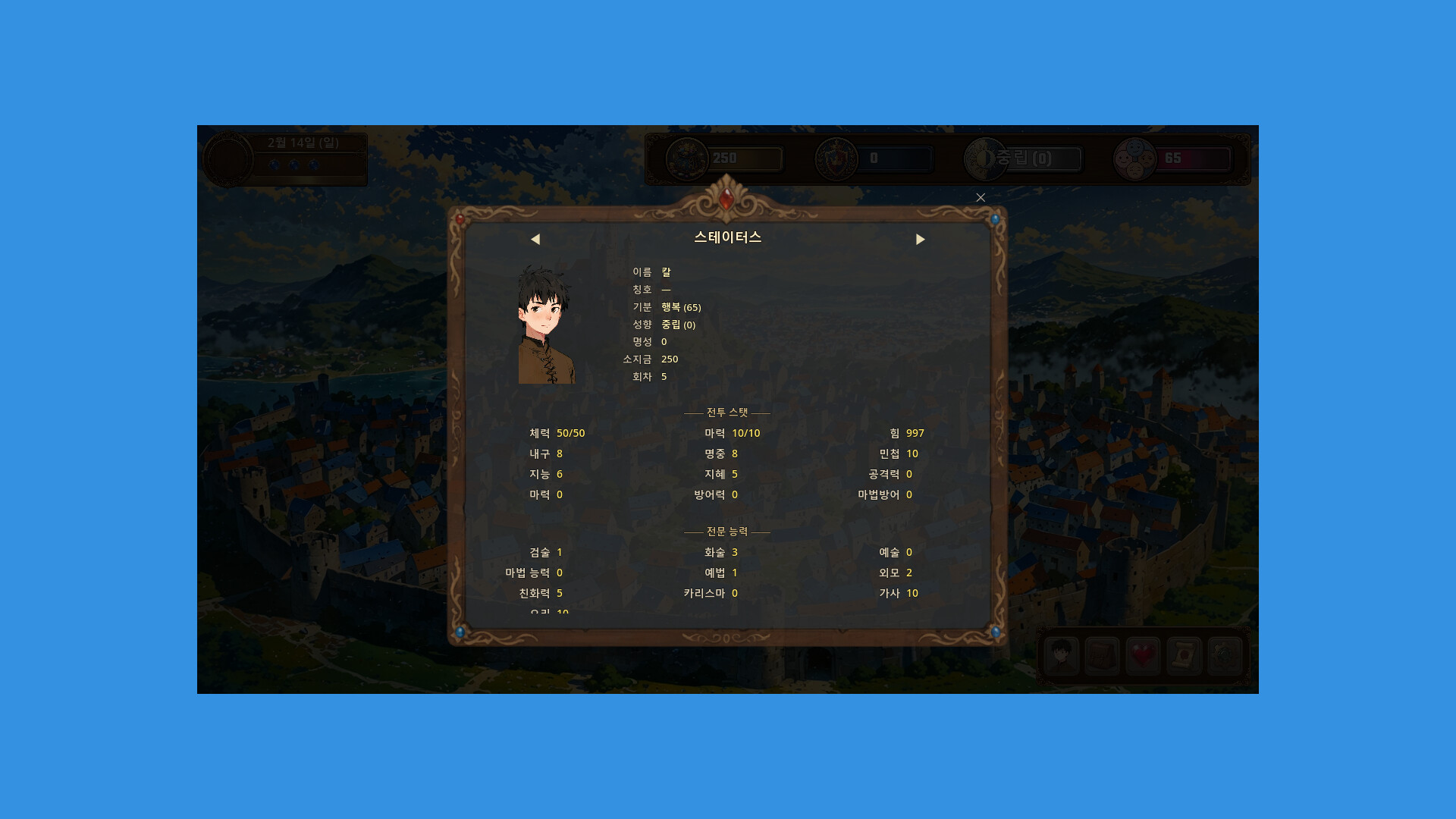
A detailed status screen tracks combat stats, mood, alignment, and specialty skills, shown here in the store page's Korean-language screenshotImage: DEVPHAN via Steam -
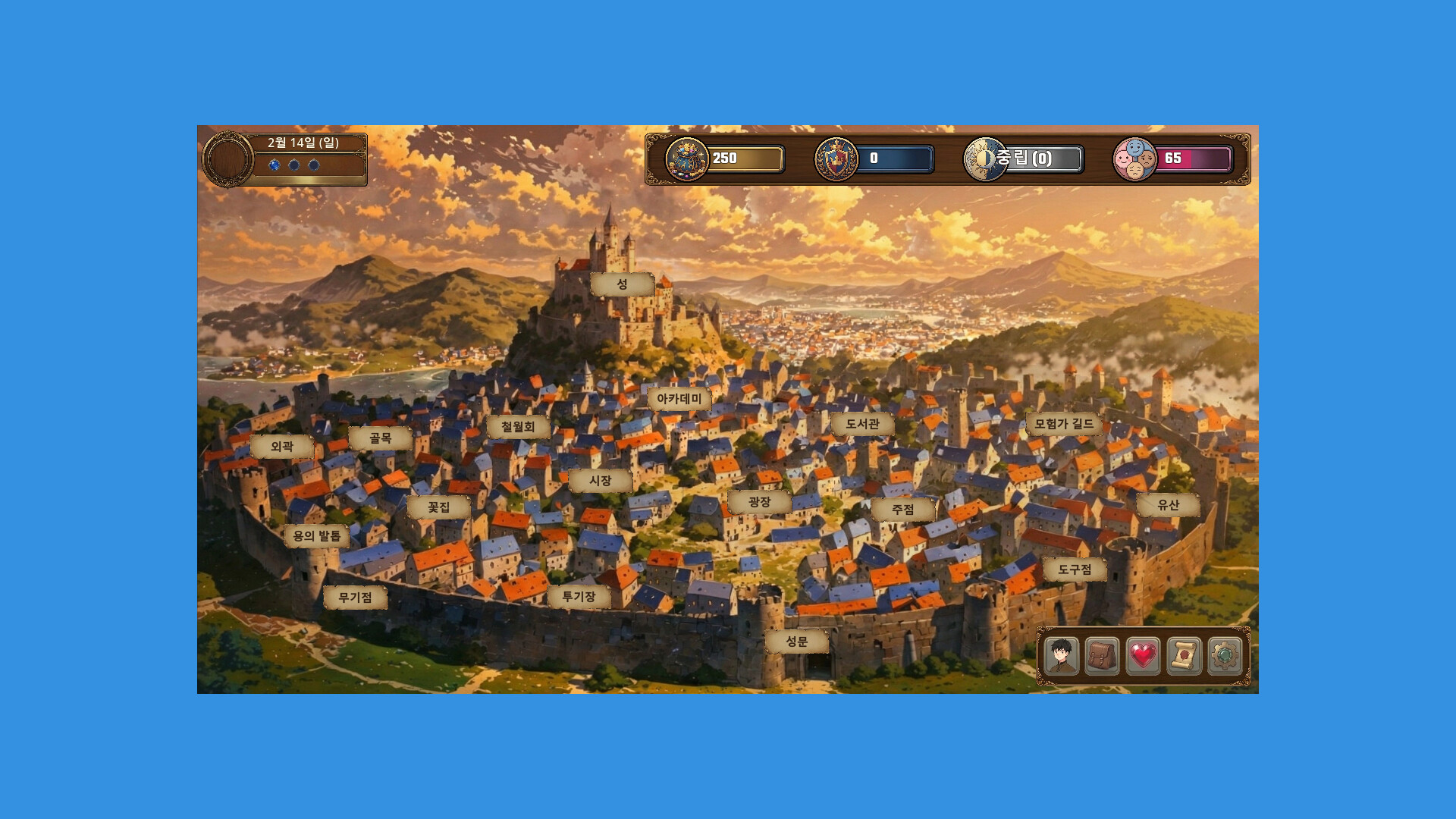
A painted city map lets players travel between labelled districts such as the guild hall, library, academy, and tavernImage: DEVPHAN via Steam -
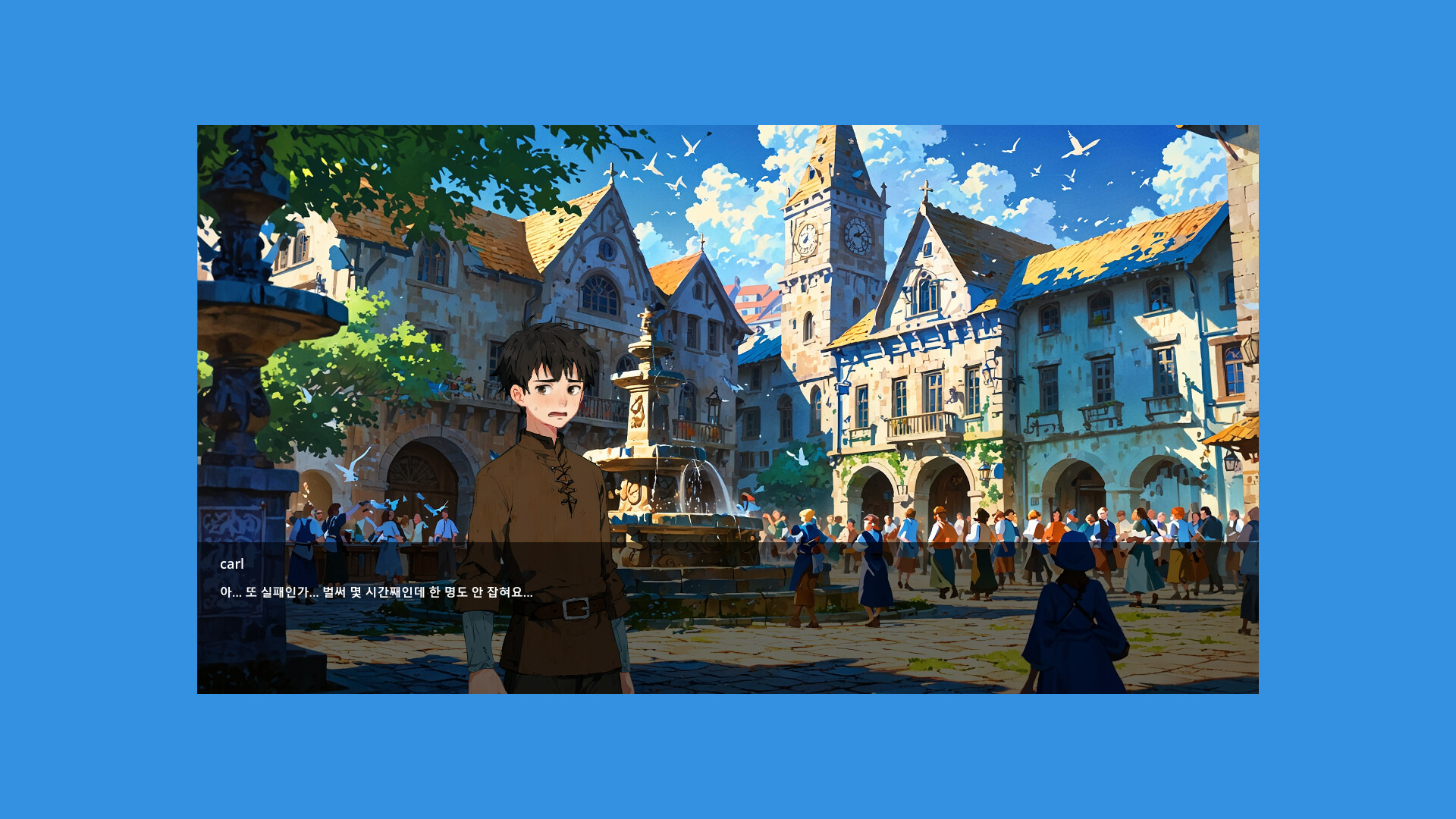
Visual novel scenes place Carl in fully painted city backdrops, with dialogue text shown here in the store page's Korean-language screenshotImage: DEVPHAN via Steam