Game review
Melvor Idle
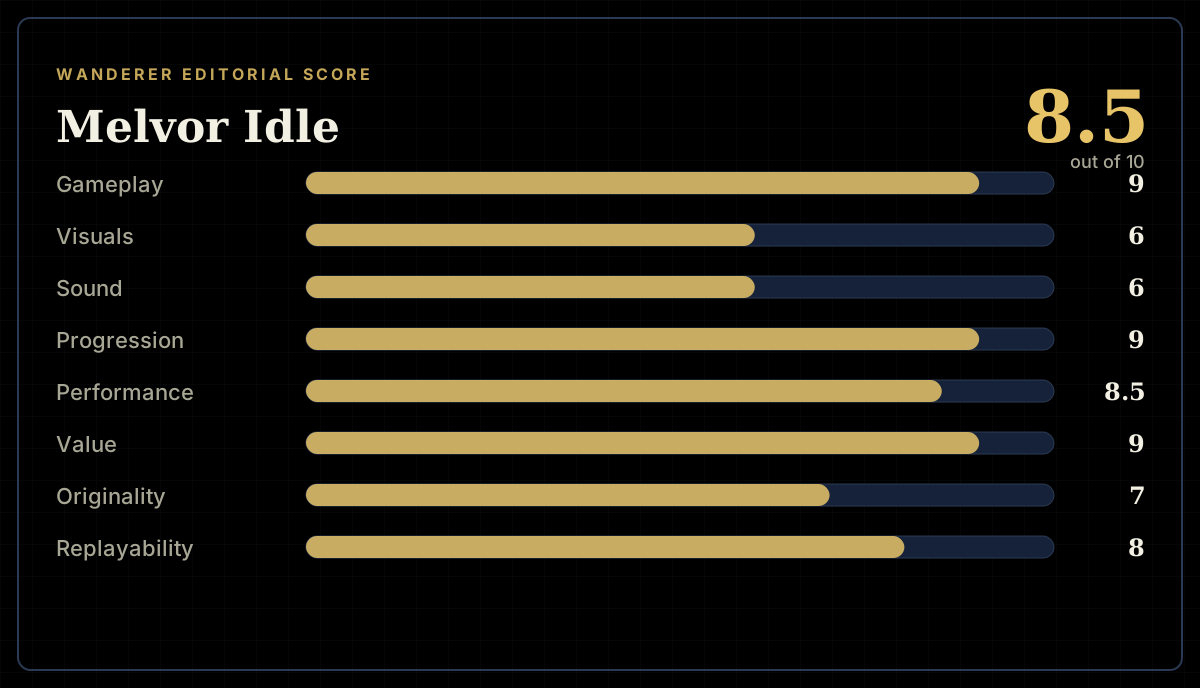
8.5 / 10
- Developer
- Games by Malcs
- Publisher
- Jagex Ltd
- Released
- 18 November 2021
- Platforms
- Windows, macOS, Linux, Android, iOS, Web browser
- Genre
- Idle RPG
- Monetisation
- One-time unlock for the full game, plus three optional paid expansions; mobile versions add ads and a separate ad-removal purchase; no microtransactions or subscriptions on any platform
- Players
- Single-player
The short version
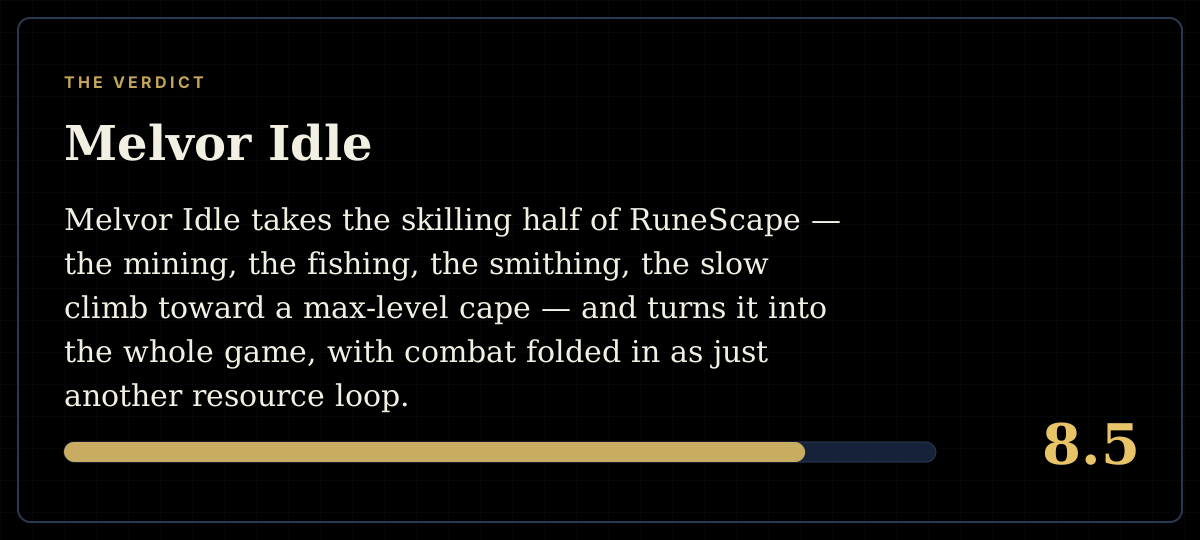
Melvor Idle takes the skilling half of RuneScape — the mining, the fishing, the smithing, the slow climb toward a max-level cape — and turns it into the whole game, with combat folded in as just another resource loop. Twenty-nine skills feed each other in ways that reward planning rather than clicking, the free version is a genuinely complete slice rather than a demo with a timer, and nothing in the game asks for a subscription or a premium currency.
It gets held back by its own restraint. The interface is closer to a spreadsheet than a game screen, the late levels of any given skill turn into pure patience, and spreading the full experience across a base game and three separate expansions means the generous asking price adds up if you want everything.
Biggest strengths
- Twenty-nine skills genuinely feed each other — better Fishing changes what Cooking can make, which changes how long you last in combat
- The free browser and mobile versions are a complete early-to-mid game, not a capped trial
- A single one-time unlock covers the whole base game forever, with no subscription anywhere
Biggest weaknesses
- The interface is number tables and small icons throughout — there is no combat animation or visual spectacle to speak of
- Late Mastery levels in any skill are pure elapsed time with no new decisions to make
- Getting the complete game means buying the base unlock plus three separate expansions on top
Who it's for: Spreadsheet-brained RuneScape veterans, and anyone who wants an idle game with real systems depth rather than a single number that goes up.
Our recommendation: Start in the browser or on mobile for free — it's the full early game, not a teaser. If Township, Astrology or Ancient Relics mode are still pulling you in after a couple of weeks, the Steam unlock and its expansions are cheap for how much they add.
8.5 / 10
There's a specific kind of player who, in an MMO, spent more time at the mining rock than in the raid. Melvor Idle is built entirely for that player. It takes the skilling half of RuneScape — the ore veins, the fishing spots, the anvils, the slow crawl toward 99 in something nobody else cares about — strips out the open world, the other players and the chat window, and hands you the menus alone. That should not work as a whole game. It does, because the menus were never the boring part; they were just never given the chance to be the main event before.
Twenty-nine skills, one economy
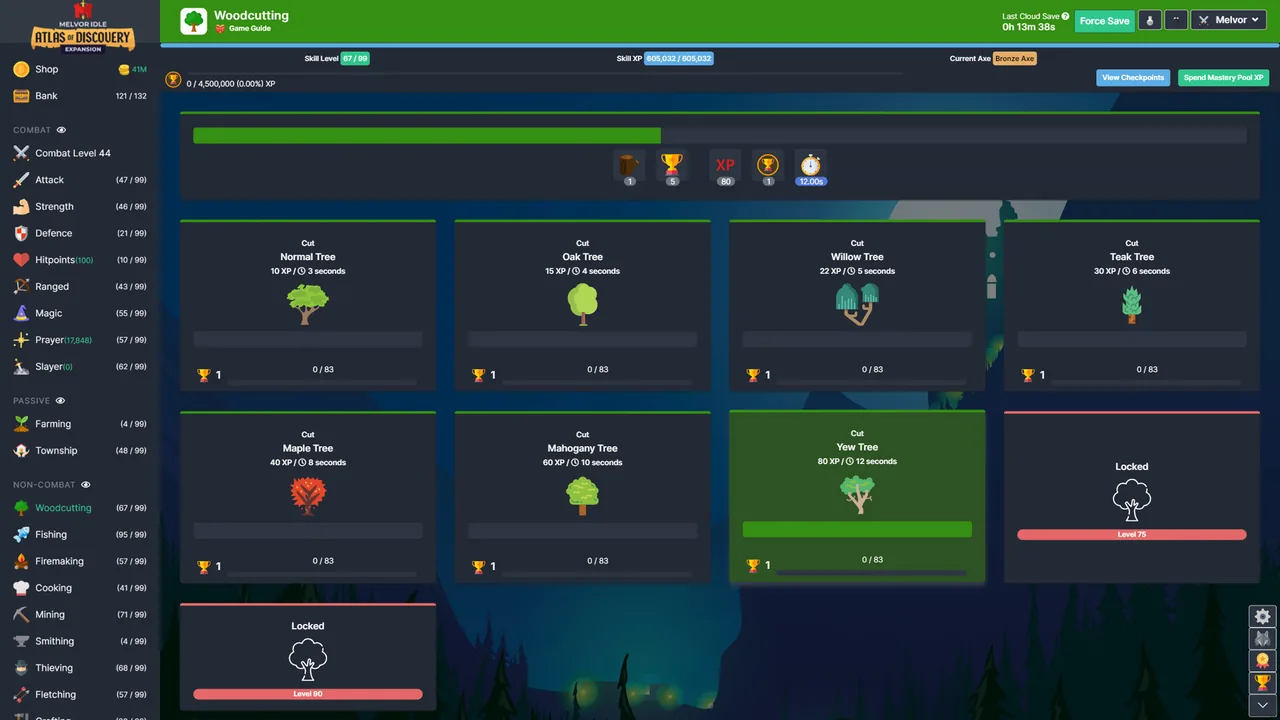
Melvor Idle currently runs twenty-nine skills across two families: nine combat skills (Attack, Strength, Defence, Hitpoints, Ranged, Magic, Prayer, Slayer and Corruption) and twenty non-combat skills covering gathering, production and support. Each one trains through a timed action — swing an axe, smelt a bar, brew a potion — that ticks forward whether or not the tab is in focus, and each has its own Mastery track on top of the raw skill level, so hitting level 99 in something is a milestone, not an ending.
What keeps this from being twenty-nine disconnected progress bars is how deliberately they're wired together. Fishing output determines what Cooking can turn into food, food determines how long a character survives a fight, combat drops determine what Smithing and Fletching can build, and those items feed back into every gathering skill that needs better tools. Township, added in the first expansion, sits on top of all of it as a passive resource engine that wants raw materials from the skills underneath it. Pull on one thread and the rest of the web tightens. That interdependence is the single best argument for playing this over most of its competitors — it's rare for an idle game to make you feel the cost of ignoring a skill for too long, and Melvor does it constantly.
Combat is homework, not a fight
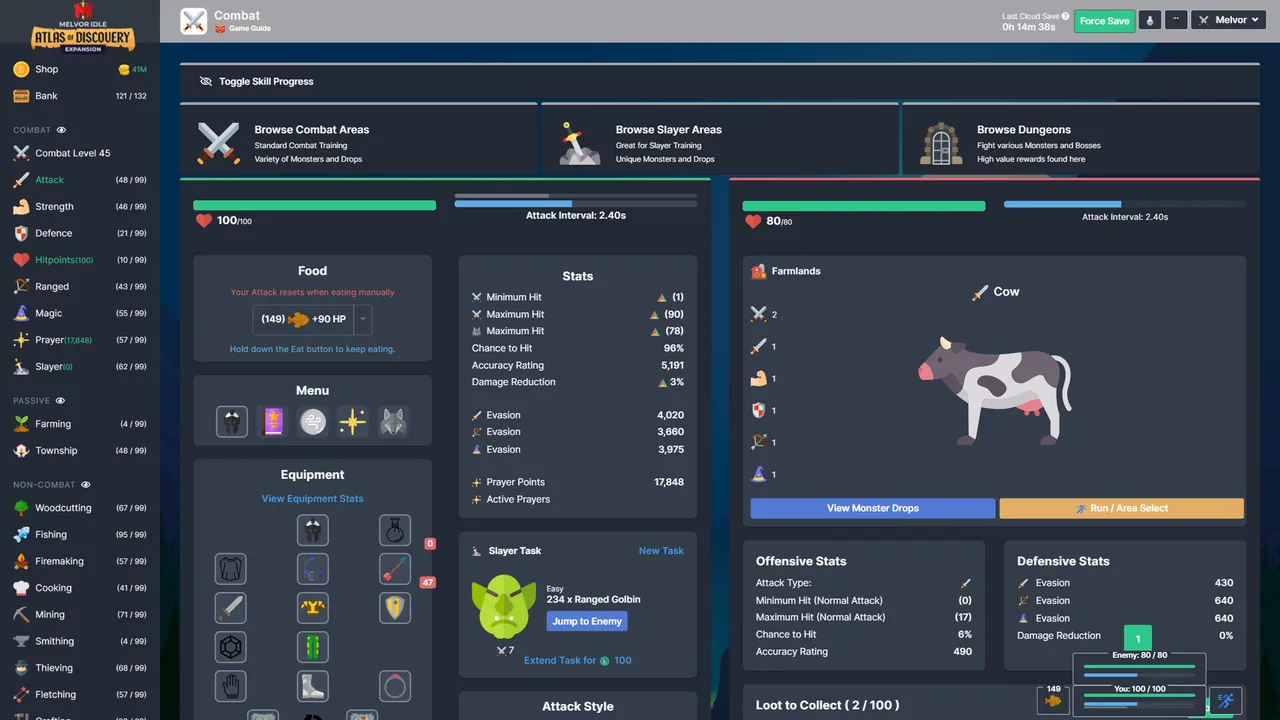
There's no reaction test here. You select a monster, set gear and Prayers, and the game resolves hit chances and damage on a timer while you do something else. What decides whether you win is whether your Combat level, food supply and equipment were good enough going in — a supply-chain problem dressed up as a fight, exactly like Idle Iktah's approach to the same idea, except Melvor attaches nine separate skills to the process (Attack, Strength, Defence, Hitpoints, Ranged, Magic, Prayer, Slayer, Corruption) instead of one generic combat stat. Slayer tasks and dungeons give it actual objectives rather than open grinding, and the various Combat Areas gate content behind Combat level in a way that keeps early monsters from becoming pointless later, since Slayer tasks keep sending you back to them.
The honest criticism is that once you understand the loop, an unexpectedly hard monster rarely teaches you anything new — the answer is almost always "come back with a higher level or better food," not "fight differently." Combat here is a resource check wearing a fight's clothing, and the game never really pretends otherwise.
The free version isn't bait
Melvor Idle launched into Early Access in September 2019 as a solo project by Australian developer Brendan Malcolm, working under the name Games by Malcs. Jagex — the studio behind RuneScape and Old School RuneScape, whose skilling design is the obvious ancestor of everything here — signed a publishing partnership in October 2021 and the game hit full release the following month, with free-to-try versions on iOS and Android alongside the Steam build.
The browser version at melvoridle.com and the mobile apps aren't watered-down teasers. They run the same skill system, the same combat, the same Mastery grind as the paid build, just without the content the three expansions later added and, on mobile, with ads. Unlocking the "Full Version" on Steam is a single one-time purchase with no recurring cost — no subscription, no energy system, no premium currency anywhere in the game. That's an unusually clean stance for a live-service idle game to hold for four years running, and it's the main reason Melvor's Steam reviews stay firmly in "Very Positive" territory rather than collecting the recurring monetisation complaints that follow most of the genre.
Three expansions, three actual skills
Where a lot of live-service idle games pad expansions with reskinned content, Melvor's three paid expansions have each shipped a structurally different system rather than a bigger number to grind:
- Throne of the Herald (October 2022) added Township, a town-management layer that turns
accumulated resources into a passive generator, plus an Astrology rework built around constellations that grant permanent character modifiers.
- Atlas of Discovery (September 2023) added Cartography and Archaeology — map exploration and
artefact-hunting — alongside a genuinely different way to play the whole game in Ancient Relics mode, where every skill starts unlocked but capped at level 10 and rises only by clearing dungeons.
- Into the Abyss (June 2024) added the Harvesting skill, a new Corruption combat skill, and a
story chapter built around the antagonist Xon, the Abyssal King.
Each is a standalone NZ$7.39 purchase, so building the complete game costs the base unlock plus three add-ons rather than one flat price. Judged individually, none of them feels like padding — Township and Ancient Relics mode in particular change what "playing Melvor" means rather than just extending the same loop. Judged as a whole, it's a fragmented way to sell a single game, and a player who wants everything is looking at four separate purchases to get there, even if the total is still modest by any standard.
Offline progression, done without the asterisk
This is where Melvor separates itself most clearly from cheaper-feeling idle games. Offline time is simulated at the same rate as active play — not a reduced trickle, not a currency you have to spend to unlock — up to a cap of 24 hours. Combat and Thieving need a setting enabled before they'll run unattended, and equipped gloves, skillcapes and auto-reused Herblore potions all keep working while the game is closed, so a properly set-up account doesn't lose much by being left alone overnight or through a workday. The 24-hour ceiling exists for practical reasons — simulating days of ticks instantly on login gets expensive and save-corrupting — and it's a generous number next to genre peers that gate offline hours behind a purchase. Nothing here is sold as a way to buy more offline time, because the base offline rate is already the good one.
Interface, presentation and what it costs to run
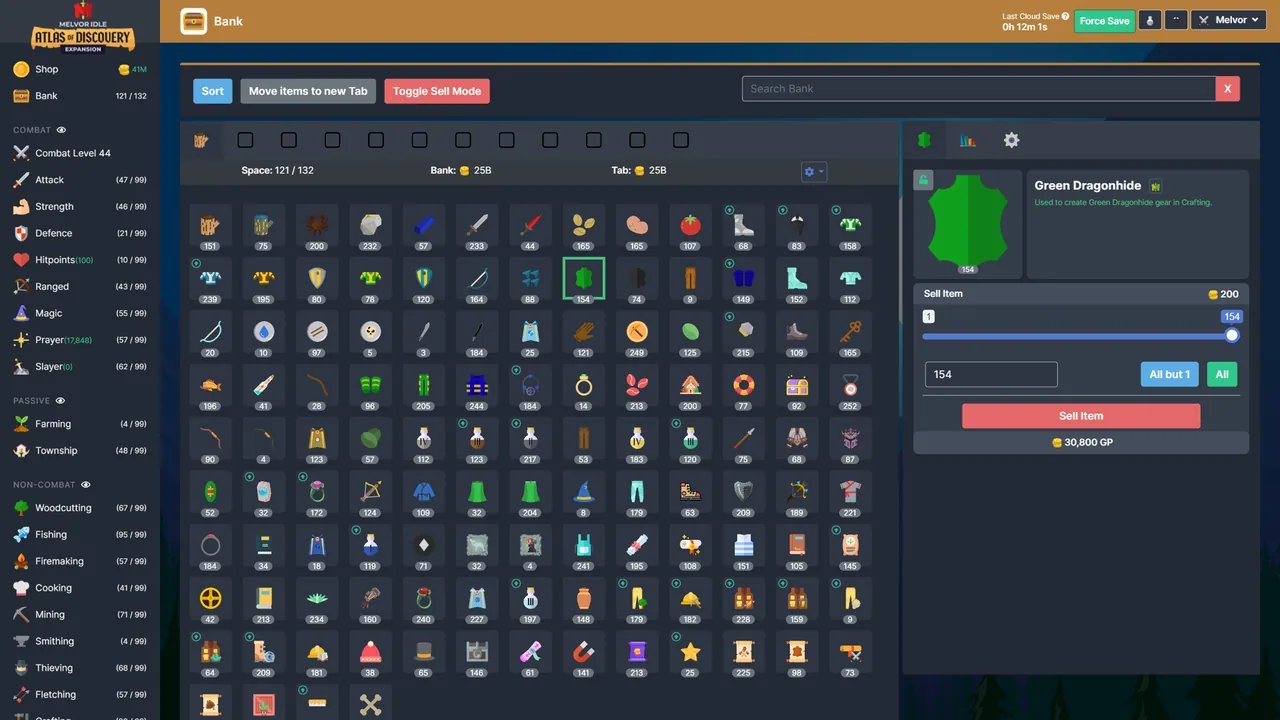
Visually, Melvor Idle makes no effort to be a looker, and it isn't trying to be one. Everything is icon grids, progress bars and number tables in a layout that owes more to a spreadsheet than to a game screen. It's legible and it's fast, which matters more than style for something meant to be glanced at dozens of times a day, but there's no combat animation, no environmental art, nothing that rewards simply watching the screen. Sound design is functional and forgettable — competent menu and combat cues, no score worth naming. None of that is a flaw exactly; it's a genre choice, and it's the same choice Melvor's whole design philosophy makes elsewhere: put the budget into systems, not presentation. The trade-off is real, though, and it's the main reason this scores lower on visuals and sound than on almost everything else.
The upside of that restraint is performance. Melvor Idle's minimum specs ask for 512MB of RAM and a Pentium 4 — this runs on essentially anything, including the browser tab it's built to fit into, and there's no version of the game that struggles to hold a steady frame rate because there's barely anything to render.
Mobile, cross-save and the ad question
The Android and iOS apps are free downloads with ads and an optional purchase to remove them. Players who buy the full unlock on Steam can carry that purchase to mobile or browser through a free Melvor Cloud account, keeping one character in sync everywhere — genuinely useful for a game built around checking in throughout the day. What doesn't carry over is ad removal itself: it's a separate purchase on each storefront, so a Steam player who also wants an ad-free phone experience is paying twice for the same convenience. It's a minor annoyance next to the rest of the monetisation model, but it's an inconsistency in an otherwise unusually clean approach to charging players.
The Jagex relationship, and what comes after it
Jagex's involvement is publishing, not ownership — Games by Malcs kept enough of its rights during the original 2021 deal that it could walk into a sequel on its own terms. That's exactly what's happening: Melvor Idle 2 is in development as a self-published project, after publishing discussions between the two studios stalled out following Jagex's own change of ownership in early
- For Melvor Idle itself, that history is reassuring rather than worrying — a Jagex-backed
publishing partnership brought marketing reach and platform support without swallowing the developer's independence or introducing the monetisation pressure that often comes with a bigger publisher's involvement. The one open question is what happens to content updates for the original game once its successor arrives, and there's no official answer to that yet.
Verdict
Melvor Idle earns its reputation as one of the reference points for the idle RPG genre by taking an idea most games treat as a side activity — the skilling grind — and proving it can carry an entire game on its own, provided the skills actually talk to each other. They do here, consistently and well, and the offline model, the pricing and the total absence of subscriptions or premium currency make it one of the more player-respecting live-service idle games available on any platform. It loses ground on presentation, on late-game pacing that eventually runs out of new decisions, and on the slightly awkward economics of spreading the complete experience across a base game and three separate expansions.
None of that changes who this is for. If the appeal of an RPG was always the numbers going up rather than the story around them, Melvor Idle is close to the platonic version of that idea, and it doesn't charge much to find out.
Pricing and monetisation checked 30 July 2026.
Players who want that same slow-numbers-going-up satisfaction attached to a persistent world with other people wandering through it might also want to look at Wanderer.
Pros and cons
Pros
- Twenty-nine skills genuinely feed each other — better Fishing changes what Cooking can make, which changes how long you last in combat
- The free browser and mobile versions are a complete early-to-mid game, not a capped trial
- A single one-time unlock covers the whole base game forever, with no subscription anywhere
- Offline progression runs a full 24 hours at the same rate as active play, not a reduced rate
- Three expansions (Township, Cartography and Archaeology, Harvesting) each add a genuinely different kind of skill rather than a reskinned grind
- Runs on almost anything, including a browser tab, with no meaningful hardware requirement
Cons
- The interface is number tables and small icons throughout — there is no combat animation or visual spectacle to speak of
- Late Mastery levels in any skill are pure elapsed time with no new decisions to make
- Getting the complete game means buying the base unlock plus three separate expansions on top
- Ad removal on Android and iOS is a separate purchase per storefront, so a Steam unlock doesn't carry over to mobile
- Combat has no positioning or reaction element — the entire encounter is decided before it starts
Screenshots
-
Melvor IdleImage: Jagex Ltd via Steam -
Melvor IdleImage: Jagex Ltd via Steam -
Melvor IdleImage: Jagex Ltd via Steam -
How the review scores each part of the gameWanderer Editorial -
The short versionWanderer Editorial