
Game review
Tales of Aradia: Idle RPG
3.5 / 10
- Developer
- AradiaStudios
- Publisher
- AradiaStudios
- Released
- 7 September 2025
- Platforms
- Windows
- Genre
- Idle RPG
- Monetisation
- Free to play; the developer's own Early Access FAQ described the base game as "totally free" with unspecified paid content packs floated as a future possibility that never materialised
- Players
- Single-player, with an asynchronous leaderboard for comparing idle efficiency and crafting progress rather than any real-time interaction
The short version
Tales of Aradia wants to be Melvor Idle with a pixel-art overworld bolted on: a dozen-plus skills, from Woodcutting and Herblore to Hunting and Diplomacy, all feeding a single idle character while you're away and a single active character while you're not. The pitch is reasonable and the skill list is genuinely broad for a solo-developed free release. What actually shipped is a lot thinner than the feature list suggests, and the single mechanic an idle RPG cannot survive without — an auto-combat loop that behaves sensibly when you're not watching it — was still broken by the players' own account when the last wave of reviews came in.
None of that would necessarily be fatal for a free Early Access game still finding its feet. What makes it hard to recommend at all is that the Steam listing itself now says the game is no longer available. Whatever roadmap AradiaStudios had for Aradia's Shadow Plague, hunting, tanning and diplomacy systems, it isn't being delivered through the storefront the game launched on.
Biggest strengths
- A wide skill list on paper — Woodcutting, Farming, Herblore, Smithing, Hunting, Diplomacy, Exploration and more, all tied to one shared character
- Cost of entry was zero for the entire time it was reachable, with no premium currency or loot box built into the base loop
- The 0.5 update in November 2025 was a real content pass, reworking combat with status effects and spells rather than just tuning numbers
Biggest weaknesses
- Auto-combat, the entire premise of an idle RPG, reportedly didn't trigger spells or healing during unattended fights, leaving mages and other build-dependent classes unable to function while idle
- Player reports describe uncapped-framerate rendering glitches and progress bars that shift the buttons underneath them mid-click
- Several skills, Firemaking among them, were called out as converting resources into experience with no other mechanical payoff, padding the skill count without adding depth
Who it's for: Genre completionists curious about a vanished free-to-play idle RPG, and readers who want to understand what an Early Access idle game looks like when its momentum runs out.
Our recommendation: Don't go looking for it — the Steam page is still up, but the game behind it is not currently available to install or purchase.
3.5 / 10
What Tales of Aradia was trying to be
Idle RPGs live or die on one design question: what happens to the player's character when nobody is looking at the screen? Melvor Idle answers it by making every skill an autonomous loop that keeps producing at full rate whether you're at the keyboard or not. Tales of Aradia borrowed that structure almost wholesale — chop wood in mystical groves, mine ore from caverns, gather herbs in enchanted meadows, then feed all of it into farming, smithing, cooking and combat — and layered a hand-crafted overworld map on top, with named regions like Sylvenwood and Riftshore standing in for Melvor's more abstract skill menus. On paper it's a sensible pitch: keep the skill-stacking depth genre fans already like, but give it a place instead of a spreadsheet.
The problem with judging that pitch now is that the game built around it is gone. Steam's own listing for Tales of Aradia: Idle RPG currently displays the line "Tales of Aradia: Idle RPG is no longer available on the Steam store" directly on its store page. The page itself, the screenshots, the Early Access FAQ and the November 2025 patch notes are all still there to read — what isn't there any more is a way to install or buy the game. That single fact reframes everything else in this review from "here's what to expect" to "here's what happened."
A skill list that got wide before it got deep
The feature list is the most ambitious part of the whole package: over a dozen skills including Woodcutting, Farming, Herblore, Smithing, Hunting, Diplomacy and Exploration, each with its own upgrade paths and rare-tier resources. That's a legitimate skill count for a solo-developed free release, and the November 2025 "Major Update 0.5" patch notes back up genuine post-launch investment — a full combat rework with new status effects, spells and weapon traits; a farming expansion with moisture and compost systems; inventory folded properly into equipment; and backend groundwork laid for Hunting, Tanning and Diplomacy systems that were still described as "framework implemented" rather than finished.
That's the trouble in miniature: a lot of what shipped was scaffolding for systems that hadn't arrived yet. Player feedback from the small review pool the game accumulated pointed at Firemaking specifically as a skill that converts a resource into experience and nothing else — no crafting output, no gameplay effect, just a number going up attached to a skill name. When a genre's whole appeal is that skills feed each other, a skill that doesn't feed anything stands out.
The auto-combat problem
An idle RPG's core promise is that leaving the game alone still produces a sensible outcome. According to player reports left during Early Access, Tales of Aradia's auto-combat didn't use character abilities at all — a mage left to fight automatically would swing a basic attack indefinitely without ever casting a spell or triggering a heal. That's not a balance complaint, it's a report that the central mechanic of an idle RPG — the "idle" part — didn't function for entire class archetypes. A build that depends on its abilities to survive simply couldn't be left alone, which undoes the specific promise the genre is built on.
Separately, players flagged interface problems consistent with a game still working out its technical foundations: an uncapped frame rate that produced visual artifacts during gathering animations, and progress bars that would appear or disappear in ways that shifted buttons out from under the cursor mid-click. Individually these are the kind of rough edges every Early Access release has for a while. Together with a broken auto-combat loop, they describe a game whose foundational systems hadn't settled by the time the last reviews were posted.
Economy and presentation
The store description promises a "robust crafting and economy," with NPC merchants and player market stalls. What actually reached players, per the same feedback, was a shop screen that lists every sellable item at once with a flat sell button attached to each — functional, but with none of the scarcity or discovery that makes a game's economy feel alive. Screenshots and the store page's own art support the "charming pixel art" pitch, and the Early Access FAQ is upfront that the core loop was meant to keep expanding with player input; there just isn't documented evidence that enough of that expansion landed before development appears to have stopped.
Monetisation and value
Whatever else is true of Tales of Aradia, it never took money from anyone in a way that's on the record. The game's own Early Access FAQ answered "will the game be priced differently during and after Early Access" with "Current Price: Totally free," floating only a vague, never-realised possibility of paid content packs down the line. For a genre where energy timers and premium currencies are common friction points, that's worth crediting: nothing in the documented feature set describes a paywall, a loot box or a pay-to-skip mechanic. The trouble is that "free and now unavailable" isn't really value for anyone — you can't spend nothing on a game you can't open.
Final verdict
Tales of Aradia had the right instincts for an idle RPG audience: a broad, interlocking skill list, a real content update two months after launch, and a monetisation-free entry point. But the reviews it collected before disappearing describe a game where the one thing an idle RPG absolutely has to get right — sensible behaviour while the player isn't watching — didn't work for entire character builds, and where interface bugs were common enough to be a recurring complaint rather than an isolated one. A small, mixed 26-review sample (42% positive) isn't a large enough base to draw sweeping conclusions from, but it's consistent with a game that stalled during Early Access rather than one that was quietly rejected by its audience.
The Steam listing now reading "no longer available" is the deciding factor here. A flawed but live Early Access game earns a chance to fix itself with the next patch; a delisted one doesn't get that chance, and a review can only score what's documented to have shipped. Tales of Aradia gets credit for an ambitious skill list and a genuinely free entry price, and loses far more for a broken core mechanic, persistent interface bugs, and a storefront that no longer sells it.
Players who want the skill-stacking idle loop Tales of Aradia was chasing, with the offline progression actually finished and no expansion currently missing in action, are better served by the established names in the genre. Those who specifically want persistent progression that keeps running while they're away, wrapped around an actively maintained world rather than a delisted one, may also want to give Wanderer a look.
Pros and cons
Pros
- A wide skill list on paper — Woodcutting, Farming, Herblore, Smithing, Hunting, Diplomacy, Exploration and more, all tied to one shared character
- Cost of entry was zero for the entire time it was reachable, with no premium currency or loot box built into the base loop
- The 0.5 update in November 2025 was a real content pass, reworking combat with status effects and spells rather than just tuning numbers
- A collection log and achievement track gave the grind a long-term goal beyond raw numbers going up
Cons
- Auto-combat, the entire premise of an idle RPG, reportedly didn't trigger spells or healing during unattended fights, leaving mages and other build-dependent classes unable to function while idle
- Player reports describe uncapped-framerate rendering glitches and progress bars that shift the buttons underneath them mid-click
- Several skills, Firemaking among them, were called out as converting resources into experience with no other mechanical payoff, padding the skill count without adding depth
- The shop interface reportedly lists every purchasable item at once with a single sell button, undercutting any sense of an economy or scarcity
- The game is no longer available on Steam, so none of the above can currently be verified or remedied by further patches
Screenshots
-
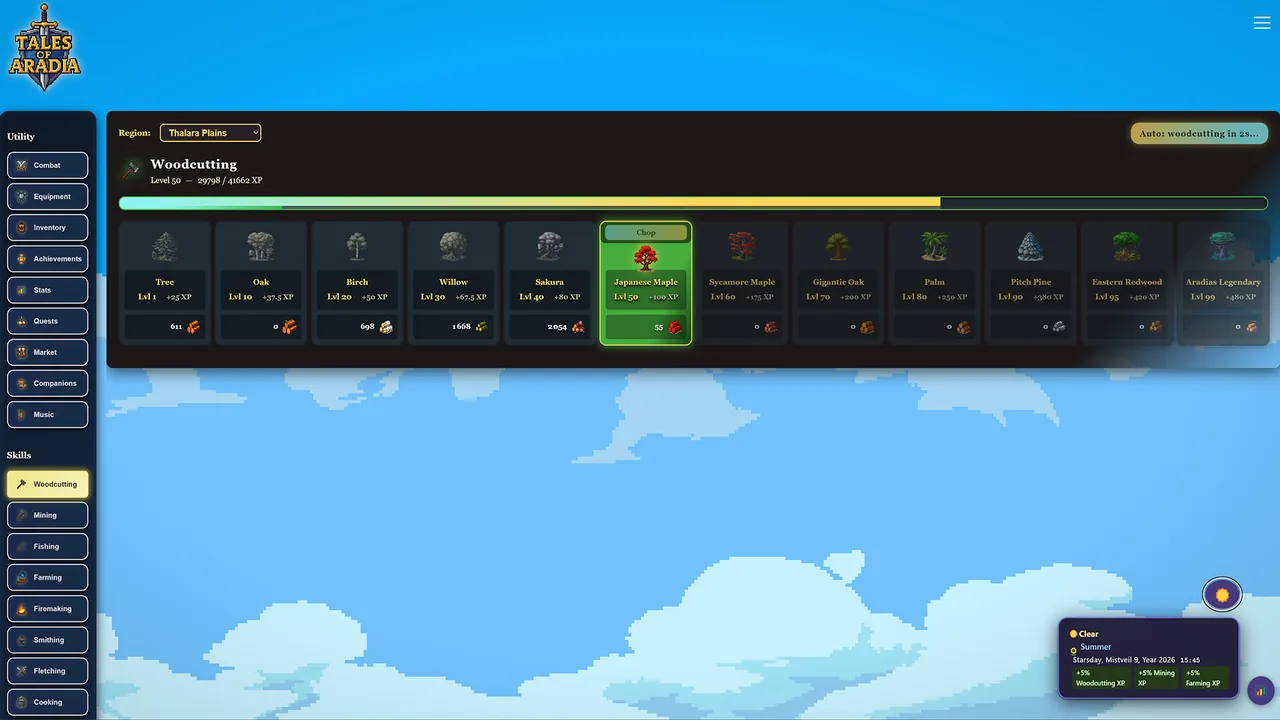
Tales of Aradia: Idle RPGImage: AradiaStudios via Steam -
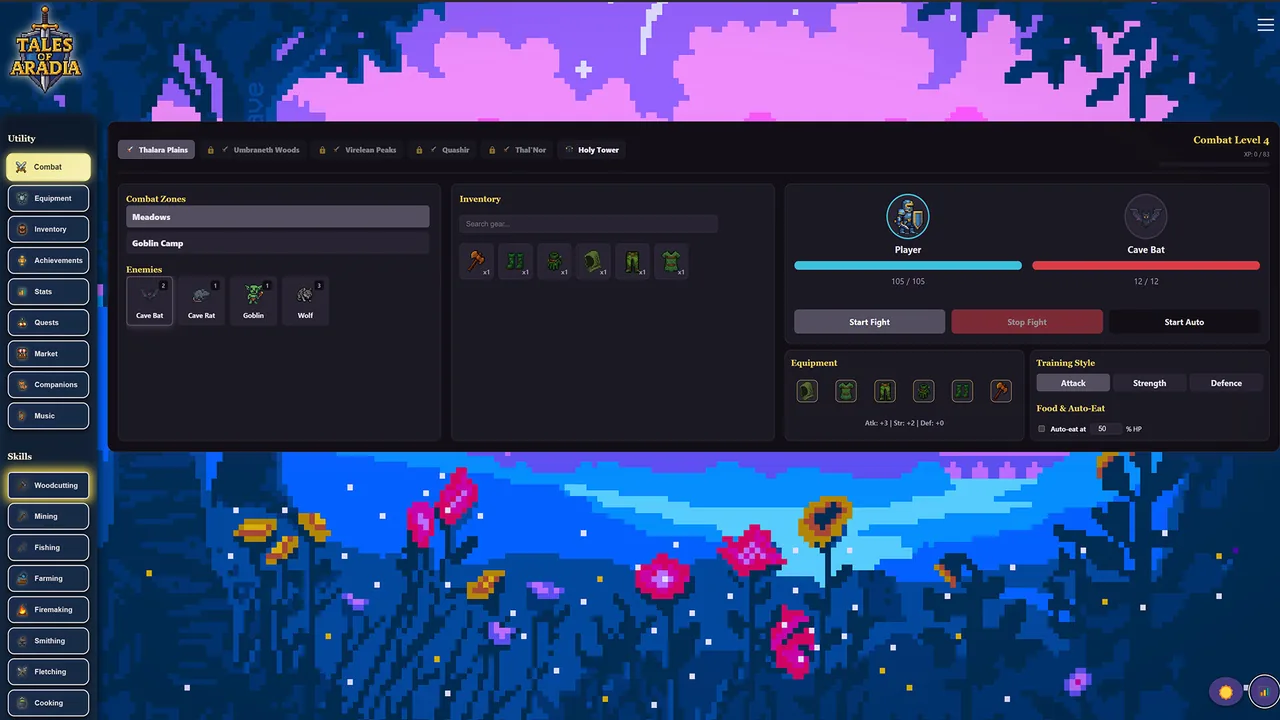
Tales of Aradia: Idle RPGImage: AradiaStudios via Steam -
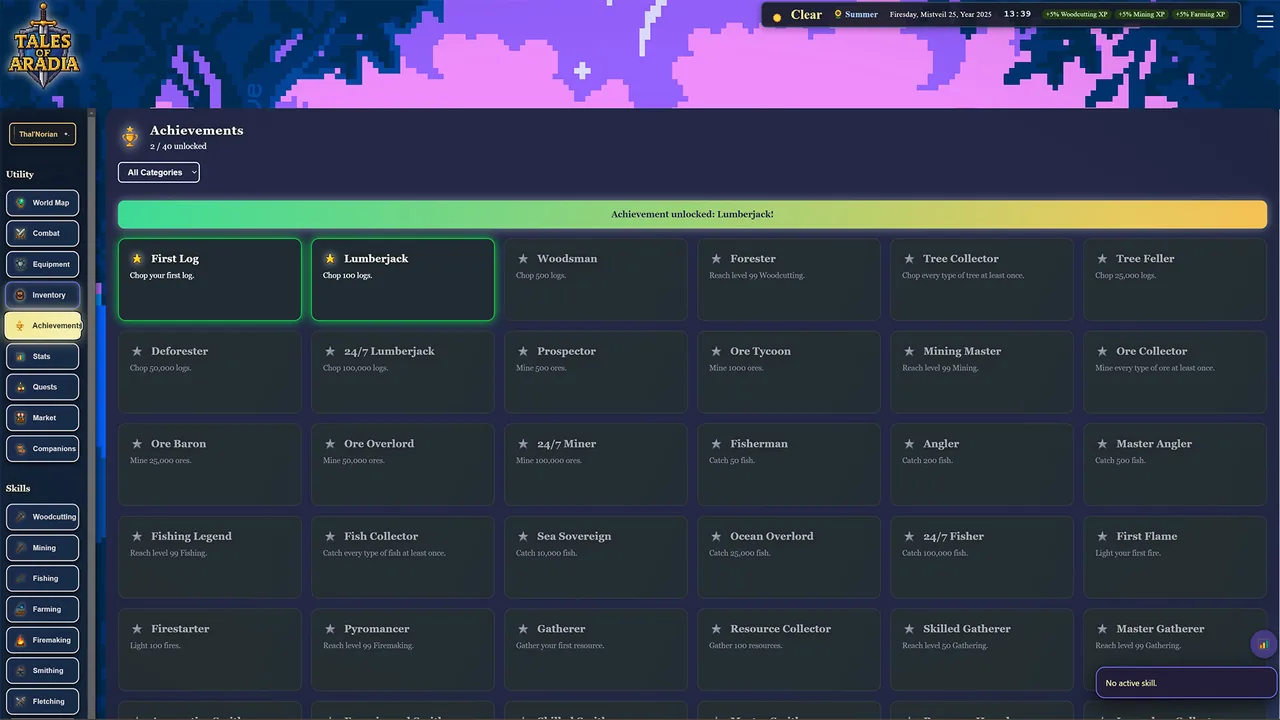
Tales of Aradia: Idle RPGImage: AradiaStudios via Steam -
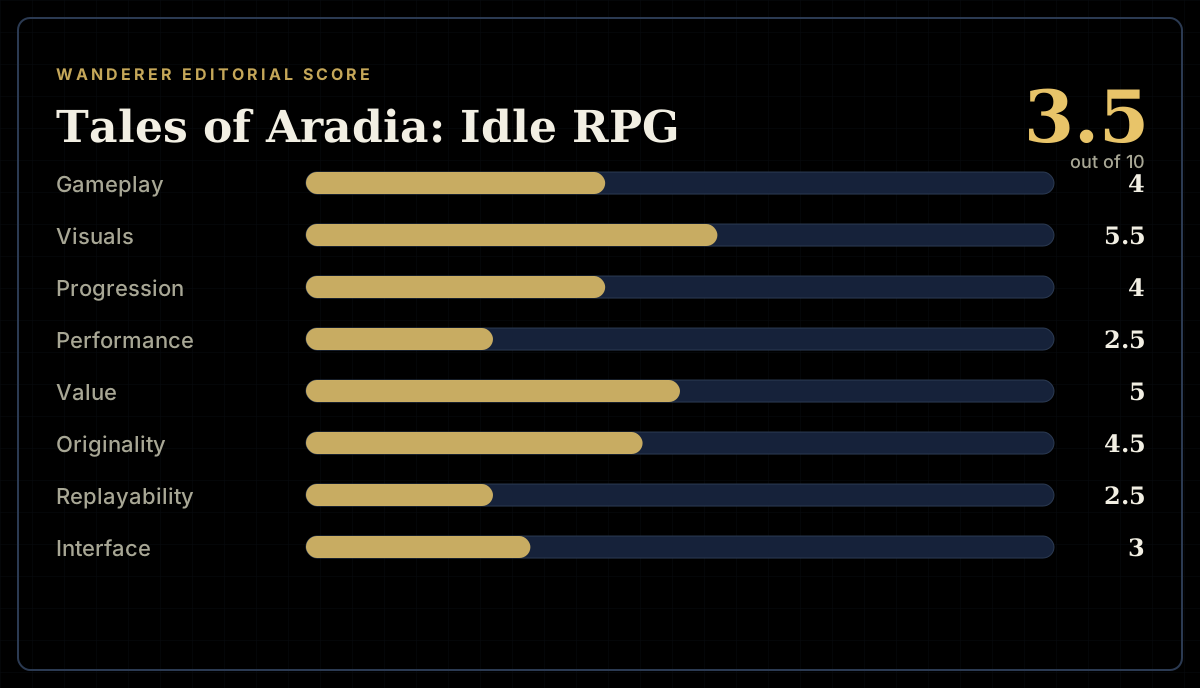
How the review scores each part of the gameWanderer Editorial -
The short versionWanderer Editorial