Game review
Grim Reach Idle
6.5 / 10
- Developer
- Heartforge Studios
- Publisher
- Heartforge Studios
- Released
- 20 July 2026
- Platforms
- Windows
- Genre
- Idle RPG
- Monetisation
- One-time purchase (NZ$7.89); the store page states explicitly "no microtransactions, no wipes," with save compatibility promised across every future update
- Players
- None; fully single-player
The short version
Grim Reach Idle is a skilling idle RPG built on a genre-defining chassis: a sidebar of trainable professions running to level 99, watchable auto-combat, offline progression, and a bank and shop laid out in a way that will feel instantly, specifically familiar to anyone who's played Melvor Idle. Several of its own reviewers say so directly, across English, French and Chinese, and a screenshot of the skill list settles the comparison rather than just alleging it.
What Grim Reach Idle adds on top is genuinely its own: 28 named Elite Champions that stalk the world on independent timers and vanish fifteen minutes after they surface, seven weekday Blessings that quietly reshape how the whole Reach plays depending on the real-world day, and a New Haven settlement-building layer added just two weeks into Early Access. Two weeks in, it's a well-liked, actively developed, openly derivative game — and whether that combination works for you depends heavily on how you feel about the game it's most often compared to.
Biggest strengths
- Twenty-eight named Elite Champions patrol the world on independent schedules and vanish fifteen minutes after appearing, giving skilling sessions real, time-pressured stakes
- Seven weekday Blessings tie in-game effects to the real calendar — richer loot on some days, faster combat on others — without resorting to FOMO-driven live-service pressure
- New Haven, a 15-building settlement added roughly two weeks into Early Access, gives permanent account-wide bonuses and is genuinely new territory for the genre's usual formula
Biggest weaknesses
- Multiple reviewers across English, French and Chinese independently describe the core structure as extremely close to Melvor Idle, and a side-by-side look at the skill list and 99-level cap makes the comparison hard to dismiss as coincidence
- Several reviewers specifically flag the price as high relative to Melvor Idle, a genre touchstone that's considerably cheaper (and free to try in browser)
- One German-language review states the game was "purely made with AI," a claim this review cannot independently verify and reports only as that reviewer's own characterisation
Who it's for: Melvor Idle fans who want the same skilling structure with a darker aesthetic, roaming world bosses and a settlement to build, and who don't mind paying more for a genre entry that's honest about where it started.
Our recommendation: A solid pick if the added systems — Champions, Blessings, New Haven — genuinely appeal to you specifically; a harder sell if you already own the game it's most compared to and are looking for something meaningfully different rather than a reskin with extras.
6.5 / 10
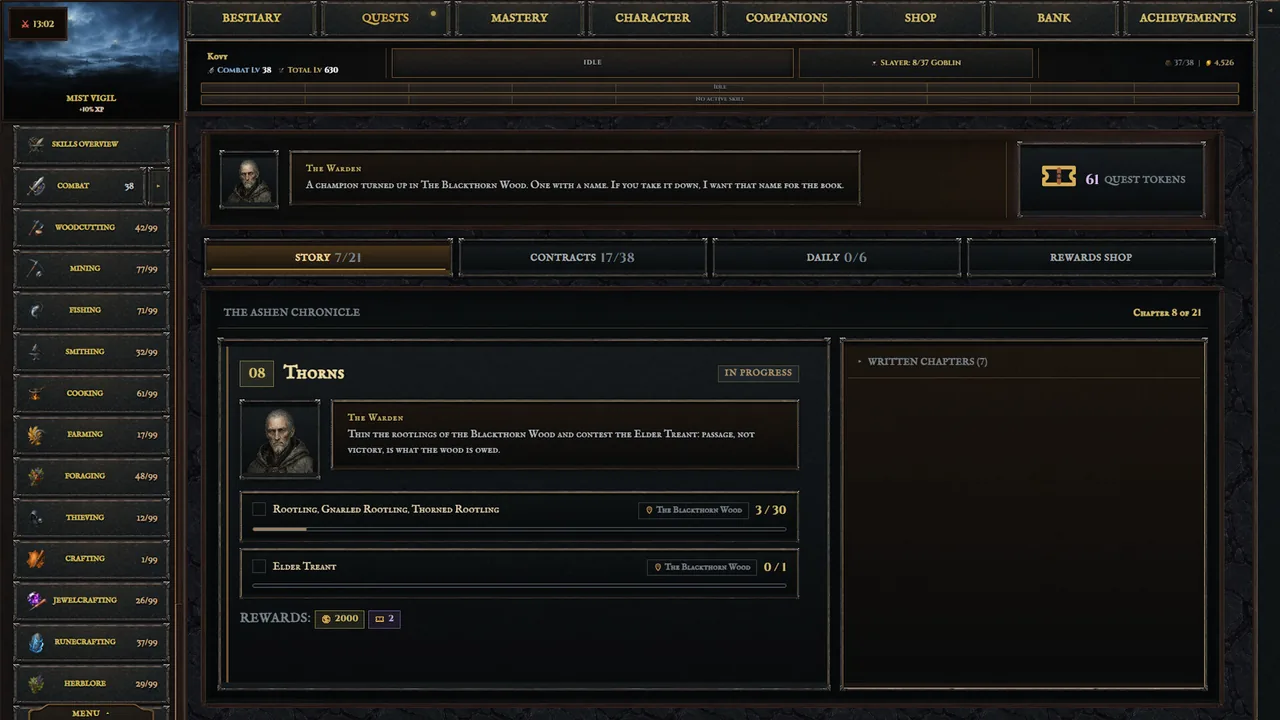
Skilling idle RPGs live and die on their sidebar — the list of trainable professions running from 1 to 99, each one a separate little economy of resources and experience. Grim Reach Idle's sidebar will read as instantly familiar to anyone who's spent time with Melvor Idle: Combat, Woodcutting, Mining, Fishing, Smithing, Cooking, Farming, Foraging, Thieving, Crafting, Jewelcrafting, Runecrafting, Herblore, each capped at level 99 in numbers that will land as a direct wink — or a direct lift, depending who you ask — to anyone who knows where that specific cap comes from. Several of Grim Reach Idle's own reviewers have already made that comparison explicit, and it's the single most important thing to understand about this game before deciding whether its price is worth paying.
What's genuinely new here
To Heartforge Studios' credit, Grim Reach Idle doesn't stop at reskinning a familiar structure in darker colours. The standout addition is its 28 named Elite Champions — bosses that stalk the game's zones on their own independent timers rather than sitting in a fixed dungeon waiting to be farmed. When one surfaces, you get a notification, a fifteen-minute countdown starts, and then it's gone until its timer cycles again. Each Champion guards a unique drop, tracked in a codex and on an in-game bounty board, giving skilling sessions a layer of real-time urgency the genre rarely attempts. Layered on top of that are seven weekday Blessings — real-calendar effects that reshape how the Reach behaves depending on which actual day you're playing, from richer beast loot on some days to faster combat on others. The store page is explicit that these are "deliberately mild, no FOMO," and nothing in the review sample contradicts that framing.
The newest system, New Haven, arrived roughly two weeks into Early Access: a settlement you build across 15 structures over three ranks, placed freely on a hand-painted map, each one granting a permanent account-wide bonus — longer offline progression caps, more bank space, faster skilling. It's a genuinely different direction for a genre that usually stops at prestige resets and gear tiers, and its arrival this early in Early Access is a reasonable signal that Heartforge is building toward differentiation rather than resting on the systems it launched with.
The comparison its own players keep making
Read enough of Grim Reach Idle's ten early reviews and a pattern becomes impossible to miss. A Chinese-language review states flatly that the game is "a complete copy of Melvor," arguing that beyond stronger art direction there's nothing new here, and specifically calls it not recommended given it costs more than the game it's compared to. An English reviewer with over 90 hours logged is more measured but reaches a similar conclusion: "a coherent/solid Melvor style game… there is nothing unique about the game," singling out equipment stat rolls as the one meaningful departure. A separate Chinese review is more forgiving — praising the visuals and the randomised elite gear system — while still flagging the price as "a bit high."
This isn't a case of one loud complaint distorting the picture. It's a specific, repeated observation from players who otherwise range from lukewarm to genuinely enthusiastic about the game, made independently across three different languages. That consistency is worth taking more seriously than a single review would be, and it should shape expectations directly: Grim Reach Idle earns its "Mostly Positive" rating as a well-executed entry in an established format, not as a fresh take on one.
One review — in German, praising a "solid game" after more than ten hours — includes a striking aside: it describes Grim Reach Idle as "purely made with AI." This review has no way to independently confirm or deny that characterisation, and reports it only as that specific reviewer's own account rather than a verified production detail. Readers curious about it should treat it as one player's impression, not an established fact about how the game was built.
Price, and what it buys
At NZ$7.89, Grim Reach Idle sits above what several of its own reviewers consider the genre's going rate, and that comparison specifically to Melvor Idle — a game with a free browser version and a low-cost expanded edition — is the most concrete, checkable value complaint in the review sample. What that price does buy, according to the store page and unchallenged by any review here, is a clean promise: no microtransactions, no save wipes, and compatibility preserved across every future update. Three substantial patches landed in Grim Reach Idle's first two weeks — Champions of the Reach, a quality pass, and the New Haven settlement system — which is a genuinely fast cadence for a young Early Access title and a reasonable sign the asking price is going toward real, ongoing development rather than a one-and-done release.
Final verdict
Grim Reach Idle is a well-made, actively developed idle RPG that layers real, distinctive ideas — roaming timed bosses, a weekday rhythm, an entire settlement-building system — on top of a skilling structure its own players keep, independently and across languages, describing as extremely close to Melvor Idle. Both things are true, and neither cancels the other out: this is a solid game built on a foundation it didn't originate, priced higher than the game most often invoked as its template.
If the specific additions here — Champions, Blessings, New Haven — sound like exactly what you want from the genre, that's a fair reason to pay the difference. If you're chiefly looking for a skilling idle RPG and don't already have a strong opinion on Melvor Idle, this is a perfectly good place to start. If you already own that game and are hoping for something that reinvents rather than extends it, temper expectations accordingly.
Players who want that same skilling-and-progression itch scratched inside a persistent, explorable fantasy world rather than a private idle sidebar may also want to look at Wanderer.
Pros and cons
Pros
- Twenty-eight named Elite Champions patrol the world on independent schedules and vanish fifteen minutes after appearing, giving skilling sessions real, time-pressured stakes
- Seven weekday Blessings tie in-game effects to the real calendar — richer loot on some days, faster combat on others — without resorting to FOMO-driven live-service pressure
- New Haven, a 15-building settlement added roughly two weeks into Early Access, gives permanent account-wide bonuses and is genuinely new territory for the genre's usual formula
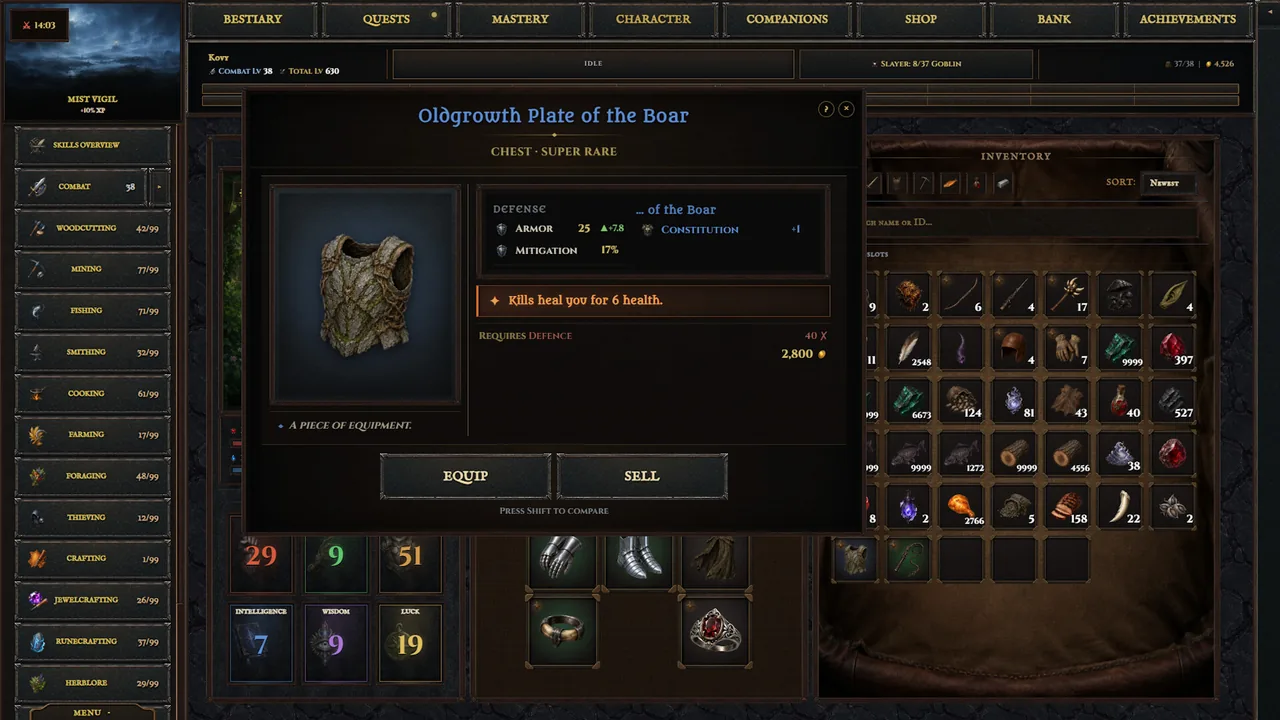
- Every rare drop rolls its own individual suffix stats, so two copies of the same item are never quite identical — a real hook for gear-focused players
- An explicit no-microtransactions, no-save-wipe promise, held to through three major patches so far according to the available patch history
Cons
- Multiple reviewers across English, French and Chinese independently describe the core structure as extremely close to Melvor Idle, and a side-by-side look at the skill list and 99-level cap makes the comparison hard to dismiss as coincidence
- Several reviewers specifically flag the price as high relative to Melvor Idle, a genre touchstone that's considerably cheaper (and free to try in browser)
- One German-language review states the game was "purely made with AI," a claim this review cannot independently verify and reports only as that reviewer's own characterisation
- A French review with nearly 200 hours logged still calls the game "a rough gem" needing "a lot, A LOT of polishing" before its potential shows through
- No achievements are implemented yet, and Early Access rough edges are acknowledged directly on the store page itself
Screenshots
-
Grim Reach IdleImage: Heartforge Studios via Steam -
Grim Reach IdleImage: Heartforge Studios via Steam -
Grim Reach IdleImage: Heartforge Studios via Steam -
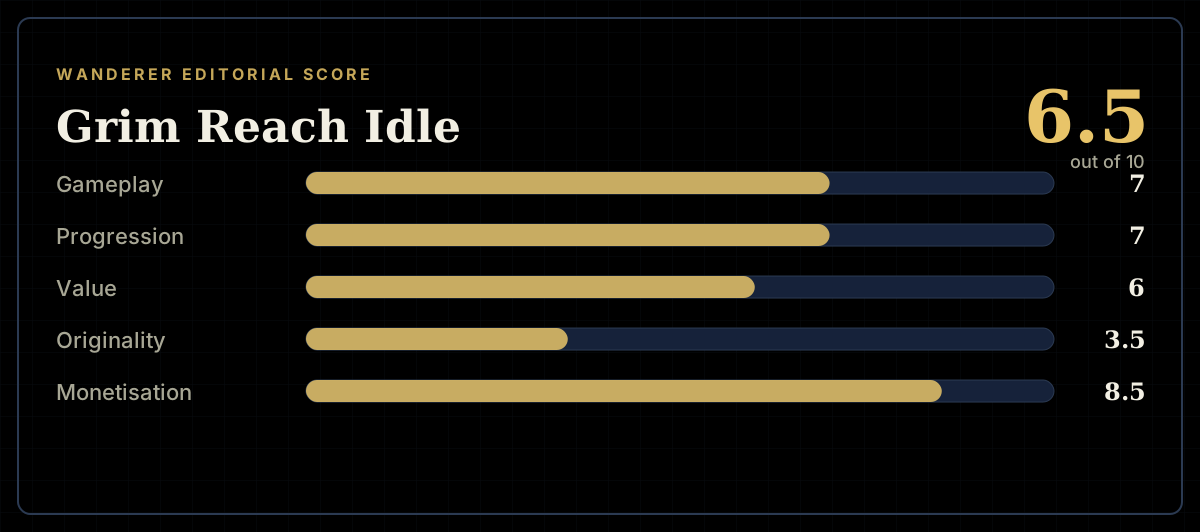
How the review scores each part of the gameWanderer Editorial -
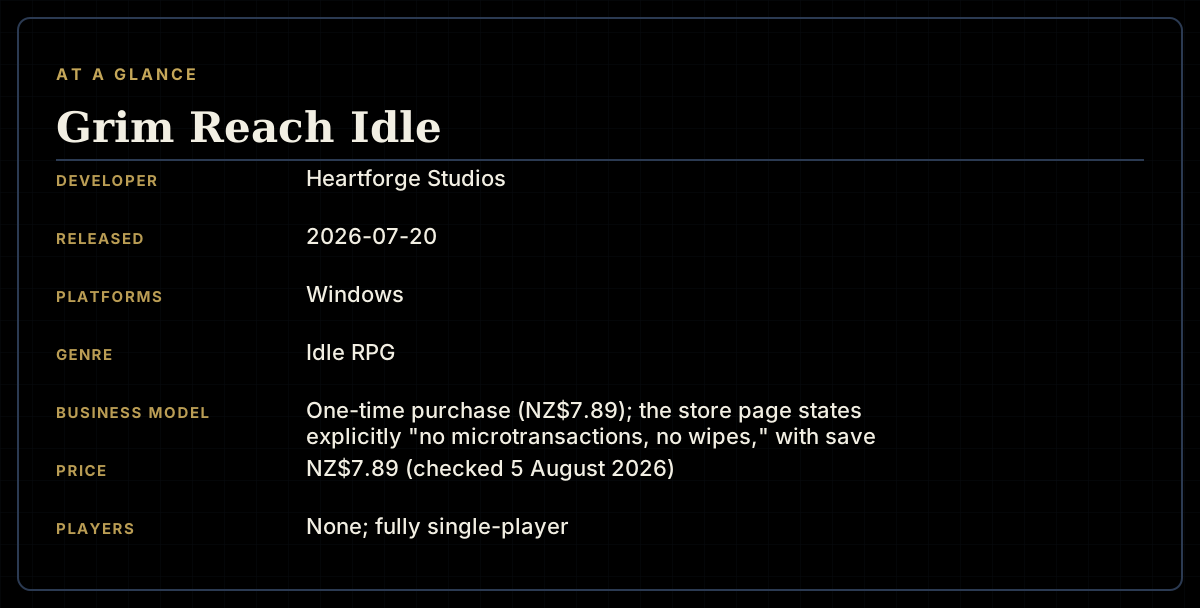
The game at a glanceWanderer Editorial -
The short versionWanderer Editorial